


 Apple Podcasts
 Spotify
 Spreaker
 Audible
 Castro
 RSS Feed
 Terrifying & True | Ed & Lorraine Warren: The Truth Behind Amityville, Annabelle & The Conjuring

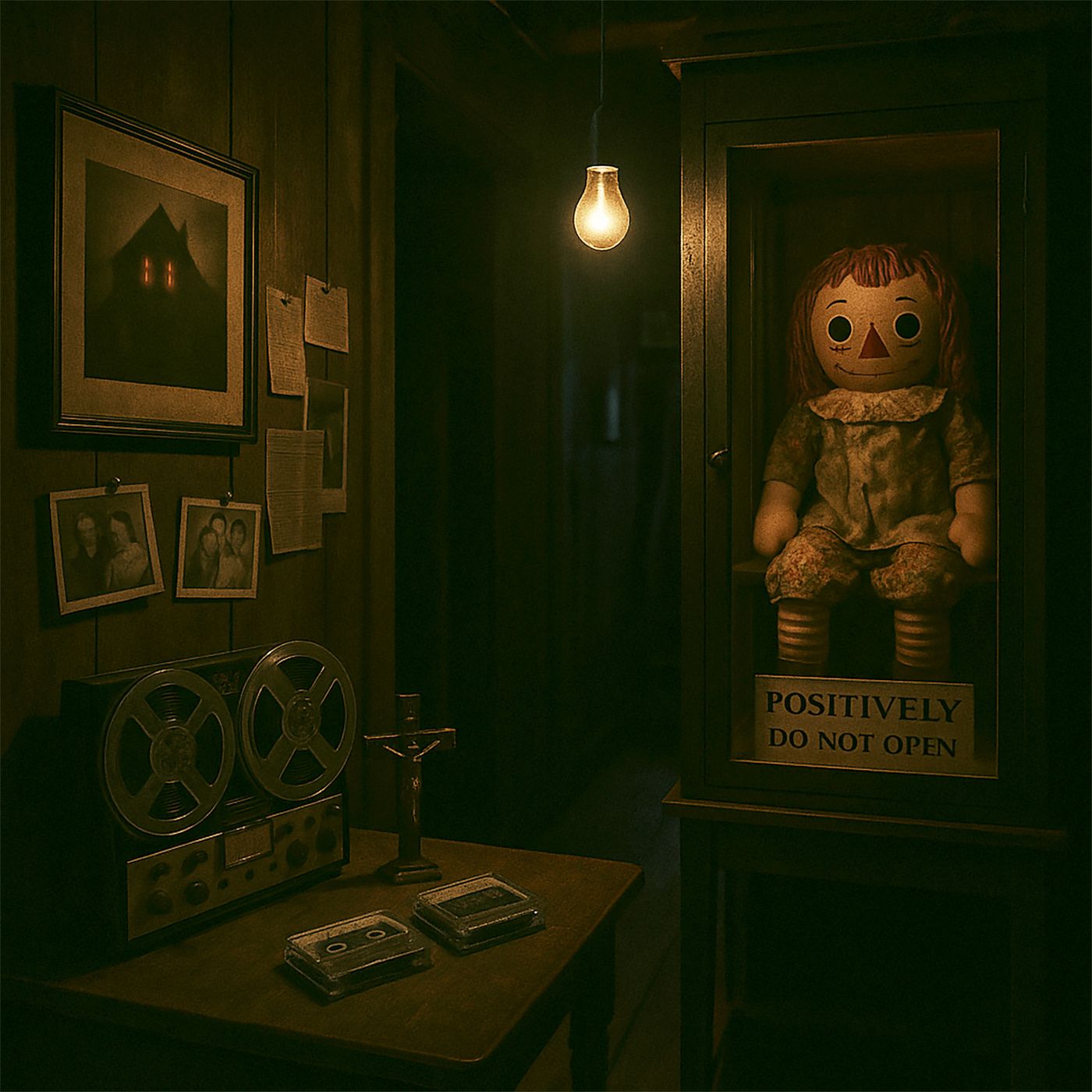
When the Halloween season rolls in, few names cast a darker shadow than Ed and Lorraine Warren—the real-life ghost hunters behind The Conjuring, Amityville Horror, and Annabelle. Their stories have fueled decades of scary movies, haunted house legends, and late-night whispers. But how much of it was true… and how much was carefully crafted myth?
This Terrifying & True deep dive unearths the real case files, skeptical investigations, and shocking contradictions that made the Warrens the most polarizing figures in paranormal history. We trace their rise from small-town “ghost chasers” to icons of spooky season, uncovering the faith, fear, and fortune that kept their names in the headlines—and on the silver screen.
Along the way, we reveal the cultural moment that made them possible: the 1970s exorcism craze, the birth of modern demonology, and the national obsession with what hides beyond the veil.
Inside this episode
- Origins & Methods: How the Warrens’ haunted New England beginnings shaped their famous possession framework.
- Legendary Cases: Amityville, Annabelle, Enfield, and more—what they claimed versus what investigators found.
- Faith vs. Forensics: Photos, tapes, and testimony—what holds up and what falls apart under the light.
- Skeptics & Secrets: From Ray Garton to Joe Nickell, the critics who challenged the Warrens’ every word.
- Legacy of Fear: How their cases built the blueprint for Hollywood horror and every spooky story that followed.
If you’re hunting for real-life horror stories, haunted history, and a chilling listen to carry you through Halloween night, step inside. The truth may be far stranger—and far scarier—than the movies ever showed.
We’re telling that story tonight.
Check out more Terrifying & True episodes!
https://www.weeklyspooky.com/c...
🎧 LISTEN NOW and subscribe for spine-tingling horror stories every week!
🎉 Unlock exclusive bonus episodes and support the show on Patreon!
👉 WeeklySpooky.com/Join
📬 Contact Us / Submit Your Horror Story!
- Twitter: @WeeklySpooky
- Facebook: facebook.com/WeeklySpooky
- Email: WeeklySpooky@gmail.com
🎵 Music by Ray Mattis 👉 Check out Ray’s incredible work here !
👨💼 Executive Producers: Rob Fields, Bobbletopia.com
🎥 Produced by: Daniel Wilder
🌐 Explore more terrifying tales at: WeeklySpooky.com
0:02 A door creaks, A cassette wheel ticks in the glass. A rag doll's blank face stares back positively. Do not open. The sign warns they said demons lived here, they said they had proof, and tonight we're conjuring up the truth about Ed and Lorraine Warren. What you were about to pat is burn wheel. Based on witness accounts, testamaties, and public record, this is terrifying and true.
0:53 Rhode Island, nineteen seventy three. A farmhouse stands in the cold, kitchen stove worn with the touch of a visiting claravoyant name given Bathsheba. Across decades, similar scenes would repeat. A demonologist with a crucifix, a medium in trance, and families pleading for help. Their names Ed and Lorraine Warren became synonymous with America's most famous hauntings, Amityville, Annabelle, Enfield, Southington.
1:34 But behind televised seances and crowded lecture halls lies another record. Skeptical investigations, contested evidence, and bitter disputes were the Warren's righteous sentinels against the inhuman or master storytellers. In an age eager for devils, we retrace the Devil's Road, from basement museums and ghost boy photographs to courtrooms, interviews and sworn statements to weigh belief against proof. If their legend is true, we'll find the marks it left, and if it isn't, we may discover why so many wanted it to be. We're telling that story tonight. Late one autumn evening in nineteen seventy three, a pair of strangers knocked on the door of a weathered farmhouse in Rhode Island.
2:50 The couple, a soft spoken woman clutching a rosary and a rugged man carrying a briefcase of holy water and taper, introduced themselves as Lorraine and Ed Warren, Catholic paranormal investigators. They had heard about the paren family's desperate plight, a presence in the house that lurked in cold rooms and whispered in the dark that night, As the story goes, Lorraine closed her eyes and pressed her hand to an old iron stove in the kitchen. After a long silence, she announced, I sense a malignant entity in this house.
3:38 Her name is Bathsheba. The Warrens believed an evil spirit had latched on to the family. Over the following weeks, they would sweep through the paren's drafty New England home with crucifixes, relics, and cassette decks, determined to document the haunting and drive out the darkness. For decades, scenes like this played out across America. Ed and Lorraine Warren presented themselves as the nation's premier ghost hunters demonologists on a mission from God. They became famous for confronting what they described as real demons and malevolent spirits tormenting ordinary families.
4:31 By their own account, the Warrens investigated well over ten thousand hauntings over five decades. They were devout Roman Catholics who saw their work as a calling to prove that the devil exists and to help people who had nowhere else to turn in the public eye. They were a unique husband and wife team of self taught paranormal investigators. Ed a World War II veteran and self described demonologist, and Lorraine, a gentle claravoyant and trance medium. Together they founded the New England Society for Psychic Research or NESPER in nineteen fifty two, which they claimed was the oldest ghost hunting group in New England. In their lectures, and books.
5:26 They often noted that Ed was the only non ordained demonologist recognized by the Catholic Church, while Lorraine was a gifted psychic armed with crucifixes, holy water, and empathy. The Warrens cast themselves as the first and often last line of defense against the supernatural. Throughout the nineteen seventies and eighties, an era fascinated by exorcisms and haunted houses, Ed and Lorraine became household names. They appeared on talk shows, in newspaper features, and later served as inspiration for a blockbuster Hollywood franchise. In the conjuring to the public who devoured their stories, the Warrens were heroes, sweet demon showing soulmates who chased evil across America. In these accounts, they emerged as devout warriors combating Satan himself in suburban living rooms, their love and faith unshaken by the terrors they encountered.
6:39 Quote For over five decades, Ed and Lorraine Warren have been known as the world's most renowned paranormal investigators. One early biography declared, continuing Lorraine is a gifted claravoyant, while Ed is the only non ordained demonologist recognized by the Catholic Church. Together, they have investigated thousands of hauntings. But that is only part of the story. As we journey down the Warren's trail, from the infamous Amityville horror House to the mysterious rag doll named Annabel, from quiet New England hamlets to sensational televised exorcisms, we will see two portraits emerge. First, we explore Ed and Lorraine's own narrative, their origins, their methods, and the cases that built their legend.
7:38 In this portion, their claims and exploits are presented largely as they told them, in a serious but open minded tone. Then about a quarter way through our path will shift will step into the shoes of investigators and skeptics who began to question the Warren's legacy. What really happened in those houses, How much of the Warren's story stands up to scrutiny, and how much was a product of media hype, creative embellishment, or even outright deception. What you are about to hear is a comprehensive three hundred and sixty degree expose of Ed and Lorraine Warren. It's a story of faith and fear of the things that go bump in the night, and of the fine line between belief and disbelief.
8:37 By the end, we'll confront the uncomfortable contradictions behind the warm, heroic image of the Warrens. We'll hear from families who once sought their help but later felt misled, from journalists and skeptical investigators who dug into the evidence and found it wanting, and even from legal records that hint at troubling secrets behind closed doors. It's a journey that will take us from the dim light of seance rooms to the harsh glare of courtroom testimonies and media investigations. So settle in and be not afraid. Our exploration of the Warren's world begins where theirs so often did, with a house, a family, and an inexplicable knock in the dark. Ed and Lorraine Warren's reputation as paranormal investigators did not spring up overnight. It was the result of years of passionate, albeit unorthodox work. Edward Warren Maney was born in nineteen twenty six and raised in a haunted house, at least according to him, in Bridgeport, Connecticut. As Ed told it, the home he grew up in had a ghostly presence,
10:09 doors would inexplicably bang, strange lights appeared, and he claimed to have seen an apparition in his bedroom closet as a boy. This early brush with the unknown kindled Ed's lifelong fascination with the paranormal. After serving in World War II, Ed married Lorraine Rita Moran, a schoolgirl sweetheart from Bridgeport, in nineteen forty five. Lorraine, born in nineteen twenty seven, had her own mystical origin story. From a young age, she purportedly could see auras and discern spirits around people.
10:53 Though initially frightened by these abilities, Lorraine came to accept her gift of Clara voidance as God given. Together Ed and Lorraine would forge a unique partnership, blending religion, art, and ghost hunting in equal measure. In the early years of their marriage, Ed attended art school and painted landscapes, but his real passion lay in painting haunted houses. According to accounts the Warrens later shared, Ed developed a clever technique in order to get inside reputedly haunted homes. Whenever he caught wind of a local ghost story or a house known for strange occurrences, he and Lorraine would drive to the site and Ed would sketch or paint the house.
11:48 He was talented enough that often the homeowners would notice the young man outside drawing their beloved if spooky residence, Ed would then offer the finished sketch to the owners. It was a friendly gesture that frequently opened the door literally to a conversation. Once invited in, Ed and Lorraine would politely inquire about any strange happenings and ask the family to share their story. In Lorraine's words, the goal was simple to help the family understand what was happening and to document proof of the supernatural. By nineteen fifty two, the couple formalized their hobby into the previously mentioned New England Society for Psychic Research. Working from the modest home they purchased in Monroe, Connecticut, the Warrens began to accumulate case files and equipment. Ed read everything he could about demonology, the study of demons and evil spirits, and styled himself a demonologist despite having no formal theological training. Lorraine honed her clairvoyant skills and later learned to enter light trances during investigations, attempting to communicate with any spirits present. Crucially, the Warrens also networked with clergymen and doctors who were
13:21 open to paranormal possibilities. They liked to say their team included medical doctors, researchers, police officers, nurses, college students, and members of the clergy. If a case seemed truly dangerous or demonic, Ed and Lorraine would urge the family to seek a Catholic priest to perform a house blessing or exorcism. A devout Catholic, Ed positioned himself as a bridge between frightened lay people and the official church authorities who were capable of sanctioning exorcisms. In fact, the Warrens claim that Ed was one of the only few lay demonologists to be recognized by Catholic Church officials, though the church has never officially confirmed recognizing any lay demonologists. The Warren's methodology typically went like this. They would arrive at a client's home armed with their taper, coorders, cameras, still and video and religious items. Lorraine might walk through each room eyes half closed, reading the psychic atmosphere. Ed would interview the family members at length, taking notes on every knock, cold spot, or nightmare They had experienced. He was also known for delivering lengthy Catholic prayers or provocative challenges to whatever entity
14:52 might be lurking. In the name of Jesus Christ, I command you to reveal your identity, he might declare into the darkness of an empty basement. If knocks or crashes answered back, Ed took it as progress. Over time, Ed amassed a library of ghostly audio recordings and blurry photographs, which he believed were hard evidence of the supernatural. Lorraine's sensitive impressions, combined with Ed's collected data, would be analyzed to form a diagnosis. Was the house truly haunted by a human spirit or ghost, or was something more ominous at work, a demonic infestation. Perhaps for the Warrens, demonic phenomena had a very specific profile. Ed often lectured about a progression infestation. A presence makes itself known with mild activity, followed by oppression, escalating attacks on an occupant such as shoves, terrible visions, or psychological torment, potentially leading to possession, wherein a demonic entity takes control of a person. In Ed and Lorraine's worldview, shaped by traditional Catholic demonology, these dark forces could be driven out only by invoking God and
16:25 the Church. They saw themselves as spiritual warriors, aiding the church's fight against the adversary, the devil. Over the years, they cultivated contacts with a handful of priests willing to participate in exorcisms or house blessings at their request. Quote it wasn't just ed and I, Lorraine reminded one reporter, the cream of the Catholic Church was involved in our cases, and there was tremendous documentation that cooperation with clergy lent an air of legitimacy to the Warren's most extreme cases and often helped in obtaining official church sanctioned exorcisms when needed.
17:15 One hallmark of the Warren's cases was their growing collection of haunted artifacts. If a particular item seemed to be focused on evil, a cursed doll, a ouiji board, a sinister mirror ed, and Lorraine would often remove it from the house, believing this would deprive the spirit of a conduit. By the nineteen seventies, the basement of their Monroe home was being filled wall to wall with occult oddities and supposedly possessed possessions. In time, it became the Warren's private museum, a locked room of horrors where they store everything from Satanic ritual paraphernalia to the infamous Annabel doll more on her a little later, Ed would say these items were still dangerous, but safer under glass thanks to the prayers and blessings placed on them. The museum eventually opened for tours, allowing curious visitors for a modest fee to see the eerie collection, but only under the watchful eye of the Warrens or their trusted associates. Lorraine in particular stressed that
18:45 these objects were not curios for amusement. Quote, don't even touch them. We have a priest blessed the room regularly, but if you disrespect what's in there, it could be very bad, she'd warn tour goers. As their fame grew, the Warrens began lecturing at colleges and appearing in the media to share tales of their most harrowing encounters. Ed was the more blunt and forceful speaker, while Lorraine's gentle sincerity tempered the tone. It was an effective balance. Together they would admonish audiences that yes, the devil is real, but so is God, and faith is your strongest weapon.
19:40 They displayed spooky photographs of floating blobs or glowing eyes, played scratchy audio recordings of ghostly voices captured on tape, and held up crucifixes they claimed had successfully fended off demons. All of this was done with a serious, matter of fact demeanor. By the late nineteen seventies, Ed and Lorraine had carved out a very specific niche. They weren't mere ghostbusters for hire. They were Catholic demonologist and medium, a duo who could tackle the cases too frightening for others.
20:26 They would often emphasize that they charged nothing for their services, quote, we'll take donations for gas, but we never once charged a family in need. Ed once said their income instead would come soon from books and lectures, the telling of the tales, rather than the investigations themselves. To understand how the Warrens convinced so many people of their credibility, one must remember the era. The late nineteen sixties and nineteen seventies saw an explosion of public interest in the paranormal.
21:13 The Exorcist was a box office smash in nineteen seventy three, making demonic possession part of water cooler conversation. Best Selling books like The Amityville Horror nineteen seventy seven and Sybil nineteen seventy three about alleged demonic abuse blurred the lines between fact and horror fiction. Amid the occult tinge zeitgeist. The Warren's real life cases offered a tantalizing promise this nightmare actually happened, ed and Lorraine's timing was perfect. They became, as one writer later put it, the fount of modern paranormal investigation in America. They offered simple moral clarity in a murky realm. Every story they told had the same moral.
22:16 Evil is real, but with faith and the Warren's help, ordinary people could fight back. Lorraine often said their mission was quote to help people not be afraid anymore. Ironically, their cases would end up scaring millions, but that was never the Warren's stated intention. They saw themselves as educators as much as investigators, teaching the public how to recognize a demon's subtle signs or why one should never ever invite trouble by dabbling with seances or Uigi boards. If you listened to Ed and Lorraine in those days, you'd likely come away convinced that ghostly and demonic forces lurked everywhere, but also reassured that this kindly couple from Connecticut had the know how to handle them. Before long, Ed and Lorraine Warren had amassed a roster of famous hauntings that would cement their legend. They went from obscure hobbyists to bonafide paranormal experts in the public eye, partly through the dramatic cases we're about to delve into. In these cases,
23:47 the ones that inspired blockbuster films and countless debates, we see the Warrens as they saw themselves, intrepid investigators confronting darkness, armed with little more than a crucifix, a tape recorder, and an unshakable faith. So let's step into the dimly lit hallways of some of the Warren's most famous cases, where reality and the supernatural supposedly intersect. For now, we will recount these stories largely as the Warrens and their supporters have described them, without any judgment or commentary. Later, we'll revisit them with a more critical eye. So keep your flashlight handy. No case did more to catapult Ed and Lorraine Warren into the public spotlight than the Amityville Horror.
25:00 To this day, mention of Amityville conjures images of the iconic Dutch colonial house with its quarter moon eye windows glowing in the night and rumors of demonic eyes glowing from within. The Warrens were among the first investigators to explore this notorious haunting, and it became a cornerstone of their fame. In December of nineteen seventy five, George and Kathy Lutz fled their dream home at one twelve Ocean Avenue in Amityville, New York after just twenty eight days, claiming they'd been terrorized by violent supernatural forces. The previous year, a gruesome tragedy had occurred in that very house. A young man, Ann Ronald d'afayo Junior, had murdered his entire family.
26:07 The Lutzes moved in not long after, fully aware of the crime but unfazed until strange things began to happen. According to their account later published in Jay Anson's nineteen seventy seven book The Amityville Horror, the family experienced foul odours, swarms of flies in the winter, unexplained cold spots, and a malicious, unseen presence. Kathy Lutz claimed she levitated off her bed one night. George Lutz woke at three point fifteen am, the approximate time of the Dafao murders every morning, in a panic. The most vivid detail, however, was the apparition of a demonic pig with glowing red eyes that their young daughter, Missy, named Jody. After a final night of banging drums, cloven hoof prints in the snow, and walls oozing green slime, so the story goes, the Lutz family could endure no more. They left all of their worldly possessions and ran enter Ed and Lorraine Warren in early nineteen seventy six, not long after the Lutz Is fled,
27:41 the Warrens were called in by a local TV news team and paranormal researchers to investigate the now empty Amityville house. Ed, Lorraine, and a crew of a few others spent a long night inside one twelve Ocean Avenue. On March sixth, nineteen seventy six, Lorraine conducted a seance in the dimly lit living room. At one point, the clairvoyant became overwhelmed by what she sensed. She later said the demonic presence in Amityville was the worst she had ever encountered. In a later interview, Lorraine recalled the oppressive evil that seemed to permeate the house and how she clutched her rosary praying for protection. Ed meanwhile moved from room to room with the crucifix and a recorder. In the upstairs sewing room, which had been the bedroom of two murdered De Fayo boys, Ed provoked the spirit. He claimed that an invisible force threw him to the floor in that room, momentarily knocking him unconscious. The Warrens also set up a time lapse camera on the second floor. When the film was developed,
29:12 it revealed a now famous photograph a young boy with glowing white eyes peeking out of a doorway on the landing, what became known as the Amityville Ghost Boy. There were no children in the house that night. The Warren's team insists this was a spirit, though skeptics suspect it was an investigator kneeling and the glowing eyes were an artifact of the infrared camera. The Amityville investigation turned Ed and Lorraine Warren into authorities on the paranormal virtually overnight. The story of the LUTs haunting became a media sensation. It inspired a best selling book, and, by nineteen seventy nine, a monster hit of a horror film. The Warrens were often given credit in these accounts as the psychic detectives who validated the Lutzes family claims. Indeed, Lorraine Warren flatly denied the growing accusations that the Amityville case was a hoax.
30:28 When a pair of paranormal debunkers, Stephen and Roxanne Kaplan, publicly characterized Amityville as an invented story, Lorraine spoke to the press to rebut them. She told a reporter from the Express Times quote, the Amityville horror was not a hoax. The Warrens maintained that something demonic was in that house, something powerful enough to influence Ronald d' fayo to commit murder and to frighten the Lutzes away. The publicity from Amityville opened new doors for the Warrens. Soon they were lecturing about the case, showing that eerie ghostboy photo to packed auditoriums. Ed often said that the Amityville house was quote as close to Hell as I ever want to get.
31:31 It's worth noting that the Amityville case has a complex life of its own. We'll revisit the other side of the Amityville story later, including evidence that much of it was fabricated, But at this point in the Warren's timeline, Amityville was a triumphant validation for them. It put their name on the map. What matters here is that in the late nineteen seventies, a great many people believed the Amityville horror was a true and terrifying encounter with dark forces, and the Warrens were seen as the experts who could confirm it. Amityville taught Ed and Lorraine an important lesson in media relations. Their skill at self promotion was as critical as their skill at exorcism. They made sure the world heard about what they had found in that house in Amityville, and the world, hungry for a real life ghost story, eagerly listened. If you visit the Warrens Occult Museum, at least when it was opened to the public, the very first item you'd likely see was a large, raggedy ann doll secured inside a wooden display case, and lettered sign on the glass warns positively, do not open this
33:08 doll is Annabelle, perhaps the most infamous artifact the Warrens ever possessed, and the subject of various films and nightmares. The real Annabelle case began in the early nineteen seventies in Hartford, Connecticut. A young nurse named Donna received a raggedy an doll as a gift from her mother. Donna lived in a small apartment with a roommate and would often come home from her hospital shift to find the rag doll had moved from where she left it. Sometimes its arms and legs would be positioned differently. Assuming it was just their imagination or perhaps an intruder with a key, the women grew uneasy. Things escalated when they began finding notes on parchment paper, which they did not keep in the house, with childish scrawls of help us. At night, the doll seemed to shift positions on its own. One day, a friend of theirs, who had never believed in the supernatural, made the mistake of taunting Annabelle. According to the story
34:44 Ed and Lorraine later told, this young man was suddenly attacked by an unseen force. He felt searing pain and looked down to find bloody claw marks across his che asked. Terrified, Donna and her roommate contacted an episcopal priest, who in turn reached out to the Warrens for help. Ed and Lorraine arrived to investigate Annabel in nineteen seventy one, and Lorraine immediately sensed not a playful ghost, but something in human attached to the doll. The Warrens concluded that a demonic spirit was manipulating the doll, pretending to be the ghost of a little girl named Annabel to earn the nurse's sympathy. The roommates had earlier contacted a medium who told them the spirit was named Annabel Higgins, hence the name.
35:53 The Warrens believed this was the demons lie in their theology, demons impersonate harmless spirits as a deception. To relieve the household, The Warrens arranged for a priest to perform an exorcism blessing of the apartment. They took the doll with them, declaring it too dangerous to leave with the women. As soon as the Warrens had Annabel in their car, Ed claimed the doll behaved, the car's brakes failed and steering faltered, until he doused the doll in Holy Water. Once home, Ed would periodically report that Annabel inexplicably levitated or moved about the house. Eventually they locked her in the now famous glass case, sealed with ritual prayers. The Warrens treated the Annabel case very seriously, often sharing a cautionary tale about it. One version, they told a visitor to the museum once banged on Annabel's case and joked, if you're so powerful, do something to me. Ed ushered the man out sternly and said he had taken a dangerous risk on the drive home. The story goes that flippant young
37:24 man died in a motorcycle accident, his girlfriend surviving to confirm he had been joking about the doll moments before losing control of the bike. Annabel, so it seemed, had claimed another victim. Whether or not this accident truly happened as described, it became part of Annabel's lore, recounted in many interviews by the Warrens to underscore that the supernatural is not a game. Quote. That doll is what I'd call a focal point, a beacon for a demonic spirit.
38:11 It's not the doll itself, it's what it's attached to Ed warned. Lorraine, for her part, simply said Annabel quote put a terrible fear in me. Within the Warren's personal belief system, Annabel represented a perfect storm, an inhuman demonic force, attracted by the naive compassion of two young women who had unwittingly given it permission to reside in the doll by simply acknowledging it, and then confronted and contained by the Warren's intervention. It was a tidy narrative, with the Warrens as both scholars figuring out out the spirit was a demon, and saviors for removing the cursed object. Over the years, Annabel's fame grew through the Warren's lectures and later the Conjuring films, But long before Hollywood came calling, Annabel sat silently in that museum, a mute testimony to Ed and Lorraine's claim that evil can inhabit even the most innocent looking of objects. The case that eventually inspired the two thousand and thirteen film The Conjuring began in January of nineteen seventy one, when Roger and Carolyn Perron
39:45 and their five daughters moved into an old farmhouse in Harrisville, Rhode Island. The Paron's new home, a sprawling, fourteen room colonial built in seventeen thirty six, held a storied past, including rumors of tragic deaths and perhaps a curse on the land. It wasn't long before the family started noticing odd occurrences, bruises on Carolyn's body that appeared each morning with no explanation, the smell of rotting flesh wafting through the house at dawn, and the sound of something scraping against kettle iron in the kitchen at night. One of the girls spoke of an unseen boy she'd met in her room, most unsettling of all, Carolyn began researching the house and became fixated on a local legend about a woman named Bathsheba Sherman, who had lived on the property in the eighteen hundreds. Bathsheba was rumored, without historical proof, to have been a witch who sacrificed an infant to the devil and who cursed the land before dying. Though
41:16 the details were murky, Carolyn grew convinced that Bathsheba's spirit might be tormenting them, especially targeting her as the mother of the household. The Parons endured nearly two years of escalating scares. Finally, in nineteen seventy three, a team of student paranormal investigators from Rhode Island College got wind of the haunting and reached out to the Warrens. Ed and Lorraine agreed to visit them the paren farmhouse. Andrea Parn, the eldest daughter, vividly recalls the night the Warrens knocked on their door just around Halloween of nineteen seventy three.
42:16 Carol and Parn welcomed the polite, neatly dressed Ed and Lorraine inside from the autumn chill, and poured them coffee, assuming they were simply curious researchers. That's when Lorraine, paused by the kitchen stove, closed her eyes as if overcome by a feeling, and made her pronouncement quote, there is a malignant entity here. Her name is Bathsheba. Everyone's jaws dropped. The Parens had not yet mentioned their Bathsheba theory to Lorraine.
43:00 To the family, it seemed like stunning proof that Lorraine's psychic intuition was genuine. After that chilling introduction, the Warrens began a series of visits to the Harrisville farmhouse Over the next year or so, they conducted interviews and vigils in the house, and Lorraine's claaravoyant impressions grew more disturbing. She felt that multiple spirits roamed the house, but one in particular, a vengeful female presence, wanted to possess Carolyn.
43:42 Ed came to believe that the Paron house was under demonic siege, with Carolyn as the main target. Under the Warren's guidance, the family started a nightly routine of prayer, but the phenomena only intensified windows would shatter, foul smells would overwhelm whole rooms, and one of the Paron girls was reportedly touched and scratched by invisible hands. The Warrens concluded that an exorcism was needed, However, since the Parons were not Catholic, obtaining church approval was tricky. Instead, Ed and Lorraine decided to perform a seance to provoke the entity and gain more information, a decision that would prove controversial.
44:42 One night in nineteen seventy four, the Warrens and a small group gathered in the Paron's dimly lit dining room for the seance. Caroline, desperate for relief, agreed to participate. According to the accounts that followed, as soon as Lorrain began the ritual, Caroline's demeanor changed dramatically. She spoke in an unearthly voice and was suddenly flung backwards from the table by an unseen force, her chair toppling over. Chaos erupted. Roger Parn shouted in alarm, thinking his wife was dying.
45:27 Roger later said that Caroline's body was bent into a frightening, unnatural shape on the floor unconscious. That was enough for him. He expelled the Warrens from the house that night out of fear for Caroline's safety. The Warrens departed deeply shaken, leaving Caroline to recover under her family's care. Lorrain had said that they did return briefly once more to check on Carolyn, who thankfully survived, but it was clear the Paron patriarch had lost faith in the intervention. The Paron haunting did not magically end that night. The family reportedly coexisted with the spirits for several years until they could afford to move out in nineteen eighty. No formal exorcism ever took place yet in the Warrens case files, the Paron haunting was still a spiritual victory of sorts. Lorraine believed that by confronting the entity directly in the seance, they prevented Carolyn from slipping fully into possession. The Warrens documented the case extensively, convinced it exemplified a demonic infestation
46:58 tied to a historic curse. For her part, Lorraine Warren called the Paron Farmhouse one of the most compelling and disturbing hauntings they ever investigated. The case gained renewed attention decades later when the Paron's story was dramatized in The Conjuring. The movie took liberties, notably portraying the Warrens as saving Carolyn with a successful exorcism. But Andrea Peron, who has written her own accounts, attests that much of the strange phenomena on screen did occur in real life, minus the neat Hollywood ending. Andrea emphasizes that despite the frightening seance incident, her family was grateful that Ed and Lorraine validated their experiences and did sincerely try to help to Ed and Lorraine.
48:01 The Paron case underscored a key point they often made. Not all hauntings are wayward human spirits, some are outright demonic, aiming to possess and destroy. It also taught them that their involvement wasn't always welcomed by everyone, a humbling lesson when Roger kicked them out. Still, they counted it as one of their milestone investigations. The Harrisville farmhouse, steeped in ghostly legend, had given the Warrens a chance to exercise their full repertoire psychic sensing, historical research, priestly blessings, and finally direct confrontation. If the stories are to be believed.
48:56 It nearly ended in tragedy, but the family survived. The Warrens walked away convinced that evil had been faced down that night. The parn family haunting became part of Warren lore, another proof point that evil is real and that the Warrens had stood on the front lines against it. In August of nineteen seventy seven, happenings in a humble council house in Enfield, North London made headlines in Britain and eventually attracted the attention of the Warrens across the Atlantic.
49:46 The case revolved around Peggy Hodgson, and her four children, especially her eleven year old daughter Janet. The Enfield poltergeist, as it came to be known, began with classic poltergeist symptoms. Furniture moved on its own, knocking sounds in the walls, and objects thrown by unseen hands. Janet was often at the center of the activity. Eye witnesses reported seeing her levitate in mid air and speak in a creepy, guttural voice, claiming to be the ghost of a former occupant. For over a year, two British paranormal researchers, Maurice Gross and Guy lyon Playfair, documented the strange occurrences, while skeptics suggested the clever children were behind the hoax. The British press had a field day, dubbing it the House of Strange Happenings Ed and Lorraine got involved briefly in nineteen seventy, near the tail end of the Enfield saga. The Warrens happened to be in England on other business when they heard about the case, and they decided to drop by the Hodgson home to see for themselves what was going on.
51:18 As the Warrens later described it, they found the chaos in Enfield to be genuine. Ed often recounted that as soon as he entered the modest brick house on Green Street, a curtain flew up in the air and across the room, as if grabbed by invisible hands, a classic poltergeist stunt. The Warrens spoke with the Hodgson family and offered their assistance. However, since the case was already being handled by the British Society for Psychical Research, the Warren's role was limited. They were more like high profile visitors than lead investigators. Despite their brief stay, the Warrens were convinced Enfield was a case of true demonic possession rather than mere child pranks.
52:20 Lorraine Tuning In psychically agreed with Ed that something inhuman lurked behind the poltergeist phenomena. Perhaps they speculated the entity had targeted Janet in hopes of eventually possessing her. Ed was impressed with the amount of documentation, knockings recorded on tape, furniture movements witnessed by police, et cetera, and said it quote couldn't all be faked. In media interviews years later, Lorraine Warren asserted that she quote knew uugh the moment we crossed the threshold that the activity was real. However, it must be noted that the Warren's direct involvement in Enfield was extremely limited. They did not conduct a full investigation of their own. They essentially dropped in. In fact, Guy lyon Playfair, one of the primary researchers on the scene recalled Ed Warren telling him there's money to be made here, which Playfair took as a sign of Ed's true motives. We'll revisit that claim a little later. Regardless, publicly, the Warrens maintained they were simply there to help validate and support the family. The Enfield poltergeist case, as told
53:55 by the Warrens, boils down to this Poltergeist final are real, and sometimes they mask a demonic presence. The Warrens in interviews would back up the Hodgson family's claims and chastise skeptics who laughed it off as simply children's tricks. When the film The Conjuring Two dramatized Enfield in two thy sixteen, it took great liberties by portraying Ed and Lorraine as central to resolving the case, even saving Janet from possession in a climactic scene. In truth, the Warrens made a short visit and were involved to a far lesser degree than portrayed in the movie. They apparently were even turned away at one point, as the British investigators hadn't invited them, But in the narrative the Warrens shared with their followers, Enfield was another data proving demonic forces at play internationally.
55:05 After meeting the Hodgsons, Lorraine commented that the events in Enfield showed demonic activity doesn't care about borders, England or America. Evil is everywhere. She felt their experiences in Connecticut gave them insight into what was happening in Enfield, and she attempted to counsel the family on prayer and faith. Ultimately, the Enfield case resolved or petered out in nineteen seventy nine without the Warren's direct intervention, but Ed and Lorraine's brief stint allowed them to attach their names to one of the twentieth centuries most famous poltergeist cases, bolstering their global reputation. It demonstrated the reach of their curiosity. They weren't confined to New England. They would go wherever the demons were Enfield, as portrayed by the Warrens, was a validation that even when skeptics cried hoax, the Warrens could discern a darker truth underneath. As Ed would later summarize, quote, a lot of people thought those girls were making it all up. We met them, we saw what we saw, and let me tell you, something was in that house,
56:36 something evil. In nineteen eighty six, Carmen and al Snedeker thought they had found an incredible bargain, a spacious rental house in Southington, Connecticut, where they could live with their daughter and three sons while their eldest boy underwent treatment nearby. The rent was cheap, and only later did the Snetekers discover why. While moving in, they stumbled upon strange mortuary tools in the basement, toe tags, coffin hardware, a gurney.
57:29 The house, it turned out, had once been the Hallahan funeral home. According to Carmen, the landlord had not disclosed this unsettling fact, though the landlord insisted the family was told up front. Regardless, the Snetekers decided to stay. They draped the basement morgue area in sheets and turned it into a bedroom for their eldest son, Philip. It was a decision they'd soon regret. Not long after, the Snedeker family began experiencing intense and bizarre phenomena. Philip, thirteen years old, who was battling Hodgkin's lymphoma, started seeing terrifying apparitions. He described figures with hollow eyes and pinstriped suits. At first, his parents wondered if the visions were side effects of his medical treatments, but Philip's personality shifted dramatically. The sweet boy took to wearing leather and writing about demons in a journal. He became moody and aggress Carmen reported hearing
59:02 strange clanking noises from the basement, like chains dragging reminiscent of mortuary equipment. There were foul smells they couldn't trace, dishes rattled in empty rooms. Most shockingly, both Carmen and al claimed they were sometimes physically assaulted by unseen entities, even describing instances of sexual molestation by the invisible Force. This detail of demonic sexual assault was notably similar to what another family, the Smurls in Pennsylvania, had reported only a few years earlier. In a case the Warrens also handled to the Warrens. Such disturbing assaults were a telltale sign of a demon at work. By nineteen eighty eight, at their wits end and financially unable to relocate, the Sneteckers reached out for help enter Ed and Lorraine Warren.
1:00:12 They arrived at the Southington house in nineteen eighty six and quickly pronounced it infested with demons. This case would become one of their most famous and later most controversial investigations, sometimes referred to as a haunting in Connecticut. When Ed and Lorraine first walked through the house, Lorraine said she could sense a deep evil in the basement, likely due to the former funeral homes practices. Ed theorized that perhaps an undertaker had engaged in necromancy or ungodly rituals with corpses, inviting a demonic presence that now plagued the living. The Warrens moved into the house for several weeks to observe and help. They brought along two trainees, their nephew John and an English researcher, as they later noted, as well as a professional horror novelist named Ray Garton. Whom they'd commissioned to eventually write a book about the case. Living with the Snedeckers, the Warrens witnessed first hand many of the disturbances. If their account is to be believed. They claimed to hear the same metallic clanking of the old coffin lift late at night, though an investigation by a
1:01:46 neighbor would later attribute such sounds to passing trucks scraping the road. Lorraine reported seeing dark, shadowy forms gliding through the halls, confronted the entities with prayer and also a bit of provocation. According to Carmen Snedeker, when Ed recited passages from the Roman ritual of exorcism, the whole house shook. Things had gotten so bad that Carmen and al Snedeker publicly stated they had been raped by demons in the house, a sensational claim they repeated on television talk shows as the Warrens stood by their side validating it. All of this was building toward a climactic resolution. The Warrens eventually brought in a Catholic priest to perform a full exorcism ritual on the house. This detail is sometimes disputed, but the Warrens maintained and exorcism was indeed done. After said exorcism, they declared the house cleared of evil. Carmen corroborated that after intense prayer, the oppressive atmosphere lifted and the attacks ceased, at least long enough for the family to move out in nineteen eighty eight. The Snedeker case could have ended there,
1:03:19 but Ed and Lorraine had made arrangements from the start to document the story for the public true to form. They saw in this dramatic haunting the makings of a book and perhaps a movie. They had brokeered a deal for a share of profits with the Snedekers. Carmen even confided to a neighbor early on that the family would receive one third of the prophets from the book. Gary Garton's nineteen ninety two book In a Dark Place, The Story of a True Haunting, presented a terrifying narrative of the s the Snedteker's Ordeal, co authored with Ed and Lorraine.
1:04:04 Around the same time, in a coordinated media push, the Snetekers and Warrens appeared on shows like Sally Jesse, Raphael, and A Current Affair dramatically sharing their story to a wide audience. The haunting was big news in Connecticut newspapers as well, with lurid headlines about a demonic presence in a family home. For those who only heard the Warren side in nineteen ninety two, the Snedeker case was absolute proof of the supernatural. The Warrens pointed to it as a rare example where they had everything multiple eye witnesses, physical attacks, even an actual exorcism with a happy ending.
1:04:54 It contributed greatly to the Warren's mystique. In fact, it spawned a Discovery Channel TV docudrama in two thousand two and a feature film in two thousand nine, The Haunting in Connecticut, all billed as based on true events. The Warren's version of the story held that diabolical forces had converged on an innocent family, but through the Warren's intervention and the power of God, those forces were exposed and defeated. Like in all of these famous cases, the Snedecker story had another side, and this one is perhaps more damning than most. Will explore the intense skepticism and even admissions of fabrication that later emerged about a haunting in Connecticut.
1:05:52 Ray Gartin himself would eventually raise serious doubts about the book he authored under the Warren's guidance, But staying with the Warren's perspective for now, the Snedeker case in the late eighties and early nineties was an absolute triumph for them. It demonstrated their pattern of operation. Identify a family in supernatural trouble, move in to gather evidence, call in the church for the final blow, then publicize the heck out of the story. Ed and Lorraine's presence during the height of the Snedeker's nightmare lent credibility to the family's claims in the eyes of many, and for those keeping score, it was yet another demonic entity vanquished. As Ed liked to say, this one was a doozy. The Warrens warned that the combination of adolescent energy, sickly Philip, the former funeral home setting, and possible dabbling in necromancy had created a perfect storm that opened a door to something truly evil.
1:07:11 Thanks to their efforts, so the story went, that door was slammed shut, but of course, in a haunted house, when one door closes, another opens. While the prior five cases Amityville Annabelle, The Paron Haunting, Enfield, and the Snenecker House are arguably the most famous in the Warren's case files, especially after their dramatizations in The Conjuring Universe of films. They were far from the only sensational stories Ed and Lorraine told in order to give you the deep dive promised.
1:07:58 It's worth noting a few other insect evidence that often came up in the Warren's interviews and lectures. The smurl Haunting Pennsylvania nineteen eighty five to nineteen eighty seven, Jack and Janet Smurrele and their daughters endured a demonic siege in West Pittston, Pennsylvania. Not unlike the Snetekers, the Warrens became involved and claimed four spirits and a demon were present, one of which sexually assaulted Jack and Janet, according to their report. The Smurle case also resulted in a book, The Haunted, and a TV movie. It bore striking similarities to the Snedeker's claim, which occurred shortly after, reinforcing the Warren's narrative that demons were active all over. It was also featured in the final Conjuring movie, The Last Rites in two thousand and twenty five. The Devil in Connecticut, Brookfield, Connecticut, nineteen eighty one. This was the famous demon murder trial of Arn Cheyenne Johnson. The Warrens were called when eleven year old David Glatzel allegedly became possessed, and during the exorcisms, Ed claimed a demon left David and entered Arne. Months later, Arn Johnson killed a man and tried to argue in
1:09:29 court that the devil made me do it. Ed saw this as a landmark chance to prove the supernatural in court. He viewed it as his big chance to put his work on trial to prove what he does is real. In front of a court of law, recalled a reporter who interviewed Ed. The judge didn't allow the demon defense, and Arn went to prison for manslaughter. But the Warrens, along with author Gerald Briddle, wrote a book about the case, The Devil in Connecticut, upholding that the possession was real. This incident intersected with the height of nineteen eighty satanic panic, and Ed and Lorraine were right there on national TV supporting the idea that demons could cause murder. Satan's harvest in the nineteen eighties, Ed and Lorraine also investigated a chilling case of an alleged satanic possession of a farmer named Maurice or Frenchy in Massachusetts, documented in the book Satan's Harvest. During the exorcism, Maurice supposedly bled from his eyes and a cross manifested on his skin, phenomena the Warrens presented as real. This case tied into fears of satanic cults, another zeitgeist element of the late nineteen teen eighties.
1:11:01 It showed the Warren's willingness to engage not just with ghosts, but with the then prevalent anxieties about secret satanic activity, again reinforcing the theme that demonic evil is lurking everywhere, even rural farms. Union Cemetery's White Lady. On a lighter note, Ed loved to show a grainy video he took at Connecticut's Union Cemetery purportedly capturing the ghost of a white lady floating. He claimed it was among the clearest ghost footage ever captured. Skeptics shrugged, but fans ate it up as proof that the Warren's actually documented spirits on film.
1:11:52 By the end of the nineteen nineties, Ed and Lorraine Warren had cemented a public image as the ghost hunter's par excellence. They wrote and co wrote numerous books, always labeled true stories, and they lectured widely. They had a devoted following of fellow paranormal enthusiasts and a network of younger proteges, like their nephew John Zaphis, now a well known demonologist himself, sometimes called the Godfather of paranormal. In two thousand one, at age seventy four, Ed Warren suffered a stroke that effectively ended his active investigations. He passed away in two thousand and six. Lorraine, however, remained accessible and involved well into her eighties, serving as a consultant on the conjuring films and giving interviews until shortly before her death in two thousand nineteen. To many, the Warrens died as heroes who had sped a lifetime keeping darkness at bay. Their cases had inspired countless other ghost hunters, and their names became nearly synonymous with paranormal investigation. But even as early as the nineteen eighties, and increasingly after Ed's death, a chorus of critics began to speak out,
1:13:22 challenging virtually every aspect of the Warren's story. Families they'd helped, fellow investigators, and even one of their own co authors would paint a very different picture of what went on in those hauntings. Some accused the Warrens of exaggeration and opportunism, others flat out called them frauds. Moreover, whispers of a scandal in the Warren's personal life, something that stood in stark contrast to their wholesome, pious image, began to surface. It's time now to shift our viewpoint. We've seen the Warrens as they saw themselves, righteous demonologists triumphing over evil.
1:14:11 But now let's examine the cracks in that narrative, the counter evidence and controversies that suggest ed and Lorraine's legacy is not so unassailable. After all, the Warrens relished their role as ghost hunters, but not everyone was convinced. As their fame grew, so did scrutiny. Journalists, investigators from the skeptical community, and even some allies turned critics started digging into the Warren's claims. What they found was often unsettling, and not in a superna natural way. Now we are going to turn a critical eye on Ed and Lorraine Warren, leaving behind the fun and spooky narrative of it all, now looking at the reality of their stories that have been challenged and sometimes even dismantled by evidence or lack thereof.
1:15:22 Far from the United front of the Conjuring movies, we will hear from family members who felt exploited, authors who say they were told to make up horror stories, and researchers who accuse the Warrens of shameless self promotion. We will also address the striking contrast between the Warren's public persona and private behavior, including allegations of an improper long term relationship in the Warren household that was kept secret for decades to be clear Ed and Lorraine always had their defenders, and we will give those defenders their due voice as well. The Warrens insisted until the very end that every case they presented was genuine, that they never fabricated evidence, and that they truly helped thousands of people.
1:16:23 But the mounting criticisms cannot be ignored. They compel us to ask tough questions. Were the Warrens documenting demons or inadvertently or deliberately crafting modern folklore? Did they seek the truth or headlines. Let's investigate these matters one by one, starting with what the skeptics discovered when they decided to go hunting for the ghost hunters. In the mid nineteen nineties, two members of the New England Skeptic Society, Perry DeAngelis and Stephen Novella, decided to conduct an in depth investigation of the Warren's supposed evidence. DeAngelis and Novella, both skeptics, and the latter a neurologist at Yale, had the advantage of being in the Warren's home state of Connecticut. They approached Ed and Lorraine, who granted them some access, perhaps assuming the skeptics would end up as believers. That did not happen. After examining the Warren's famous photographs, audio recordings, and other trinkets in the Occult Museum, the two skeptics published their assessment. The Warren's evidence ranged from misinterpretation to outright flimflam. They found no clear documentation that couldn't be
1:17:56 explained by normal means. Their blunt conclusion was that the Warren's claims were quote at best as tellers of meaningless ghost stories and at worst dangerous frauds. In fact, DeAngelis and Novella famously described the Warren's body of evidence as and I quote nothing but a big pile of blarney. In other words, charming Irish storytelling entertaining may be sincere, but not factual. Ed and Lorraine, they noted, were masterful self promoters, but offered zero proof of the paranormal that could withstand independent scrutiny. Around the same time, Joe Nickel, one of America's most prominent paranormal skeptics and an investigator with the Committee for Skeptical Inquiry, was digging into specific Warren cases. In nineteen ninety two. Nichol had actually met the Warrens during the publicity tour for the Snedeker Haunting on the Sally Jesse Rafael show. No Less, he was struck by Ed Warren's intensity and by something unsettling off camera.
1:19:19 Ed was quote cursing like a sailor and even making veiled threatening asides to investigator Nichol about not interfering. This hinted at a less than saintly side to the Warrens when dealing with critics. Nichol proceeded to investigate the Snedeker case on the ground in Southington. Interviewing neighbors, police, and other local sources, what he found diverged sharply from the Warren's narrative. First, Nicholl discovered evidence that the Snetekers knew the house had had been a funeral home from the start, Contrary to their claim of being shocked by that discovery, neighbors and the rental's previous owners insisted the family was aware, suggesting the we didn't know it was a mortuary angle was played up for drama. What was more damning, Nicol learned the Snedekers had fallen behind on rent and were served in eviction notice during the time they started going public with the haunting. In fact, their own landlady, frustrated and suspecting a ploy, told reporters quote, after more than two years as tenants, suddenly we are told about these alleged ghosts, and then read in the paper that the
1:20:50 Warrens will be conducting a seminar and charging the public for it. If the ghosts really are there, then why did the Snedekers stay over two and why are they staying now? Are they looking for publicity or profit? Or what her skepticism was understandable. It did look suspicious that only when facing eviction and with a lucrative book deal in the works did the Snedeker's demonic horror reach its peak and become a media circus. Nichol also tracked down an upstairs neighbor who lived above the Snetekers throughout the supposed haunting. This neighbor had some choice words. She called the Warrens con artists, flatly stating quote, I haven't experienced anything.
1:21:45 I definitely know that no one has been raped up here. She was convinced the Warrens had quote, caused a lot of problems, and they are not ghost problems. Essentially, the people who observed the Snedeker saga unfold felt it was a money grab and a hoax, and they resented the negative attention it brought to their quiet town. The skeptical investigation uncovered a possibly scandalous explanation for some of the Snedeker's claims too. Recall the invisible sexual assault on a young cousin that Carmen Snedeker's niece had reported. According to Nichol, the eldest son, Philip, was caught in the act of molesting his female cousins, a fact quietly documented in the book In a Dark Place itself. The boy admitted to fondling the girls at night. He was removed from the home for psychiatric help and diagnosed with schizophrenia. So the demonic fondling wasn't demonic at all. It was a tragic case of abuse by a disturbed teen in the family that casts the sensational demon rape narrative in a much more disturbing light, suggesting that something very human was behind it,
1:23:18 and the ghost story served to obscure an ugly reality. Perhaps the most significant revelation from the Snedeker case was what happened after the book and TV deals were signed. Many who knew the inside story came forward to cry foul. Ray Garton, the horror author hired to write In a Dark Place, became one of the most vocal critics. Garton initially tried to play along with the Warren's program, but he was privately very frustrated. He later said the Snedecker family members were inconsistent in their stories, likely due to personal problems. Quote the family involved, which was going through some serious problems like alcoholism and drug addiction could not keep their story straight, and I became very frustrated. It's hard writing a nonfiction book when all the people involved are telling you different stories, Garton admitted. When he went to Ed in confusion, Ed reportedly told him quote, they're crazy.
1:24:38 All the people who come to us are crazy. Just use what you can and make the rest up. Make it scary. This jaw dropping allegation from Garten basically accuses Ed Warren of encouraging him to fabricate elements in order to create a better horror story. Since distanced himself from the book, even expressing relief when it went out of print. Involving Lorraine, Garton didn't mince words. Quote if she told me the sun would come up tomorrow morning, I'd get a second opinion. That quip, reprinted in Skeptic Benjamin Radford's writings, encapsulates how little credibility he now gives the Warrens. Joe Nichol's Skeptical Inquirer report on the case came to a scathing conclusion. He quoted the Snedeker's own landlady's husband, who, upon seeing the media frenzy, declared, quote, it's a fraud.
1:25:46 It's a joke. It's a hoax, it's Halloween. It's a scheme to make money. Nichol agreed. Nichol agreed, pointing out how the book release was timed for Halloween and heavily promoted on television. He noted that some of the Warren's own co authors have admitted ed told them to make up scary incidents to spice up the accounts. In Nichol's estimation, even if something initially strange happened in Southington, by the time the Warrens were through, it had been transformed into a commercial hoax. If the case did not originate as a hoax, people could scarcely be blamed for thinking it has been transformed into one, Nichol wrote dryly. Subsequent developments only bolstered that conclusion. Nichols not the only skeptic to scrutinize famous Warren cases. Fellow investigator Benjamin Radford examined the Amityville file and noted that it too had been refuted by eye witnesses, investigations, and forensic evidence. The Warrens always swore Amityville was real, but the weight of evidence, which we will outline soon, suggests it was a concocted story.
1:27:19 James Randy, the famed magician and skeptic, frequently lumped Ed and Lorraine Warren in with what he called quote Charlatan's who prey on the gullible. Though Randy did not devote a column specifically to the Warrens, he often cited the Amityville saga as an example of a paranormal claim definitively disproven, yet believers clung to it, thanks in part to the Warren's efforts. In private conversations, Randy reportedly had little patience for Ed Warren's tales of demon and ghosts, considering them unproven at best and laughable at worst. Even within their own paranormal circles. Not everyone admired the Warrens. Guy lyon Playfair, the spr researcher we referenced at Enfield, had a negative view of Ed Warren's involvement Playfair felt Ed was a quote a complete fill in whatever word you want, implying he saw Ed as a charlatan or phantasist. And remember Playfield reported that Ed told him quite bluntly during Enfield quote you could make a lot of money off this case.
1:28:46 To Playfair, that was proof that prophet, not truth, was Ed's driving motive. In that instance. The Warrens, he said, showed up uninvited and were quickly shown the door, hardly the gallant heroes portrayed in films. The New England skeptical society's ultimate verdict, echoed by others like Nickel and Radford, is that Ed and Lorraine never actually proved anything supernatural. They might have been sincere at times, but they were mistaken seeing demons in every corner, but never providing concrete, testable evidence, or they were exaggerating and fabricating stories to build their mystique and bank account. Either way, skeptics assert the Warrens did not have the goods. As Benjamin Radford put it, the Warren's real talent was in storytelling and self promotion, not demon expulsion. So on one side we we have the Warren's elaborate stories of ghosts and demons. On the other, we have skeptics tearing holes in those stories and sometimes catching the Warrens in what appear to be lies.
1:30:16 But nothing drives the skeptical point home more than hearing from the insiders, the families and collaborators themselves, who eventually spoke out. It's one thing for outside skeptics to cast doubt on the Warrens. Believers could brush that off as cynics who simply weren't there. It's far more damaging when the people who were directly involved in Warren cases come forward to contest the official story. And indeed, over the years, several key individuals, from haunted family members to the Warren's own writers have delivered testimonies that seriously undercut the Warren's legacy.
1:31:15 We've already heard from author Ray Garton about the Snedeker case, but this is not the only voice. Let's consider the aftermath of the Warren's Devil in Connecticut case, the Arne Johnson trial, and the purported possession of young David Glatzel in nineteen eighty. In two thousand and six, the book The Devil in Connecticut was set to be reprinted, riding the wave of renewed interest in Warren's stories. This did not sit well with one of the Glatzell family members, Carl Glatzel, junior David's older. In two thousand and seven, Carl Glatzel sued Lorraine Warren and author Gerald Briddle, alleging that the book grossly misrepresented the truth and violated his family's privacy. Carl, who was sixteen at the time of the events, stated emphatically that the claims of demonic possession were a hoax engineered by the Warrens along with a local priest. He said the Warrens quote concocted a phony story about demons in an attempt to get rich and famous at our expense. Those are strong words, get rich and famous at our expense. Carl was angry that after
1:32:50 twenty plus years, the Warrens were dredging up what he called lies that had caused his family nothing but ridicule and pain. Carl recounted that as a teenager, he'd never believed his brother David was truly possessed. Instead, he says, David was mentally ill and later recovered with proper treatment. The Warrens, he claims, manipulated the family's story and even made him out to be a villain in the book simply because he didn't go along with the demon narrative. Indeed, in The Devil in Connecticut, Carl is portrayed as an antagonist who didn't believe and supposedly even dabbled in occultism, something he denies. Carl said many incidents in the book were complete lies. The effect on him was devastating. He felt ostracized, had to leave town, lost friends and business opportunities because people associated him with quote that demon's story.
1:34:06 In the lawsuit press release, he flatly asserted his brother was never possessed, just ill quote the entire family was manipulated and exploited by the Warrens. Carl said, how did Lorraine Warren respond to this serious accusation by doubling down? Lorraine, then about eighty years old, defended the case as real. She pointed out that the Catholic Church had been involved quote six priests who participated in exorcisms agreed David was possessed, Lorraine said, and she claimed quote tremendous documentation existed from the church's investigation. Basically, her stance was he didn't make this up. The highest religious authorities saw it too. Lorraine also questioned Carl's motives. Quote after twenty something years, why is this coming up now? What's behind it? She mused, insinuating that Carl just wanted money or attention. Author Gerald Briddle also defended his work. He said he spent over one hundred hours interviewing the Glatzells and had tapes to prove they endorsed the story. In fact, Brittle claimed the
1:35:39 family even signed off on the manuscript as accurate back in nineteen eighty three. So Briddle's line was Carl's the only one complaining and he has an agenda. Everyone else in the family was on board when we published. It became a he said, she said. Carl's lawsuit was eventually dismissed, largely on technical grounds the Statute of limitations, since he was suing after the reprint and not the original publication. Brittle did agree to pull the book from print to avoid further legal hassle, which might say something in itself. However, Carl Glatzel's case is illuminating regardless of the legal outcome.
1:36:30 It demonstrates that at least some of the real people behind the Warren's true stories felt harmed and misrepresented. Carl essentially accused the Warrens of exploiting his family's trauma for profit. It also highlights how the Warren's narrative often relied on the co operation or silence of the families as long as everyone went along the story stood, but once someone like Carl objected, it exposed that the unanimous front was not so solid after all. Another insider critic is Jack Smurle, patriarch of the Smurle Haunting. While Jack and Janet Smurle themselves mostly stood by their claims, they co authored The Haunted with the Warrens after all other relatives had doubts.
1:37:34 Janet's mother was vocal that she never experienced anything supernatural in the home, and a local priest who investigated the Smurle case for the diocese, Father Alfredo Callerco, said he found no evidence of a haunting and suggested the family's issues might be medical or psychological. Janet Smirle had a history of teen liberal lobe epilepsy, which can cause hallucinations. Though the Warrens and Smirls pressed on with a demon explanation, the church itself did not officially affirm it. The Warrens sometimes clashed with church investigators. If a priest or bishop didn't support their claims, ed would insinuate the clergyman was inexperienced or in denial. This sometimes put them at odds even with the church they championed. Perhaps the most startling insider perspective comes not from a haunted family, but from within the Warren's own household. This is the case of Judith Penny, which remained hidden for decades until surfacing in twenty fourteen via legal declarations tied to them the Conjuring Film Franchisees litigation. According to Penny in a sworn testimony,
1:39:07 Ed Warren initiated a sexual relationship with her when she was just fifteen years old around nineteen sixty three. Penny says Ed was in his mid thirties, then working as a city bus driver, and he met her as a teen riding the bus. By nineteen sixty three, Penny alleges she had moved into the Warren's home, with Lorraine being aware of the situation. Effectively, she became Ed's live in lover. While Lorraine, around thirty six years old at the time, was fully aware and accepting of this highly unconventional arrangement, Penny's account gets even more unsettling from there. In nineteen sixty three, a neighbor found out about the situation, and Judith was arrested for underage relations. A court apparently ordered her to a delinquent youth program for a while Ed, she says, would pick her up from high school and drive her to these mandated meetings. To avoid scandal, Ed and Lorraine allegedly told people Judith was a niece or a poor girl they were helping out. This charade eventually
1:40:40 continued for years. Penny claimed that in nineteen seventy eight, she even became pregnant with Ed's child, but Lorraine persuaded her to get an abortion to prevent the affair from coming to light and jeopardizing their ghost hunting business. If true, that suggests Lorraine was complicit in maintaining a facade of the happy, pious couple while tolerating Ed's sexual relationship with a minor turned mistress. Moreover, Penny stated Ed could be physically abusive toward Lorraine, alleging sometimes Ed would have to slap her across the face to shut her up. Some nights I thought they were going to kill each other.
1:41:35 This paints an ugly picture of their home life, far removed from the loving partnership depicted in books and films. Penny says she stayed with Ed until the early two thousands, over four decades, effectively as part of the Warren household, until Ed's death in two thousand and six, she expressed deep regret and confusion as to quote, while Lorraine let me stay there, I screwed up my life like this, indicating she felt exploited and emotionally damaged. These allegations only became public because of a lawsuit different from Glatzell's involving film producers and authors fighting over the Conjuring franchise's prophets, where Penny's story was used to question the Warren's public image.
1:42:32 Warner Brothers lawyers called it hearsay being weaponized by a disgruntled author with a vendetta, referring to Gerald Briddle, who was suing them at the time. Lorraine's attorney, Gary Barkin, denied Judith was Ed's lover, insisting quote the Warrens opened their home to miss Penny when she was eighteen and had nowhere to go. She lived and watched the house while Ed and Lorraine or on the road. In other words, the official line was we were just helping a troubled team. Nothing inappropriate happened. She was like a housekeeper. The attorney also claimed the family had no knowledge of any affair.
1:43:20 Of course, that denial is somewhat inconsistent with Penny's detailed account. For instance, she says she was fifteen when it all started, not eighteen. To date, Penny's allegations haven't been adjudicated in court or thoroughly investigated by media beyond the initial Hollywood reporter story that broke it. Lorraine was in her nineties and in declining health by that point, and she passed away shortly after without ever publicly addressing the specifics. For some, the Penny story is a sordid footnote, irrelevant to the Warren's paranormal claims, but for others it's profoundly significant. It suggests Ed and Lorraine were not who they appeared to be morally, and that they were capable of maintaining a long term deception like the illusion of a monogamous marriage, in order to protect their image. If they could fool the world about something as fundamental as their living arrangements, critics argue, what else could they be hiding or misrepresenting?
1:44:42 In summary, the voices from inside the Warren, Mythos, Ray Garton, Carl Glatzel, Judith Penny, and others provide a stark counter narrative. They speak of invented incidents, pressured or vulnerable people, and priorities of money and fame over truth. They suggest that when the Warrens declared something a demonic haunting, it might actually have been a family's personal struggles or outright fabrications molded into a saleable story. Importantly, these whistleblowers highlight a pattern the Warrens often worked with people who were in some kind of distress or crisis, illness, financial trouble, or personal trauma. It was precisely those people's stories that became sensational hauntings. Skeptics suggest the Warrens possibly exploited these crises, intentionally or not, by fitting them into a demonic framework and then monetizing that framework. We should note, however, that not every family turned on the Warrens. The Paron family, for instance, while acknowledging the Hollywood movie was exaggerated, has
1:46:12 not accused the Warrens of any wrongdoing. In fact, Andrea Paron remains on friendly terms with Lorraine's team and still asserts her haunting was genuine, though she doesn't blame the Warrens for being kicked out by her father. The Smirls remained believers, and there are surely many cases the Warrens claimed, thousands we'll never hear about, presumably where folks quietly moved on, either helped by the Warren's council, or at least feeling validated. None the less, the pattern of significant cases unraveling under scrutiny is hard to ignore. Now it's time to dissect those inconsistencies and debunct elements case by case to see how the legend of the Warrens fares against documented reality.
1:47:16 Let's revisit those five big cases, Amityville, Annabelle, the Pairon Farmhouse, Enfield, and the Snedeker House, but now under the cold light of facts and contradictions. The goal here is not to mock belief in the paranormal, but to see whether the specific claims made by the Warrens hold up as well as where they fall apart. First, Amityville. Perhaps no haunting has been more thoroughly debunked than Amityville, ironically the one that started the war in Celebrity journalist Rick Moran and others found numerous holes in the Lutz's story. For instance, the Lutz family said they called the police multiple times during the haunting, but records show no calls. They claimed cloven hoof prints were found in the snow, but weather records show no snow on those dates. Neighbors saw nothing unusual.
1:48:39 And then there's the bombshell. William Webber, attorney for the Dafao murderer, admitted publicly in nineteen seventy nine that he and the Lutzes invented the horror story quote over many bottles of wine. Weber had hoped a demon angle might help his client, or at least make money from a book deal. Jay Andsen's book was indeed a lucrative project, so essentially one of the original architects of Amityville confessed it was a hoax for profit. Stephen and Roxanne Kaplan's nineteen seventy nine investigation came to the same conclusion. They called the whole thing a hoax and wrote The Amityville Horror Conspiracy, detailing the inconsistencies. But what about the Warrens.
1:49:44 They stuck to their guns that Amityville was real and dangerous, even as evidence of a hoax piled up. Skeptics argue the Warrens had every reason to cling to Amityville's vorocity. It was, after all, their claim to fame. If Amityville was fake, their credibility would suffer. They've been criticized in the past for ignoring evidence. Benjamin Radford points out that eye witness testimony and forensic evidence flatly contradict key elements of the Warren's version. This raises a question. Did Ed and Lorraine truly experience something in that house or were they simply eager to validate the Lutz's story. We know the Warrens weren't present during the actual LUTs haunting, they went in afterward. If the Lutzes fabricated things, the Warrens could only experience an empty house except for whatever atmosphere they brought with them, It's conceivable the Warrens spooked themselves or outright fibbed about experiences like Ed being thrown by a spirit. Regardless, today, Amityville is widely regarded as fictional, Yet the Warren's promotional materials never conceded that this willingness
1:51:20 to endorse a probable hoax calls into question their discernment or honesty. With Annabel. We enter Murkier Territory. Because the case relies entirely on the Warren's word, we have the testimonies of Donna and Angie the nurses as relayed by the Warrens, but not much independent verification. The events moving doll, parchment notes scratches on a young man are frankly things that could be pranks or misremembered incidents. No one outside the immediate circle saw the doll move. The Warrens jumped to the conclusion of demon based on their own demonology framework.
1:52:14 Another investigator might have thought it was a spirit or nothing at all. The question of authenticity here rests on trust. Do we trust the Warren's account They did keep the doll locked up, but skeptics would say that's just theater. Notably, some skeptics, like Joe Nickel, point out that raggedy a dolls don't walk if it was found in different positions, could it be someone in the household moving it for fun or simply memory playing tricks. Without evidence, Annabel is a great spooky story, but not proof of the paranormal.
1:53:01 Even the supposed fatal motorcycle accident of the young man who taunted the doll is hard to confirm. Names were never given. It has the feel of an urban legend, amplified by the Warrens, who certainly had motive to discourage people from mocking their prized exhibit. In summary, Annabel's case hasn't been debunked per se, but it's on tenuous ground reliance solely on anecdotes, and given the other credibility issues swirling around the Warrens, one has to consider the possibility that Annabel's legend grew with retellings. The doll, after all, makes for a perfect iconic centerpiece in the occult museum, whether truly cursed or not. When it comes to the Paron family and the so called Conjuring House, thanks to Andrea Paran's extensive memoirs House of Darkness, House of Light, as well as interviews, we have a pretty full picture of this case. The Parans absolutely experienced something, but the interpretation varies. Andrea's view is that there were multiple spirits, not all evil, and the family eventually came to some
1:54:32 kind of truce with them. She doesn't actually blame Bathsheba's ghost for everything bad. That was more the Warren's theory. Importantly, the Parons never had the house cleansed while they lived there. They endured until moving out. The Warren's involvement was brief, but indeed dramatic with that seance gone wrong. From a critical perspective, what happened in the seance could have been induced by the power of suggestion or even stress. Carolyn Parron was already under strain. The Warrens repeatedly told her she was in danger of possession. Under that psychological weight, it is plausible she entered a sort of trance or had a fainting spell during the seance, which everyone then interpreted as a sort of demonic attack. Psychologists call this mass suggestibility in high tension events. The fact that Roger threw the Warrens out indicates he felt their intention was harmful, not helpful. Indeed, one could argue that the Warrens made things worse for the Parons, not better, by stirring up panic.
1:56:03 The Paron case lacks physical evidence. It is a collection of subjective experiences. Opposing viewpoints even among the family exist. One of the younger Paron daughters later said she never saw anything and slept through all the commotion. The Warrens claim that Bathsheba was the culprit witch spirit also doesn't hold historical water. Bathsheba Sherman was a real person, but there's zero evidence that she was a satanist or murderer. The legend was a local myth at best, So one inconsistency is that the Warrens confidently identified an entity by name that might have been nothing more than folklore. But what did later owners of the claim and most haunted house in America experience when they moved in? Later owners of the house have said they experienced nothing unusual, which suggests that maybe the Paron's own dynamics. Five kids in a drafty old house, financial troubles, marital strain from the haunting stress created an atmosphere for perceived paranormal activity. To skeptics,
1:57:38 the Paron haunting could be a case of misinterpretation of natural noises combined with vivid imaginations influenced by local ghost stories. It's telling that the Warren's supposedly authoritative involvement didn't resolve a thing. It ended with them leaving in defeat. That undermines the notion that they had some special powers to combat demons. In this case, they retreated and the family lived on haunted for years. That reality is far messier than the neat and tidy feature film version. Now we move our attention to Enfield. This one has been dissected by the spr investigators in detail. The consensus among many, though not all, investigators, is that the Hodgson girls faked some of the phenomena in order to get attention. They were caught on occasion bending spoons or tipping chairs. However, Maurice Gross and Guy Playfair believed that while the girls may have exaggerated at times, there was a core of genuine poltergeist activity, like furniture moving without explanation, which they witnessed.
1:59:08 But where do the Warrens fit? As noted, they had minimal access. Guy Playfair was unequivocal that the Warrens showed up and immediately sensationalized the case, offering to make it profitable. He didn't take them seriously. Indeed, no official report from the Enfield case includes anything the Warrens contributed, except Lorraine's later public statements agreeing it was demonic. The Warrens didn't publish a report or book on Enfield, so any claimed that they investigated is tenuous. At best, they simply dropped by.
1:59:57 Yet the Conjuring Two film gives gives the impression they were deeply involved an invention for dramatic purposes. This highlights a broader pattern. The Warren's actual role in cases is sometimes exaggerated in later retellings, whether by themselves or others. In Enfield, the critique is they tried to inject themselves into someone else's investigation, perhaps to attach their name to a high profile case, and were rebuffed for it. That doesn't reflect well. It suggests a bit of clout chasing, and the fact that Ed allegedly fabricated a sensational interview transcript with Janet, which Playfair said the girl did not recall, giving hints that Ed might not have been above making things up in order to boost a story. Now we finally land back at the Snedeker House the Southington Haunting.
2:01:07 We've already covered much of the debunking here thanks to Nichol and Garten. This case, when deconstructed, looks very bad for the Warren's credibility. The timeline of events haunting claims crescendo exactly when a book deal is inked and an eviction looms, is indeed suspicious. The repetition of claims from the Smirl case, like demon rape, for instance, makes it seem like the Warrens were recycling a narrative template. The direct witness testimony from the neighbors and clergy basically indicates nothing supernatural happened in that house that couldn't be explained ad Garton's revelation of being told to embellish and the Sun's misdeeds explaining phenomena, and it's pretty much a case closed.
2:02:04 The Snedeker Haunting, as sold to the public, was largely a work of fiction. Nickel even uncovered that after the Warren's left, Carmen Snedeker's landlord had a priest blessed the house and then rented it out to new tenants who reported zero problems. If a place is truly infested with demons, one wouldn't expect the next family to live peacefully. The silence of subsequent tenants is telling. It implies the demons left when the story did, or, more bluntly, the demons were likely a concoction and not a reality anchored to that location. This systematic breakdown reveals one consistent theme. The more evidence we seek for a warre and case, the more it dissolves into normalcy or deception. Their biggest cases either have been discredited, like Amityville, or have zero verifiable evidence like Annabelle, or involved them only peripherally such as an Enfield, or or co created with people who later cried foul, like Snedeker with the Devil in Connecticut. None of this is to say Ed and Lorraine never sincerely helped anyone, or that all their cases were fraudulent. Many
2:03:37 families who called them may have been comforted by their belief and prayers, But from an investigative standpoint, the Warren's legacy is built on accounts that are not reproducible or independently verified. In fields like science or law, such anecdotes aren't considered to be relied bible. As one Reddit commentator quipped, quote, they sold themselves as experts, and they were great at selling. But when you look for the substance behind the showmanship, it is truly lacking. Why did the Warrens become so famous and influential despite the shaky foundations of their stories.
2:04:27 The answer lies partly in the cultural context of the times and the savvy way Ed and Lorraine engaged with the media. The Warrens heyday coincided with the late nineteen seventies through the nineteen eighties, a period when America and Britain were going through the so called Satanic Panic. There was widespread fear of Satanic cults, demonic possession, and occult influences on youth, such as the hysteria around dungeons and dragons, heavy metal music, daycare, sex abuse, cases with supposed Satanic rituals, and many more such claims. While the Warrens were not directly involved in most of those specific moral panics, their work certainly fed into the general demon fearing atmosphere. They would lecture church groups warning that evil is real, the devil is real, which resonated with evangelical and Catholic audiences worried about societal decline. They often stressed that seemingly innocuous practices like Ouiji boards or witchcraft could open doors to
2:05:59 literal demons, a classic panic narrative. Essentially, the Warrens provided real life validation to people's worst fears. Yes, demons are out there stealing souls in suburban Connecticut. This played right into the anxieties of the era. They became go to demonologists, just as the cultural appetite for them had peaud media sensationalism further amplified their profile. Ed and Lorraine cultivated media relationships shamelessly. They appeared on daytime talk shows that thrived on shocking stories. For example, they turned the Snedecker case into compelling television by bringing the family on the Sally Jesse Raphael Show, dramatically recounting demon attacks to a horrified audience.
2:07:02 Tabloid newspapers lapped it up with headlines like demonic presence said to plague family. One local paper's headline about the Snedeckers was cheekily telling quote, couple seize ghost skeptics see through it. That about captures the dichotomy of public reaction. But the fact is the ghost part made the front page and the skeptic rebuttal was a subheading. The Warrens understood that the media loves a good story more than it loves a thorough fact check. Audiences rarely saw the follow up where neighbors or investigators debunked the case. They remembered the thrilling tale of a family under siege by hellish forces. As Disrupt's magazine noted, the Warrens were adept at leveraging various platforms to share their experiences. TV radio magazines.
2:08:12 All were regular outlets, and Ed's assertive personality complemented Lorraine's serene demeanor in engaging audiences. In other words, they made for great TV. Ed the blunt, ex cop type talking about demonology and Lorraine the sweet, grandmotherly psychic. It was an irresistible combo of spooky and wholesome. They were characterized in press releases as kindly pious ghost hunters helping desperate people, which created a narrative of altruism all around them. But as skeptic Kenny Biddle has pointed out, many of those medium appearances were light on evidence and heavy on anecdote.
2:09:06 The Warrens rarely, if ever, shared raw data for outside analysis. It was all, here's a spooky photo we took, or listen to this creepy audio, Ambiguous items that believers could get excited about, but skeptics could reasonably explain or doubt. Financially, Ed and Lorraine built a cottage industry from their demonology. Let's talk a little about the money trail, as it often explains motives. The Warrens always claimed they did not charge for investigations, which may be true. At least there's no evidence they had a fee, like some psychic mediums often do, but they certainly monetized their cases in other words.
2:10:01 Most notably was books, starting with The Demonologist in nineteen eighty, which recounted their early career. Nearly every famous case became a paperback. These books sold well to horror fans and believers alike. They typically had the Warren's name on the cover for credibility, alongside an actual authors who had done the writing. Royalties and advances from these would flow partly to the Warrens. When Brittle sued Warner Brothers in two thy seventeen, it came out that The Demonologist alone had sold over one hundred thousand copies in its first run, and interest researched after the Conjuring movies, so they made a tidy sum from book deals. Another source of income was the lecture circuit. Throughout the eighties and nineties, the Warren spoke at hundreds of venues, universities, church gatherings, even high school assemblies on Halloween. Often these were paid gigs.
2:11:20 A college might pay a few thousand dollars for a single appearance. They also sometimes charged admission for special talks or demonology classes ed ran his own College of Demonology out of his house at one point, basically evening classes for local curiosity seekers. Lecture income wasn't astronomical, but it was steady, and combined with book sales, gave them a living. Ed had retired from the police force or from being a bus driver. Accounts vary, and this was their full time vocation. Another source, especially later on, were media rights.
2:12:08 The Warrens were quite business savvy in optioning their stories for film and TV. The Amityville case yielded multiple movies, though indirectly as Jay Anson and the Lutzes had the main rights. The Warrens were directly involved as consultants on The Haunted, the nineteen ninety one TV movie about the Smurl case the Haunting in Connecticut. They weren't in it, but they likely got some royalty from the underlying books adaptation. The big payday obviously came with The Conjuring from twenty thirteen and its sequels and spin offs. Lorraine Warren was a consultant on The Conjuring, even making a cameo in the promotional videos, and according to reports, the Warrens or Rain and Ed's estate had made a deal with New Line Cinema Warner Brothers for rights to their case files.
2:13:08 This is particularly interesting. Brittle claimed he had exclusive rights via his nineteen seventies contract, but apparently the Warrens or perhaps their son in law who managed the estate, sold overlapping rights to the studio that turned into the lawsuit, where Warner Brothers argued these stories are historical facts in the public domain in order to avoid paying Brittle. Ultimately, Warner Brothers settled regardless. By the end of her life, Lorraine likely saw substantial money, perhaps not nine hundred million dollars as Brittle sued for, but certainly in the hundreds of thousands, if not few million, for the sale of rights.
2:14:01 The occult Museum's current operators, the Warren's daughter and son in law, have also capitalized on the conjuring craze, doing Annabelle tours at horror conventions, etc. Which appear to be profitable enterprises. People pay fifty dollars or more just for a photo op with the supposed cursed doll While Ed was alive, they would open the museum in Monroe for small groups that maybe five or ten dollars a head. Reports say three dollars back in the early days a token fee. Really it wasn't a cash cow. However, in recent years, with zoning closing the home museum, the artifacts are taken on the road to conventions like Scarefest, where fans pay for the quote Warren occult museum exhibits. Some have reported thirty five dollars for entry at an event.
2:15:05 The Warren Legacy is now a brand helded by their son in law, Tony Sparra, who runs Nesper. They sell merchandise online, annabl t shirts, etc. And hold annual Warrenology conferences that can cost attendees hundreds of dollars for admission. While this is after Ed and Lorraine, it's all built on the foundation that they lay is chasing money inherently bad. Not necessarily everyone needs to make a living, but the potential for financial incentive to exaggerate or fabricate is clearly present in the Warren's model. When a case could yield a lucrative book or movie deal, the temptation to make it as frightening and marketable as possible would be strong.
2:16:03 Joe Nickel once noted how the Snedeker's story seemed almost tailor made for a Hollywood script and indeed it did become one. He pointed out the formula quote, take a house reeking of death, bring in a demonologist, commission a writer to enhance alleged events, and hollywoodize the book into a thriller flick. That formula very easily applied to Amityville, to Snedeker, to Smirl, etc. It's hard to imagine it's all just a simple coincidence. Although there is another aspect to consider. What if the Warrens weren't entirely legitimate but also were not outright frauds and hoaxters. It's worth considering confirmation bias and exaggeration rather than outright fraud. It's possible the Warrens began by It's possible the Warrens began by genuinely investigating and just gradually started interpreting any odd thing as supernatural, as the old saying goes, when you're a hammer, everything looks like a nail. Once they became demonologists, all
2:17:39 their cases miraculously involved demons. In that case, you would start finding what you expect to find over time. In order to keep their stories fresh for books and lectures. Maybe they embellished a bit more each time. Perhaps ed rationalized it as a dramatization in service of a higher truth, teaching people about evil. This is, of course speculative, but many who met Ed described him as having a big ego and a flare for the dramatic. He may have thought a little enhancement of facts was fine if it made for a better lesson or a more convincing tale to save souls. Lorraine's role in this dynamic is interesting, to say the least. By most accounts, she was kind, empathetic, and maybe genuinely believed in her gift. Some wonder if Lorraine was as clueless as outsiders in cases where Ed or others may have concocted things, or if she was complicit.
2:18:54 Garton's comments about Lorraine needing a second opinion if she said the sun will rise, implies he found her just as lacking in credibility as Ed. But publicly Lorraine retained a grandmotherly near saintly reputation. The movies certainly cast her that way. The Judith Penny allegations, if believed, tarnish that image by suggesting Lorraine aloud or tolerated serious wrongdoing for the sake of appearances. It introduces the idea that Lorraine could compartmentalize fervently devout on one hand and capable of moral compromise on the other. In weighing opposing viewpoints, we should note that many devout paranormal believers still defend the Warrens.
2:19:50 They argue that skeptics have an anti religious or anti spiritual bias, or that families like the Glatzells or Snedic who oppose the stories are motivated by embarrassment or payback. For instance, David Glatzel, the supposed possessed Boy, did not join his brother Carl's lawsuit and has never publicly refuted being possessed. In fact, he reportedly still believes something did happen to him. Arn Johnson and his wife, Debbie Glatzel stuck by the Warren's account until their deaths. The Warren's son in law, Tony Spera, frequently states that thousands of grateful letters exist from people the Warrens helped, but those cases just aren't public. If that's true, it could be because minor cases without dramatic demons were never promoted. But the Warrens might have done a lot of quiet good by easing people's fears, even if only psychologically. Another defense worth looking at is deception in pursuit of a good cause and ends justify the means. Kind of attitude some have suggested ed may be embellished because he thought scaring people about demons would bring them closer to God. The
2:21:25 Warrens often said their main message was quote to make people aware of the devil so they'd turn to God. If one takes a charitable view, they might have seen themselves almost as pastors, using ghost stories as modern parables. Still lying for Jesus is, as one would imagine, not a doctrine any church would endorse. And finally, Hollywood versus reality deserves some attelle. The conjuring movies have cemented an image of Ed and Lorraine far more heroic and clean cut than reality. In films, they swoop in, figure everything out, risk their lives, and save the day, all while exchanging loving gazes and quoting scripture. The real Warrens, as we've cataloged, had far murkier outcomes. It was rare they conclusively solved a case. No one was clearly freed by them, except via claims we have to take on faith. Often, priests or time would solve the issue. They also didn't always immediately identify what was going on. They misidentified ghosts as demons or vice versa. Arguably, and crucially, their marriage, as
2:22:59 portrayed on on screen a perfect union, clashes with the Penny story. As one Vox article put it, on one side, we have the cinematic Warrens, lovable, wise, courageous, the type of happily married couple anyone would want as friends. On the other side, skeptics see them as conniving, reality distorting self promoters running a long term con job, plus allegations of a deeply unhealthy private life where Ed was a predator and Lorraine complicit. That's a gulf as wide as well heaven and hell. The truth probably lies somewhere in between the two extremes. Ed and Lorraine were devout, They did sincerely hold a belief in the supernatural, and they did actually visit haunted houses and spend long nights in cold attics waiting for ghosts. That does take a certain kind of dedication or obsession. They likely brought comfort to some people and perhaps deterred a few from dabbling in occult things that they considered dangerous, but at the same
2:24:34 time they embellished and monetized these experiences to serve a narrative, one that made them quasi celebrities and eventually characters in a lucrative pop culture franchise. As time goes on, the real Ed and Lorraine will probably be subsumed by the legends they helped to create. The movies will stand loosely inspired by real events but largely fictional. Tony Sperra and nesper will continue to portray the Warrens as pioneering researchers, minimizing the controversies as lies or misunderstandings. Skeptics will continue to use the Warrens as a cautionary tale of why not to trust ghost stories without evidence. Regardless of where one falls on the belief spectrum, Ed and Lorraine Warren undeniably left a mark. They can, in many ways be seen as the progenitors of modern ghost hunting culture. Today's plethora of paranormal reality TV shows, from Ghost Hunters to Ghost Adventures owe a debt to the Warren's template. Go to a spooky location with gadgets and a medium, seek evidence,
2:26:05 dramatize the slightest bump in the night, and always conclude something paranormal is afoot. Shows like these rarely find anything conclusive, yet the format itself is popular, and that's essentially what the Warrens were doing decades prior. Moreover, the idea of the demonologist as a vocation wasn't really a thing in public consciousness until Ed Warren. Now you have self styled demonologists everywhere, often also laying claim to being sanctioned by some religious authority, much like Ed did, though that claim of recognition by the Catholic Church is disputed. The Warrens brought religious warfare into ghost hunting, framing it as a fight of good versus evil. That's become standard in many paranormal circles. If there's a ghost, assume it might be demonic.
2:27:17 Have crosses and holy water ready. Their influence extends to the occult artifact fascination as well. John Safis, their nephew, has a show called Haunted Collector, where he, quite like his uncle, collects supposedly cursed items in a museum. Zach Baggins of Ghost Adventures now has a famous haunted museum of his own in Las Vegas, displaying things like Dibick boxes and allegedly a piece of the Amityville House, clearly echoing the Warren occult museum concept. The whole trope of the evil doll in popular culture arguably has turbocharged since Annabel's story went mainstream. Now we have multiple Annabelle movies plus other creepy doll films, and most people post videos on TikTok of their very own haunted dolls moving, usually using phishing line or ai. Annabel took a story about a raggedy ann doll, gave it a new coat of paint, a more sinister appearance and face, and managed to create a horror icon, which is pretty remarkable on social media.
2:28:46 Thousands of amateur investigators trade EVPs or electronic voice phenomena recordings and ghost photos sincerely or for clicks. A lot of them site being in inspired by reading Ed and Lorraine's books or seeing them on television when they were younger. The Warrens are almost folk heroes to the believer community, figures who fought the darkness and prove to the world that supernatural forces exist, and of course in the image of their own Christian beliefs. That image persists robustly in believer communities, with the skeptical expos as known but heartily dismissed.
2:29:36 The Conjuring Universe films also introduced the Warrens to a whole new generation globally. Many who watch the movies then search and are surprised to find the Warrens or real people. From there, many fall down the rabbit hole of reading the pros and cons about them. In a way, the w Warrens have attained a legendary status where they themselves are now characters in ghost lore. People share alleged true tapes of Ed Warren's exorcisms on YouTube or revisit old interviews as if they are cryptic gospel. Religiously, the Warrens might have impacted how some individuals view the paranormal. Typically, the Catholic Church Warrens against ghost hunting and especially taking it lightly. They urge people to go through priests, not freelancers.
2:30:38 Ed's claim of being recognized by the Church was refuted by Catholic spokesmen. Officially, no lay demonologists are sanctioned. However, the Warren's high profile possibly pressured the Church to clarify its stance on exorcisms. Notably, in the two thousands, the church did start and more formally training exorcists in response to demand and ironically to counter a lot of the freelance exorcists that were popping up. The Warrens were a bit renegade in that sense, Ed performed parts of rituals he wasn't supposed to, and Lorraine held seances things conservative Catholics frown upon. Yet they remained devout Catholics and had friendly relations with some clergy. It's a complicated legacy in religious terms. They promoted faith on one hand, but also kind of dabbled in the areas the Church considered risky.
2:31:41 Seeking out spirits is discouraged in doctrine, even if the Warrens framed it as helping people under attack. Another interesting aspect of their legacy is the conversation about mental health versus supernatural. Many cases they had handled, like the Glatzell Boy or the Snedeker's Son, or even Janet Hodson at Enfield, could be interpreted as mental or emotional issues that might have been better helped by therapy or medical intervention rather than exorcism. The Warren's approach was always through a demonology lens.
2:32:23 This sometimes came under ethical fire, were they possibly delaying proper care for people by insisting it was a demon. Carl Glatzel insinuated as much, saying his brother had an illness and recovered, implying the demon narrative was simply a harmful distraction. Modern ghost hunter teams often include psychologists or emphasize ruling out mental ills illness first, a nod perhaps to lessons learned from past excesses. The Warren seldom, if ever, publicly entertained the idea that something might not be supernatural.
2:33:17 That absolutism is something current paranormal investigators are more cautious about, at least publicly, to avoid liability. In the end, Ed and Lorraine Warren leave us with a paradoxical legacy. They advanced the popularity of the paranormal while simultaneously serving as examples of why paranormal claims demand scrutiny. They have ardent fans and equally ardent critics, and both camps use the Warren saga to bolster their worldview. Believers say, look at the war Warren's files, so many cases, all these people, surely not all made up. Skeptics would say, look at all the inconsistencies and admissions of fabrication. Around the Warrens.
2:34:16 It shows how even intelligent people can be fooled or be fooling others. In a sense, the Warrens will forever occupy a gray space between fact and fiction, belief and doubt. As we conclude this lengthy expose, it's only fair to acknowledge that Ed and Lorraine themselves, if they were here, would likely shrug off the criticism and reiterate their mission. Lorraine often said she never paid mind to skeptics. She felt vindicated by her faith and the evidence she had seen with her own eyes. Ed would likely go on the offensive, challenging doubters to spend a night in the old Haunted Museum with Annabelle to see just how brave they really are. For my listeners, the Warren story is a cautionary tale. It teaches us about the power of belief, the hunger for wonder and fear in a modern world, and the very human tendency to let narrative and emotion override empirical truth. Whether one sees Ed and Lorraine Warren as dedicated demon fighters, kindly grandparents with a unique calling,
2:35:52 or as Charlatan's simply spinning yarns for fame, and fortune, or per perhaps as a bit of both. One thing is very certain. Their impact on paranormal culture is indelible. They've become, in essence, ghosts in their own right, haunting the annals of American folklore, refusing to fade away, continuing to provoke curiosity, dread, admiration, and doubt in equal measure.
2:36:33 If you've listened this far into the program, our lengthiest Terrifying and True ever, thank you for joining us on this ride, because you, like me, love everything spooky, You love thinking about what goes bump in the night, but you also maintain a bit of objectivity. You love to know the stories, but that doesn't mean you always believe them. You simply find joy in the telling and retelling. So I hope this episode has shined a little light onto the reality of the war ends, while still giving you a bit of that spooky fun All about the yarns they spun, Happy Halloween, My Spookies. Terrifying and True is narrated by Enrique Kuto. It's executive produced by Rob Fieldsman Bobbletopia dot Com and produced by Dan Wilder, with original theme music by Ray Mattis. If you have a story, you think we should cover on Terrifying and True. Send us an email at Weekly Spooky at gmail dot com, and if you want to support us for as little as one dollar a month, go to Weeklyspooky dot com slash join. Your support for as little as one dollar a month keeps the show going. And speaking of I want to say an extra special thank you to our Patreon podcast boosters, folks who pay a little bit more to hear their name at the end of the show.
2:38:00 And they are Johnny Nicks, Kate and Lulu, Jessica Fuller, Mike Escuey, Jenny Green, Amber Hansburg, Karen we Met, Jack Ker, and Craig Cohen. Thank you all so much and thank you for listening. We'll see you all right here next time on Terrifying and True.
