


 Apple Podcasts
 Spotify
 Spreaker
 Audible
 Castro
 RSS Feed
 Clown Panic 2016: When Weird Experiences Become Urban Legends | Thursday Thrills
Key Takeaways
- The infamous 2016 killer clown panic began in August 2016 when children and residents at Fleetwood Manor Apartments in Greenville County, South Carolina, reported mysterious figures in clown makeup lurking near the woods.
- Despite extensive searches by deputies, contemporary reporting confirmed that authorities found no clowns, costumes, hidden camps, or physical evidence to substantiate the initial South Carolina claims.
- The local scare quickly evolved into a nationwide and international phenomenon as television coverage, viral videos, and social media amplified rumors and inspired copycats across multiple states and countries.
- The panic led to real-world consequences, including school lockdowns, increased police patrols, corporate adjustments by Target and McDonald's, and actual arrests for threats, public intimidation, and false reports.
- Psychological studies and cultural factors, such as the inherent creepiness of exaggerated facial expressions and unpredictability, explain why the clown persona became the ultimate vehicle for mass viral fear.
The 2016 killer clown panic began with reports from South Carolina woods and spread into threats, hoaxes, and copycat encounters. Ten years later, Henrique Couto follows the Greenville County sightings through news coverage and social media to arrests, school scares, and Penn State's student clown hunt. Thursday Thrills separates the unsubstantiated earliest claims from the real consequences of viral fear. Police could not confirm those first woodland clowns, yet people elsewhere began putting on masks. How did a story about hidden strangers become a nightmare people acted out in public?
Bonus episodes & support: https://weeklyspooky.com/join
More scary stories: https://weeklyspooky.com/
Story submissions: WeeklySpooky@gmail.com
Frequently Asked Questions
What started the Clown Panic 2016?
The panic began on August 21, 2016, when police received reports from residents at Fleetwood Manor Apartments in Greenville County, South Carolina, claiming that individuals dressed as clowns were trying to lure children into the woods.
Did police find physical evidence of clowns in South Carolina?
No, deputies searched the wooded area and an abandoned house near the property but found no clowns, costumes, hidden camps, or physical evidence proving the initial reports.
How did the clown sightings spread nationwide?
Local news coverage, social media posts, and viral internet hoaxes condensed the uncertain neighborhood reports into alarming headlines, inspiring copycats and pranksters across the United States and internationally to dress as clowns.
What were some real-world consequences of the 2016 clown panic?
The panic resulted in tangible disruptions, including school lockdowns in places like Alabama, threat investigations involving the FBI, arrests for disorderly conduct and false alarms, and precautionary changes by brands like Target and McDonald's.
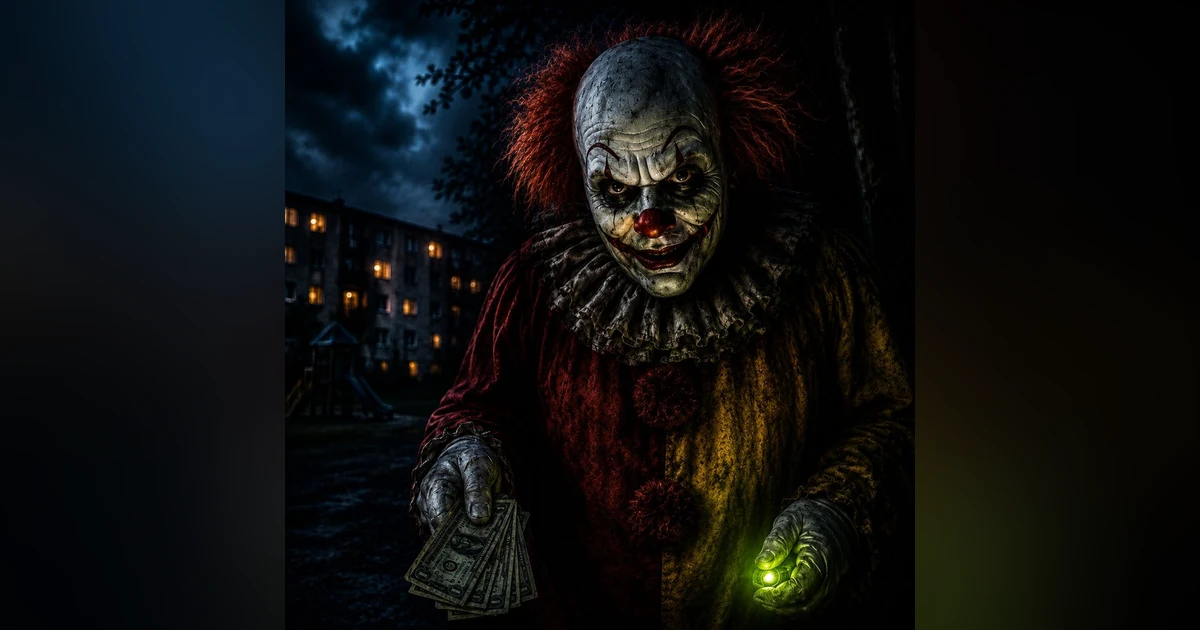
Ten years ago. This week, children at a Greenville County, South Carolina, apartment complex came running home with a story no adult wanted to believe. They said clowns were standing near the woods. Some said the figures showed money and tried to lure them to the trees. A resident reported green lights or lasers. Others described whispering, strange noises, and a large clown with a blinking nose near a dumpster. Deputies searched the woods and an abandoned house beside a pond. They found no clown, no hidden camp, no costume, no clear physical evidence, but whether the first clowns were real almost stopped mattering, because within weeks, people across the country began putting on masks and making the story real.
Thursday Thrills. This is Thursday Thrills, a quick weekly ride into the creepy stories, haunted places, weird obsessions, and eerie little corners of the world worth talking about. I'm your host Henrique Couto. Tonight, on the tenth anniversary of one of the Internet age's strangest panics, We are going back to the woods behind Fleetwood Manor apartments. This episode arrives on August twentieth, twenty twenty six. The first major Greenville County police report was made on August twenty first, twenty sixteen, ten years ago. Exactly, We're there, ever, really clowns hiding in those woods? Or did America become so frightened of the story that people began putting on costumes and turning an uncertain rumor into a real threat.
Fleetwood Manor was not a crumbling mansion with lightning over the roof, despite the name. It was an ordinary apartment complex in Greenville County. Families lived there, children played outside behind the property. A man made trail crossed a wooden area and led toward an abandoned house beside a pond. On the evening of August twenty first, Deputies responded after residents said children had seen someone, perhaps several people in circus clothing and white face paint near those woods. The most alarming claim was that clowns had to displayed large amounts of money and tried to persuade children to follow them deeper between the trees.
A woman told a deputy that her son had seen clowns whispering and making strange noises. I'm not sure what a strange noise is for a clown, but that does make me curious. According to the report, she said she went to look and saw figures flashing green laser lights before they ran away. Another resident described a large clown with a blinking nose beneath a light near the garbage dumpsters at two thirty in the morning. The clown waved, She waved back. The figure didn't approach her. That detail is so strangely ordinary that it makes the story scarier.
A wave should be friendly at two point thirty in the morning, from a silent clown under a dumpster light, it becomes something else entirely. The children reportedly believed the clowns lived in the abandoned house at the end of the trail. A deputy checked it and found no clothing, no sign of occupation, and nothing connecting the house to any of the sightings. Management warned residents, parents were urged to supervise children, and police increased patrols. Those responses were verified, the clown claims not so much. Investigators had frightened residents and uncertain accounts, but no photograph, costume, identifiable suspect, or physical evidence, not even a rubber chicken.
Some witnesses declined to give police their names. Retellings varied on how many clowns appeared and exactly what they did. Eight days later, a teenager at another apartment complex reported seeing a man photographing children, and then a person in a clown mask emerging from the woods. More calls placed clowns near roads, laundromats, and apartment buildings. Officers responded, but again found nothing that substantiated the sightings. The mystery was still local, but the story was learning how to travel. Local television showed the treeline, the trail, and the apartment buildings. News sites repeated the police report. Facebook posts condensed a complicated situation into one sentence built to spread Clowns are luring children into the woods.
The qualifiers fell away. Children reported became clowns are. A claim became a warning. A warning became proof that the thing everybody was sharing must already be happening. The Internet had been primed for the image. Earlier that August, photographs of a dirty clown holding black balloons beneath a Green Bay overpass went viral. The clown, called Gags, was later revealed as part of a local filmmaker's campaign for a short horror film. It had no proven connection to Fleetwood Manor, but it showed how easily a staged clown photograph could become news. Now, every blurry image had already made story.
Every distant figure at a tree line could be the next sighting. Every prankster with makeup, a mask, and a phone had the equipment to join in. Reports appeared in other towns and states. Some were mistaken identities, some were hoaxes, some never advanced beyond a post. Others involved real people deliberately dressing as clowns to frighten strangers, and each new report made the earlier ones feel more believable. Ten unrelated stories do not prove one another, but when they arrive in the same costume, on the same screen inside the same week, they begin to feel like one organized event.
There was no evidence of a coordinated clown invasion. Coordination was unnecessary. The story supplied the costume and instructions. Stand near woods, appear at dusk, refuse to explain yourself, and let somebody else host the picture. By September, the legend was not merely spreading. It was recruiting. On September twenty third, a police officer in Middlesboro, Kentucky, spotted a person in a full clown costume near a wooded area by an apartment complex. This time there was no vanishing figure. Police arrested twenty year old at Jonathan Martin, cited him under a city face-covering ordinance and charged him with disorderly conduct.
He also had outstanding warrants. A month after South Carolina children reported a clown beside apartment complex Woods, an actual man in a clown suit was found beside a apartment complex Woods. That may not have proved the first story, it proved someone had learned the part. In Flomaton, Alabama, social media accounts with names including Flomo Klown and Shoota Cllown sent threats to students. Schools locked down. More than thirty officers went to campus, and investigators worked with the FBI to trace the posts. Authorities identified an adult and a juvenile connected to the accounts. The adult was arrested and the juvenile had charges pursued.
There may never have been a clown physically waiting at school. The threats still frightened families, disrupted classes, consumed police resources, and carried real consequences. Ohio offered the panic in two forms, almost side by side. In reading, a reported clown assault and threat against a school led the district to cancel classes on September thirtieth. That report remained under investigation at the time. The next morning, in a separate case, an eighteen year old woman claimed a knife wielding clown had attacked her. Police found inconsistencies, and she admitted inventing the story because she was late for work and feared losing her job.
Give her an a plus for creativity. She was charged with making a false alarm. A frightening report could close schools, but a false report could imitate it before police had even resolved the first one. Make sure you're following Weekly Spooky on your favorite podcast app, because every Thursday we bring you another thrill and share this episode with someone who remembers exactly how weird. The fall of twenty sixteen became things get a little more intense when Penn State got involved. On October third, social media rumors claimed a clown had been seen near campus. At least five hundred students poured into the streets for a chant all shouting clown hunt.
Campus police reported no credible threat, no injuries, no damage, and no actual clown except an image projected onto a building. Five hundred people had mobilized to hunt a rumor wearing face paint. The absence of a clown no longer prevented a clown event from occurring. Institutions changed plans, Police warned against threatening costume stunts, school's restricted clown outfits, Target reduced its selection of clown masks. Right before Halloween, McDonald said Ronald McDonald would keep a lower profile at community appearances because of the climate around clown sightings. When Ronald McDonald has to lay low, the panic has officially escaped the woods.
By October, reports, threats, warnings and copycats were appearing in Canada, Britain, Australia and elsewhere. British police warned that using a clown costume to intimidate people could be treated as a crime. Of course, they'll treat anything like a crime if they want. The pattern survived every border, a mask, an ordinary place, a frightened witness, a social post, and police trying to determine whether a threat existed behind the performance. The earliest reports may never have been proven, but the fear inspired real people to become the thing. Everyone was afraid of This wouldn't have worked with almost any other costume.
A clown face is designed to communicate emotion from the far side of a circus tent. The smile is permanent, the eyes are exaggerated. The person underneath is hidden but not completely. You're looking at something human whose real expression has been painted over. A twenty sixteen study of more than thirteen hundred people placed clowns among the occupations most associated with creepiness. The researchers linked that feeling to unpredictability and uncertainty about whether danger is present. That is exactly what a clown at the edge of the woods creates at a birthday party. The costume has an explanation. At a parade, it has a route under a spotlight.
It has a job at a tree line after sunset. It's a familiar childhood image. Behaving vary incorrectly. By twenty sixteen, horror movies, viral prank videos, and characters such as Pennywise had already taught audiences how to finish the picture. The clown did not need to chase anyone. It only had to stand there while imagination supplied the rest. So was there really a clown behind fleetwood manor Several possibilities remain, and none can be proved from the public record. A prankster may have disappeared before deputies arrive. Children and adults may have understood somebody's clothing or behavior in the dark.
One real but harmless sighting may have absorbed unrelated rumors. Several teenagers may have played separate jokes. It may have begun as a hoax or frightened children. Parents and repeated questions may have assembled a shared story from uncertain pieces. More than one explanation can be true. That is the trap at the center of the two thy sixteen clown panic. Once copycats appeared, every genuine costume made the original claims seem more real. Every hoax made police more skeptical of the next frightened caller. Every arrest proved somebody would do this, without proving who if anyone had done it first, rumor, performance, fear, and genuine intimidation folded together until separating them became merely impossible ten years later.
The most important part of the story may not be whether the first clown existed. It may be how quickly modern urban legends can stop being only legends. Once a scary story had to survive by being retold, But now it can be photographed, reposted, imitated, threatened in a school, message, acted out beside a road, and copied in another country before investigators finished checking the first location. The legend can recruit participants while the facts are still being searched for. Maybe there was never a clown waiting in those first South Carolina woods. Maybe there was, But once the story escaped, people supplied their own costumes, threats, hoaxes, and endings.
The legend did not need to be true. It only needed enough people to believe it and enough others willing to become it. Imagine one last ordinary neighborhood. At the end of a summer evening, apartment windows begin to glow, children being called inside, cicadas humming as the final daylight drains from the sky. Beyond the grass is a wall of trees, and just where the woods begin there may be a shape righter than the shadows around it, too far away to identify, standing perfectly still and smiling, whether the person inside is smiling or not. I'm Henrique Couto, and this has been Thursday thrills.
Drive safe, keep your headlights on, and If you see something brightly colored standing at the edge of the woods tonight, don't follow it between the trees. Come back tomorrow for more fear. Until then, lock your doors, as if that will help you
