


 Apple Podcasts

 Spotify

 Spreaker

 Audible

 Castro

 RSS Feed
Shark Week Horror: Jersey Shore Attacks & Unsolved Sea Mysteries | Thursday Thrills

Key Takeaways
- Shark horror stories range from verified historical tragedies like the 1916 Jersey Shore attacks to eerie cryptid legends such as the Black Demon of Baja.
- The infamous 1935 Sydney Shark Arm case involved a captive tiger shark that regurgitated a human arm, inadvertently exposing a bizarre true crime underworld plot.
- Nature itself often resembles a horror writer, with sand tiger shark embryos consuming their siblings in utero and Greenland sharks living for centuries in icy depths.
- Misidentified decomposed carcasses, such as the 1808 Stronsay Beast, have historically fueled terrifying myths of sea serpents that actually turned out to be basking sharks.
- While real sharks are crucial to marine ecosystems and unprovoked attacks are rare, the psychological terror of dark water and unseen predators remains a powerful staple of ocean mysteries.
The 1916 Jersey Shore shark attacks changed how Americans feared the water. Sydney's 1935 Shark Arm murder case began when a captive shark vomited a tattooed human arm. Henrique Couto follows both cases in this Shark Week edition of Thursday Thrills, separating disputed details from the evidence. The journey also examines the unverified Black Demon, the Stronsay Beast, and megalodon's place in prehistory. Real shark biology adds river hunters and long-lived Greenland sharks. Explore the history behind the headlines without treating folklore as proof that an extinct predator survives.
Bonus episodes & support: https://weeklyspooky.com/join
More scary stories: https://weeklyspooky.com/
Story submissions: WeeklySpooky@gmail.com
Frequently Asked Questions
What were the 1916 Jersey Shore shark attacks?
The 1916 Jersey Shore attacks were a series of five shark attacks along the coast of New Jersey and Matawan Creek over twelve days, resulting in four deaths and sparking a national panic that changed how Americans viewed swimming in the ocean.
What is the Sydney Shark Arm case?
The Sydney Shark Arm case occurred in 1935 when a captive tiger shark at an aquarium regurgitated a human arm, which forensics proved had been deliberately severed, leading police into a strange true crime murder investigation.
Are Megalodons still alive in the ocean?
No, scientific evidence places the extinction of the Megalodon shark roughly 3.6 million years ago, with the fossil record showing no credible proof or modern remains of living specimens.
What is the Black Demon of Baja?
The Black Demon is a modern cryptid legend from Mexico's Baja Peninsula describing an impossibly large, dark shark up to fifty feet long that supposedly attacks whales and small boats.
Just in time for Shark Week twenty twenty six, We're diving into true shark attacks, megalodon legends, terrifying sea monsters, and the bizarre unsolved murder exposed when a captive tiger shark regurgitated a human arm. We revisit the nineteen sixteen Jersey Shore and Mattawan Creek attacks, the Black Demon of Baja, and Sydney's infamous shark arm case. Along the way, meet the strons beast, centuries old greenland sharks, river roaming bull sharks, and sand tiger embryos that eat their siblings before they're even born. So say Thrills. This is Thursday thrillsick weekly ride into the creepy stories, haunted places, weird obsessions, and eerie little corners of the world worth talking about.
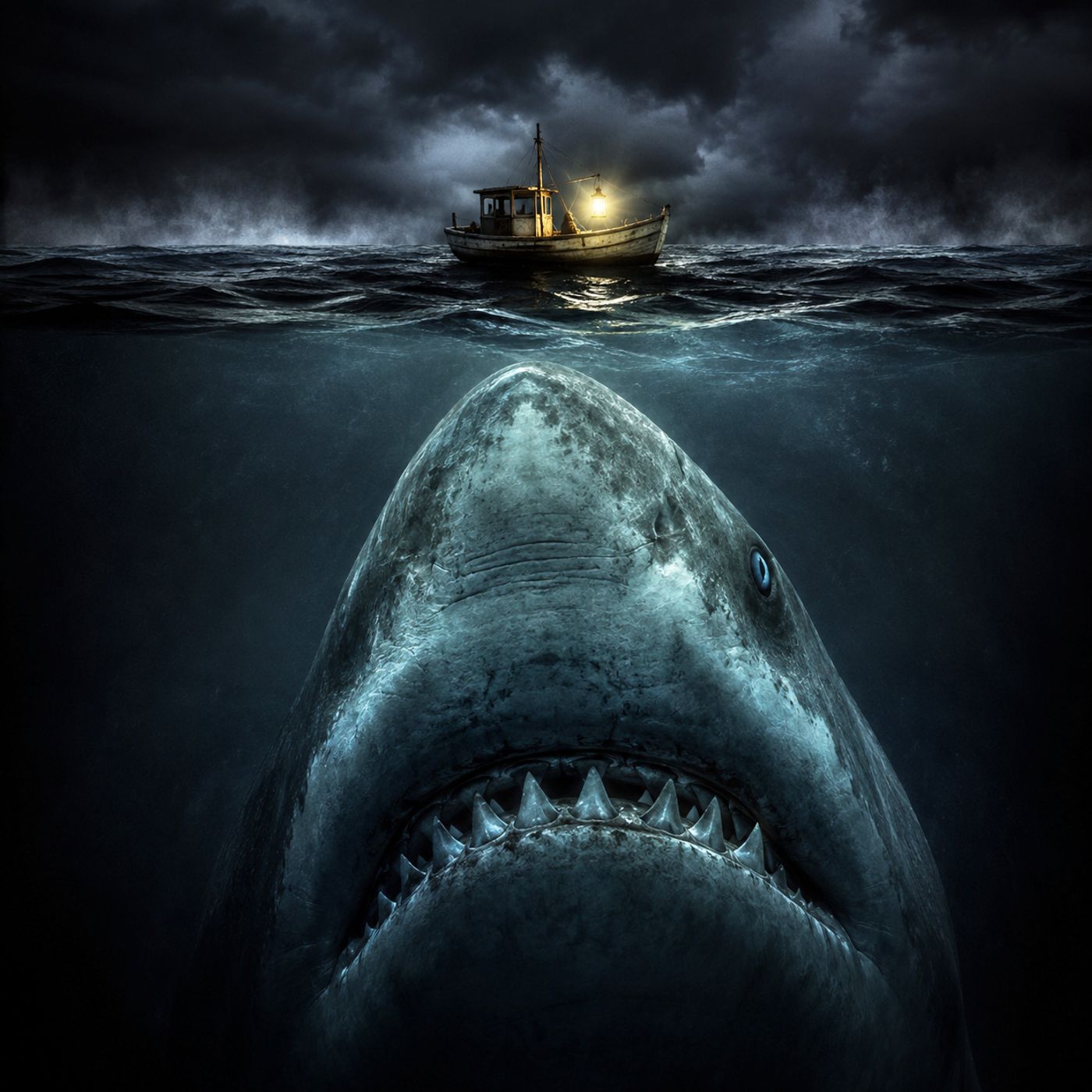
Imagine yourself on a small boat after midnight. The shoreline is gone. The moon keeps vanishing behind clouds. Your flashlight reaches the water, but it can't reach through it. Every wave is black glass folding over something you can't see. Then something bumps the bottom of the boat. Not hard, just one slow knock. You hold your breath. A second knock comes from the other side. Then the boat rises several inches, as though something enormous has passed directly underneath it. That is the special terror of a shark story. The monster doesn't have to step from the shadows. The shadow is its entire world.
And with Shark Week beginning this Sunday, July twenty sixth, this feels like the perfect opportunity to open the file marked Things you Should Not think about while swimming Tonight, we're diving into frightening shark legends, bizarre true stories, real attacks, ancient sea monsters, and a few facts about sharks that sound as if Nature hired a horror writer. Most sharks are not hunting people. Shark attacks are rare, and these animals are far more important to the ocean than the movie will usually admit, especially Shark Nato. But we can respect sharks and still acknowledge one uncomfortable truth. They are extremely good at being terrifying.
Before the summer of nineteen sixteen, plenty of Americans doubted that a shark could kill a swimmer in the temperate waters of the northeastern United States. Then came twelve days that changed the way the country looked at the ocean. It began on July first, in beech Haven, New Jersey, which, by the way, I've spent some time at which extra makes me nervous. Gorgeous place though, gotta love Long Beach Island. Make sure you go to the restaurant Chicken or the egg. Get the gosh darnwitch. You're welcome anyway. Charles van Sant went into the Atlantic for an evening swim.
People on shore heard him shouting and at first thought he was calling to a dog in the water. He wasn't. Van Sant was pulled back to shore, but he died from his injuries. That death was horrifying, yet it was also treated as something nearly impossible, a freak event that did not justify closing beaches during the busiest part of summer. Five days later, forty five miles north, a young hotel employee named Charles Bruder was swimming off Spring Lake when he was attacked and killed. Now the impossible thing had happened twice, newspapers began warning of a man eater moving along the New Jersey shore.
Tourists became nervous. Shark sightings multiplied. Every dark shape in the surf became a fin, and every fin belonged to the same unseen killer. Then on July twelfth, the story left the ocean. Mattawan Creek was more than fifteen miles from the open Atlantic. It was narrow, muddy, and familiar, the kind of place where local boys went swimming without imagining that anything from the deep sea could follow them. There. A sea captain named Thomas Cottrell reportedly spotted a large shark in the creek and tried to warn the town. His warning was dismissed. Later that day, eleven year old Lester Stillwell was swimming with friends near a dock when the boys saw something dark moving through the water.
A fin appeared. Before Lester could escape, he was pulled beneath the surface. A young local man named Stanley Fisher entered the creek to search for him. Fisher found the boy, but during the rescue he was attacked as well. He made it back to the shore alive, but died later from his wounds. Less than half an hour after, at another spot along the creek, a teenager named Joseph Dunn was attacked. His companions managed to pull him away and he survived. By the end of the those twelve days, five people had been attacked and four were dead.
Mattawan became the setting for a real life monster hunt. People stretched nets across the creek. Armed patrols searched the water. Explosives were thrown into places where the shark might be hiding. The fear reached Washington, and the attacks became a national obsession. A great white shark was caught nearby soon afterward and said to contain human remains, but the identity of the attacker has never been settled beyond a doubt. Some experts have argued for a bull shark because they tolerate brackish and fresh water. Others believe a white shark could have entered the tidal creek. More than one shark may have been involved, and honestly, the uncertainty makes the story worse.
A single rogue shark moving north sounds like a movie monster. Several unrelated sharks appearing in exactly the wrong places sounds like the sea itself has turned against all of us. The nineteen sixteen attacks are often connected to jaws, although author Peter Benchley later denied that they were a direct inspiration. Either way, the shape of the nightmare is familiar. Summer heat, crowded beaches, officials reluctant to frighten tourists, and something moving beneath the water while everyone argues over whether it can possibly be there, I think it's about time to drift back toward shore for just a moment.
When we return, we'll meet a fifty foot black shark from the waters of Baja, discover a shark that may have been alive before the American Revolution, and visit an aquarium where a tiger shark became the world's most horrifying witness in a murder case. So don't go swimming until we return. In the waters around Mexico's Baja Peninsula, modern cryptid lore tells of El Demonio Negro, the Black Demon. The creature is usually described as an impossibly large shark, sometimes fifty feet long, with a dark body, a massive tail, and enough strength to attack whales, scatters sea lions, or strike small boats from below.
The Sea of Cortes is a perfect place to grow a legend such as this. It's beautiful, biologically rich, and deep enough to make even an experienced person wonder what might pass beneath a boat without ever reaching the surface. Accounts of the Black Demon vary wildly and no verified photograph, specimen, or scientifically documented encounter has established that an unknown giant shark calls that area home. The story's history is also murkier than many retellings suggest. Much of its popularity comes from modern television, cryptid culture, and fishermen's tails that are difficult to trace. But a legend does not need a clean paper trail.
It needs a memorable shape, and the Black Demon has the shape of the shark people refuse to let die. Meglodon the Megledon was real. It lived from roughly twenty three million to three point six million years ago and was the largest shark known to science. It may have reached around three times the length of a modern great white, with teeth as large as a human hand. That's not folklore. That animal genuinely moved through our oceans. What is folklore is the idea that it's still down there. Scientists have found no credible evidence of living Megalodon's no fresh teeth, no modern remains, no reliable footage.
The fossil record places its disappearance millions of years before human beings began telling stories about sea monsters. Still, whenever someone sees a fin that looks a bit too tall, a shadow that looks gargantuan, or a whale with a wound too large to explain. Megledon swims back into the conversation because we misjudged the size is a reasonable statement, but we just saw a prehistoric super predator is a much better fire story. Plus, when you consider all the deep sea life that's never been discovered until a few weeks ago, like the giant squid, well, it does make you wonder, doesn't it.
Before we get to our next full story, here are three things sharks do that sound completely made up. First up, sand tiger sharks begin eating one another before they're born. The largest embryos in each of the mother's two uteri consume their smaller siblings. After that, they feed on unfertilized eggs. The result is usually two very large pups, one from each uterus, entering the world after winning a prenatal survival contest. That makes most slasher films seem cordial, So please remember every adult sand tiger shark is the survivor of a horror story that began before birth. Secondly, greenland sharks can live for centuries.
Researchers using radiocarbon dating on tissue in their eye lenses. Concluded that greenland sharks can live at least two hundred and seventy two years. The largest animal in the study was estimated at three hundred and ninety two years old, with a wide margin of uncertainty, and females may not reach sexual maturity until roughly a century and a half into being alive. That means a greenland shark moving slowly beneath Arctic ice today could have been a lot before the United States of America even existed. Imagine spending one hundred and fifty years as a teenager. I think I'd pass.
That may be the most frightening fact in this entire show. And thirdly, some sharks do not respect the boundary between ocean and river. Bull Sharks can tolerate low salinity water and travel into rivers and estuaries. Whether a bull shark was responsible for some of the nineteen sixteen attacks remains debated, but the species itself is perfectly capable of entering places where most people would never expect a large shark. The beach is not always the edge of shark territory. Sometimes the map keeps heading inland. Now, we traveled to Sydney, Australia in nineteen thirty five for a case that sounds less like history and more like a headline discovered in a cursed scrap book you found in a ditch.
A fisherman near Coogie Beach hooked a small shark before he could bring it in, A roughly four meter tiger shark swallowed the smaller animal and was captured too. The tiger shark was taken alive to the Cougie Aquarium baths, where it became a major attraction for the Anzac Day holiday. For several days, it ate well and behaved normally. Then on April twenty fifth, it became sluggish and agitated. Spectators gathered around the pool. The shark thrashed, and in front of the crowd, it regurgitated a human arm. At first, everyone assumed the arm belonged to another victim of a shark attack, but an examination showed that it had not been bitten from a body.
It had been deliberately severed with a sharp instrument. The shark had not killed the man, the shark had swallowed evidence. A distinctive tattoo and surviving fingerprints allowed police to identify the arm as belonging to Jim Smith, a former boxer, bookmaker, small time criminal, and police informant who had been missing for weeks. The investigation led into Sydney's underworld and toward a suspected forger named Patrick Brady. It also involved a businessman named Reginald Holmes, who had connections to Smith and to a series of criminal schemes. Then the story somehow becomes even stranger. Holmes attempted suicide, survived when the bullet failed to kill him, fell into the water, became caught by a rope, revived, climbed into a speedboat, and led police on a chase through Sydney Harbor that lasted for hours.
After his capture, Holmes agreed to cooperate with investigators, but only hours before he was expected to testify at the inquest into Smith's death. Holmes was found shot dead in his car, with a crucial witness going on and the rest of Jim Smith's body never recovered. The case against Brady collapsed, he was acquitted, and the murder remained unsolved. The shark was never the killer. It was a witness, A witness with no testimony, no loyalty, and possibly the worst sense of timing i've ever heard of. But when you gotta eat, you gotta eat. Our final legend, Tonight begins after a storm on Ornkey Island on Stranse in September of eighteen oh eight, a huge, badly decomposed sea creature washed ashore.
Witnesses described a long body, a neck, strange appendages, and a mane of bristles all along its back. To people already familiar with stories of sea serpents, the conclusion seemed obvious. The Great Sea snake was real. The remains were examined, measured, sketched, and debated. Edinburgh anatomist John Barkley argued that the carcass provided physical evidence for a sea serpent. London anatomist Everard Home reached a less exciting conclusion. It was a decomposing basking shark. The argument continued, because the carcass did not look much like the gentle, planked and eating giant we now recognize as a basking shark. Decay had transformed it.
Familiar features had collapsed or vanished, leaving behind a shape that the hue human mind could rebuild into something prehistoric. That's why the Stronse beast is such a perfect shark legend. It doesn't even require a living monster. It shows how a real shark can become a sea serpent after death, how the ocean can return an ordinary animal in such a ruined and unfamiliar form that even trained observers began reaching for mythology. Sometimes a sea monster turns out to be a shark, and sometimes the shark turns out to be more monstrous than legend. So what is the scariest shark story?
Is it the nineteen sixteen attacks where a real predator entered a narrow creek and changed American fear forever? Is it the Black Black Demon, an enormous shadow that survives because no one can prove what fishermen saw. Maybe it's the shark arm case, where the shark was only carrying a secret created by human beings of a sordid type. Or is it the stroanse Beast, reminding us that the sea can take something natural, twist it beyond recognition, and deliver it back as a monster. Real sharks are not supernatural killers. Attacks are rare, and many shark species face far more danger from humans than humans face from them.
But fear does not require an evil animal. It only requires one that eats efficiently really only requires dark water, limited vision, and the knowledge that something large can move directly beneath you without making a sound. So enjoy shark Week, learn something, appreciate these incredible animals. And if you ever happen to be on a boat after midnight and hear one slow knock against the hull, maybe don't lean over the side to investigate. And also be glad you didn't hear a base riff playing underneath. Stay safe out there, keep the headlights on one foot on dry land, and remember the ocean doesn't need to invent monsters, it only needs to hide them.
Come back tomorrow for more fear. Until then, lock your doors as if that will help you.
