


 Apple Podcasts

 Spotify

 Spreaker

 Audible

 Castro

 RSS Feed

 iHeartRadio
Terrifying & True | The Lost Franklin Expedition: Arctic Horror and the Northwest Passage Mystery
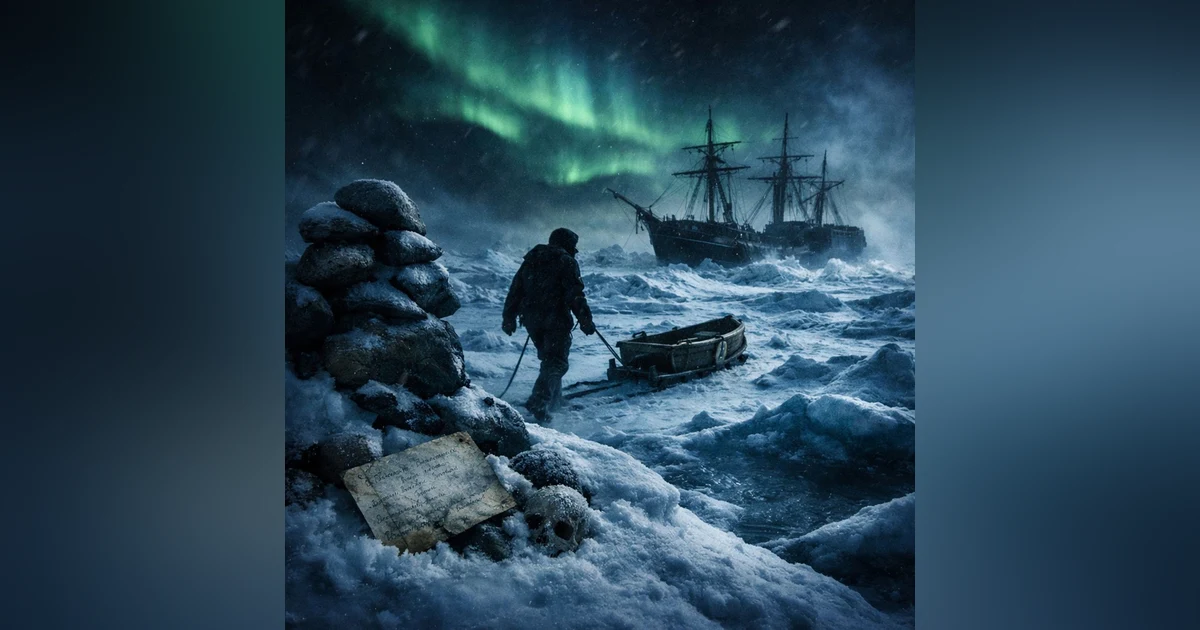

In 1845, Sir John Franklin and 129 men sailed into the Arctic chasing the Northwest Passage—and vanished into a white maze of ice, darkness, and slow collapse. This episode follows the chilling, evidence-anchored timeline of the Lost Franklin Expedition, from the first quiet graves at Beechey Island to the brutal trap of Victoria Strait, where the ice held two war-built ships like insects in amber: HMS Erebus and HMS Terror.
We trace the expedition’s last clear message—the Victory Point note—and the desperate decision to abandon shelter and march south across a landscape that doesn’t care about courage. Along the way: the long-dismissed Inuit testimony that kept pointing searchers toward the truth… and the grim archaeological signs of starvation, scurvy, and the terrifying edge where survival turns into taboo.
Then, nearly two centuries later, the Arctic finally gives something back: the discovery of the wrecks of HMS Erebus (2014) and HMS Terror (2016)—preserved in black water like a paused nightmare, raising haunting questions about what happened after the ships were left behind.
Inside this episode:
- The obsession: why Britain needed the Northwest Passage badly enough to gamble lives
- The trap: how the ice sealed Erebus and Terror near King William Island
- The turning point: the Victory Point note and Franklin’s death (June 1847)
- The march south: what Inuit witnesses reported—and why it was dismissed for decades
- The forensic truths: lead, scurvy, starvation, and evidence of desperate measures
- The wrecks found: how modern search teams combined tech with Inuit knowledge to locate the ships
Some mysteries aren’t solved all at once—they’re uncovered in scraps, bones, and cold, reluctant proof. And in the Franklin case, the scariest part is that you don’t need a monster. The ice is enough. We’re telling that story tonight.
🎧 LISTEN NOW and subscribe for spine-tingling horror stories every week!
🎉 Unlock exclusive bonus episodes and support the show on Patreon!
👉 WeeklySpooky.com/Join
📬 Contact Us / Submit Your Horror Story!
- Twitter: @WeeklySpooky
- Facebook: facebook.com/WeeklySpooky
- Email: WeeklySpooky@gmail.com
🎵 Music by Ray Mattis 👉 Check out Ray’s incredible work here !
👨💼 Executive Producers: Rob Fields, Bobbletopia.com
🎥 Produced by: Daniel Wilder
🌐 Explore more terrifying tales at: WeeklySpooky.com
0:01 In eighteen forty five, one hundred and twenty nine men sailed toward the Northwest Passage with ships built for war and supplies meant to outlast hunger. Then the Arctic closed like a fist, a note in stone, caring graves in permafrost, footsteps that end in white silence, and a truth the world refused to believe until the bones were discovered. What you were about to pat is burd to beel Based on witness accounts, testimonies, and public record, this is terrifying and truth.
0:58 Tonight. We begin at the top of the world, where the horizon is a blank page and the cold can erase a human life without leaving so much as a footprint. In eighteen forty five, Sir John Franklin led the HMS Erebus and HMS Terror into the Arctic, determined to conquer the Northwest Passage. They never returned. For years, there were no survivors, only rumors, scattered relics, and eye witness accounts that powerful people chose to ignore. What happened to Franklin's men.
1:44 Did they die aboard their ships, vanish on a doomed march south, or endure long enough to leave behind a final message meant to be found. The answers are written in ice, ink and evidence pulled from the sea. Make sure you're subscribed on your favorite podcasting app so you never miss one bit of terrifying and true. Now get comfortable, find something warm to wear and something hot to drink. Things are about to get very chilling. Imagine this a flat white horizon that goes on forever. A wind that doesn't howl so much as it grinds, like the world itself is chewing on stone. The sea is frozen, but it isn't still. The ice shifts slow muscular pushes, cracking like gunshots, and groaning like something alive. Overhead, the sky is a hard black bowl dusted with stars. Sometimes the
3:16 aurora blooms, green curtains rippling across the darkness, beautiful enough to make you forget for a second that beauty doesn't care whether you live or die. And down there, embedded in that ice, like insects and amber, are two ships, the HMS Erebus and HMS Terror. They were built for war and refitted for the end of the world. Reinforced hulls, iron plating, steam engines, coal stoves, provisions stacked like a fortress against starvation. They carried one hundred and twenty nine men, officers, sailors, royal marines, sent by the most powerful navy on Earth to finish a puzzle that had obsessed empires for centuries.
4:21 The Northwest Passage, a hidden highway through the top of the world, a shortcut to Asia, a map maker's dream, a politician's trophy, a doorway cut through ice. But in eighteen forty five, when Sir John Franklin sailed into the Arctic to find it, the Arctic didn't refuse him. It kept him For years. England waited for the letter that never arrived, the proud announcement of success. Instead, there was only only silence, then rumor, then scraps, then bones, and finally a truth so bleak and human that it feels like horror, even when you strip away every ounce of exaggeration.
5:19 We're talking about the lost Franklin expedition, what we know, what we can infer, and what the Arctic itself has chosen to reveal, peace by peace over nearly two centuries. We'll paint the picture with drama, but will stay anchored to the record. The last known note the archaeology and the Inuit testimony that turned out again and again to be the closest thing anyone had to a map out of the dark. If you want to understand how one hundred and ten twenty nine men ended up starving on the edge of a frozen sea, you have to understand what the Northwest Passage meant in the eighteen hundreds. This wasn't just an adventurous detour. It was economics, pride, and imperial mythology, all tied together with rope and gunpowder. The idea was simple. Europe wanted faster access to Asia to trade tea, silk, spices, goods that made fortunes. Sailing around Africa was long and often dangerous. If there was a sea route through the North, through the maze of islands and channels above Canada, you could cut the travel time
6:51 and the cost. Whoever controlled that route would control a new artery of global power. But the Arctic wasn't a blank white space. It was a complicated place with its own logic and people who already knew it. Inuit communities had lived, traveled, hunted, and survived there for generations. The land and sea had names and stories and routes, but European maps didn't show any of that. On European charts. It was simply unknown, which is a polite word for we haven't listened. By the time Franklin sailed, the British Navy had already sent multiple expeditions north. They charted coastlines, They suffered, They learned just enough to be confident, but not enough to be safe. And there's a particular kind of danger that comes from half knowledge. You know the ISA exsis exists, but you believe you've outsmarted it. Enter Sir John Franklin. Franklin was a veteran of Arctic hardship.
8:11 Earlier in his career he'd led overland expeditions that were disasters in the most brutal way starvation, exposure, death. He survived and returned to Britain as a kind of stubborn symbol, a man who had endured the North and still wanted more. By eighteen forty five, he was older, late fifties, respected, famous, and depending on who you ask, either the perfect leader or a romantic choice made by people who wanted a hero more than they wanted a planner. The Admiraltrey gave him two ships and the best thinking of the a.
9:01 The expedition was designed like a victory parade that happened to float. The erebus and aptly named Terror weren't sleek new vessels built for exploration. They were bomb ships. Sturdy, thick holed vessels originally designed to carry heavy mortars that made them strong, and strength matters when the ocean starts turning into jagged stone. For the Franklin Expedition, they were modified to survive ice, reinforced boughs, internal bracing, and metal plating.
9:43 They were outfitted with steam engines converted from locomotives, and propellers that could be lifted out of harm's way. They carried coal to run them. They had heated cabins, a library. They even had musical in instruments. And they had canned food, thousands of tins, because the Industrial Revolution had given Britain a new miracle, food that could be preserved and shipped anywhere. They also carried something far less visible. Assumptions, the assumption that technology could flatten nature into a problem to be solved, the assumption that British discipline could substitute for local knowledge, the assumption that the Arctic, like the rest of the world would eventually yield to a flag. Franklin sailed with one hundred and twenty nine men. Among them were Captain Francis Crozier, a seasoned polar navigator who commanded Terror, and Commander James Fitzjames Franklin second in command and captain of Erebus.
11:04 These were competent officers, not amateurs. The crew included men with experience in cold climates, but experience is not immunity, and the North has a way of turning competence into tragedy if the math doesn't work out. On May nineteenth, eighteen forty five, the expedition left England. They stopped in Greenland to take on additional supplies and livestock. By late July they were seen by whalers in Baffin Bay, the last confirmed European sighting. Then they sailed into the maze.
11:52 We know that Franklin's ships wintered at Beechey Island in eighteen forty five through eighteen forty six. That fact is carved into the ground because three of the men died and were buried there. Their graves, simple stark, are the first true punctuation mark in this story. At this time in history, a few deaths on an Arctic expedition might not have seemed extraordinary. The cold kills. Illness happens so to accidents, but those three graves are an early warning that something was already going wrong. Maybe it was tuberculosis, Maybe it was pneumonia. Maybe it was the beginning of the nutritional deficiencies that would later cripple the entire expedition.
12:53 Maybe it was all of it at once. That's the thing about cold environments is that they don't just threaten you. They amplify every threat. A cough becomes a crisis, a cut becomes a death sentence, A month of poor nutrition becomes a slow demolition. Beechey Island is where you first feel the shift. The expedition is still on its intended path, Hope still exists, but the Arctic has already taken its first payment. When the ice broke the following summer, Franklin pushed on, and that decision pressing deeper rather than retreating, makes sense if you believe you're close, if you believe the map is about to make sense, if you believe the ice will behave the way it did last year.
13:59 It didn't. And when Franklin pushed deeper. The ice didn't just refuse to move, it closed like a fist. In September of eighteen forty six, Erebus and Terror became trapped in pack ice off the northwest coast of King William Island, near a narrow stretch of water called Victoria Strait. They would remain trapped there for the next year and a half. Really let that sink in an entire year and a half of immobility. Two ships locked in place, surrounded by a frozen ocean that refuses to loosen its grip. The men could move within the ships and onto the ice, but the expedition's purpose travel was gone. Their world shrank to a floating wooden box and a landscape of ice ridges and lethal cracks. At first, they would have rationed calmly.
15:17 The Admiral Tree had planned for multiple years, but planning on paper and surviving in reality are different things. In the Arctic, the calendar can betray you, spring can arrive late, summer can be brief and weak, and if you count on a thaw that doesn't come, your supplies stop being provisions and start being a countdown. This is where the Franklin story becomes claustrophobic. We tend to imagine the Arctic as open, vast and spacious, but when you're trapped in it, it becomes the opposite. The ice closes in the darkness, lasts, the air inside the ship grows stale. The men breathe the same air, eat the same food, listen to the same creaks of wood and pressure, and over time bodies begin to fail. For years, the great mystery of the Franklin Expedition was that there was no narrative, no journal recovered, no survivor testimony. But there was one critical message, one note left behind on paper and hidden in a karn,
16:49 later found by a search party. It's called the Victory Point Note. The document began as a routine report in May of eighteen forty seven, stating that the ships were wintering in the ice and that all was well, the kind of bland optimism you put in writing when you still believe the plan will work. Then in the margins a year later, in April of eighteen forty eight, someone returned to that note and added a second message. Because there was no room left for the truth, the margins say the expedition was in disaster. Sir John Franklin had died in June of eighteen forty seven. By April eighteen forty eight, twenty four men were dead. The ships had been trapped since September of eighteen forty six. The survivors were abandoning Arabus and Terror and were preparing to march south, hauling boats on sledges, aiming for the Back River, an overland route, in order to reach help. That is the moment the story breaks wide open. It tells us the timeline.
18:18 It tells us leadership passed to Crozier and Fitzjames. It tells us the decision was made. Leave the ships, leave the ice, and gamble everything on walking out of the Arctic. When you imagine that scene men dragging a boat across jagged ice, you can feel the desperation even without embellishment. A ship is shelter, supplies, warmth. Abandoning it means you believe staying is worse than leaving, which means the ships weren't just trapped, They were becoming tombs. They left the decks behind and stepped on to a white silence that doesn't care about prayers. South was the only direction left, and the ice was about to show them what South costs.
19:22 And here's where the story shifts in a way that matters, because for a long time, the British narrative treated the Arctic as if it were empty. But it was not empty. People were there, watching, remembering, and later telling searchers what they had seen. Inuit witnesses reported seeing groups of white men traveling south, struggling, thin, exhausted. They described ships trapped in ice. They described a camp, They described bodies. They described a scene that would scandalize Victorian Britain, starvation so severe that the men began cutting flesh from the dead.
20:17 When John Ray, a Hudson's Bay Company doctor and explorer, returned to Britain in eighteen fifty four with Inuit testimony and Franklin expedition artifacts, silverware, and personal items, his report should have been treated like gold. It was the closest thing to an answer that anyone had. Instead, it was treated like an insult. Victorian society could imagine British men dying heroically, It could imagine them freezing with dignity. It could not imagine them becoming human in the ugliest way possible.
21:01 Lady Jane Franklin and prominent voices attacked Ray's report, questioning Inuit credibility and suggesting murder or exaggeration. The reaction did two things. It delayed the acceptance of what likely happened, and it pushed Inuit testimony into the category of folklore rather than evidence. But the Arctic has a brutal way of settling arguments. Over the decades, searchers found traces a skeleton here, a scrap of clothing there, a boat sledge abandoned, as if the men simply stepped away and never returned.
21:57 Items were scattered along the coast of King William Island and the route toward the mainland. And then there were the bones. Some were still articulated, lying where men fell. Others were disassembled, cut broken. Archaeologists later examined these remains and found marks consistent with butchery, cuts where joints were separated, fractures where bone marrow was extracted. This is not the kind of damage caused by animals alone. It's the kind of damage caused by tools in human hands. Cannibalism is a stomach turning word, as it should be, but in this story it isn't presented as sensational horror. It's presented as a last resort that speaks to me how completely the plan had failed. When people reach that point, the expedition is no longer a mission. It's a collapse. And collapse doesn't happen for one reason. It happens because multiple systems fail at the same time. So what were those failures?
23:25 The Franklin Expedition's demise has been studied like a forensic puzzle. Over time, several contributing factors have emerged, not as neat answers, but as overlapping weights that pulled the men under. First was scurvy. Vitamin C deficiency can cripple a crew, gums, bleed, teeth, loosen, old wounds reopen, Fatigue becomes crushing. In an environment where every movement costs calories, weakness becomes fatal. Arctic expeditions had battled scurvy for centuries. Franklin's expedition carried anti scorbutics, but the effectiveness storage and supply were limited. If scurvy took hold, it would have turned strong sailors into men who could barely stand on their own. Second was starvation and cold.
24:33 Even with provisions and ice bound, expedition burns calories at an alarming rate. Heating the ships requires fuel, hunting requires strength, and if the ice doesn't release you when you planned, you're not just stuck, you're outlasting your food. And Third, lead poisoning. In the nineteen eighties, researchers exhumed the three Beechy Island bodies preserved in permafrost. Tests revealed elevated levels of lead in their tissues. That finding sparked a major theory the crew may have been slowly poisoned by lead solder used to seal the canned food, or by lead in the ship's water systems. Lead poisoning can cause cognitive impairment, weakness, gastro intestinal issues, and mood changes. In an arctic crisis, even a mild decline in judgment can become catastrophic. It's important to be cautious here. Lead poisoning alone doesn't explain everything.
25:49 It may have weakened them, impaired decision making, and made them more vulnerable to other problems. But the expedition like died from a combination of factors nutrition, disease, weather and relentless ice. And the ice isn't just a background setting, it's a mechanism of death. It removes mobility, It delays rescue. It turns distance into a wall, which brings us to the most haunting question, what happened to the ships after they were abandoned for a long time. We didn't know.
26:36 Then the Arctic gave them back. In the twenty first century, Canada intensified the search for Franklin's ships, combining technology, sonar, underwater archaeology with something that should have been valued from the beginning Inuit knowledge in two thousand. In fourteen, HMS Erebus was found in Wilmot and Crampton Bay. In twenty sixteen, HMS Terror was found in Terror Bay. The details of those discoveries matter because they underline a theme. In this case, what was dismissed as story turned out to be the truth.
27:29 Local Inuit had spoken about a ship in a particular place, They had seen wood in the ice, they had passed down information from elders, and when researchers finally listened, the ships were there. The wrecks were astonishingly preserved. Cold water, sloughs, decay, silence holds things in place inside those ships, objects remain like they were paused midlife. Equipment, bottles, tools, personal items, The wrecks are not just historical curiosities. They are evidence waiting to be read. And the wrecks also complicate the narrative because Terror was found in a location that suggests it traveled, drifted, or was moved after abandonment. That raises new questions. Did some men return to the ship, did a smaller group attempt to sail it? Did the ship break free at some point and simply drift away from the original trap. These are open questions. What we can say is that the wrecks confirm something eerie. The expedition's
28:59 story didn't end in one dramatic moment. It ended in stages, like a flame slowly extinguished, and that silent vanishing became a scandal back in Britain. At first, the absence of news wasn't immediately alarming. Arctic voyages could take years, after all, ships could winter, letters could be delayed by seasons. But as eighteen forty six became eighteen forty seven and eighteen forty seven slipped toward eighteen forty eight, the silence started to feel less like delay and more like a void.
29:59 And in prin and proper Victorian England, a void is intolerable Franklin wasn't just an officer. He was a symbol, a knight, a man chosen to complete a national obsession. If he failed, it would not be a private tragedy. It would be a public embarrassment, a wound on their society. Lady Jane Franklin, Franklin's wife, refused to let that wound close without answers. Her role in this story is often mentioned as a footnote, but it shouldn't be. She was relentless, politically savvy, and emotionally driven in a way that could move mountains. She pushed the admiraltrey, She raised funds, she enlisted public support, and she helped turn the search for her husband into a sustained campaign that sent ship after ship into the Arctic. Beginning in eighteen forty eight. Search expeditions spread out like fingers across the map. Some came from the west through the Pacific side, others came from the east through Baffin Bay. They combed coastlines, questioned whalers, examined karens, and scanned the horizon for smoke that never appeared.
31:36 The search itself became one of the largest exploration efforts in Arctic history, and it redrew maps, ironically achieving some of the geographical work Franklin set out to do, but paid for in years of anxiety and desperation. In other words, frank Engln's expedition vanished, but it left a gravitational pull so strong that it dragged dozens of other ships north to find it. When John Ray returned in eighteen fifty four with Inuit accounts and Franklin expedition items as well, his report collided with Victorian sensibilities like a fist through glass.
32:28 Ray wasn't reporting a tidy ending. He wasn't offering a heroic tableau of men dying with flags in their hands. He was reporting something messy and human starvation, collapse, and cannibalism. The reaction was immediate, emotional, and revealing. Lady Franklin and her supporters fought Ray's conclusions not only because because they challenged her hope that the expedition might still be honorable, but because they threatened the entire cultural story Britain had told itself about its own men. Inuit testimony was treated as suspect, not because it was inconsistent, but because it was inconvenient. It was easier to imagine that the Inuit had misunderstood, or lied, or even murdered the sailors, than to imagine British seamen doing the unthinkable. But Ray's report didn't fade. It hung in the air, and the Arctic kept producing the kind of evidence that doesn't care about pride.
33:53 In eighteen fifty seven, Lady Franklin funded another expedition aboard a ship called Fox, led by Francis Leopold McClintock. This mission matters because it finally brought back the closest thing to a narrative. McClintock's team wintered in the Arctic, traveled by sledge, and did what earlier searches struggled to do. They focused intensely on King William Island. There. In eighteen fifty nine, one of McClintock's officers, Lieutenant William Hobson, found the Karen at Victory Point and recovered that infamous note, that scrap of paper routine in its first message, desperate in its margins, confirmed Franklin's death. The ice bound timeline and the abandonment of the ships didn't answer everything, but it ended the most agonizing uncertainty there were no survivors.
35:10 The expedition had become an absence long before Britain had admitted it. McClintock's men also found a boat on a sledge, an image so strange it became iconic. A ship's boat dragged inland, filled with relics, equipment, books, odds and ends that suggest the men were still thinking like sailors and officers, still clinging to order and procedure, even as the world turned against them. The boat site and others like it, made one thing painfully clear. The march South was not a clean retreat. It was a slow unraveling. Those three Beechy Island graves early in the story, easy to treat as a small tragedy, became a cold mirror decades later when scientists returned to them. The bodies were preserved so well by permafrost that their faces could still be seen, their hair, their skin, their hands. It's a kind of time travel that feels indecent, but it also gave researchers rare insight into an expedition that left almost no written
36:43 record behind. The tests showing elevated lead levels were a bombshell because they offered a mechanism for failure. That wasn't simply bad luck. If the expedition's food or water systems were poisoning the men slowly, than the tragedy wasn't only the Arctic's cruelty. It was also the expedition's own infrastructure, turning trader. It's one thing to fight a hostile environment. It's another to discover that your supplies are quietly weakening you from the inside. And again, it's important not to turn that into a single cause answer. The Franklin Expedition didn't die from one villain. It died from a stack of problems, each one survivable alone but lethal together. Now we need to talk about dates and notes as well as theories, but we live in the space where history becomes human. So let's paint the picture as honestly as we can. Imagine. You are a sailor on terror in the second winter. You wake up and your breath smokes in the air. The stove is lit, but it's never enough.
38:16 Your hands crack and bleed, your teeth hurt. You're tired in a way that sleep does not fix. Outside, it's dark for weeks at a time. The wind scrapes snow across the deck, like sand paper. When the ice shifts, the ship groans. Sometimes you swear the sound is a voice. While you have entertainment, books, music, The men around you are changing. Some are irritable, some are quiet, some are sick.
39:00 Watch your friends lose weight, You watch small injuries turn into infections. You watch morale drain away like heat through a cracked window. And then one day you hear the rumor the commander is dead. Franklin is gone. Now the expedition is just a group of men in a trap, pretending the trap is only temporary until the day it's not.
39:42 The decision is made. You're leaving the ships. You're hauling boats across the ice. You're carrying the tools and the food you can manage, knowing it won't be enough. You're walking toward a place you've never seen, across terrain that doesn't care how brave you are. And somewhere along that route you realize the truth. You're not walking out, You're walking into a story no one will believe. For a long time, Franklin's Expedition lived in a kind of limbo between history and legend. In Britain, it became a moral tale about courage, sacrifice, and Empire in Canada, it became part of the broader story of Arctic sovereignty and exploration, and among Inuit communities it remained what it had always been, something witnessed, remembered, and told, an event that happened in a real place to real people, not an abstract mystery.
41:08 In modern culture, Franklin's story is irresistible because it's already structured like horror, isolation and environment that feels alive, a slow deterioration, a desperate trek, and a grim moral boundary crossed under starvation. It's not surprising that novels and television have leaned into that, because even without any supernatural additions, the true story carries the same dread. And then in the twenty tens, when the recks were found, the story shifted again from speculation toward tangible reality. Cameras went down into the black water and came back with images of the ships almost intact, like the Arctic had stored them carefully for a future generation to examine. What's left now is the long work of archaeology and identification, artifacts being cataloged, sites being protected, and in some cases, human remains linked to names through DNA and historical records. Each identification is a small act of restoration, pulling one man at a
42:38 time out of anonymity, but the larger truth remains unchanged. One hundred and twenty nine men sailed into the top of the world, and the top of the world did not give them back, not quickly, not cleanly, not The top of the world still hasn't finished telling us what it did with them. The Lost Franklin Expedition is terrifying because it's real, not in the way a ghost story is real, real in the way that human limits are real.
43:23 It's a story of ambition meeting an environment that doesn't negotiate. It's a story of technology that promised safety and delivered illusion, a story of men who were trained to endure, enduring past the point where endurance becomes something else entirely for generations, Britain framed Franklin's fate as martyrdom, noble and clean, but the evidence and the Inuit testimony, as well as the archaeology, insist on a more complicated truth. The men suffered, they broke, they did what starving people do. They died one by one, and the Arctic erased their names as easily as it erased their footprints. And yet the story didn't disappear. Forever.
44:27 It lingered in oral history, It waded in the cold, it surfaced in artifacts. It slept in two wrecks beneath black water until sonar and persistence and community knowledge brought it into the light. So what do we do with this story now? We tell it with respect for the dead and with humility for the place that killed them. We acknowledge where the record speaks and where it goes silent.
45:07 We remember that the Arctic wasn't empty. We remember that Inuit witnesses were not a footnote. They were the closest thing Franklin's men ever had to a witness stand. And if you ever find yourself looking at a map of the Far North, tracing a finger through the labyrinth of islands, it's worth remembering those lines were drawn with loss. Somewhere out there, beneath ice and water. The Arctic still holds things we haven't found yet. It holds artifacts and clues and the last private thoughts of men who sailed into the white thinking they were entering a passage when they were entering a grave. And the grave, for a very long time, kept their secret somewhere beneath the black water, in the dark of a ship that never made it home, the Arctic is still keeping their secret. Terrifying and True is narrated by Enrique Kuto. It's executive produced by Rob Fieldsman bobble Topia dot com and produced by Dan Wilder, with original theme music by Ray Mattis. If you have
46:37 a story you think we should cover on Terrifying and True, send us an email at Weekly Spooky at gmail dot com, and if you want to support us for as little as one dollar a month, go to Weeklyspooky dot com slash Join. Your support for as little as one dollar a month keeps the show going. And speaking of I want to say an extra special thank you to our Patreon podcast boosters, folks who pay a little bit more to hear their name at the end of the show. And they are Johnny Nicks, Kate and Lulu, Jessica Fuller, Mike Escuey, Jenny Green, Amber Hansford, Karen we Met, Jack Ker, and Craig Cohen. Thank you all so much and thank you for listening. We'll see you all right here next time. On Terrifying and True.
