


 Apple Podcasts

 Spotify

 Spreaker

 Audible

 Castro

 RSS Feed

 iHeartRadio
Terrifying & True | New England Vampire Panic: Why Families Burned the Dead
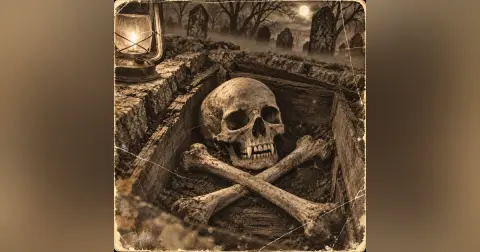
Mercy Brown was dead. Her brother was dying. New England’s vampire panic drove families to open graves and burn hearts, hoping to save the living from tuberculosis, then called consumption. Henrique Couto traces Rhode Island’s vampire folklore, Connecticut’s mysterious JB55 burial and the evidence behind America’s graveyard rituals. Hear archival recordings of folklorist Michael Bell, Everett Peck and archaeologist Nicholas Bellantoni. With Thanksgiving’s promise of reunion as its backdrop, why did grieving families seek a cure inside a coffin? We're telling that story tonight.
Bonus episodes & support: https://weeklyspooky.com/join
More scary stories: https://weeklyspooky.com/
Story submissions: WeeklySpooky@gmail.com
0:03 Mercy Brown was dead. Her brother was dying. In Rhode Island, some people searched her body for evidence that she was feeding on the living. They hoped to save him. What happened in that cemetery, what happened in that cemetery would make her an American vampire legend. What you are about to hear is believed to be real. Based on witness accounts, testimonies, and public record, this is Terrifying and True.
0:51 Someone has moved the man's skull. Inside a stone-lined grave in Connecticut, the head is no longer where a head belongs. Two thigh bones have been crossed beneath it. A human body has been taken apart and arranged into a skull and crossbones. Above the remains, brass tacks in the coffin lid spell out a short inscription, JB55. There is no surviving written explanation of the arrangement, no account identifying the people who returned to this particular grave. But elsewhere in New England, families left a record of something almost impossible to reconcile with the way we remember them. They dug up their own dead. They opened bodies, searched for blood, and burned human hearts. These were not performances staged to frighten children, The people carrying them out were trying to keep someone alive. And that brings us to a very different New England image. The family coming home for Thanksgiving.
2:15 19th century writers celebrated that tradition. They described the crowded table, the abundance, the happiness of gathering people beneath one roof. They also wrote about the people missing from it Thanksgiving made a family count its blessings. Sometimes it made the losses impossible to overlook. The grave openings we're following were not Thanksgiving ceremonies. Their connection to the holiday is something closer to home. The fear of a family disappearing, one person at a time, and the desperate effort to preserve whoever remained. In the stories told around these deaths, the danger was not a stranger arriving at the door. It was someone the family had already buried. And beneath that Connecticut coffin lid, long after the witnesses were gone, something of the fear was still there. We're telling that story tonight.
3:25 Make sure you're subscribed for many, many more terrifying and true stories Every Monday. In Sarah Hale's novel, Northwood, a mother has remembered the cranberry sauce. Her son, Sidney, has come home after a long absence. She's prepared the dishes he used to like in the way he remembers them. The table is covered with a white cloth. There's chicken and gravy, bread and butter, ham, pies, cakes, preserves. His father asks a blessing, and the family sits down. This is Thanksgiving Eve in a fictional New Hampshire household, a state I spent many summers in with my father. But not in this time period, because the scene appears in the revised 1852 edition of a novel Hale first published in 1827. Sidney can hardly concentrate on the food. He wants to look at familiar faces and listen to familiar voices.
4:45 What moves him is being called a son, a brother. The feast is almost secondary to the fact that he is returned to the people who know those names for him. There's even someone recovering from illness at the table, an English visitor whose appetite has returned after a fever. Later, the family arranges him on a sofa beside the fire with pillows to make him comfortable. He asks about the celebration coming the next day. The father explains that Thanksgiving is a festival of the people appointed by the governor. Food, family, Faith, a sick person recovering in the shelter of a household, Hale put all those things into her picture of the holiday, and she did not leave Thanksgiving inside the pages of a novel. In her magazine editorials, she urged the states to observe it together on the last Thursday in November.
5:52 Her case for that timing was practical as well as patriotic. The year's elections would be finished, the harvest gathered, preparations for winter made. She wanted families scattered across the country to share one observance, even when they could not occupy one room. Thanksgiving would follow them wherever they settled. A common date could connect households separated by hundreds of miles. That was the promise she was trying to nationalize. Writing in 1858, she called the noise of ordinary worldly business to give way to children, gratitude, and what she described as the glad greetings of family reunion. She also asked readers to send gifts to the poor. Plenty was supposed to reach beyond the people already seated at a comfortable table. Then, the following November, her magazine printed a letter that gave the season another shade. Its writer described the thoughts stirred by harvest time, quote, the family gathering, kindred smiles, or tearful memories. Tearful memories, even in this hopeful portrait of thanksgiving,
7:23 The family gathering did not necessarily mean that everyone could come home. The household in Hale's novel shelters a recovering guest. In other New England homes, disease could turn the family connection into a source of dread. Relatives kept falling ill. A death did not end the danger. For one household, that story takes us back before Hale's novel, to South Woodstock, Vermont in 1817. Frederick Ransom was 19. He had been born in June of 1797 and was a Dartmouth college student.
8:09 He died of consumption on February 14th. The name consumption could make the progress of the illness sound like something feeding In the tuberculosis behind these accounts, a person might develop a persistent cough, lose weight and appetite, become weak, run a fever, or sweat through the night. Disease could take away the ordinary signs of someone flourishing in a household, their strength, their ability to eat, and the weight on their body. Frederick was not the only child in the Ransom family. His younger brother, Daniel, was just three years old when Frederick died. Decades later, Daniel wrote about him.
9:00 His account, dated 1894, survives through the Woodstock History Center. He began with Frederick's birth, death, and education. The outlines of a young man's life before the story took a terrible turn. Daniel was candid about the limits of his memories. He had been too young to remember much about his brother. What followed was a story that had been related to him. There was, he wrote, a tendency toward consumption in the family. His father accepted something of the idea that disease could be hereditary. But alongside that explanation, he entertained another possibility.
9:48 Someone who had died might still hold the means of protecting the people left alive. The remedy Daniel described was specific. Take the heart from a family member who had died of consumption. Burn it. The others would then be free of disease. This was not simply a belief about where an illness came from. It required a family to act upon a body they had already buried. According to Daniel's account, his father had Frederick's heart removed after burial. It was burned in Captain Pearson's blacksmith forge. A college student's heart carried into a place built for working metal. That is the physical detail the family story preserved, not a distant castle or stranger arriving in town. a local forge, and the body of a son. Daniel never says his father thought Frederick was walking at night or attacking the family.
10:59 In his account, burning the heart was a way to keep others alive. That was the hope behind what happened at the forge, and Daniel did not give the burning a happy ending. His mother, A sister and two brothers subsequently died of the same disease. He stated plainly that the supposed remedy had not worked. The account comes to us with both things intact, the extraordinary intervention and its failure. Daniel remembered little of Frederick himself, but he could name the losses that followed him easily. The family story had survived The promised protection had not. Folklorist Michael Bell has spent decades collecting accounts of these very practices. Speaking to WAMC's Listen with the Lights On in 2016, he described what he had found in other families.
12:04 Usually the exhumation. Now there are some cases that are very interesting where someone who's sick and dying will plead. I've found at least two of these. Plead with Their parents, please, when I die, cut my heart out and burn it to save my sister, who's also sick. The Ransoms had not invented this remedy. To see how a search for a cure could begin inside of, of all places, a coffin, we have to go back another 33 years to a Connecticut household and a very peculiar prescription.
12:50 The thing they were looking for was a plant. In a report published in June of 1784, Moses Holmes described a prescription for consumption that required opening a grave. Somewhere inside the dead person's breast or vital organs, the practitioner claimed there might be a fresh sprout, perhaps a vine, something growing out of someone who was supposed to have finished being alive. Find that growth, burn it with the remaining organs, and the remedy would supposedly cure the same disease in the family. This was not a search for two little marks on a neck. The promised answer lay inside a coffin where the living could not inspect it without disturbing the dead. Holmes never named the man who prescribed this He called him a quack doctor and a foreigner.
13:55 So we have Holmes' warning. The other man's explanation, that's missing. But the advice had reached a household in Willington, Connecticut. Two members of Isaac Johnson's family had died of consumption. A third was sick. One of the dead had been buried for a year and 11 months. The other for a year. On June 1st, both bodies were dug up. Holmes said he witnessed the proceedings. Two physicians were also there, Doctors Grant and West. They examined the small remains, looking into the place where the proposed cure was supposed to begin.
14:38 They found no such growth in the bodies. They could have ended the story with an empty search, but something else in the grave. needed explaining. Beneath a coffin were several fresh sprouts, about an inch long. Holmes did not deny seeing them. He put them in his report. The distinction was where they grew. Not out of the breast. Not out of the organs. Under the coffin. He thought the likeliest explanation was sorrel seeds had fallen there when the coffin was lowered into the earth to him the little plants were evidence of seeds growing not of a dead relative maintaining some terrible connection to a sick one holmes wanted readers to remember exactly where those sprouts had been found fresh growth beside the dead was strange enough to repeat leave out the seeds or move the sprouts inside the body and suddenly the search sounds like a success.
15:51 His account reached readers of the Connecticut Current later that month. It did not end by offering another cure. It asked that the dead be allowed to rest, quietly, without these interruptions, and warned the public against being led astray. Holmes never used the word vampire. His warning was about a supposed cure that sent people into a grave looking for a plant. In Manchester, Vermont, a later account would describe a much larger audience gathering around a different version of the remedy. The story concerns Captain Isaac Burton and two women connected to the same family. His first wife, Rachel Harris, was the stepdaughter of a man called Esquire Powell. Burton's second wife, Hulda Powell, was that man's daughter by his first marriage.
16:50 Rachel and Hulda were stepsisters. Burton had married Rachel in 1789. Their marriage lasted less than a year. By the following winter, she was dead, and in January of 1791, he married Hulda. Then Hulda, too, became ill. In the explanation that took hold among friends and relatives... The first wife became implicated in the decline of the second. Judge John Pettibone wrote this down decades later, crediting an unnamed eyewitness. His account places the gathering in February, roughly three years after Rachel's burial, around 1793. According to that account, the proposed treatment required what remained of Rachel's vital organs to be burned in a charcoal fire. Her body was disinterred. The liver, heart, and lungs were removed and taken to Jacob Mead's blacksmith forge.
17:57 Another forge, but this time the story does not remain within a family's recollection of its own losses. It draws in a crowd. Pettibone recorded a detail almost too ordinary for the scene. It was good slaying, but not spelt the way you might be thinking. The same winter conditions that belonged to errands and visits belonged to this account of a dead woman's organs being brought to a blacksmith. The estimate he preserved was between 500 and 1,000 people present. Even the lower figure makes the supposed remedy a public event.
18:42 Timothy Meade officiated Pettibone described him conducting a sacrifice against what the account called a demon vampire, believed to be drawing blood from Burton's living wife. The organs were burned to ashes on the forge. The supposed danger had been transported away from the grave. What remained of Rachel's organs could be carried, placed on a forge, and reduced to ash. The treatment for Hulda had become something people could watch, even though the remains before them belonged to a woman who had been dead for years. Hulda died in September of 1793. What happened at the forge did not save her, but the account of the gathering survived in a manuscript, passed into a historian's hands, and eventually reached the Vermont Historical Society. Mary Munson sent the manuscript to the Society in 1929. Her family was connected to the Society. Captain Burton, yet she said she had never heard this story from them.
19:55 She had known about the manuscript for more than 40 years. The story inside it was new to her. A Connecticut newspaper had already reported something far more drastic. than burning a heart. An opened coffin is already a terrible threshold to cross. The person inside it has been mourned, carried away, and put beyond the reach of the family. Returning means undoing that separation. It means allowing the possibility that the burial settled nothing. And once that possibility takes hold, the grave becomes a place where Anything can be read as a sign. A sprout, an organ that has not vanished, something that appears too fresh beside everything that has decayed.
20:50 The living bring a question into the cemetery and the dead have no way to challenge the answer. That is what makes these accounts so unsettling. The people being examined had belonged to the households now searching for them. Rachel had been a wife. Frederick had been a son. Their bodies had become the place to look for a rescue. But a failed remedy leaves a dangerous opening. If burning one part of the body has not ended the sickness, someone can always propose going further. The failure need not destroy the belief. It can enlarge what the belief demands.
21:34 The next account takes that possibility out of the forge and back to the burial ground. And this time, the fire stays there. By 1854, a Connecticut newspaper was confronting a story it could scarcely credit. The Ray family lived near Jewett City in the town of Griswold. According to an account published by the Norwick Courier, the father had died of consumption. Two sons had followed him. Both, the paper believed, had reached adulthood. Then another son became ill.
22:22 The proposed response was to return to the burial ground and dig up his brothers. This time, the newspaper supplied an explanation for the intervention. The dead were supposedly dead. feeding upon the living. As long as a buried body remains in a state of decomposition, the surviving members of its family would have to furnish its sustenance. The implication was appalling. Burial had not ended the relationship. A brother could be dead and still require something from the people who had mourned him. The family and friends went to the The two brothers were exhumed. According to the courier, their bodies were burned there on the spot. The courier tells us what happened to the bodies, but it never tells us that the surviving brother recovered. It also gives us the newspaper's disgust. The writer described the scene as revolting and treated the explanation as an insult to an enlightened Christian state. The article circulated beyond Connecticut. A Massachusetts newspaper reprinted it that June. The exhumation had become a public embarrassment as well as a private family catastrophe. The relatives could see a chance to save a new life
23:53 where the newspaper saw something almost unbelievable. People were already arguing about what a dead body could still do to the living. Five years later, another account reached Henry David Thoreau. In his journal entry for September 26, 1859, he recorded having just read about a Vermont family. Several members had died of consumption. The family had burned the lungs, heart, and liver of the latest person to die, hoping to prevent another death. Thoreau did not witness the burning, He also didn't name the family. His journal preserves the fact that the report had reached him and his reaction to it. Quote, The savage in man is never quite eradicated, he wrote.
24:48 That was Thoreau's judgment, but the family whose story he had read left no answer on his page. While we are allowed the response of a famous observer, were not allowed the explanation of a single person who stood beside that particular body. Decades passed. Medical knowledge changed. In 1882, Robert Koch announced the discovery of the bacterium that causes tuberculosis. The disease had an identifiable physical agent. That discovery, however, had not made families safe from it. Even the man who found the germ could not offer the rescue those households desperately needed. In 1890, Koch introduced an extract of tuberculosis bacteria as a treatment. It failed as a cure.
25:45 The discovery that had explained the disease had not supplied a dependable way to stop it. That leaves a frightening distance between a laboratory and a sick room. A doctor could reject the explanation of an angry corpse and still be unable to promise that the patient would survive. Knowing that a heart burning on a forge could not save someone didn't make it easier to watch them die. The old remedies still had room to work on the living. They offered a task to perform and a place to look when the illness itself remained beyond a family's reach.
26:28 By the autumn of 1891, the old promise of household reunion had acquired an official national voice. On November 13th, President Benjamin Harrison issued his Thanksgiving Proclamation. He appointed Thursday, November 26th, as the Day of Observance. Alongside worship and rest from work, he recommended, quote, the renewal of family ties about our American firesides. He also asked Americans to help people suffering in body or spirit. His picture of the holiday made room for people whose year had not ended comfortably. We don't know how the Browns of Exeter, Rhode Island, spent that Thanksgiving, but while the president was calling families home, illness was pulling theirs apart. George Brown had already lost his wife and his eldest daughter to consumption.
27:31 His wife, Mary Eliza, died in December of 1883. Mary Olive followed the next year. Years later, their son, Edwin, developed lung trouble. He was a young married man. His story was not simply that of a boy remaining under his father's roof while his sisters died around him. He had begun a household of his own, and he was prepared to travel far from Rhode Island in the hope of recovering. He went to Colorado Springs. His wife followed him there later. For a time, according to local newspapers' account, he seemed to improve. The journey had offered something the family needed, an apparent change in the course of the illness.
28:21 But it did not last. The local Gleaner newspaper reported that no real benefit had come from the stay. Husband and wife also wanted to see their Rhode Island friends again. After an absence of 18 months, they returned east. They stayed with his wife's parents, Mr. and Mrs. Willett Himes. It was a homecoming, but not the kind that could settle everyone's fears. Edwin had crossed the country, and come back still ill. During his absence, another of George's daughters had died. Her name was Mercy Lena Brown. She died in January of 1892. Her mother and older sister had been dead for years. Mercy's loss was new, and Edwin was still alive with the same disease threatening to take him.
29:19 That was when people began pressing George, with a different explanation. A Providence dispatch described visitors expressing faith in an old theory. Living flesh and blood might remain somewhere inside the bodies of deceased relatives. That surviving material was supposed to feed upon a living family member whose health was already failing. The proposed search would involve his wife and both daughters. George resisted. The local account said he had disclaimed faith in the vampire theory from the beginning. Whatever his neighbors believed, he was not initially asking anyone to prove that his dead family was attacking his son. But the requests continued.
30:11 The suggestion came with a purpose that was difficult to separate from the horror of the procedure. It was supposed to help Edwin. The proposal put the dead women in a terrible position. The mother who had died years earlier the older daughter, the newly buried Mercy, any one of them might be blamed for what was happening to Edwin. Their places in the family had become reasons to examine them. And for George, there was no harmless version of the request. Saying yes meant allowing people to disturb his wife and daughters.
30:52 Saying no meant refusing something others were presenting as a chance. for his son. We can't know how he weighed those choices. The record gives us his objection, the pressure, and, finally, his consent. The search would begin with the people he had already lost. George had resisted the idea, but now he had given permission. The people urging the examination could now open the bodies he had laid to rest. On March 17, 1892, three bodies were taken from their resting places in the Exeter Cemetery. George Brown was not there.
31:45 The local gleaner reported that George had rejected the vampire theory from the beginning. Other people had pressed the matter until he gave way. Now his wife and two daughters were being examined without him. Dr. Metcalf of Wickford was present. The gleaner's correspondent described him as another unbeliever carrying out the examination under protest. The doctor and those who had urged the exhumations could look into the same opened coffin without agreeing about what they were looking for. The older remains offered little encouragement to the proposed cure. George's wife and eldest daughter had been dead for years. A contemporary report carried by the Indianapolis Journal described what was left as skeletons. The gleaner called the bodies decayed and bloodless.
32:44 If the danger depended on blood remaining inside a dead relative, those bodies did not supply it. Then there was Mercy Lena. Mercy had been dead for only about two months. Her mother and sister had been buried for years. The searchers were opening three coffins at very different stages of decay. The doctor's reported finding was natural decomposition. That explanation was already there in 1892, at the examination itself. But... It continued.
33:24 When the heart and liver were removed, the newspapers reported some Blood dripped from them. For the doctor, this was not unusual. For people expecting to find the evidence of an attachment between the dead and the living, blood was the thing they had come to find. The fear did not require anyone to see Mercy walk out of her grave. She could remain in the coffin and still be blamed while Edwin grew weaker. There was a cruel trap in the search. The oldest body had decayed until little remained to accuse. Mercy's body had not had those years. The difference between them could make the most recent death appear the most suspicious, even with a physician examining that what they saw was entirely natural. Put beside Edwin's decline, the blood could be made to tell a story. Something remained inside the dead sister while something else was being taken from the living brother. That was the connection the belief supplied.
34:37 The examination had not demonstrated it, but an explanation does not have to be true to direct someone's hands. Once the heart was treated as the place where the danger lived, removing it became part of the supposed rescue. The daughter who needed help No further treatment could be cut open in an effort to treat the son who did. The heart was burned. That act is common to the contemporary accounts, even though they disagree about the other organ burned with it. One says liver, another says lungs. The remains were returned to the earth. Three graves had been opened, but no medical finding had established that Mercy was dead. feeding on her brother. The examination had produced an ordinary finding and an extraordinary response. What happened to the ashes is less certain than most familiar versions of the story suggest. Later accounts say Edwin drank the ashes in water. The local reporter, writing just over a week after exhumation, knew they were supposed to be given to the sick, but he did not say what had happened to Mercy's ashes. By March 25th, the gleaner was reporting that Edwin's health remained discouraging. Opening the graves had not produced a visible recovery for the
36:10 neighbors to celebrate. The gleaner's writer refused to join in the scorn directed at the Browns. He called George a good and respectable citizen. He rejected the remedies, but saw the proceedings as an attempt to ease the fear of the living. Edwin died on May 2nd. The Brown family had tried to preserve itself. Now another of its members needed a grave. The ritual had not saved him. That result might seem to close the argument, yet when George Stetson investigated related practices in Rhode Island, he encountered a man who told him a very different kind of ending.
36:57 Stetson published the interview in 1896. He withheld the man's name and the name of the village. This was not Edwin Brown, and it was not an account of Mercy's exhumation. The man was a mason about 50 years old and alive to tell his own story. The advice had come from someone nearby Stetson described another family in the same seaside village, people he considered prosperous and intelligent. They too had lost children to consumption. According to local report, they claimed to have preserved the survivors by digging up and burning the dead. The head of that household was the person who advised the Mason's father, so this was more than a strange treatment arriving without a name or a history.
37:56 It came through a neighbor whose family was said to have benefited from it. A living household could seem to stand behind the promise. Stetson had only common report for that first family's success. He didn't establish that the ritual had really protected anyone, but the mason gave him something much harder to dismiss in conversation. A man who could point to his own survival and tell the researcher exactly when he believed it had begun. He said that consumption had taken two of his brothers. When the second brother became ill, someone advised their father to exhume the first and burn his heart. The sick brother objected to disturbing the dead. The procedure was not carried out, and he died.
38:51 Then the mason himself became sick. This time, according to his account, the advice prevailed. The most recently dead brother was exhumed. Those present claimed to find living blood in the heart, which was burned. The mason told Stetson that he began improving immediately afterward. Stetson found the mason healthy and vigorous. The man was there, alive, insisting that the burning had saved him. But this recovery could not tell Stetson what had caused it. But the Mason's story arranged the events into a compelling sequence. One brother refused the procedure and died. Another accepted it and lived. He remembered that doctors had disbelieved in the remedy. He believed anyway.
39:47 When Stetson asked how it worked, The man could offer no explanation. He didn't even recognize the superstition by the name Stetson gave it. What he had was the account of his own recovery, and a dead brother whose opened grave had become part of the account. Such stories could travel after the people in them were gone. A family facing another illness might hear a promise where a physician saw no effective treatment The failure at one bedside did not erase the claimed success at another. Mercy's grave was closed again. The belief that had opened it was not.
40:32 Almost 90 years after Mercy's exhumation, the story was still in the family. In 1981, Michael Bell recorded Everett Peck, an Exeter resident who identified Mercy as a relative. Peck remembered his mother warning him away from her gravestone. The Science History Institute later preserved the tape in its podcast, Distillations. Listen to what Peck says his family believed. What they do here, they change this around as if I believe in vampire. Now, that ain't what I'm saying. I'm just revealing what they believed and how they had to handle their own problems, see? They had come down with some disease, young and old, all of a sudden.
41:23 And anything that they did didn't seem to stop it. The message is only seven words long. I am waiting and watching for you. Those are words from a gravestone. The name on that memorial is Nellie Vaughn, not Mercy Brown. Nellie's cemetery record places her at the Plain Meeting House Cemetery in West Greenwich, Rhode Island. It identifies her as the daughter of George and Ellen and records her death in 1889. The inscription survives in that record, too, with an ampersand between waiting and watching. A name, parents, a year, words left for the people who would come afterward. But Nellie acquired a vampire reputation long after her lifetime, without an established contemporary account of relatives treating her body as the source of their illness. In the 2002 documentary Ghost and Vampire Legends of Rhode Island, folklorist Michael Bell discussed that inscription and an unproven theory. Students looking for Mercy Brown's grave had found Nellie's instead.
42:54 If you look at it in the light of a young person that's died too soon, what they're saying is, oh, I'm waiting and watching for the day when we'll all be together again. But if you're thinking vampire, it takes on a whole different meaning and cast. We've never been able to find. The principle People involved in creating that legend, that is the teacher who told the story or the students who first went out there and found her tombstone, it makes sense that she's mistaken for Mercy Brown. But I can't prove it. Years later, visitors were still arriving at the wrong cemetery.
43:37 Researchers Donald Hawley and Casey Cordy encountered teenagers looking for Mercy Brown In Nellie's cemetery, they also met a man carrying Bell's book who said Nellie had left a message on his answering machine. Seems a bit unusual. An answering machine. The supposed contact had moved from a stone inscription to the machine that took a living person's calls when they were out. The researchers also documented repeated damage to Nellie's marker. and its removal for protection. A legend could bring people searching for a thrill, while a real memorial would pay the price. Removing the damaged stone protected an object, but it could not make every visitor forget the name. And the folklore found a wonderfully strange way to argue with itself.
44:38 In a later ghost story collected by Charles Robinson, A woman in the cemetery repeatedly insists that Nellie is not a vampire. The visitor retreats. When she looks back, the woman is gone. The legend has given Nellie an unusual job for the afterlife, correcting her own reputation. Even the denial becomes another reason to visit. There is a trap in those seven words on Nellie's stone They address you, whoever you are, whenever you arrive. The sentence can seem to reach out of the grave and find the person reading it. Waiting and watching. In a cemetery, those words can sound like a promise of reunion. Read them after someone has told you a vampire is buried there, and the promise starts to sound like a threat. The lettering hasn't changed. The story you brought with you has, though.
45:50 And it changes what you hear. That's the uneasy thing about Nellie's place in all of this. There is no established 19th century accusation to follow backward. No reported burning that explains why she became a monster. Instead, the frightening object is the memorial itself. Ordinary words made ominous by expectation. Her name supplies the missing person for a story that has arrived looking for someone to haunt it. Long before those cemetery visits, a newspaper had carried New England's grave openings to a very different audience. It's a newspaper clipping among Bram Stoker's research papers. for Dracula. The headline announces, quote, vampires in New England. Published in the New York World in February of 1896, the article describes bodies dug up and hearts burned. Its opening explanation gives readers a vivid creature, a dead relative rising at night to drink the blood of surviving family members. Remember the mason who spoke to George Stetson the man who said he had recovered after his brother's heart was burned. He had not recognized the vampire name. The newspaper places a version of his family
47:23 story beneath that label, alongside another unnamed household's losses. But the retelling muddles who refused the remedy and who died. The Mason's own illness and claimed recovery disappeared. The family's story has become less precise. The blood-drinking creature is much easier to picture. The difference matters. A reader arriving through the headline already has a monster in view before meeting the sick family. The report then travels beyond New England into European vampire scares, grave examinations, and gruesome methods of destruction.
48:11 Local attempts at rescue become exhibits in a much larger chamber of horrors. And someone kept the clipping. The clipping doesn't tell us that Mercy Brown became the Count or inspired another character. The article never names its families. His surviving notes begin around 1890, before Mercy had died. Dracula was published in 1897. In the novel, Van Helsing takes Dr. Seward into the tomb of Lucy Westenra. They open her coffin. There is a wooden lid to unscrew, then a lead lining to cut through. Van Helsing makes an opening, works the metal, and brings the candle closer. Lucy is gone.
49:05 Seward recoils, but an empty coffin has not yet persuaded him that a dead woman It proves that her body is missing. Someone could have taken it. He presses for another explanation, even inside the tomb. The terrible discovery does not end the argument. It gives the argument a new place to go. Stoker does not leave his doctor with that one visit. When Seward returns to the tomb in daylight, Lucy is back inside the coffin, and she doesn't look like a body that has spent days in a tomb.
49:48 Van Helsing draws attention to her teeth. Seward still reaches for the answer that keeps the world familiar. Somebody must have put her there. The novel keeps tightening that space for an ordinary explanation. An empty coffin could be a theft. A body returned could be a deception. The men must come back and watch. The place where Lucy ought to remain becomes the place where they wait to find out what she does when she leaves. That is a cruel piece of storytelling. The reader knows what kind of book this is. Seward has to surrender his certainty a little bit at a time, with the dead woman he knew lying in front of him. Every return to the tomb makes the next visit harder to avoid, and that rhythm can follow us into a cemetery. We've learned to expect the skeptical doctor to be wrong. We've learned that an apparently natural explanation may be the last comfortable mistake before the coffin swings open. Stoker can reward that expectation. The historical record owes us no such... satisfying ending. In Dracula, the missing body leads toward a terrible answer. The vampire is real. At Mercy's grave, Dr. Metcalf has reached the
51:22 opposite conclusion. He saw natural decay. The book leads its doctor toward a vampire. The physician at the real grave saw the simple effects of death. These stories are irresistible, partly because they offer us something to find. A hidden heart, an empty coffin, a threatening inscription. But Nellie's memorial asks a quieter question. When we arrive expecting a vampire, whose name are we willing to attach to it? For one man in Connecticut, even the name would have to be recovered.
52:04 His grave did not leave us a novelist's explanation, a visitor's ghost story, or a newspaper report of what the neighbors had done. It left the bones where someone had put them. In 1990, sand and gravel operations in Griswold, Connecticut exposed an old burial ground. Archaeologists excavated the remains of 27 people. One grave contained the man from our opening, with the coffin marked JB55. Nicholas Bellatoni was Connecticut's state archaeologist when he excavated that grave. Speaking to the New England Legends podcast in 2020, he recalled finding the bones at the foot of the coffin, undisturbed.
53:03 But then as I moved up the grave to remove those field stones, I started to see things that I had never seen before. One of which was that the femurs or thigh bones had been dislodged from their anatomical positions and crossed over the chest. The chest had been broken into. The arms had been moved, rearranged a little bit. and the skull, or the head, had been deliberately decapitated and rolled to face the west. Literally to say, I was befuddled by the whole thing, because while I had worked other graves in my tenure, I had never seen anything like this, and I had no idea what I was looking at.
53:48 Someone really had opened this coffin and rearranged the man inside. Bellantoni had found the skull and crossbones where they had been left. The arrangement resembled the old treatments for suspected vampires. That gave the archaeologists a possible explanation. It couldn't tell them, though, who had returned to the grave or what those people believed they were stopping. For a long time, they couldn't even name the man. The tax offered a beginning. and what appeared to be his age at death, but JB was a very small piece of a vanished life. There was another clue in his ribs. Their inner surfaces showed changes consistent with a chronic lung infection, possibly tuberculosis. The bones did not prove that diagnosis. They did, however, bring the physical evidence uncomfortably close. to the illness running through the old accounts. The bones had already been asked another question, and for years, the answer had gone nowhere. In the early 1990s, a sample from one of his thigh bones went to a military DNA laboratory. Testing recovered information inherited through the maternal line, but there was no known maternal
55:18 relative to compare it with. The laboratory had a result and still had no person. It's a strange limit to reach. Here was physical evidence that had survived the original burial, the disturbance, and all those years underground. Scientists could recover something of the man's biological inheritance, but they couldn't yet connect it to a household in the records. The same remains had made him so recognizable as the supposed vampire of Griswold, but otherwise kept him frustratingly anonymous. The crossed bones could be photographed, the initials could be read, yet the life those initials stood for remained out of reach.
56:08 A different kind of search would have to begin. Then in 2019, scientists announced a possible identification, Working with DNA from the remains, the team recovered a profile from the Y chromosome, which is passed along the paternal line. Comparison with genealogy data pointed toward the surname, Barber. It was a lead, but not a name printed inside a gene. The researchers still needed a historical person who could fit the evidence. A death notice offered one. A boy named Nathan Barber had died in Griswold in 1826, and the notice identified his father as John. Near J.B. 's grave, archaeologists had found a child's burial marked N.B. 13. The notice gave Nathan's age as 12, so the numbers did not match perfectly, but the initials, location, and family information made John Barber a plausible candidate. John Barber was a possibility, but not a settled identity. After nearly two centuries, a man remembered through the disturbing condition of his skeleton might have a family name once again. The effort didn't stop
57:39 with the proposed name. In 2022, researchers unveiled a reconstruction of his face. A team at Virginia Commonwealth University had made a three-dimensional digital model of the skull. That model helped specialists build a facial approximation for the man whose remains had become famous as a warning sign. While this can't shed a light on the context in particular, it does change the question we ask of the skull. Instead of only wondering what somebody did to it, we can begin considering the face it once supported. There's something unsettling in that reversal. We met him as an arrangement of bones inside a disturbed coffin. Now the investigation is trying to take him in the other direction, toward the living person who existed before anyone went back to his grave.
58:42 The feared body was someone's body. Whatever his full name, his story began long before the terrible thing that made strangers remember him. To understand the fear around him, we have to go back into the houses where people kept getting sick. Tuberculosis can spread through the air when someone with active disease in the lungs or throat coughs, speaks, or sings people who spend substantial time together can be exposed without seeing anything pass between them sharing the air can matter in a household where people care for the sick and sleep beneath the same roof That doesn't establish who infected whom in any of these families. It does explain why disease could keep appearing among relatives without a single dead person leaving a grave. For this airborne infection, the important connection is shared air, not the food on a Thanksgiving plate. Everyone doesn't get ill at once, either.
59:52 Infection can remain inactive without symptoms or infectiousness before developing into active disease later. The terrible consequence could therefore appear to pause and resume. A family might bury someone, watch another relative decline, and mistake the order of events for an attack from the dead. The connections they noticed were not imaginary. Their explanation of those connections was wrong. Finding the bacterium had not given those families a cure. Streptomycin was discovered in 1943, more than 50 years after Mercy and Edwin had died. The antibiotics came too late for them.
1:00:42 And one family in 1892 brings us back to Thanksgiving. Remember President Benjamin Harrison's invitation to renew family ties... around American firesides in November of 1891. Within the following year, tuberculosis had entered the story of the White House itself. His wife, Caroline Harrison, died there on October 25, 1892. Her funeral service was held in the East Room before her burial in Indianapolis. Ten days after her death, Harrison issued another Thanksgiving proclamation. He appointed November 24th for the observance.
1:01:31 The document praised the country's blessings. The man asking the country to give thanks was approaching the holiday without his wife. The holiday could bring people together and make an absence even harder to overlook. In the vampire accounts, people tried to force a different ending. A heart burned in a forge. A doctor protested beside an opened body. Neighbors searched the dead for a means of saving the living. The acts were real. The promised rescue. Only to those who believed.
1:02:11 Speaking to the Science History Institute in 2021 during the COVID pandemic, Bell recognized familiar fears running through those older accounts. They were asking the same questions then that people are asking now. What's going to happen to us? Will we be safe? What should we do? You know, what can we do? And these are the questions that are generated by the fear and uncertainty that accompany, you know, all epidemics, regardless of the time or the place. The surviving objects ask for a quieter kind of attention. Mercy Brown has a name that was hers before the legend.
1:02:52 Frederick Ransom has a brother's account that reaches us through the memory of a devastated family. And in Connecticut, a coffin lid carries the small record someone made for a man they buried. The crossed bones made him famous. The coffin lid remembered something else. J.B. 55 Terrifying and True is narrated by Enrique Couto. It's executive produced by Rob Fields and bobbletopia.com and produced by Dan Wilder with original theme music by Ray Mattis. If you have a story you think we should cover on Terrifying and True, send us an email at weeklyspooky at gmail.com. And if you want to support us for as little as $ 1 a month, go to weeklyspooky.com slash join. Your support for as little as $ 1 a month keeps the show going. And speaking of, I want to say an extra special thank you to our Patreon podcast boosters, folks who pay a little bit more to hear their name at the end of the show.
1:03:55 And they are Johnny Nix, Kate and Lulu, Jessica Fuller, Mike Eshkewi, Jenny Green, Amber Hansford, Karen Wemet, Jack Kerr, and Craig Cohen. Thank you all so much, and thank you for listening. We'll see you all right here next time on Terrifying and True.
