


 Apple Podcasts

 Spotify

 Spreaker

 Audible

 Castro

 RSS Feed

 iHeartRadio
Folklore Friday | Harvest Spirits & Scarecrows: Autumn’s Dark Folklore
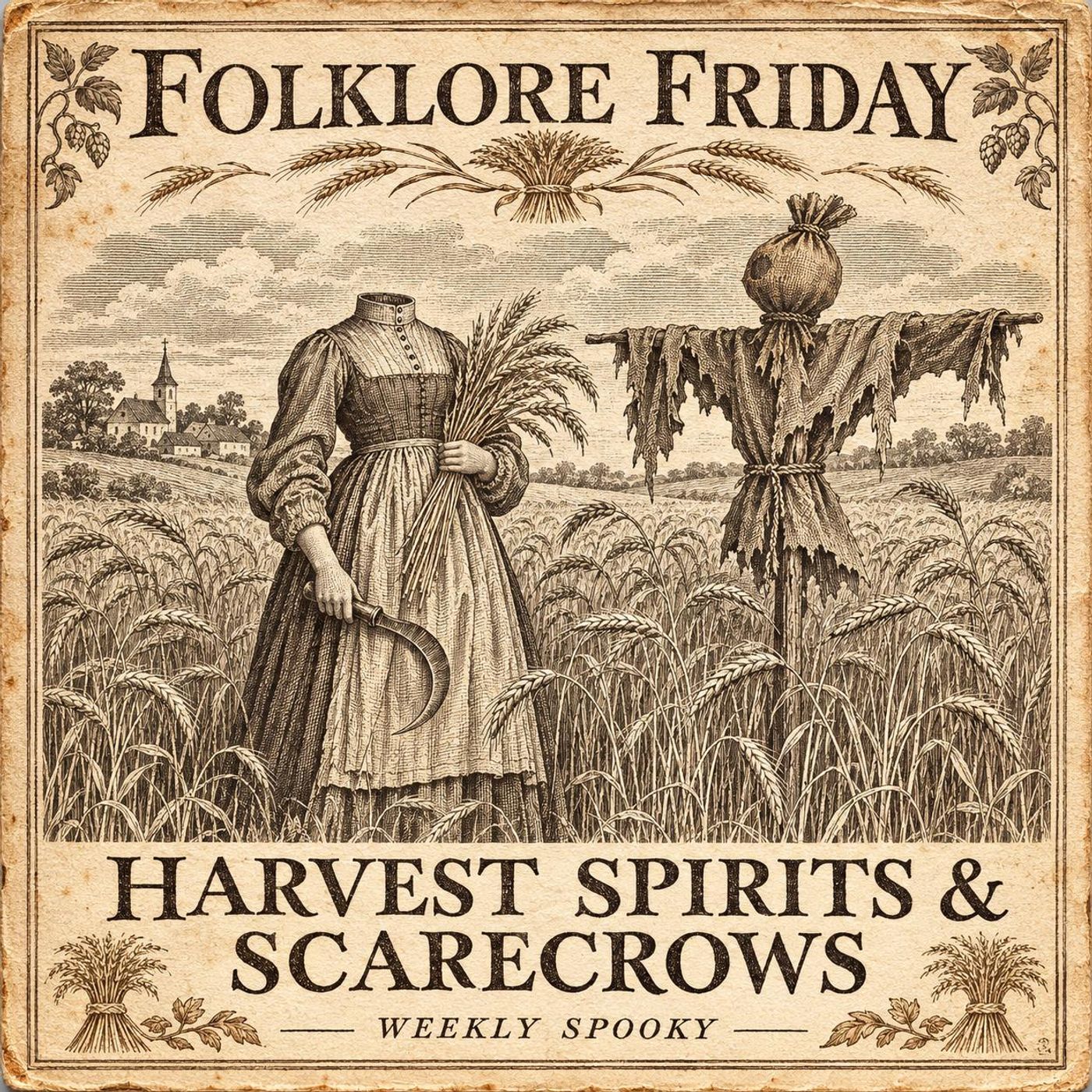
Autumn folklore turns a peaceful harvest into something sinister. Henrique Couto welcomes folklorist and author D.L. Wainright back to Folklore Friday to explore German and Slavic crop spirits, the child-snatching Rye Aunt, and a headless woman who stalks the fields at midday. Could warnings about these creatures reflect the dangers of heat, hunger, and a failed harvest? Along the way: Rusalka, eerie scarecrows, and the Sack Man. With dark folklore, unsettling imagery, and plenty of banter, this Weekly Spooky conversation asks why the fields that fed us also filled us with fear.
D.L.’s books: https://thehollowsun.com/
Bonus episodes & support: https://weeklyspooky.com/join
More scary stories: https://weeklyspooky.com/
Story submissions: WeeklySpooky@gmail.com
0:06 Well, my spookies, we're back with another Folklore Friday. And I am accompanied by D.L. Wainwright. Not D.L. Hughley, which is the odd... It's the only D.L. I know, you know? It's a very different space in entertainment. But D.L. Wainwright is joining me tonight. We had a great time talking about kind of lesser-known vampire folklores. Last month. So this time around, we're going to dive into the folklore around, to some extent, harvests and the autumnal. I love that word. Autumnal. Yes. Right?
0:52 Isn't that a great word? It's much better than just the fall. The fall. Because it sounds fancier. Yeah, it doesn't sound like you know. Oh, gosh. Is it French? Now you've ruined it. Now you've ruined it. That's what it is. It's French. Oh, it's totally. Yeah, it's got to be French. They put the M and the N next to each other and then smoke a cigarette holding it weird. That's just the way they are. Well, so, like, I was learning. I've been slowly but surely learning Portuguese. And very slowly. Not as surely as I'd like. But I wanted to learn how to say cigar because I love cigars. And it's... Uh, and I was like, okay, that's different. So then, uh, as I was digging around to find out, like, where'd that come from? Um, it turns out it comes from, um, Karu to, uh, which was like a, an Indies term for just roll, like rolling up something. So it actually came from the Indies where they were selling tobacco for the first time. They, they called it that because it was a rolled up piece of leaf. So then when it comes back to Europe, it becomes the French word, which is Chirrut. Or Chirrut, or however they probably say it.
2:14 And Chirrut in America is a very specific type of rustic cigar that's rolled very simply and has open ends on both sides. You can cut it in half and share it and stuff. But the funny thing about that is... that I had always thought Chirrut when I heard that term, I was like, wow, that sounds so like rustic native. Like that sounds very like an, like an Indian term or blah, blah, blah, blah, blah. And, uh, I was right. I just wasn't right in the way I thought it was an Indian term, but not, not at all. Um, it's a long way to go to say, uh, uh, it's been very disappointing to share, to see Portuguese share so much with French. But I'm trying my best.
2:55 Not that far. And again, it's all part of the romance. Oh, yeah, yeah. No, I know. But I'd like to think they're a world apart in their hearts. I mean, it's just, you just have like what, like Spain between them. Right? Am I thinking of geography? Yeah, you're right. Okay. You got Spain right there. Yeah, yeah. No, Portugal and Spain. And then, yeah, yeah. You know, I mean, it's okay. I mean, it's okay. The one thing the Portuguese are good at, though, is making sure you know that they're not French or Spanish or Italian. Well, you know, Europe's just that way. It is. They're very nationalistic. They're very cultural, preservation-y. When I was learning about Portugal's whole deal, they have a naming list.
3:46 If both parents of a child are citizens, then they have a list of approved names, first names. And the list is very extensive, but it's stuff like you can't name a kid Thomas. You have to name him Tomas, because that's the Portuguese version. Stuff like that. And I was like, wow, that's so weird. And I found out, oh, they're not even in the top 10 countries that have that rule in Europe. It's actually super common. It's about preserving the culture. That's their argument. I don't know. All right. I mean, that's one way to do it. My mom named most of her kids off of things that she liked from movies and soap operas.
4:26 Yeah. I mean, I feel like that's the way to do it. That's just me. But I'm not saying this for no reason. I'm also saying it because we're going to be probably dealing a lot with European folklore, I would assume. Yes. And actually, it's... interesting that you do bring it up about like the, the, the cultural things like that. So when doing a lot of the research for what we're going to talk about, um, I found that a lot of the information for it was in articles, uh, like, uh, journal articles that were written in either German or Czech, uh, and stuff. And I had to like kind of Google translate like sections at a time.
5:09 Sure. But like, um, a lot of them were talking about again, like, uh, this is part of our cultural heritage, is about these different folkloric things that have to do with the fields and about the specters and stuff that exist in them. And let's compare the things that we believe in the Czech, the Czech people believe in stuff in our heritage versus the surrounding areas and theirs are a little different and things like that. But it was very much, a lot of it was very steeped into let's explore more about our particular culture and what makes our things different than or similar to the others and stuff.
5:51 Well, and that tells you a lot about the, about them, about where they've been, where they're going. That's one of the more, I mean, that's even, we like to think in the United States that, that we're somehow kind of homogenous and we're not homogenous. I mean, but, but it's weird. Like you'll, I mean, the problem is that people think like, it's like, uh, when they say Americans are homogenous, they mean it as an insult, but when they would say it about Europeans, they would mean it like, it's a good thing, you know? But, uh, America is very, very vast as far as, uh, the types of people, the types of culture. I mean, even just from, you know, my home in sunny Dayton, Ohio to Cleveland, um, Cleveland has an immense amount of like Polish influence, an immense amount of German influence. Um, you know, the first time I ate dinner at a friend's house outside of Cleveland, he made us cabbage rolls, which were amazing, super good. Um, but I'd never, you know, I was like 14 years old.
6:49 I'd never even heard of those because it's just not, we have those, uh, you know, groups here, but we didn't have like massive enclaves like they did out there. So we have all these different cultural elements, um, But, uh, so like I'll hear cry baby bridge stories and there are, you know, billion cry baby bridges, uh, everywhere. And one thing that's really fascinated me is I've started running into people who think that there's only one and it's theirs. And I didn't know that that I, the first time I heard about a cry baby bridge, it was in a context of that. There are there everywhere. So, but it was interesting cause you'd hear like, you know, one cry baby bridge would be like, um, a mother couldn't stand her babies wailing. So she threw it off the bridge and another would be a car accident with a baby in the car. And then another would be like a jealous husband kills his wife and kid or, you know, like it, like they all would have these different elements.
7:49 And it seemed like, you know, that could kind of tell you something about what was happening culturally, you know, when that, when that story supposedly took place in the 1920s or thirties or forties or whichever, you know, whichever it might be. Because even, like, the La Llorona. La Llorona. La Llorona. Yeah, it's what we talked about last time. Thank you. Even that story has a lot of variations and stuff like that. Both, like, locationally and, like, time-wise and stuff. Because, again, it would probably be very reflective of, like, different things from that era and from that location. Oh, yeah. Yeah, that influenced it. But, no, yeah, the U.S. is super, like.
8:32 Not homogenous i know i couldn't agree more yeah and that's and that's definitely like been reflected in in a lot of the different um local lores and stuff i mean. Because like heck even our accents and stuff are reflections of all of that and stuff in the different regions of the u.s are from what the different concentrations of immigrants were over time and things um So, yeah, so it's very silly for anybody outside the U.S. I think that they've never been here before if they think so. The problem is they probably would be like, well, I've never been there. It's like, well, you couldn't because you'd have to go to, like, 60 places to have been to America, you know, wholesale. It's just very, very hard.
9:20 Yeah, and we're so big. And that's the thing that I think they can't comprehend. No, they can't. And that's... How I can oftentimes tell whenever I'm reading a story that's written by someone who's not from America and never been to America, but they're writing it taking place in America because it'll be like, yes, and he drove from Southern California to New York in a day. And I'm like, hmm. I mean, you got a pretty heavy foot there, pal. Yeah, yeah. No, I don't think so. And then again, when I lived in Jersey, once I told a friend, I was going to, Ohio to see my mother. And he was like, oh man, while you're out, you should go to Vegas. And I was like, oh wow. Why don't you just stop on by?
10:02 Yeah, I'll just pop by Vegas. It's only three times as far away as you are from me. I can't say that only people throughout the other part of the world don't know geography. I'll give them that. It's a lot to memorize. There are lots of people in the U.S. Who haven't really traveled beyond where they grew up and they don't really realize how vast the country is and how different each place is. It's like traveling to a different country whenever you go from one region to another and stuff like that. We are just huge we've got so much. Happening yeah and and and unlike europe most of our states don't like have a like vicious angry reluctance to share anything with their neighbors culturally yeah because you know the the french can look at the italians and be like ah but remember 300 years ago when they were just jerks ah like i don't want their wine but it's really good so we'll take it but we're But as to where over here, you know, Ohio and Indiana, like our football team's playing again. Anyway, give me some of that fudge. You know, like we just.
11:13 Like we'll have we'll have rivalries, but it's not it's not the same. Yeah, it wasn't as bloody and, you know, heads on pikes as I mean, well. We did have the Civil War. Yeah, that was there. Yeah. Yeah. That was just one, though. But per capita, we're the same because we've only been around for like 300 years. So I'm not saying it's strictly because we're more altruistic. It's more because we don't have as much time put in. And especially time, you know, during the more brutal eras of human history. We don't have like grudges that have built over. And I mean, we've been more kind of united than we have been divided and stuff.
11:57 So that is fair. But. There are still, yeah, little rivalries between some seasons. Oh, yeah. But yeah, nothing like the. I mean, the worst we have is New England versus the South. Yeah. Yeah. Like, unprompted, they'll tell you what they think of the South in New England. Yeah, and unprompted, the South will tell you what they think of them Yankees up there. Yep, yep. Them damn Yankees eating pie for breakfast. So... uh as far as have grits no oh you know what's the first time i had grits was in connecticut believe it or not what well my grandmother picked it up when they were in virginia so uh so she brought it with her she was obsessed with grits i couldn't tell you i mean well i could tell you why because they're delicious.
12:46 They are not i grew up in this house and i had to eat grits all the time i'm like why don't i just eat the corn just regular corn why do you have to mush it up like you've already chewed it for me. It's hominy young lady it's hominy You need some harmony in your hominy. No, no, thank you. And then again, I'm a bad Southerner. I've never really liked a lot of Southern foods like fried okra and like stuff like that. How do you not like fried okra? I don't know. My dad loved it. And like he would also eat like chicken gizzards and frog legs and all that. Oh, frog legs. That's French, by the way. It was the bullfrogs that we gigged in our pond. Ah, frog gigging. That's what's up. I love frog legs very, very much. They're super good.
13:33 All right. Do you at least like collared greens? No. How do you not like collared greens, man? Man, you're a bully. I don't know. I like... I like food with flavor. Collard greens are cooked in sow belly. They're very, they're like very smoky. I mean, we're talking about traditional prep preparation. Well, it is hard to keep collard greens from getting mushy, but not letting them be as viciously fibrous as they are because, uh, collard greens are like, if you put that in a salad, that's, that's rough chewing. That's a lot of chewing. If it's, you know, uncooked collard greens.
14:15 That's true. Yeah. But I don't want that. I mean, I don't know. I'm just not a good southerner. I like kale. I like arugula. Arugula is my favorite. Arugula is good. I like that. You know, collard greens and kale have like the same nutritional value, believe it or not. That's great. But kale tastes better. So I'm... But other people don't like it. I know it's very big. I get it. But like I like cooking kale and stuff. Oh, well, cooked kale is a whole other ballgame. I like to put a big handful of shredded kale into like any like vegetable soup I make just to give it a little oomph, a little flavor, a little more nutrition. And if it's cooking in a soup for an hour, it's not going to be the sheer amount of chewing.
14:59 It's not as bad as collard greens, but it's still a very fibrous soup. Yeah. Experience. Mustard greens are also really good. I don't think I've had mustard greens. Maybe I should try. You should try those. Those are good in a salad. They're not quite as fibrous and they have the same nutritional value as kale because kale is the king of vegetable nutrition. So highly recommend mustard greens. But you got to wash them real good because they only grow in like super sandy soil. So they tend to like have a little bit of like dustiness on them. You just got to give them a really good, a really good rinse in. Um, man, I'm going to Georgia in like three, three days. And I'm like, all I'm looking forward to is what would be a nightmare to you.
15:39 Yeah. You know? So I, yeah. Do you at least like boiled peanuts? Uh, I mean, I like, no, I like roasted peanuts. Have you had, you've had boiled peanuts though? Yeah. Oh, they're like Southern edamame. That's the way I like. I mean, I like edamame. I mean, I love edamame. I just remember the first time I ate them. I was like, This is like a peanutty edamame. It's like a very similar experience, very similar texture once it's cooked, boiled. Man, you at least like Coca-Cola, right? No, I don't. I don't like soda. Yeah, I don't drink soda. Okay, if you don't drink any soda, that's okay. No, but even whenever I did drink soda, I didn't like Coke. Wow. Yeah, I know. I'm just, I'm not a good, I'm not good at being a southerner. I'm sorry.
16:28 Something is very broken inside you. And I'm sorry. Like it was, it was bad going to, uh, and I'm probably have family that might listen to this. I'm sorry. And I love you. But, uh, whenever we'd go to like family gatherings, um, and people like have like the, the, the, oh gosh, what are those things called? My brain is drawing a blank probably just because of the reeling back of the, the horror of it. Um, uh, casserole things. And they really bring like all these different like casseroles and, yeah these other things like the fried stuff a whole bunch of like the fried yeah and all these other very southern stuff and i'm just as a child i was like i'll just eat this roll people are like why aren't you eating more you gotta eat more it does not help them like i don't i can't all that stuff though and so that's just like things are just stuck with me is just the no i don't like it i like yeah I don't know, I like garlicky, flavor-y things, and none of that stuff had it.
17:27 It was just all very... I. Get that. Yeah. I would say if you're ever at a phenomenal restaurant that everybody knows they love it, and they have the little cups of collard greens and stuff. No, I know. I've had it since. I'm sure. No, thank you. My husband loves it. I mean, it doesn't have to be your favorite thing in the world, either. No, my husband loves good collard greens. Yeah. quote unquote, what he calls. Right. No, it's okay. He can, he can, he can be Southern enough for both of us there. That's fair. You know, he'll, he'll pick up the slack for you. Yeah. I, yeah, I, I could, I could have all that. Do you like, do you like barbecue? Are you not a meat person?
18:10 I can't remember if you're a meat person or not. So I am a meat person, but so here's the funny thing is that I never liked Southern barbecue. And so I grew up never thinking that I liked barbecue because a lot of Southern ones will have like the sweet, barbecue sauce and i don't like mixing sweets with salty and um oh wow yeah uh and so i was always like ew barbecue's gross until uh one time when we lived in connecticut and my husband uh got like this dry rub barbecue uh rib stuff and he's like just try it and this is like one of his favorite stories to tell is uh whenever i bit into it and i evidently. Went barbecue's delicious.
18:52 To tell this now about like now I love barbecue and I love like like pulled pork and stuff like that and I love like like all of it as long as it's not that particular kind of like sweet. Well like they make it way too sweet in a lot of places for me I mean. You know yeah like but there's and then I've come to learn that different states have like different kinds of barbecues and stuff like that and like like I like like the the visit like the North Carolina like kind of more vinegary one and stuff like that and like um so I, yeah, so I like barbecue. So there you go. I'm I, and I like cornbread. I love cornbread. See, I'm not a complete loss. If you couldn't like cornbread, that would be heartbreaking. Do you like cornbread pudding?
19:32 I don't think I've ever had cornbread pudding. It's actually a casserole. Um, but it's, it's just, it's, it's, it's literally cornbread mix, but with, um, but with a cream corn mixed in, but then it's baked. So you end up with just like, it's, like a big piece of cornbread, but with a little bit of like a creamy. It's not, I'm not going to say you'll like it, but it's not, it doesn't, to me, it's not gross the way describing it sounds. It's just super, super moist and fluffy. And when you bite into it, you get a little bit of corn and cornbread. Okay. It scratches a different itch. It's not the same as eating cornbread, but it's very, it's similar. I like the texture combination. I think it's, it's fun. And I grew up with Kentucky food.
20:15 Yeah. Yeah. Yeah. But a corn bread pudding with corn. Yeah. Cornbread pudding. And it's easy to make too. So if you like it, it becomes like your go, it can easily become your go-to Thanksgiving side dish. Cause if you like it yourself, it's a pretty good crowd pleaser. And it's very easy to make. It's like, I got some cornbread mix. I got a couple of cans of cream corn. I got a casserole dish, you know, salt and pepper. Boom. I love, I love to cook. I can't, uh, I, I, that's actually like my, I cannot wait for Thanksgiving. I make believe this or don't. I make a Turkey for fun because no one asks me to make the dinner Turkey. Oh, so I make my own Turkey just for the hell of it. Like a day or two before. That's completely the same. Oh man. I didn't even make that connection.
21:07 Oh man. Now I have a whole lot more to think about. So, but anyway, um, wild, I'm glad you were able to discover that you could like barbecue though. Um, cause that, that would be a true, a true loss. Um, fried okra sounds so good now. Um, But hey, listeners, all of this does have to do with what we're talking about because it's all crops. And we're going to be talking about crops today. They're used to me. They're like, we don't expect anything from the tangents other than that they do indeed end at some point. Beyond that, no promises are made.
21:50 But no, yeah, we could totally make it relevant. Oh, I think talking about food this close to Thanksgiving, I think, is highly relevant as long as we... We get to the spoopy eventually. Yes. Which I, you know, I always try to get to the spooky in an efficient amount of time. But, I mean, I don't know. Growing up not thinking you didn't like barbecue to me is actually too scary to tell a child before bed. I'm sorry. I don't like the sweet barbecue. Blech. Barbecue, it needs to be salty, not sweet. It needs to be spicy as hell. It needs to be like the flames of hell and fire and damnation.
22:33 And that's a little too much. I don't think I can take all that. There's a barbecue place right next to the theater my buddy's film festival is at. That's why I'll be in Georgia. And the barbecue place right next door, they have one of the hottest barbecue sauces ever. Um, that's just on the table waiting for you. Like you don't even have to ask for it special, which I love that because that's like such a lack of care for your fellow man. And I respect that it says, it says hot on it. I mean, it doesn't just sit there at least. Yeah. It says hot, you know? Um, but one time when I was there, you know, they have those old, those old school bottles just with the tape, with the, the thing on it, somebody had with like a marker added very to one of them and i was like i bet that person was like sitting there like oh oh do i have a marker i want to protect the future um oh yeah you just you just zap that on there and you're you're talking to your ancestors in no time so uh anyhow uh so so uh we got some crops uh to talk about yes.
23:36 All right okay so um today we're going to be talking about um uh stuff to do with uh germanic and slavic uh sort of crop specters um sometimes considered like like a a spirit or like a demon thing um but uh Yeah, very, very, these are like, so I did, I tried to look up a lot of different things because I wanted to do something that has to do with crops and harvest for Thanksgiving and stuff like that. And everything just kept leading me back to Germanic and Slavic stuff because I evidently just have the creepiest crap.
24:21 They like it creepy and well, and they had some hard living times. They did. Which breeds a lot of scary stories. It does. And so, If everyone remembers when we were talking last time, we talked about how folklore tends to a lot of times have a reason behind it. And a lot of times is like sort of a cautionary tale. It's to like. Stop kids from like going and playing in the water or they'll drown, things like that. Don't go off with the stranger, other things. So time and time again, when researching and digging into these lore that we're about to talk about, it becomes evident that a lot of the messages here were to keep children out of the crops so that they don't mess it up. They don't, yeah, they don't, because this is your food that you're going to be needing to keep you through the winter and stuff like that. So don't go through trampling on the crops.
25:20 Thin margins, a few, a few less carrots could make a big difference for your elderly grandma. Yes. And it was also warning to not, like, not just for kids, but for other people, not to steal other people's crops. And so let's get into it. We've got quite an interesting cast of characters. All right. So first, we'll talk about, and this was.... In one of the Czech things that I was reading, which I said they were talking a lot about their heritage and things like that, they got into a very poetic detail about where some of these concepts even started to come from. If you are looking out over a field of grain and you see the wind blowing the beautiful ripples across it, how.
26:19 Peoples in the past tried to come up with what was actually causing those ripples. Not that it was the wind, like it went on water and stuff, but they were like, it looks like there's something playing in there. Like there's something running around. And so there would be, there started to be concepts of sort of like these, um, I'm going to say corn dogs, but like corn hound or corn wolf or like rye dogs and stuff like that. I like the term rye dog. Rye dog. That's like a beer name. Rye dog. Or sometimes lambs, but it would be like these animals that they believed were running around, frolicking and stuff. And then that kind of evolved into a sort of concept that it's not just actual animals.
27:09 They're like these spirit things. That exist in the fields that are sort of like protectors of the fields and stuff like that. So there's a lot of different animal ones. Like I said, there's dogs, there's wolves, lambs, and even sometimes there would be like cats and snakes. Now, this is interesting because... for multiple reasons, in that they probably would actually have seen many of these things in a field and stuff at some point too, which is why they would think that. Because if you think about what little animals, little pests go into the field to eat the grain would be mice, and what things like to hunt the mice are going to be the cats and the dogs and the snakes.
27:54 Snakes love to eat them little rodents. This is actually a similar thing to what we see happen over in Japan because in, uh, Japan, uh, the kitsune, the fox spirit is said to kind of be sort of a patron, uh, protector of like rice fields and stuff. And, uh, therefore like also by association, the, uh, Kami Inari, who is like the, the fox, like associated fox spirit, like Kami kind of thing, is also sort of a commie of the rice fields and of the harvest and stuff. And it's because, again, foxes hunt mice. So if you see foxes in your fields, you're like, oh, they're protecting the rice and stuff. Yeah, because they're going after your mice.
28:43 You're guaranteed to have. A better crop. And more importantly, they don't tend to mess with vegetables at all. They really would just be there to eat little rodents and critters. Yeah, that makes sense. And they look cool. Foxes just are cool looking. They're sleek. Yeah, foxes. Yeah, foxes are cool. They are. I love them. And in rice fields especially, you've got a lot of times probably in the mornings the mist coming off of the rice paddies and then you see a fox slinking around. And of course it's going to look like a spirit thing running around. Yeah. Yeah. Similarly, you've got over in the Germanic and the Slavic regions and stuff, other kinds of things coming up. You see these animals a lot in your fields, and that tends to mean a better harvest because they're getting rid of all the pests that are going to be eating your harvest, the rabbits, the mice, and stuff like that.
29:38 And so you start to associate them as being protectors of your harvest and of your field. And that makes total sense. I totally get that. Then it starts to evolve into something else. You start to get other things that are also in the fields. So there's one And she's a predominantly Germanic one. She doesn't really go down to the Slavic stuff. The Slavic ones have a different weird lady. But there's this weird lady. And she's got a bunch of different names. But, like, Rye Ant is one of them. Rye Ant. I like that. Rye Ant. Like an aunt. Yeah, yeah, yeah. And she is, like, a creepy old woman that evidently has huge pendulous breasts.
30:26 That it's described in every piece it is everything because. They built because the um which i don't remember if i got into this about with um the the i think i might have the strege in italian folklore last time about uh the the witch things that would feed poison from their breasts she's a similar thing so she will nurse the children that she captures which she captures children um of this black tar-like poison from her breasts. But she... Yeah. So she is a protector of the field. But if you are wandering around in the field, you're a child and stuff, she will tend to snatch you up.
31:11 And... Sorry if I'm losing my voice again. Like I said, I'm getting over sickness. Sorry, everybody. So she will. poison the kids she will sometimes uh swap them out kind of like a changeling sort of thing um and uh other times she'll just like i guess like kill you steal you away other stuff um so she's this really creepy old lady uh then you've got a uh creepy man there is a version of him in both the germanic and in the slavic stuff um although it changes a lot depending on the thing uh like in the Germanic one, it might be like this, uh, like tall man with like a hat or something. And in like the Slavic ones, it's, it described him as being sort of grotesque looking. One of the stories said he had like a long head.
32:05 I like that description. Lengthwise or like. Hey Arnold, like, I guess lengthwise, just like a really, like a long, weird oval head. Um, and, uh, He also will snatch you up in the fields and stuff. If you're a kid who wandered out into the things in one of the Slavic ones, the one with the long head, he evidently kind of like, you know how in some folklores there will be entities that you meet who will ask you a question. They've got like some type of riddle. And if you answer wrong, then you're dead kind of thing. He did that to them where he had some type of question that they answered wrong.
32:48 And so then they got killed kind of thing. And so, uh, you know, kids be ready for your pop quizzes. That's all, that's all you need to know really. But I mean, but I, I guess just be very, just think before you respond to a strange long headed man in a field. And, um, that's, that fits on a t-shirt. So you should be able to remember it. And, uh, Then there's also, like in Ukraine, there's a creepy old lady who crouches in pea patches, and she will, again, kill any children or anybody who wanders and crushes the peas. Now, in the Slavic areas, there's this one lady, and she also has a bunch of different names, and she's got a few variations, and she can either be seen as a creepy old lady or a a sort of adolescent girl or mostly a beautiful young woman. And oftentimes, um, or at least in one particular region, oftentimes she will be accompanied by these strange pale human like figures. And she herself is usually dressed in like all blinding white and she will carry like a is very specifically, which some of the other ones will have some of this elements to it, but she is very specifically about midday.
34:20 That is her time. She wanders the fields during the midday time when you shouldn't be working. And if she finds that you're working, she will either drive you mad or decapitate you. There was one thing where children were warned not to go into the fields at midday because she'll burn them um so some thoughts are that she's basically an analogy to heat stroke oh yeah yeah um because she's got like the the blinding white thing the weird sort of figures with her and stuff and um the whole driving you crazy or just knocking you dead heat stroke don't be working out in the hottest part of the day.
35:03 And the most subtle of all, burning you alive. Burning you alive. Very, very subtle. You really got to think on that one. Yeah. That makes sense. And, you know, I'd never heard of a folklore of the midday being the time of a entity. So that's really, really fascinating. And then when you mentioned, because at first I was like, midday, you shouldn't be working at midday. And I was like, Oh, no, back in the olden days, you know, before Henry Ford invented the eight-hour workday. But, I mean, that's what you would take your, I mean, your siesta. Your siesta, exactly. It was at the hottest part of the day. Yeah. And then you'd work until. The sun was gone. Yeah, it's dangerous to work out in the fields when it's that hottest part of the day and stuff. You're supposed to take a break. So she's kind of a cautionary tale about that. And the other ones that we have, you know, gotten into are, many of them will also have variants to their stories in different regions that are also specific to midday.
35:59 Really? Yes. So, like, the creepy man who's out in the fields will sometimes be called, like, the midday man and stuff like that. That's wild. Yeah. Oh, and sometimes he's got, like, wolves or dogs and stuff with him. They love wolves and dogs in Europe. Yeah, and sometimes the creepy old lady also has, like, wolves and dogs. Yeah. Uh, because again, I think that has an extra little bit of creepy for the kids. It's like, Oh, and if they don't get each. Other, wolves will. Oh yeah. Yeah. Cause you should avoid wolves. Well, and then, you know, if the kids see a wolf or a strange dog, there might, their first thought might be that belongs to this creature. Not, you know, Oh, I should try to pet that gray wolf. Who's going to maul me.
36:43 Yes. Um, because you're out in the field and you see like a wolf in the, or if you're walking by like a, the, the, grain and you see a wolf out there, you'd be like, okay, no talk, no touchy, but that's probably, that probably belongs to the rye ants and she's going to snatch me up kind of thing. Turn around, walk away slowly. Yeah. They chase. If you run, they chase. Yes. Um, and I love that though. The midday, I'd never even thought about that. And the more I think about it, the more it makes sense too, because it's for kids, um, And what's the kid that's going to work past when they're supposed to take a break? The strong young ones. But it's not even just for kids. The midday ones for everybody. Yes.
37:26 Really? Yes. So she's not just for kids. All right. So the other ones, like the pee patch lady and the other things, are oftentimes cautionary things for the kids. But this particular lady, which let me pull up my notes because like she's got different names and I'm not going to be able to pronounce any of them. I don't know why I brought this up. She has many names, none of them pronounceable. Like Pretz, Pretz, Polinka, Serpicia, Serpicia. That sounds like a word. Sure. But that one, the Serpsia, is actually, she's headless. So she's a headless woman in white with a sickle. Oh, wow.
38:09 Which is fun. Quite an image. Headless woman in white with a sickle. Yeah, headless woman in white walking around with a sickle. There's also, oh, so, and the long-headed man version of the other guy, because Rye Man is like the more Germanic one, but Serp or Serpal, which is kind of like a masculine version of that Serpusia, when he's the long-headed guy who cuts the heads off children and others who eats the grains of neighbors' crops and asked those kids the question. It's a trick question. We have a question. I like how Uh, one is headless and the other has a long head. So it's all about the heads are what make them strange.
38:58 And he cuts off the head. The one with the long head chops off people's heads. If you, if you're stealing other people's crops. Um, Oh yeah, we, yeah, that would be, I mean, cause that's killer. That's just committing murder, stealing people's food. Yeah. You know, in that era when there was no, I mean, uh, plentifulness was very rare, uh, incredibly rare, scary, rare. Um, I love the long head, but I've got to say, I don't know the sheer amount of folklore you do, which is why. I'm happy to have you here, but I've heard plenty of women in white, never heard a headless woman in white. Well, and again, I think the wearing the white clothes, um, and one of the, the, the like scholarly journal thingies that I was reading, it was also going into this and about their theories are very similar is that again, it's, it's cause it's the midday it's, they're the ones that are associated with the blinding light and stuff of the midday and sort of like the, like, like even her sickle is often in stories described as being gleaming, blindingly bright.
40:04 Her eyes are too bright to look at and stuff like that. Like it's all supposed to just be like that glaring sun. Um, that you get there in the midday because that's just as dangerous, if not more so than whatever creepy potential things are out in the forest at night is the sun during the hottest part of the day is I can kill you. Well, nighttime is scary, at least to some extent in general. So I think it's less, it's much less dangerous because most people would at least feel like they're risking something going out in the middle of the night. Oh, I can't see what if I trip, what if I fall, but, as a, as a person who's worked on, on films, my entire adult life, no one listens about heat stroke until they get heat stroke. I was a production assistant on a movie when I was 19. And that was the first time I got heat stroke. Oh no. I, I thought I was stopping enough. I thought I was drinking enough water. I wasn't. Um, and now I tell that story every time I make a movie and it's hot out, I tell people, I'm like, you know, if you need to stop for a second in the shade and drink some water, just know that that, that 10 minutes is way better than waiting 45 for an ambulance to come for you.
41:23 Yep. So, you know, just say like, I'm feeling pretty hot and I'll be like, all right, let's, let's get you some more water. There's never a shortage of water, you know, for, for you guys. So I think that's a really interesting methodology because yeah, It seems perfectly safe. It's the middle of the day. The sun's out. And in reality, that's a silent killer just waiting for anybody who thinks they're, you know, the worst part is they think they're helping. They believe that they're doing good by working through the heat. Yeah. So I'm guessing a lot of villages over a lot of years lost a lot of their strongest people, their strongest men and boys, especially who would go out and harvest and be like, we're hungry people. I'll go out there and I'll work straight through the break. And then they die. And it's like, oh, well, now we don't have you at all. So now we really are going to probably starve. That's fun. You know, that's, that's man.
42:19 Those are them. My buddy, Jeff always says this. There's those good old days. You're always talking about, you know, and not just the guys. Cause, um, one of the articles I was reading about her was actually talking about the, the think that a lot of, um, uh, cause she also, she and the, you know, it's not her, but the, the ride mother, because of the whole changeling thing and stuff like that. And the taking of the children, um, a combination of these factors, I think were also ways of playing in or tapping in to fears of like mothers and new mothers, especially like if you've just had your baby, don't go out in the fields and overwork yourself kind of thing.
43:02 Yeah. But so this would help to scare them into being like, I've got to be more vigilant and I've got to take this break and I've got to make sure my kids are where I can see them and stuff like that. So, because again, like, To your point, people would be like, but I really have this crop that I've got to work on and I've got to make sure that this is ready so that we'll be able to eat in the wintertime. And they'll get so focused on that, they won't pay attention to their own health, to their children's health, to all that and stuff like that. So this was just like another way of being able to be like, hey, hey, hey, slow down. Because otherwise your kids might get snatched up. Yeah. Well, and you got to think when we started growing crops, it was a less... brutal way of living than in general than being nomadic and just chasing mammoths and stuff to hunt them and eat them but it required something that is still hard in human nature which is deferred gratification the idea of always of thinking long term and not short term it's very easy to think well we're hungry so i'm going to work forever you know i'm going to work all day until i can't walk But you have to think long-term of like, yes, but can you put in a good amount of hours every single day till winter? Because that's what we desperately need. Right.
44:21 We don't need you tomorrow. Yeah, we don't need you tomorrow so exhausted you can't wake up, let alone dying or breaking a leg or spraining an ankle and hopefully surviving that. But even if you do, it's months that you're not out there doing your work. Yeah. And that's something that only the people who are the most adept to farming would really... comprehend would be the idea like no no no you need to think about how can I do this every day not how can I do this today right because the. Most valuable farm tool is yourself and so just like you have to keep all of your other tools in good condition you've got to keep yourself in good condition because if you wear out and you can't like if you do get heat stroke and it puts you out for like a week or something or however long it takes you to like recover oh yeah then that's you're losing more time with where you're you're farming than if you had just taken a break during noon we're supposed to go drink some water go sit in the.
45:20 Shade yeah it's the law of diminishing returns which is a very valuable lesson that anybody listening to this if you haven't learned to understand the law of diminishing returns do yourself a favor and really put some thought into it because it it will make your life better um you know sometimes it's good to push yourself and sometimes it's foolish And that's always something I have to think about that all the time because I work so much and so often. But like, you know, sometimes I'll be working and I'll look at the schedule and be like, you know, if I stopped now, I probably wouldn't be miserable tomorrow. And that means more than what I would get done today.
46:01 Yeah. You know, and that's hard for people, for any people, I feel like, especially if you care about what you're doing. And I feel like, I feel like, you know, if you're farming for survival, you're going to feel very passionate about growing that food. You know what I mean? Like it's like, it's cause as it stands now in modern life, we all have like a, you know, degrees of separation. I, I collate papers and that turns into food. Yay. You know, like there's a lot of things that happen in between there that you're not involved in. You just go into the grocery store. So yeah, Yeah, but I imagine being very passionate about that and being very concerned.
46:42 And really, like a lot of folklore, it's discouraging foolhardiness. It's discouraging you being like, but I am so smart and strong. But I have done so much. But look at my neighbor. He's doing so much more than I am. And it's like, who gives a shit about him? Worry about our crops. We got to make it. We got to make it to winter. We got to have enough. But don't you see, I am worrying about our crops. That's why I'm working in the midday. That's why I'm running for mayor of our commune or whatever the hell it is. No, that's, but that's fascinating. Cause I'd never, cause you know, I always hear the folklore about like, I love all the wintertime folklore stuff.
47:23 You know, if you don't do your work, your belly gets slid open and all this stuff, because it's, it's a way of communicating to especially children, like, death comes from not doing your work because they don't really understand like no what you know if you don't do your work then um grandma and the baby eat slightly less and after three years they're dead because they just get weaker and you know you can't they're not gonna they're not gonna get that so if you just say oh well your stomach's gonna be ripped open and your warm entrails are gonna spill on the floor and then they're gonna stuff you with straw Granted, I mean, there were a lot of details in there may not have been necessary. But, hey, you know, I've never I've never been to the Alps. I don't know what goes on there, but they make me feel like I kind of do. But it tells you how like how severe it is because children under I mean, that's why so much of child stories are metaphors, because children understand simplified versions of these things. Right.
48:20 So don't go trample through the crops that are going to feed us because otherwise you'll get decapitated. Yeah. You'll get decapitated. You might also have to suckle at a morbid teat first. Who knows? Yeah. There's a lot going on here. I read like an interesting theory about her, the rye ant, and about like that black. Like toxin and stuff. And someone was like, well, maybe it's like they're sort ofâ interpretation of like how rye can get like that kind of like black um like fungus on it like the air god or whatever it's called um that was that some people kind of contribute to the sort of witch madness thing of eating the bread that had that and i'm like yeah and i'm like that's a good that's an interesting theory because it does cause like like madness and it is like a poison thing but The thing is, and why I'm not sure how well that goes with it, is that she's supposed to be a good thing in the field. She's a good thing for your field to have. And having the black, icky stuff that's going to poison you.
49:25 Isn't a good thing. So like if, yeah, if she was being like the site of her was associated with with that your crops are going to have like cause that issue i would get that but she was something you wanted in your field you just don't want to encounter her um and stuff because she was a protector of your fields um so that's really interesting yeah so i mean maybe or maybe maybe it was that she protected it and people just like sometimes were like oh no we must've done something to make her mad. Cause now we've got this black icky stuff on our things, but who knows? Yeah. But, uh, what, what an image though. And, uh, I just, I've, I'm, I'm still just, I'm fascinated. I never, I never heard, uh, folklore about not working in the middle of the day, but it makes perfect sense. It makes sense to everything I know about folklore and folk tales and how you communicate things to workers and children and all that. Which, of course, you know, the delineation between workers and children was pretty minimal in that era.
50:28 I mean, I think you were in the fields by the time you were 11 or 12, you were probably, you know, putting your back into it. So good young backs, strong backs. See, because they didn't realize what we mastered in America, which is that the children crave the mines, not the fields. Yeah. Thirst for the mines. Thirst for the mines. In their free time, they want to be in the mines crafting. That's why Minecraft exists. Minecraft, oh my God. They crave the mines. They crave the mines. The children want to return to the mines. Their little hands are perfect for all of it. But no, that's, yeah, I'd never heard of, there are so few, I feel like I hear about so few midday games um entities aside from when you're on the ocean well on the ocean there's a lot of midday i feel like i've heard more about like midday entities um you know just things that come out in broad daylight because most of the time things don't come out in broad daylight they wait till dark or they wait until you know whatever but these are just you know they're out in the field getting a tan waiting to see if anybody screws up i like that i respect that.
51:41 Yeah because yeah because again it Folklore, cautionary tales. Oh, yeah. This is cautionary tale for that. All right. But now, so talk about the harvest time, because this is all the time of like dealing with it in the hotter times and you're overheating and stuff like that. But when it. Comes time for harvest, it was thought that as you are like threshing, you're going through, you're taking down all of these stalks of grain and As you're doing that, the spirits, whichever ones you have in your field, are retreating more and more and more and more until you get to the final ones. And so they're, for the most part, like a lot of the regions had this.
52:31 Sort of tradition where you. Leave the last socks in the corner. And those are for the spirit. Okay. You would even say specifically, this is for the rye ants and stuff like that. And that's where they lived, and that's what they would feed off of during the winter. Because otherwise, if you cut that down, they would follow you back to your storehouse, and they would feed on everything in your storehouse. Oh, okay. Yeah. But conversely, there was one, and I think it was in the Czech region, where... you are supposed to cut down that last bit, and you're either sort of killing the spirit thing then, or you're trapping the spirit in that, and you take that to your storehouse intentionally to, I guess, keep until next year. But I think the other stuff makes more sense.
53:25 Yeah, a little bit more to me. Yeah. And what was interesting is that one was even talking about how that tradition even went back to keeping. That for Odin's horse and stuff like that was, yeah. And so it just showed that this was such an old tradition that they just kind of like readapted it, um, to what their new things were. Well, it's not Odin's horse anymore. Now it's for this, this thing or that thing that is, uh, in our fields. Cause you, you don't, number one, you don't want it to come and eat all of your stuff. But number two, if these are protective spirits and the entire time, That you've had these fields growing and stuff like that. They've been doing what they can to ensure that this is going to be a good crop. Why would you want to kill them?
54:12 Why would you want to take away their home? Why would you want to starve them out or anything like that? You would want to thank them. You would want to be like, okay, this is a good little spot. You can have that. Thank you very much for all of your help. Yeah. Yeah. Which I think is very lovely. Do you have a garden? Or have you gardened much? I have. I don't. But. Uh, but my lady friend does, and it's given me a whole new perspective on what we're talking about right now, because like last year we had so many hot peppers and, and like all these things. And this year we had none because of the weather, the weather system. So different. We, last year we had a lot of sudden spikes of super hotness. And this year it didn't get that hot and then it did, but then it was really late and it was just really odd. But we ended up like last year we had so much fresh green stuff.
55:08 And this year it was just like, we had some green beans. We had, um, a few other things. We had like a few tomatoes, but like last year we had so many ghost peppers. We didn't realize they grow so fast. We, we planned on having like 20. We had so many, I mean, I was, I was giving them away. We made hot sauce out of them. I mean, we just had a million of them. And we had half as many habaneros, which was also amazing. This year, we didn't get a single habanero. We had to move the pepper plants into her workshop because the frost came before they were ready. Oh, yeah. When I imagine that, but this is your only way of sustenance as opposed to a cute way to add some fresh ingredients to your frittata, which is basically... As I say that out loud, what a... farm life that it's like, oh man, I got to use grocery store tomatoes in my frittata. I wish I was being funny too. Literally.
56:06 It's like, cause that's the, my favorite thing for fresh ingredients is you make a frittata and also, you know, it's a nice way to get everything out of your cupboard. So, you know, put it in a frittata, but so I just imagine like, what if that was the only way we would get tomatoes? What if that was the only way we got carrots? What if that was the only way we would just have none and that would be a major disadvantage. It's terrifying to imagine that that would be like all the food you have in the world. And it makes me think a lot more about why I can't blame people for thinking weird things if to like, hopefully, you know, fix their crops or guarantee their ops or be thankful for their crops. It's kind of like, I always loved, uh, the, the, the trope that's in a lot of movies and books and stuff about like how a town is would be very, very successful. And then it would turn out it was because they had made a deal with the devil. They had made a deal with some kind of evil entity to sacrifice, you know, innocent lives or whatever it was so that they would have like great success. And when I think back part of me to like the eras when those stories were actually being told, I always imagine like, Oh, that'd be, it's just sour grapes. That's, You know, like the town over is not having the good harvest. They're like, oh, well, you know, they went to the devil and said, like, we'll kiss your hooven feet if you give us these things.
57:28 We're over here being godly. And yeah, we're hungry, but we are doing it right. We're trying. Hey, or maybe, like last time, maybe it's a strigoi, and the strigoi has taken all of the power from your crop. Goddamn strigoi. It's that damn strigoi. Always with the strigoi. It's always sapping the energy from our crops, from our wemen, from everything. That damn strigoi. But, you know, like sometimes it's like a lot of it's just like they just want to have a, they want an answer other than bad things happen to good people. Yeah. So they just, yeah, they throw in this, like, what if it's a curse? What if it's this thing?
58:08 What if I upset the gods or what? Like, yeah. And they must have done something to please the gods. Or what if I did something to upset my farm, my field spirits and stuff, whereas they've been treating their field spirits, right. And stuff like, what are we doing wrong? And, Not thinking, oh, it's just because maybe you should have put some shade over this thing because it was too harsh this year. And they were doing it right. No, it must be some supernatural thing. And sometimes it's just the way the wind blows, literally. And it's a brutal reality. And that's what I love about this folklore, just diving into folklore, is that it's so often just about trying to make sense out of the harsh realities of existence it's it's it's like tiny little tiny religions you know because because religions are big answers to all of these things. But folklore, little, tiny answers.
59:11 You know, how do we get the corn to grow? Yeah. How do we get whatever? They're little. They're small. They're incubated in little communities where people are hoping. And it's funny because when you hear this, you'll hear you hear a lot of like self-flagellation. If we do these bad things, all these bad things happen. We did this bad thing. That's why these bad things happen. But that's actually control. Because if you could say, oh, well, we caused this because we sucked. That means we cannot do it next time. It's actually a safer thought than sometimes you just, the food doesn't come and we, and a bunch of us die. And that's, you know, now, anyway, go to bed, you know, see you in the morning. No, it's like if we're pure of heart and we're kind and we obey the strigoi, you know, we obey the whatever thing.
1:00:01 The rye briant. Yeah. Then we'll be fine. And then it's like, well, we did all those things and we weren't. That's because we lied to ourself that we had done the right thing. This time we'll do the right thing. That's, but I mean, like, it sounds crazy because it is, but it's because you're being driven crazy by the realities of existence, which were I know I say it, I'll say it a lot because anytime I talk about the past, I just am always shocked by the, the sheer brutality of the reality of human existence. I mean, it's still pretty brutal in many places, but for the vast majority, it's like a, it's like a playground compared to a hundred years ago, even 50 years ago. It's, it's incredible how far so many have come. Uh, so I'm just, I'm just like, well, it makes me feel grateful, but it also, but like in the most creepy Halloween way feeling way, you know, like, I'm like, boy, I sure am glad I don't need to believe in a headless woman with a sickle and white or with teats, either one, hopefully not both at the same time. That's a little much, uh, for my, for my brain to handle, but Hey, uh, it's, it, no, I just, I can't help, but think about that a lot and think about you know, where humanities come from and where they, where they're going and where they're like, I'm not one of them like Mork from Mork and Mindy all of a sudden, uh, where they are going, where are you going human? But, uh, no, I, I love that. I really feel like you, you learn a lot about humanity from these stories and the stories we
1:01:32 tell ourselves. I feel like that's the, the biggest thing is that these aren't stories they were telling outsiders. These aren't stories they were telling somebody else's kids. These were stories they were telling themselves with their community. So, there were stories they needed to hear as well as the people around them. And I think that's, you know, that's the part that like kind of blows my mind, um, a lot. Like I can't stop thinking about stuff like that. I know me and my pontification about the human, human experience. No, I mean, it makes sense. It's, it's diving into the psychology of, um, where like these superstitions and the, the folklore and stuff that they come up with. Um, where they come from. Cause like, not only is this cautionary tales, but also it's, yeah.
1:02:17 So your point, uh, a way to kind of take back some of the power that they may not feel that they have in certain situations and stuff. So, yeah. And all you really need to know is people have been people for a very long time because even back then they'd find a way to blame themselves, uh, for any problem, uh, but it would bring comfort and, uh, sometimes the only comfort that they could even imagine. Yes. Uh, so do we have any other weird things that don't involve teats, but if you got a teats are fine too, you know, but, Oh, I. There, I didn't, I did forget to mention two other creepy things, uh, found in the fields and to explain the waving ripples.
1:03:03 Um, so do you know what a Rusalka is? I don't believe so. So Rusalka is like a Slavic-Russian sort of water monster thing that was like a beautiful woman who drowned. And she usually will lure guys to the water and sometimes will tickle them to death or drown them and stuff like that. And for some reason, and probably because the ripples reminded people of water, that was one of the things that they thought was in the fields, was that a Rusalka had come from or not just a but like a bunch of them had come from like a nearby water source and were playing in the fields and um and like there had even been like one story of this one guy who was like working in his own field and he looked over and he saw one start to come out of like the um neighbor's field it was like this beautiful young lady and all of a sudden like the church bells were like ringing because it was like that time of day for it and she was like and ran back into the field.
1:04:08 She hated that. She ran away and stuff. And he's like, oh, that must not have been a normal young lady. So it was probably a Rusaka. And then similarly, there are these things that are sort of like little water monster children that were thought to be unbaptized infants that their mothers had drowned. Oh, um, yeah. Like, so, uh, and, uh, those are, I took a note on that. Those are, I think at Mavki or something. Um, yes, Mavki, uh, Mavki. Uh, so they're very similar to like for Salky or, but not, uh, sexy ladies, uh, obviously cause they're little babies. Um, so those were also things that people thought had wandered over into the thing, uh, And what's really creepy with them particularly, in my mind, is that people said that they would hear these tormented children wailing sounds. There's just these crying infant sounds and stuff. And it would be these weird, creepy, little pudgy toddler monsters crying. wandering around in the fields and stuff and sometimes hanging off of the stocks and stuff like, like grabbing onto it, like, like swaying and stuff in it. And I'm like, that's a terrifying thing to just like encounter.
1:05:34 Yeah. Yeah. I would, I would have to agree. And like, I mean, I wonder if part of that was just like, because as we talked about earlier, new mothers would just, you know, go right back into work in the fields. You just strap your baby to your back and maybe it was just something someone's walking past the field. You hear like this, infant. Wailing yeah and they like would come like their imaginations running wild and they're like oh surely it's a monster. But cats in the field oh yeah they sound like babies sometimes like shockingly like babies that's. It that's could it could have been cats like uh fighting or getting it on because they also make weird wailing sounds whenever. They're uh in the mood. Um, yeah.
1:06:17 So it absolutely could have been, uh, like just like cats. Yeah. In there. Um, but just, I don't know, for some reason, weird little creepy baby things. Like there's also something in, um, in the Philippines that's like this creepy, uh, thing that that's out in the woods that, that is a baby, uh, thing. Like it makes a baby cry to lure you out so that it can get you. And so, and like that, for some reason, it just always weirds me out. I, that's one of my weird out things. Is, is it unexplained baby? Yeah. Like an unexplained baby, it being something that looks like a baby and, and plays on that instinct of yours, but it's not a baby. Yeah. Well, I mean, that's the changeling, you know, that's the, they're, they're, and that's, yeah. Cause I mean, talk about a, especially in that era, just a universal thing. thing you would help a baby. Yeah. I mean, you would always help a baby. If you saw a baby laying in the middle of a field, you'd go get that baby because you know it's not going to live. It's amazing it's alive right now to let you know it's there. And what I find really fascinating, too, is water is, you know, obviously a massive part of folklore sailing, but also lakes and rivers and all that. Water is such a terrifying thing.
1:07:35 Yeah. You know, it could just kill you. I was actually having a conversation because I do my local folklore reels on like TikTok and stuff. And somebody commented and said like, if that woman really drowned in that canal, it's like five feet or it's like four and a half feet deep. And it wasn't just folk. I mean, like that person had drowned there that I found the newspaper clipping. And I commented, I was like, you know, honestly, that's what chills me the worst is stopping for a moment and realizing how little water it takes to drown. If you're unconscious or you, you know, get hit in the head or whatever, or you want to drown or whatever it might be. Um, water is terrifying, you know, in, in, in, and then of course the, the true beauty of the fear of water is no water is death. Yes. So, you know, you're going to have a million stories. So my point is that I just love the idea that somebody looked over the field and saw the grain or what have you rippling almost like water in the wind because i've seen that it does it kind of looks like water and just immediately became afraid of it too just like he was just like what if it's just like the water full of things that'll kill you.
1:08:48 Yeah what if it also has rusalka. Yeah and that but that's you know again like the fascinating part of the human psyche that it's like water ain't safe bro i mean we got to be around it though but it ain't safe and now it's like what if the fields are like water shit like this is not a good day for us because i mean well. Because i mean to their point similarly not only does it have the ripples but you can't see what's happening down below the surface of lake of those because it's it's oftentimes very deep it's very high like like uh wheat and rye and stuff gets high and then there's also like uh corn and things that it gets you don't know what's in there like all you're seeing is something making the stocks move and like who knows what terrorists lurk in that darkness and stuff beneath the surface much.
1:09:37 Like water yeah And they're right because the terrors could be rodents and pests eating your food while you're not even aware of it. Yeah. Or the wolves that are chasing the rabbits through that. Then we'll be like, oh, but you're a bigger snack. Yeah. I could bring you to my headless teetid mommy, you know. No, no, that was two different things. The teetid lady was. Different than the headless lady. They're all together now. That's forever in my brain. They're all just midday terrors. The day terror with the bloody text. But that's, I mean, you're right though. And mystery is where the stories will come from the most. It's the mystery of what's in the field, the mystery of why crops don't turn out, the mystery of everything. Because everything's a mystery to some extent.
1:10:24 I mean, some of these stories are far enough back that there's like no Copernicus. You know, I mean, there's a lot of mystery going on. And, like, they might be making, like, strange sounds. So, like, where I grew up in the mountains of North Carolina, the person who had built our house was a hippie doctor. But for some reason he had planted bamboo, which you never do because bamboo grows like crazy. So by the time we got the house, there was a huge bamboo forest. And it's very thick. And whenever all the bamboo sways in the wind, you've got all, like, the strange clicking, clacking, clicking sounds. So our dogs all night would just be barking like crazy because they think that there's something, something out there in the bamboo and stuff. Which, I mean, to be fair, a lot of things all around us in the forest, like there's bears and there's coyotes and there's other things.
1:11:16 But no, it's that bamboo. That damn bamboo. Yeah. So similarly out in the fields, you've got all these things swaying. They're probably making sounds, especially when you start to get the corn growing. worked in there with all those big thick. Stocks and stuff. So yeah, you've got, your imagination is going to run wild, especially whenever you, you are taking your break in midday and you're a little dizzy and like sitting there and you're looking, you're like, that's a little creepy out there. I wonder, I wonder if people felt like if there were, if people felt weird about things like corn and potatoes, like new world crops too, because they were somewhat alien when they, when they initially came across the ocean. That's true. Um, I don't know about potatoes, except that, like, was there is that one place or is it like in Russia or something where nobody wanted to eat the potatoes until like the guy in charge was like, oh, no, these are my special potatoes.
1:12:10 No one's allowed to eat them. And then they were all like, oh, I want some of them potatoes. Russians. Nothing's changed. It worked. He did that intentionally to trick them to be like, oh, I want that special crop. Yeah. It must be good if he doesn't want us to have any. Yeah, but I guess corn got pretty well accepted because, like I said, some of the different names for these things had corn in them, like corn hounds and stuff like that. Yeah, it's possible that nobody was creeped out by them at all. I don't know anything about, I mean, I know very little about farming. I know even less about farming from 300 years ago.
1:12:53 Well, I mean, obviously they were creeped out enough to think that there's things that exist out in the stalks of them. But the food itself, they were probably like, oh, poor God. Oh, yeah. There's a reason it was everywhere. I blew a friend's mind when I told them that potatoes were New World. Oh, yeah. Potatoes, tomatoes. Yeah. Like all of the best stuff. Is from the Americas. Yeah, the vast majority of the best stuff. Yeah. It's like most of the stuff that isn't from here, it's like, oh, you know, it's this thing. It's like a smaller, sadder thing. potato you know it's like a smaller sadder uh carrot a smaller sadder whatever um no that'll be the best stuff i mean uh tobacco i mean everything you know so many cash crops came out of the new world but uh it's a testament because like potatoes are you know they're not only synonymous with russia synonymous with ireland there's some synonymous with india with with the hindustan in that area because it became a major part of their cuisine right away And the idea that, well, that was only 300 years ago.
1:13:52 Before that, they just didn't. And chili peppers, that's the best one. Oh, yeah. Peppers. And it's hard to think about Italy without thinking of tomatoes. Yes. But again, tomatoes were New World. Yeah. Before that, it was all eggplants and olive oil and garlic. No tomato. That's nuts. It's everywhere. No potatoes to make your gnocchi. Yeah. It must have been a sad place, you know? I mean, it was always, but I mean, good old European stories. Always, always, always charming, always sad. But like, yeah, that stuff, it's easy to forget that like all of that history that we understand is actually relatively recent with those food crops and stuff like that. I mean, tobacco has become such a major part of so many Middle Eastern traditions, but they didn't even have it until 300 years ago. It wasn't there at all. Chili peppers are an intricate part of Indian cooking, an intricate part of Korean cooking, an intricate part of Chinese cooking. They didn't have it until 300 years ago. That's wild, because now when I think of if I want the hottest food I can possibly get at a restaurant, I'm going to get Thai food, and they didn't have it until 300 years ago. Uh, so it's just fascinating. Um, although there are people in Asia who try to claim that they had hot peppers before. Um,
1:15:23 I'm pretty sure my homies, the Portuguese brought it over, but like, uh, before it was brought over for trade, they try to, they, they've been trying to claim this and it's like, stop coping. Uh, they're like, well, what if birds had brought the seeds over and then it was in their drop? He was like, that's a really long flight. That just makes me think of Monty Python and the Holy Grail and talk about coconuts. When you're right, you're right. I can't deny that at all. So, but anyway, it's just, yeah, this very big world is shockingly small and shockingly big always at the same time is really my point about like, the crops being so different.
1:16:06 I mean, potatoes became, um, a major winter survival food and they didn't even have them for a very long time in Europe. Um, they were mainly, mainly a survival food here, but then people were like, man, have you had these things? Cause they're very good, uh, at, at storing in the winter. And they'd be like, oh man, we got to get some of those. You know, we already have some tubers, but not like that. We want those tubers. So, uh, but anyway, there was, there. Were some things, um, And I actually watched a video about some of like the old stuff that like kind of now nobody eats anymore over there because it's all been like replaced by these far more easy to like kind of mass grow and more uniform type of stuff.
1:16:50 But there were some crops that would like keep them. sustained over the winter and stuff. Parsnips, turnips, I think. Yeah. And like, like some, but I mean, so even those things are still around, but there's other things that aren't around now because those were ones that are like slower to grow or the. Other things like that. But once you have them growing, then you're good for like generations and stuff. But like, it's, it's hard for you to do like a sort of mass commercial, like a agricultural thing with some of those plants. They're just more like, This would be good for your family specifically. But yeah. So they had something, but it's not going to be as good as like the potato. No, you can't really beat the potato.
1:17:32 The potato. Yeah. So we got anything else on the headless teated chopping block? All right. Let me pull up my notes. What did I get? All right. Um, okay. We got there, we got there, we got ripples across the thing. Yeah. Um, yeah, we've got the Rusalka, the Mafka. Um, Oh yeah. There was one other creepy lady. Okay. Um, so in the Bohemian region, there's Zetola, uh, who she would catch children, uh, And put hobnails into their backsides. And I had to look up what a hobnail was. Yeah. It is evidently like an old school, like what cleats were.
1:18:14 It was like these nails that you would put into like the bottoms of shoes to sort of make cleats out of them. Okay. And so she, yeah, so she'll put these nails in people, in kids' butts. That'll do it. Yeah. Oh, sometimes it's a girl, sometimes it's a guy. So Zetola is sometimes described as masculine, sometimes as feminine. But it also guards the fields. Yeah. So it's just it's to keep children from running around where. They shouldn't be, Cause otherwise you're going to get a nail in your butt and that's not nice. Um, I mean, I, that would, I would connect with that. And I like that it's a hobnail, which they would know about because there are these hefty nails that go through shoes and shoes would be about the toughest material you'd know about. So a hobnail, that sounds pretty brutal.
1:19:06 And you probably like somebody may have stepped on your foot with one. So you like, no, that they hurt. Yeah. You know, I don't want that on my butt. Yeah. No, no, you could say that again. Um, but I, I love the creativity too, you know, not just, uh, you know, switches whipping kids or stuffing them in sacks, but no, like hobnail right in here. I mean the, well, the creepy old lady, uh, that would feed you the tar. She also would sometimes have like switches and stuff like that. Oh yeah. That's a bonus. That's not the key. You know, that's not the whole shebang. Yeah. And she's different than the hobnail person. Yeah, quite a bit.
1:19:51 Let's see. So we got the rye man. So the rye man. Isn't as ominous as, like, the other dude that would, like, stand in the field. And, like, he wasn't, like, the long-headed guy. Mm-hmm. But he was still a mysterious male figure that children would be warned about to keep them away from the thing so they don't go eat the grain. So he, I guess, would do something. It didn't really specify what he would do. I guess just be a creepy guy. Or maybe he would get you to, because that sounds like, you know, this is going back to like when we talked about before about how my older siblings came up with the cavity man. It's basically, it's the same thing of just this, just creepy guy. There's just going to be a creepy guy out in the field.
1:20:39 Don't you? Yeah. Yeah. Creepy guys coming. Creepy guys coming. I wonder if any, like I, cause you know, of course it can't be autumn without a reference to scarecrows. I wonder if anybody had ever like heard those stories and then, Ended up, I don't know if scarecrows, uh, I don't know enough about them to know if they were like a North America thing or if they, they were done overseas as well. Um, but like, I wonder if they'd ever like been like, I grew up with these stories that like a, a scary dude just stands in the field and then they go to your field. They're like, why is there a scary dude standing in your field? And they're like, oh, we put that there. It's good. It keeps the crows away. And they're like, are, are you sure you put it there? Like, I really need to know before I go out to get some turnips or whatever. Like I gotta know what's going on there.
1:21:29 Well, let's see. So I did a quick search and it says that scarecrows have been around since ancient Egypt. Oh, really? Yeah. I didn't even know Egypt had crows. The Egyptians were the first group of people in recorded history to use scarecrows to protect their wheat fields along the Nile River. And they did like their, you know, building their effigies and stuff. They were all about that. That's fascinating. Because then I wonder if, like, if scarecrows had any kind of determination, if, like, You know, that story had come from maybe a child's recollection of a scarecrow or something, too, because that's a man standing, that's really tall, standing in the field. That's true. And sometimes they wear a hat. You could have no head. And sometimes they could have no head because it could get knocked off by the wind or something.
1:22:12 Or it might be a weird shape, like the long-headed thing. Yeah. Someone's not really good at building their scarecrow. Yeah. I like to imagine that, you know, some old, you know, weathered farmer just sitting there going, Almost. It's just like beautiful face. He looks like Clark Cable or something. He's like, almost, almost. You can't just, you can't just stuff a sack with flour and put it out there or flowers and put it out there. You got to make them beautiful. That way the crows know it's a handsome man. That's going to scare you away. Well, oftentimes these, these guys standing in the field and the creepy stories aren't usually very handsome. They must've been from the, the farmers then.
1:22:54 Yeah. Just didn't care, and they're just like, this is good enough. I've seen German folk art. That sounds right. A little on the scary side, a little on the uncanny scary side. Maybe the long-headed one was instead of finding a pumpkin, they just had a gourd. Yeah, a gourd. Stick it in there. This is fine. All we had was a sack. I'm not going to cut the sack in half for the head. It doesn't matter. It's just got to be a human-like shape. Yeah, birds don't know. A hundred years later, somebody's like, my great-grandmother told me about this human-like shape in the field. That's a very good point. I mean, it could have been like something little kids, like they saw like a creepy guy figure just standing out in the middle of the field and they don't know what it is. And they just, yeah, run home and they're like, it's a scary man. And the parents are like.
1:23:43 This is a great opportunity to make sure my children don't go home. Their eyes just turn into cha-ching and they're like dollar signs, except the dollars are no child dying dollars. But still. Yeah, and they're like, that's right. There's a scary man in the field and he'll snatch you up if you go in there. And they're like, oh, no. Yeah. And the minds of children are an element of folklore that's worth considering. Children will... misinterpret things they'll be told something in jest and then make it into their 30s 40s and 50s not knowing it was a joke i have been there um my grandpa had a really wry sense of humor and i thought some of the things he said were literal um nothing like horrifying but like things that as but now when i would say it back i'd be like oh it's a joke it Like, why would anybody say that? Like, it's not real. Um, but like, so I imagine things like that too. Um, uh, especially if we're talking about like tragic stories too, you know, a little kid growing up in a, in a town, maybe from very far away, maybe from somewhere where scarecrows are normal. And, but they're like five, they see the scary, all they remember is I was always scared of this guy in the field. Then, uh, the field didn't turn out.
1:25:02 A bunch of people died. We had to flee from there. Um, one of my, my mother died of whatever. And then I never brought it up to my dad before he died. I'm pretty sure that there was this ghostly guy in the field. Like, I mean, it just kind of slowly comes, especially if you have that kind of level of, um, uh, of, of stakes, like saying like, All I know is that the only field I ever saw turn out that badly had a man standing in it. I saw him clear as day when I was a boy. You know, in desperate times, it's like, listen, especially if it's like, well, we've all heard stories about, you know, Jakob's village that everybody except him basically starved somehow. So it's like we either we need to listen to it, but also keep an eye on him.
1:25:44 I don't know. I don't I don't know. I mean, I trust him enough, but also it could have been him. Yeah. The more I think about it, the more I like the scarecrow theory as well, to just kind of tweak it with telling little kids. Because if you're like, oh yeah, that's like the Rye man. He protects the fields. Because he does. He protects it from the birds. You just tell that little kid, oh yeah, that's to protect the fields. And they'll be like, oh, there's a man out there who protects the fields? And I could see how that becomes a sort of But then again, it's a creepy, not quite human thing that they're seeing that, of course, is going to like can worm its way into their imagination as being like.
1:26:30 But what if it's not really a man? There's something wrong with that, man. Yeah. And and, you know, what if, you know, by the time you'd ever think about it, there's nobody to correct it. What if I mean, there are a million things. What if it was from before you emigrated? What if it was from, you know, when you were so far away, you would at that time never be able to ask somebody like, I saw a man standing in the field when I was a kid. They'd be like, that's a dummy that's supposed to scare birds. There's nobody to tell you that. Instead somebody would be like, you know, instead somebody would say, oh, well, I've heard stories. about things that protect the crops and all of a sudden they're like it's you know you got peanut butter in my chocolate you got chocolate in my peanut butter you great taste that tastes great together you know this mortifying memory of a scarecrow and this mortifying memory of some alps like punished demon so you.
1:27:21 Know and sometimes the creepy man figure or the creepy woman figure would more so the man would have like kind of animal characteristics so it might be also that they just like put like a like a deer skull or something up there for the head. Why wouldn't you? Yeah. I mean, really, why wouldn't you? I mean, you'd have a deer skull. Yeah. You're not going to use it for anything other than decoration. So that would make perfect sense. And, and the deer skull would be, um, it'd be long. It'd be uncanny. Yeah. And deer skulls were used as heads and effigies all over Europe for hundreds of, if not thousands of years. Or like a horse skull or something. It's a fun, like horse or cattle or something, just something up there that's head.
1:28:05 Like it's good enough and stuff. Yeah. It's not just good. It's good enough. It's good. No, you see, and this is, this is why I love conversations like this, because I hope that anybody out there who's listened to this will leave with one real thought. And that is that farming is very scary. Cause like, Because if you think about it though, like you watch a horror movie or you read a scary book, whenever they said it in rural America, especially you, you, you're always like, why is it that this feels right? Like, why do I feel creeped out by the image of a scarecrow? Why do I feel creeped out by like big empty fields on every side of me? It's because somewhere in you, primordially, you know, that farming is scary.
1:28:53 Yeah. You know that it's like, maybe, maybe it's, primordially something in you is also like, this is unnatural. This is not, this is not how plants do. It's a fascinating thing. Yeah. Um, but I, I do have, and I probably should have checked to see if she was okay if I share this, but I do have like a friend who told me years ago, cause people come to me since they, I, they know that I know folklore stuff. To ask about stuff. She's like, hey, I have a friend who's in Pennsylvania and he saw something one night that has scared him. And since he was like a kid and it is like stuck with him and it has always haunted him.
1:29:37 And it was a thing where it was a very tall man in like a cornfield, but he had like deer antlers. And she's like, what is that? What would that potentially be? And I was like, well, you know, Pennsylvania has a lot of Germans. And in Germany, there was this particular field geister uh which was this guy that stands in the field that has like animal characteristics yeah and so um so i'm like who knows maybe it came. With them well yeah i mean i mean it's easy to forget those influences until you realize things like even the word spooky that came from from the dutch right yeah the dutch it came from dutch travelers yeah Like, so it like in America. So like, yeah, even down to like the, the silly words we use to describe the fun, scary for Halloween. Now it's like, that's a Dutch word that was spread about by horse and buggy. Like, you know, we have a lot of that, you know, a lot of that. I mean, I don't have any friends who grew up with La Llorona as their boogeyman really, other than like a couple of my friends who are, who are, you know, died in the wool Mexican, but like, You know, my average friend, like, they'll be like, oh, I remember, you know, hearing scary stories about, like, you know, traditional kind of, like, scary dudes or whatever. But I never hear anybody, you know, talk about the weeping woman that's, like, in my circle.
1:31:03 Oh, because the woman in white and, like, the weeping woman, there's stuff beyond just her. Oh, sure. Like, in folklore and both America and, like, even over in England and stuff of, like, the woman. Like, that's a very. Oh yeah. Very common. Yeah. I just never hear about that. Like the, in this area, just like little kids who were afraid of that specific type of thing, you know, they're more afraid of like monster under the bed or they're afraid of the boogeyman or the concept of some kind of boogeyman. Um, and then I'm over here, like, you know, the weeping woman was the thing I was, she was the most boogie boogeyman. I, I mean, I was, I, that I still am like scared of the story, even though I find it fun. Um, because I like scary things, but like, that was a story that was told to me when I was at my most gullible and, uh, and it was told to me well, and it, it, it stuck with me. And whenever I have a friend who has a kid who's like acting up and stuff, I'm like, you need to get that kid understanding who La Llorona is now. Cause that will straighten them up. They need to understand that like you love them and you are the only thing keeping them from drowning. That is, that is, that is literally true. And it's true if you tell them the story.
1:32:16 So it's, it's both true. But, uh, but it, uh, there was another, uh, Oh, uh, the other one I don't hear around here, but, uh, I heard a little bit when I was a kid is, uh, uh, El Hombre de Saco, the sack man, man who would, uh, wander, wander your town. And, uh, had the sack, the, the, the gruesome reveal is his sack is full of children's body parts. Oh gosh. That was a story my grandpa was told by his aunt when he was a little boy in Portugal. And I looked into it because El Hombre de Saco, my Portuguese, not good. That's the Spanish version because I can never one day, but I'm trying. But I found out that that story started in Iberia. And when, and, and, and then also in, you know, France and Germany, they had like these, cause there were all these, I mean, even Krampus had a sack full of kids and stuff like there.
1:33:12 So there were all these different versions, but like literally the phrase has gone all the way to South America. There are the story made it to Argentina. It made it to Brazil. It made it everywhere. Um, and, and, uh, to the point where, uh, one of the first times I heard somebody tell me about it. They were telling me like, oh, I know this Mexican folklore. And then they tell me, I'm like, that's a Portuguese story my grandpa told me. And then so we look into it. It's like, oh my gosh, this went across the ocean and just kept going. We bring our beliefs and our folklores and our superstitions with us. Oh, yeah. Yeah. So that's another one I always like to think about how mortifying that was. And that story was literally to get my grandpa to not wander because it was a very dangerous time. In history. This was right before World War II ended. And things were extra hinky.
1:34:05 But he said that the way it was told was there was some old guy. There was an actual guy with a sack who walked around town and his aunt would point it out. His aunt Conceição. Great Portuguese name. Only Portuguese. Conceição means conception. In Portuguese, that's a first name for a woman. No other language. I couldn't find another example. Conceição. But she would tell him that like this old guy that was carrying a sack, like that sack is full of parts of naughty boys and girls, like body parts. Like he's the one who finds you when you run off on your own and you do these things. And he didn't tell it to me in like some big, dark, creepy. He just was like, oh, you like, you know, when I was a kid, I heard a ghost story once, you know, like that came up because I was really into horror stuff when I was like 13. So it just kind of came up.
1:34:54 But really, she's probably just pointed to this one poor dude who was just going about his day working, but he happened to have a. Sack, and she's like, that's him. That's the sack man. He's just like a guy who deals in onions or something. He's filthy. It helps to have a visual to point to your kid, which then it goes right back to the scarecrow and stuff. If your kid's misbehaving and you point over to the field in the distance and. Be like, see that guy over there? It's going to get you if you go out. Oh, yeah. And my grandpa's from, I'm a horrible Portuguese because I can never remember the name of the event. But my grandpa's from the village where the whole super weird guys in masks running around chasing people and whipping people in Portugal. He's from that village. The one where they have this like really, it's for Christmas time. It's like completely different from almost anywhere else in the region. They do this whole thing where they slaughter a pig. and then they chase, they chase and they give kids treats, you know, if they're, but they first, they come out and scare them with their masks on and stuff. It's, that's the one village that like does that. I believe they still do a version of it to this day, but I watched a film strip from 1976 of them doing it. Like, like, and these guys wearing masks and having these little, uh, shaker things that they're whipping at people, uh, the bagpipist, cause they, they played the, the, um, the Portuguese bagpipe, uh, uh, the Galatian bagpipe. Uh, so like, like that's the village he was from. So it was already like a, like kind of a bastion of old, of odd old world
1:36:26 folklore with lots of Celtic inspiration and, and all this weird stuff going on. Anyway, I remember cause I heard about that tradition because of this podcast, you know, I want to find cool, weird stuff. And I literally was like, uh, uh, I was literally like, what part of Portugal was that in? And it's like, Oh, like the literal like state in air quotes, like the state, like place that was where my grandfather grew up, which is a very small Northern part of Portugal. Um, so it was like, Oh, cool. That's like straight up where we're from. All right. All right. I'll explain something. Uh, anyway, uh, but yeah, so El Hombre de Saco has, you know, crossed over into so many of those, but yeah, my friends, they mostly had kind of like a traditional, just general boogeyman concept, uh, you know, just a scary guy of some sort. Maybe they never even were told about him. They just started imagining a scary guy because it would be dark and they'd be creeped out at night or what have you.
1:37:22 I'm trying to think if there were any I don't think there were any like real specific things. Uh, I mean, a lot of kids were tormented by scary stories when they were growing up quite so much. No, like there would be creepy things that had happened and stuff like that. Um, growing up either in Florida or North Carolina and stuff that like friends and things would talk about. But I don't think, yeah, there was like, aside from like urban legend stuff, there wasn't, um, anything that was a very specific regional boogeyman. Um, Nah, which is a little sad. Maybe that's, Oh, I want a boogie man. I guess I'd had one. I had this cavity man.
1:38:03 I was just saying, and you got it the way you're supposed to, which is by a loved one terrorizing you. Cause that is the one true way to get your very own boogie man. And I think that's, uh, that's the perfect, uh, point to, uh, the perfect, uh, uh, punctuation to this whole conversation is that at the end of the day, it usually folklores come from some place of love even if it's a very weird twisted love well. I mean in a in a world where trauma was a everyday part of life. Yeah Why shouldn't your bedtime story also traumatize you if it's pushing you in a good direction? That's true. Like, away from the damn field, away from the damn stream, stay in your damn bed. Yeah. Those were all very popular concepts. Stay in your damn bed.
1:38:59 Yeah, don't go wander around by yourself because you're going to have the sack man's going to get you. Ugh. Or at least parts of you. Or at least parts of you. Well, that's not better. Does it, is it at least your least favorite parts? Really? I don't get to choose. I don't think there's any conversation going on there. I think that once the sack man gets you, you just, you just go with the flow. Wait a minute. Wait a minute. The sack man. Wait a minute.
1:39:39 I think that's a thing in a, in the, the, the, the, the, Folklore D & D. There's the Crooked Moon, which is like a folk horror, like a additional like kind of supplement thing that like came out. I wish my husband was in here. I could ask him because he made a mini for it. That's the sack man. And it was like this guy and he's coming out of like a sack to get you. And he actually used like there's somebody made like these files that I used and I 3D printed sort of a D & D version. of Freddy Krueger and Jason. So he used like the Freddy ones, like coming out of the sack to like, to.
1:40:21 Get the children. Now that's making me curious. I wonder if it's based on the same sack man. I wouldn't be shocked. Like that. Cause like what a, what an odd coincidence that would be to have a sack man. Huh? Well, that's fine. Well then. Well, I mean, it kind of makes sense because it's folklore, so it does delve into a few different things. There's one of the, just going back to the South, if you're familiar in the South, the Haints and stuff. Oh, yeah. The bard version of this can do a whistling thing and it summons Haints and stuff. So good.
1:41:03 Yes. So it wouldn't surprise me if it was something that was based on the actual. I gotta look into that. Thank you for giving me a fun little rabbit hole to, to, to, yeah. And, and, and feel for, if you dig up any Portuguese stuff, I've only found a little bit. I, uh, uh, yeah, there's so much weird stuff. I need to, I need to properly memorize that event. I was that Christmas event. Cause that is so mortifying, uh, men in masks, scaring little kids and everything. Um, I did a brief terrifying and true episode on it, but that was, two years, three years ago. So I, I, my brain is just like, I remember the broad strokes.
1:41:45 Hmm. Uh, I'm trying to think. Let's turn it. Maybe if it's, was it Portugal or Spain? Oh, uh, they're nothing alike. Nothing. They are. Well, they're right next door. I'm trying to remember. There is one thing in, in, folklore and i was doing a little search thing if i could find back couldn't find it right now uh somebody one of the the kings adopted like all of these like kids so they wouldn't turn into werewolves or or vampires because there's like this there was this one belief uh having to do i think with like if you're like the seventh child born or something like that and so there were all these kids And so I think, like, he adopted them so that they wouldn't be, like, he did something to try to create a loophole so that they were all kind of adopted. They weren't whatever the thing was that was going to qualify them as to be the thing that was going to turn them into this monster.
1:42:47 And, like, he saved them all by doing this. I love that. Yeah. Like kind of honorary adoption. Like they weren't really all like princes and princesses, but at least now they're not going to become a monster. So that's good. And so their parents wouldn't like kick them out of the house being like, this is a cursed child. Now they could be like, Oh no, this is a good kid. This is fine. So I can keep it. See, there we go. See, so now, now we've ended on a more positive note. That's not just teats and, Well. Then you just brought it right back. You're just really focused on it. It can't help it.
1:43:27 Sometimes her nipples were thought to be like iron or to glow like glowing hot iron and stuff too, which would not be fun to nurse from. So there's some added details. There you go for that. Now go to sleep. Oh, and so pendulous that oftentimes she would throw them over her shoulders if she's running. You know, you're not just a folklorist. You're my kind of folklorist. Especially if they are iron at the ends. You don't want them knocking into you while you're running, right? No, no.
1:44:07 While you're chasing down the children. Yeah. Well, thank you for joining me here tonight. I really do appreciate you talking about this, but this has been a great, like really awesome deep dive into folklore. I feel like most people would not know anything about. So I really appreciate you doing some digging and sharing this with, with the listeners. No problem. And just to remind everyone, don't steal food from your neighbor's crops. And if you do have your own vegetables, just leave one thing at least left for your, your little crop spirits so that they, they, They'll be happy and you'll have a good crop next year. Darn tootin'. And before we go, did you say you had an appearance coming up?
1:44:51 Oh, yeah. I'm going to be at Twin Cities. When is my phone? Twin Cities Convention up in Minnesota. And that's going to be on the 20th through the 22nd, I think. I don't know if I'm going to be on panels yet. I supposedly maybe, but, uh, but I will be definitely if you guys, if there's any people that are up in the twin cities area, if you go there, I will be in the vendor hall. I might be dressed as Alistair from has been hotel complete with a, um, a microphone hidden in my, my thing so that I can be like, I love that. Um, and yeah, so come say hi and be like, Hey, I heard you babbling about folklore. Um, And I'll babble more about folklore with you.
1:45:39 It's true. That's how we met. We just started both babbling about folklore in person. That's right. Yeah. It was at the oddities convention stuff. There was talk about the folklore and about St. Nicholas and stuff. And yeah, the pickle children. We'll leave it at that until next time, my spookies. But thank you again. Thank you.
