


 Apple Podcasts
 Spotify
 Spreaker
 Audible
 Castro
 RSS Feed
 Terrifying & True | The Pale Crawler: How The Rake Became a Cryptid Legend
Key Takeaways
- The Pale Crawler, heavily tied to the creepypasta legend known as The Rake, originated as a collaborative internet monster created anonymously on 4chan in late 2005.
- While viral trail-camera hoaxes and internet forums have fueled alleged sightings from Effingham, Illinois to rural Kentucky, many encounters can be explained by ordinary factors like misidentified wildlife, pareidolia, and sleep paralysis.
- Digital folklore thrives in an feedback loop where creepypasta fiction, YouTube videos, and Reddit communities provide witnesses with a recognizable template and a name for unexplainable nocturnal shadows.
- Ostension, or legend tripping, frequently places individuals in environments primed for fear, such as driving toward reputed local haunted sites where ambiguous shapes are easily misinterpreted as cryptids.
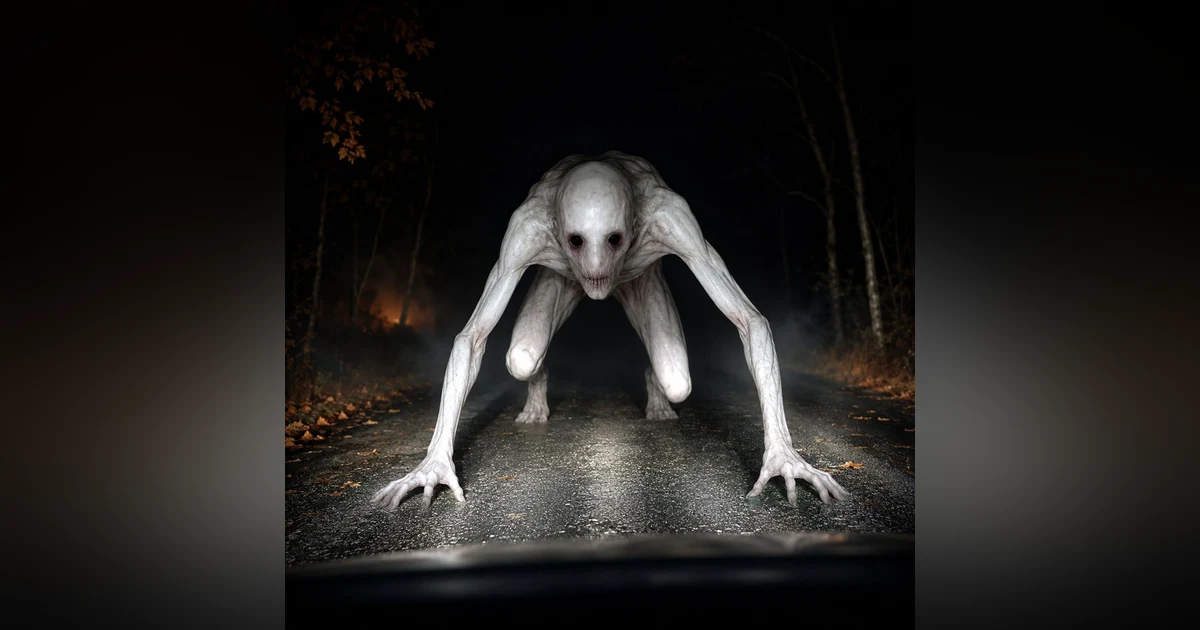
The Pale Crawler looks like a creature caught between a human and an animal, but The Rake began as a deliberately written horror story. Terrifying & True traces Operation Crawler, alleged Illinois and Kentucky encounters, and the viral trail-camera images that helped turn creepypasta into cryptid folklore. Misidentified wildlife, pareidolia, sleep paralysis, and staged footage offer ways to examine the claims without treating them as proof. Follow the monster from online fiction to reported woodland sightings, and discover how a shared story can start shaping what people think they see.
Bonus episodes & support: https://weeklyspooky.com/join
More scary stories: https://weeklyspooky.com/
Story submissions: WeeklySpooky@gmail.com
Frequently Asked Questions
What is the origin of the Pale Crawler and The Rake?
The Rake and the Pale Crawler trace back to an anonymous 2005 forum experiment on 4chan where users collaborated to invent a new modern monster with a pale, hairless, and long-limbed humanoid template.
Are Pale Crawler sightings real or hoaxes?
Many viral items, such as the famous 2010 Louisiana trail-camera image, have been exposed as hoaxes, while sincere eyewitness accounts are often driven by misidentified wildlife, pareidolia, or sleep paralysis.
What is r/CrawlerSightings?
r/CrawlerSightings is a dedicated Reddit community that collects first-hand and second-hand stories, drawings, and videos of pale, multi-limbed humanoid creatures, serving as a primary hub for modern digital folklore.
How do ordinary phenomena get mistaken for the Pale Crawler?
Low-light conditions, headlights distorting depth, eyeshine, and animals suffering from mange or hair loss can easily transform ordinary wildlife into terrifying, otherworldly apparitions.
On a country road after midnight, your headlights catch something pale crawling beside the trees. It rises too tall, too thin, with a face as blank as a mannequin, and vanishes into the woods. The worst part this monster may have been invented online years before anyone claimed to see it. What you were about to do is believed to be based on witness accounts, testimonies, and public record. This is terrifying and tonight, A pale humanoid crawls out of the deepest corners of the Internet and into alleged encounters on lonely roads, wooded yards, and abandoned tunnels. It's called the pale Crawler many no a nearly identical creature as the Rake.
The documented trail begins in two thousand and five when anonymous forum users deliberately set out to build a new monster, hairless, long limbed, faceless, and most often moving on all fours. Then the images spread, witness stories followed. A trail camera photo went viral. Reddit communities gathered the sightings, YouTube and TikTok gave the creature movement sound and an audience large enough to turn fiction into folklore. Were people encountering an unknown cryptid, misidentifying animals and shadows, replaying a story during sleep paralysis, or had the Internet given an ancient fear a perfect modern body. Tonight, we're following the creation sightings, hoaxes, and Halloween Afterlife of the Pale Crawler and asking when an invented monster can become real enough to haunt us.
So make sure you're subscribed on your favorite podcast app for a brand new, terrifying and true every Monday in the week. Now, let's take a deep dive into cyberspace to see just how such a creature is born. In April of twoenty eighteen, a woman using the name Jade submitted an account of something she said had happened eight years earlier. She and two friends had been driving toward a reputedly haunted cemetery outside Effingham, Illinois, some time between one and two in the morning. According to her report, their headlights caught yellow reflective eyes beside the road. The shape was too low for a deer, she thought, but too large for a raccoon or possum.
As the car moved closer, she described something skinny, hairless, and gray. It was crouched near the ditch. Its arms appeared extraordinarily long. If it stood, she estimated it might have reached seven feet tall. It resembled a person, she wrote, but she did not believe that it was human. The three friends pasted it. Jade said it watched the car, then slipped into the darkness. They abandoned the cemetery trip and went home. About six months later, someone sent Jade a trail camera image of a pale figure in the woods. It looked close enough to what she remembered that she took it as confirmation.
Then she learned the image was a fake. But the picture did not end her belief. It only strengthened it. And that is where this story becomes stranger than an ordinary cryptid report, because a nearly identical visual template, the crouched posture, the pale skin, the impossible limbs had already been designed by anonymous Internet users years before Jade said she saw it. When a monster is invented before the sightings begin, what exactly are people encountering an unknown animal? Perhaps a memory searching for a shape, or a story that teaches the darkness how exactly it should appear. Most cryptid legends arrive backward.
First comes the strange encounter then the name. Then the stories accumulate until a creature that may have been glimpsed for seconds acquires habits, territories, and a biography. The rake arrived with design notes. Its traceable history generally leads to four chan's anonymous slash b board in late two thousand and five. The original discussion is not preserved as a complete, independently readable archive, but later archival summaries and Internet histories agree on the basic event. Someone posted a blunt invitation quote, Hey, slash B, let's make a new monster. That is exactly what the board began to do. Users proposed a humanoid that usually moved on all fours.
It would have pale or grayish skin, very little in the way of a face, and a habit of watching people from suburban yards. At one stage, it had been three solid green eyes arranged around its head. At another, it had two oversized eyes, no nose, and a small mouth that could open along a hinge to reveal rows upon rows of teeth. The details changed because changing them was the point. This was collaborative horror, built in public. One user added anatomy, another's supplied behavior. Others debated whether the thing should hunt stare, disguise itself, or attack only when approached.
One proposed name was Operation Crawler. Eventually the creature became known as the Rake. That early process is interesting because the familiar image was not discovered in an old regional tradition. It was engineered through selection. A pale body reads clearly in the darkness. Long limbs make a human silhouette feel unnerving. Moving on all fours breaks the rules of how a person should move. A blank face allows the viewer to imagine the missing expression. The monster was simple enough to recognize and incomplete enough to improve on. Notice what the early design never provided. There was no homeland, no discoverer, no biological explanation.
Even its origin and diet were left unknown. That absence made the creature portable. A legend tied to one bridge, town or forest has to travel away from its setting. The Rake could be dropped into any yard, bedroom, tunnel, or roadside without causing a contradiction against itself. The Internet had not merely invented a monster. It had invented a template. As reposts multiplied, some of the strangest early features fell away. The three green eyes disappeared, so did the idea that it might pass unnoticed in a fedora and trench coat. Artists and storytellers converged on the version that worked the best, pale flesh, dark eyes, long limbs, and a rouched posture.
The design became less elaborate, and in silhouette, more plausible. In July of two thousand six, one of the earliest surviving full Ke stories appeared on the personal blog of a Something Awful user named Brian Somerville. The page did not establish whether Somerville wrote the story or reposted it, but the version became foundational. It presented the Rake not as a new Internet character, but as something investigators had supposedly traced across centuries. The text offered fragments from a sixteen ninety one mariner's log an, eighteen eighty journal translated from Spanish, a nineteen sixty four suicide note, and a modern family's encounter in New York.
None of those documents was historical evidence. They were pieces of the fiction, but they were very clever pieces. Each fragment was brief, each appeared to come from a different time and voice. The gaps between them suggested that a larger record had been lost, suppressed, or scattered instead of explaining the creature, the story made its absence from history feel suspicious. That technique gave the rake borrowed age. A monster created the previous year could not be discussed as though sailors, diarists, and frightened families had always known it. This is the central power of creepy pasta. A horror story is copied, pasted, altered, and carried into new spaces until its authorship becomes less important than its circulation.
The Rake moved from blogs to live journal, back to four chan's paranormal board, into story archives, videos, fan art, and Reddit discussions. Some people encountered it as fiction. Others met it stripped out of context, a photograph, a paragraph, a narrator insisting that the account was true. By twenty ten, the Rake no longer belonged to one thread or one writer. It had accumulated variations. In some stories, it crouched at the foot of a bed. In others, it watched from lawns or tree lines. Its face changed, its eyes changed, Its motives were almost nonexistent. That lack of fixed rules helped it spread.
Bigfoot carries decades of arguments about tracks, habitat, and biology. The Rake only needed a shape pale, thin, low to the ground, and almost human. The Rake is not an ancient cryptid later rediscovered online. Its documented history begins as collaborative fiction, and the supposed old documents were part of a two thousand and six horror story. But that doesn't prove every later witness invented an experience. It does mean those later reports entered a world where the monster's appearance had already been designed and widely circulated. By the end of twenty ten, then had built the creature, supplied its past, and taught readers how to recognize it.
What the legend still lacked was a convincing photograph. Then a trail camera image from Louisiana appeared to change all of that and deepen the legend. On December tenth, twenty ten, a strange image began moving through news reports and paranormal websites. The story attached to it was almost perfectly designed for viral belief. A Louisiana deer hunter had supposedly found his trail camera broken. The memory card survived on it was a night photograph of something moving through the woods. The figure was pale and nearly hairless. Its body was bent low, long arms reached toward the ground. Its eyes reflected the camera flash.
It seemed to look directly into the lens. Trail camera images carry a special authority encryptid culture. There's no witness aiming the lens and no obvious filmmaker shaping the frame. The machine appears to have caught something by accident that can make a blurry photograph feel more honest than a clear one. But a camera can record only the image placed before it, It cannot verify the caption attached later. In this case, the broken camera, story, surviving memory card, and isolated woods did as much work as the figure itself. A local NBC station described it as a cross between a human and an animal.
MSNBC helped carry the picture beyond Louisiana. Online viewers compared it to the Dover Demon, a ghoul, a zombie, and a creature from a horror film. Others gave it a more recent name, the Rake. The resemblance was powerful, even though the timelines were separate. The Rake's design came first, the photograph arrived later, but once they met online, they seemed to authenticate one another. The story gave the image a name. The image gave the story a body. The photograph, however, did not survive serious scrutiny. The cryptozoology site carrying it later added an update saying it appeared to be a hoax.
Commenters pointed to inconsistent image quality, strange blur, questionable shadows, and a date stamp that they believed had been added later. Some thought the figure resembled a grim an enemy from the video game Resistance. Three others saw movie monsters, game ghoules, or simple image manipulation. None of those guesses established a clean chain from creator to television report. The exact origin remained muddy. What did become clear was that the photograph was not reliable wildlife evidence. Yet unreliable evidence can have a very long after life. Copies circulated without the update. It lost. The Louisiana News story then acquired new caption.
It became a trail camera photograph of the rake A crawler, a demon proof that something pale and human shaped lived beyond the flash. It continued to be passed to people who had never seen the original reporting. One of those people, according to her later account, was Jade. Her report was published in twenty eighteen, describing the twenty ten drive near Effingham. That eight year delay is important, as is the setting. Jade and her friends were already traveling toward a cemetery reputed to be haunted. Her published account does not say they were searching for a crawler. They were going to a place they had already been told was haunted.
Entering the night with the possibility of something strange already in mind, she reported that the figure near the ditch had yellow reflecting eyes, a gray, hairless body, and arms long enough to suggest a much taller standing height. She and her friends did not stop to examine it. They passed, watched its slip away, and left the area. Then came the photograph. In Jade's telling, a friend's cousin claimed the image had come from a trail camera just one town away. He later admitted he had been pranking them. Jade also learned that the image itself was fake. Even so, she wrote that it represented what she had seen so closely that it revived the fear and reassured her that the original experience had not been imaginary.
That reaction is not evidence that she lied, It is evidence of what an image can do. Before the photograph, she had a brief, frightening memory with no agreed category. After the photograph, she had a match. She later found a Facebook page devoted to strange local history, where users mentioned glowing eyed creatures near the cemetery. In twenty fourteen. She encountered another person online who claimed to have seen something similar in the Effingham countryside in twenty eleven. Each step made the event feel less isolated. A picture, a local post, another witness, a name waiting somewhere online. By the time her account reached the National Cryptid Society, the creature could be filed as a pale crawler.
Jade's report establishes that a detailed story was submitted in twenty eighteen about an alleged twenty ten encounter. It does not independently establish what exactly was beside the road. Her two companions were not separately interviewed in the published case file, and the photograph she associated with the event was already known to be false. A sincere report may still contain errors of distance, memory, or identification. Sincerity and accuracy are not the same question, but Internet legends do not require courtroom proof. They require recognizable patterns across forums. Users began and drawing a distinction that kept the belief alive.
The Rake, they agreed, was fictional. Crawlers were something else, real creatures that merely resembled the fiction. That distinction solved a difficult problem. It allowed believers to discard the invented name without discarding the sightings. Every pale, long limbed humanoid report could be separated from the Rake's authors and moved into a new category. The Internet had not proved that the monster existed. It had done something even more durable. It had taught people what to call the shape that they could not explain today. A person searching for or the pale Crawler does not find one settled legend. They find a filing system.
Online communities collect stories of pale figures on roads, in yards, beside caves, and at bedroom doors. The descriptions vary, but a core template repeats hairless or nearly hairless skin, a thin humanoid body, arms and legs that appear too long, dark or reflective eyes, movement on all fours, and the ability, in some accounts to rise suddenly onto two legs. A dedicated Reddit community now collects reports under the crawler Sighting's name. Its feed mixes first hand claims, second hand stories, drawings, reposted videos, promotional links, and speculation. That makes it valuable evidence of folklore in motion. It does not make it a vetted database of animals.
This distinction is easy to lose because repetition feels like corroboration. Read ten stories with the same details, and the creature begins to seem stable. But those ten stories may not be independent. A witness may have seen rake artwork years earlier and forgotten it. A poster may choose the crawler community because the description already fits. Commenters may ask questions that encourage one feature and ignore another. Stories with familiar traits are more likely to be shared, narrated, and and remembered as crawler encounters the category atits itself. Reports that match the template stay in the pile. Reports that do not become something else.
That doesn't mean every witness is participating in a hoax. Many people describe experiences they clearly find disturbing. The more useful question is not whether they're sincere, it's what can produce a sincere report of something impossible. Night is a very efficient monster maker. Headlights flattened depth, a ditch changes apparent height, brush hides legs, and separates an animal's body into strange pieces. Eyeshine can create the impression of a fixed stare. A creature moving at an angle may seem to have limbs arranged in ways they simply aren't known. Animals can also become unfamiliar when sick, injured, or partly obscured.
Wildlife agencies document deer with patchy or extensive hair loss caused by seasonal molt, lice, mange, and skin infections. A thin deer with missing fur lowered near the road may not look much like the healthy animal imagined on a crossing sign. That does not explain every report now, but it demonstrates how quickly the familiar can become grotesque when the usual markers disappear. Bedroom encounters belong to another category. However, some crawler stories begin with a person waking, unable to move since a presence, and seeing a figure near the bed. Those details closely match sleep paralysis, a state in which awareness returns, while the muscle paralysis of rapid eye movement sleep briefly remains hallucinated.
Figures, pressure, and a threatening presence are all well documented parts of the experience. A large systematic review estimated that about seven point six percent of the general population had experienced sleep paralysis at least once, with higher rates in some groups. That is far from everyone, but it's also far too common to treat every pale figure at the foot of a bed as evidence of an unknown species. Then there are deliberate constructions. The same tools that built the rake can build evidence for it. Costumes, puppets, composited images, game models, camera blur, and staged night footage all benefit from the low information of darkness.
The less a viewer can see, the more the imagination completes found footage. Horror understands this perfectly. Don't show the creature clearly, Let it cross the frame, let the camera shake, Let the person filming react before the audience knows exactly what they saw. The uncertainty is not a weakness, it's the product. Digital folklore. Scholars describe creepy pasta as a form of internet folklore that is created, distributed, revised, and expanded across text, images, video, and games. Online communities do more than preserve a story, they collaborate on what the story becomes. The Pale Crawler may be one of the clearest examples because its evidence and its folklore are made through the same exact machinery.
A witness posts an account, Commenters supply a name, narrators adapt it for video, artists give it a clearer body. The viewer carries that body into the next ambiguous encounter. The next report seems to confirm the art that helped shape its description. Round and round it goes. Folklorests use the term ostension for moments when people act, out, test, or embody a legend. One familiar form is let tripping, visiting a location associated with a frightening story to see what happens. Jade and her friend's destination fits that pattern. They were driving toward a cemetery known through local haunting stories.
That fact doesn't disprove what they saw, but it does mean their attention had been turned toward the unusual before anything appeared beside the road. The same process continues when people enter tunnels, forests, or abandoned structures specifically looking for crawlers. Every unexplained sound becomes part of the test, Every pale blur becomes potential evidence. Even an unsuccessful hunt produces a video, a story, and a new location where the creature might be found next time. An unexplained case does not mean an undiscoverable humanoid. It means the available information is insufficient for a confident identification. A witness can honestly report a frightening shape and still misjudge its size, anatomy, or distance.
A video can be inconclusive without becoming paranormal, and rejecting a crawler explanation does not require calling every witness dishonest. The pale Crawler survives inside that very middle ground. The available evidence is too weak, anonymous, or altered to establish a species, Yet many reports communicate genuine fear, making the subject difficult to reduce to a single joke. The uncertainty yves room for believers, skeptics, storytellers, and algorithms to keep feeding the same shape. Once a monster becomes a category, every shadow can be filed beneath its name, and every new filing makes the category feel older, larger, and more real.
The Rake and the pale Crawler are often treated as interchangeable. They're not quite the same thing. The Rake is a fictitional character with a traceable digital origin. Its early features were debated by anonymous users. Its supposed historical documents were written as part of a horror story. It spread through reposts fan art and videos can be followed across the Internet. The pale Crawler is less specific and therefore harder to kill. It is a label placed over many different claims roadside animals, bedroom figures, humanoid silhouettes, staged clips, old photographs, and stories told years after the alleged event.
It does not have one author or one official canon. It's a category built from resemblance that makes the documented record both clear and limited. We can document that Internet users collaboratively designed the Rake in two thousand and five. We can document an influential story published in two thousand and six that supplied fictional history. We can document the creature spreading across forums and horror communities. We can document a Louisiana image that reached television in December of twenty ten and was quickly treated as a hoax. We can document Jade's twenty eighteen submission describing what she said happened near Effingham in twenty ten.
We can document online communities continuing to sort new claims under the Crawler name. What we cannot document is a pale Crawler specimen. Among the sources reviewed for this episode, no verified body ever emerged. No biological sample was publicly tied to an unknown humanoid. No trackway was documented under controlled conditions, No clear, independently authenticated recording established the anatomy claimed in the stories that absence does not tell us that every encounter began with nothing. People see animals they cannot identify. They wake during sleep paralysis. They encounter humans at a distance. They misunderstand scale, They remember frightening moments imperfectly.
They get pranked. They sometimes get deceived by images created for entertainment, and occasionally they may experience something that remains genuinely unresolved because the information needed to identify it is gone. But a collection of unresolved moments is not automatically one creature. The pale Crawler's power comes from making them all feel connected. A pale figure beside an Illinois road can be placed beside a Louisiana trail camera. A bedroom hallucination can sit beside a trail camera hoax. A deer with hair loss can be compared to a drawing derived from the rake. Once the stories share a page, the similarities become the headline and the differences begin to fade.
This is how a taxonomy of fear forms. The creature is especially adaptable because so little about it is fixed. Bigfoot is generally large, upright, and covered in hair. The mothman belongs to a particular place and historical moment. The pale crawler can be described at wildly different heights. Faceless or black eyed, silent or shrieking, crouched or towering. Contradictions do not break the legend. They become regional or individual variations. Its blankness is an advantage. The face has almost no expression. The body is close enough to human to trigger recognition, but wrong enough to resist it. It belongs naturally to roadsides, tree lines, tunnels, and bedroom corners, the places where vision is incomplete and the mind is forced to finish the picture.
That's also why the legend fits so easily into Halloween culture. It requires no ancient curse, no elaborate ritual, and no historical costume. It is the fear that something almost human is waiting just beyond whatever light you have. The story also demons a change in how folklore is made. Older legends often seem authorless because the first teller disappeared into time. The rake became authorless instantly, not because its origin was ancient, but because anonymity and reposting separated the creature from the people who built it. The Internet compressed generations of folkloric change into just a few years. Then something stranger began to happen.
People began insisting that the fictional creature and the alleged real creature were different. The rake could remain invented while crawlers remained possible. The hoax could be rejected while the shape inside it remained persuasive. Each failed piece of evidence could be removed without damaging the larger belief. That is a remarkably durable structure. It has no single claim that can be disproved and take the entire legend along with it. Return to Jade's account, the most revealing moment may not be the figure near the ditch. We only have her later description of that event. The more revealing moment is what happened when the false photograph reached her.
She recognized it, then she learned it was fake, and still she could not dismiss the resemblance. That response does not settle what she saw. It shows how an image can attach itself to a memory without replacing the witness's belief in that memory. The fake did not create certainty by proving the creature. It created certainty by giving the experience a visible form that may be the pale Crawler's real origin, not one four Chan thread or roadside encounter or manipulated photograph, but the space where those things can meet. A story supplies the anatomy, an image supplies the face, A witness supplies the fear, a community supplies the name.
And the next person who sees something pale at the limit of the headlights doesn't begin with an empty darkness. The silhouette is already waiting there. The rake was built on a screen, the pale Crawler was built in the distance between that screen and the road, and once the dark has been given a shape, it becomes very difficult to see it. Terrifying and True is narrated by Henrique Couto. It's executive produced by Rob Fields and bobble Toopia dot com and produced by Dan Wilder, with original theme music by Ray Mattis. If you have a story you think we should cover on Terrifying and True, send us an email at Weekly Spooky at gmail dot com, and if you want to support us for as little as one dollar a month, go to Weeklyspooky dot com.
Slash join. Your support for as little as one dollar a month keeps the show going. And speaking of I want to say an extra special thank you to our Patreon podcast boosters, folks who pay a. Little bit more to hear their name at the end of the show. And they are Johnny Nix, Kate and Lulu, Jessica Fuller, Mike Escuey, Jenny Green, Amber Hansburg, Karenwemet, Jack Ker, and Craig Cohen. Thank you all so much and thank you for listening. We'll see you all right here next time on Terrifying and True
