


 Apple Podcasts

 Spotify

 Spreaker

 Audible

 Castro

 RSS Feed

 iHeartRadio
Terrifying & True | The Portland Gale: The Steamship That Vanished in the 1898 Storm
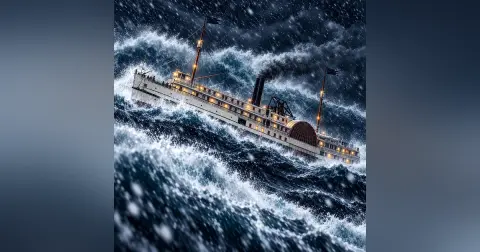
On Thanksgiving weekend in 1898, the steamship Portland left Boston for Maine and vanished in the storm that would bear its name. Wreckage washed ashore on Cape Cod. More than a century passed before NOAA researchers used a distinctive steam pipe to help identify the wreck. Follow the surfmen who fought to save lives and the families left searching for answers. A recording from the 2019 NOAA memorial brings us back to the people who never reached shore.
Narrated by Henrique Couto.
What can a wreck tell us about a night with no survivors? We're telling that story tonight.
Bonus episodes & support: https://weeklyspooky.com/join
More scary stories: https://weeklyspooky.com/
Story submissions: WeeklySpooky@gmail.com
0:02 A passenger steamship leaves Boston after Thanksgiving and never arrives. Nobody aboard survives. When the wreck is finally found, it offers a new question. Did the storm overwhelm her, or did something fail inside the ship before she sank? What you are about to hear is believed to be real. Based on witness accounts, testimonies, and public record, this is Terrifying and True.
0:51 The cups are still there. So are the plates. More than 400 feet beneath the surface, a camera finds the remains of ordinary life aboard the Portland. Everyone who would explain how that life ended went down with her. On Saturday, November 26th, 1898, the Portland left Boston at seven in the morning, bound for Maine. Thanksgiving had been just two days earlier. This was a familiar crossing, Aboard a familiar ship, she offered an overnight journey for her passengers and regular enjoyment for the crew. By the following morning, a storm was destroying vessels along the New England coast. Sailors clung to wrecks within sight of land. Lifesavers hauled men through the surf on rescue lines and rowed toward others, stranded on rocks. some of those sailors would come home with stories of that night. The Portland never arrived, for the families waiting in Maine, evidence came from the beaches of Cape Cod. Broken wood, cargo, lifebelts bearing the ship's name,
2:22 and bodies. Nothing washed ashore that could explain the captain's final decisions or tell them exactly where the steamship had gone down. Finding her would take most of a century. Identifying the wreck would take even longer. Then cameras would begin examining what the land had left behind. Each discovery would bring investigators closer to the missing ship while exposing how much of that last voyage was still beyond their reach. Make sure you're subscribed on your favorite podcast app for more terrifying and true every Monday. But now, the Portland Gale.
3:12 We're telling that story tonight. Boston's India Wharf, Saturday. November 26th, 1898. The Portland was preparing for its regular evening departure. Its destination was the city whose name it carried, up the New England coast in Maine. Thanksgiving had been just two days earlier, now passengers were traveling again, and this ship offered an overnight passage between two familiar ports. The crossing normally took eight or nine hours. Board in Boston in the evening, reach Portland early the following morning. A traveler could pay for a journey, settle into the ship's accommodations, and let the crew handle the miles in between. From the wharf, the Portland presented something considerably more substantial than a small coastal boat. Built in Bath, Maine in 1889, it measured 291 feet overall. The wooden hull was just over 42 feet across. Around its enormous side paddle wheels,
4:43 the projecting guardrails widened that span to 65 feet. Those wheels were part of its identity. There was no single paddle churning behind the stern. The Portland carried one on either side, driven by steam machinery within the vessel. The arrangement made a broad silhouette on the water, a long hull beneath decks and accommodations that rose above it with the means of propulsion extending outward on both sides. Coal-fired boilers supplied that machinery. Steam worked through a single-cylinder engine, and an upright walking beam, the great moving lever of the propulsion system. Passengers traveled aboard a ship whose power had to be maintained throughout the crossing. The names on its crew list included the men responsible for the fires, the engine, and the machinery's lubrication. Inside, the ship offered cherry-paneled staterooms, carved mahogany furniture, and wine-colored upholstery. Carpets covered the floors, its grand saloon had a skylight overhead. This was a coastal transport with the furnishings of a handsome public room, carrying people through the night without asking them
6:13 to spend the entire crossing exposed on deck. The steamship belonged to an established service, running between Boston and Portland. It carried freight as well as passengers. A berth occupied by a traveler, a shipment consigned to a business, a crew member earning a month's wages. All three belonged to the same working route. Some of the passengers had already come a long way. Jess and Jessene Schmidt were returning from Europe with their young sons, Jorgen and Anton. Boston was not their final destination. The Portland would take them through the last sea passage toward their family in Maine.
7:01 George Keniston, a Bowdoin college student, was returning from a Thanksgiving visit with relatives. Emily Cobb was traveling to sing at a Portland church. For the people employed aboard, the Portland was also a workplace divided into exact responsibilities. Its payroll named engineers, oilers, firemen, deckhands, cooks, watchmen, stewards, and cabin attendants. The comfort of the passengers' rooms depended on labor extending well beyond those rooms. Thomas Merrill was the chief engineer. Franklin Leighton was the electrician. A vessel with electric lighting required someone responsible for that system, just as its steam machinery required engineers and its fires required tending.
7:59 Their jobs extended from the machinery below to the passenger accommodations above. Alonzo Matthews was a steward, Carrie Harris a stewardess. She had been born in Nova Scotia, as had saloon watchman Arthur Johnston. The crew's origins extended far beyond its main home port. The records include men born in Newfoundland, New Brunswick, Virginia, Jamaica, and the Cape Verde Islands. Porter Henry Allen came from Harrisonburg, Virginia. Cabin attendant George Graham had been born in Burlington, New Jersey. Their work converged here, on the Boston to Portland run. Many of these employees were black. Nineteen crew members belonged to Portland's Abyssinian Meeting House.
8:57 The building had hosted worship, anti-slavery organizing, benevolent society meeting, schooling, dinners, and entertainment. Its history included formerly enslaved people and advocates of abolition. Maritime employment helped support households that in turn supported this center of community life. The ship therefore carried people whose connections extended far beyond their individual jobs into a congregation and a neighborhood ashore. At the head of the crew stood the master, Captain Hollis Blanchard, born in Belfast, Maine.
9:40 The decision about taking this particular ship out of Boston rested with him. The weather was becoming a concern. Across the route, another captain was making a different decision. In his account of the wreck, Joseph Ames tells of a telephone call between Blanchard in Boston and Captain Alexander Denison of the Bay State in Portland. Denison meant to stay in port, Blanchard meant to sail. Later that afternoon, John Liskom, the company's general manager, tried to reach Blanchard through the agent in Boston. Liscombe later said he wanted the Portland held at the wharf until at least nine o'clock. Whether his message reached Blanchard is still unknown. Weather warnings had gone out that day, too, but no one on shore could say for certain which warnings the captain had received.
10:45 At the wharf, however, The timetable still called for seven. The Portland had accommodations for many more people than it carried that evening. This was not a vessel packed to its capacity with passengers. Nearly 200 passengers and crew were aboard, traveling in a ship that had served this coast for nine years. Its size, familiar route, and appointed rooms were all real. None could determine what the weather would become once it was out of the harbor. Seven o'clock arrived, and the Portland departed on schedule. At the other end of the route, the Bay State was staying in Boston.
11:35 Out of Boston came her sister ship, bound northeast with her passengers and her freight, her cooks and engineers, and watchmen. Behind it was the wharf where a delay could have kept everyone ashore. Ahead lay the coast, the open water between the harbors, and a November night already beginning to change. At about eleven that night, the captain of the fishing schooner Grayling reported a steamship coming toward his vessel near Cape Ann. He feared a collision and burned a flare.
12:23 The steamer turned aside. As she passed, the men identified the Portland. According to the captain's account, she was rolling and pitching badly, but still appeared to be in normal condition. It's just a brief glimpse of a ship still moving, still responding to another vessel in her path. Beyond that glimpse lay a night for which the people aboard left no testimony. Two areas of low pressure had come together off New Jersey. Now the storm was moving up the coast in the same direction as the Portland. It brought heavy snow to New England, and out on Nantucket the winds would reach hurricane-force. That Saturday morning, the Weather Bureau had sent word to observers along the New England coast.
13:22 They were to expect northeast gales and heavy snow that night. Ashore, the warning could be displayed as a storm signal for mariners getting ready to sail. Farther south, 20 ocean steamers lay at anchor in New York's Upper Bay through Saturday night. Snow and gale had stopped them from going to sea. Long Island Sound steamers remained at their docks for roughly 20 hours. Vessels with schedules and passengers were waiting for the weather to allow them to move. Out at sea, the warnings became something the ship had to move through.
14:08 The Portland's route led northeast toward Maine. a Nor'easter blows from that direction. To make the scheduled passage, the steamship had to advance into the weather. Her engine could turn the paddles without guaranteeing useful progress against the wind and sea. A side-wheel steamer works by driving broad blades through the water on either side of the hull. In smoother conditions, that machinery could move a large vessel reliably along a coastal route. Heavy rolling could change how the wheels met the water. The two sides would not remain neatly level as a vessel pitched and rolled. The Portland also had a relatively shallow draft and a large structure above the water.
15:01 There was plenty for the wind to press against. The sanctuary's reconstruction identifies her shallow draft and side-wheel propulsion as disadvantages in her struggle to make headway. To head back to Boston, Blanchard would first have to bring the Portland around, for part of that turn the wind and waves would catch her broadside, with all that height above the water exposed to the gale. Nobody aboard lived to say whether he tried or not. On land, the storm was swallowing landmarks.
15:43 At Hull, Joshua James watched the storm come in from the northeast. By ten o'clock, he said, the sleet and snow were so thick that his men could see scarcely a hundred yards. Two hours later, in James' words, quote, At midnight, it was a hurricane. James' men kept up their patrols. The worst of the storm lasted a full day. Even when the wind began to drop, it took another 12 hours to ease. All that time, anyone walking the beach had to watch the sea as well as peer out across it for ships in trouble. The pilot boat Columbia was wrecked at Scituate Beach. Driven onto the shore, it demolished a cottage. None of its crew survived. At Scituate Point, the destruction extended through a village of more than a hundred dwellings, a place that ordinarily offered a firm boundary between buildings and passing ships, had become part of the wreckage. At Hull, heavy granite protection along the railroad was wrecked for roughly a mile. Beaches were stripped and narrowed. In the Scituate and Marshfield area, The storm cut through the barrier between Third and Fourth Cliffs, opening a new outlet for the North and South Rivers. The
17:14 old outlet, farther south, would close by 1900. Families at Scituate Point had to get out of their houses during the gale. The life-saving service recorded one husband's attempt to help his wife escape their own home. She drowned. Other people in the village barely made it out alive. At Sandwich, Associated Press reporter William Swan would gather accounts of great elms falling across the streets. At Hull, some beaches had been lowered two or three feet and narrowed by ten or fifteen. The land itself was being stripped from beneath the patrols watching for ships. For days afterwards, Word from some towns on Cape Cod reached the rest of the country in pieces. The trains couldn't get through the washouts.
18:12 Bridges were down. Where someone might ordinarily have gone to the telegraph office and sent news in a few minutes, there were broken wires. Sunday morning brought a sound from somewhere off Race Point, at the outer end of Cape Cod. Four short blasts from a steam whistle. The San Francisco Call reported that the lifesavers at Race Point heard the signal and manned their boats. People later came to believe those four blasts had come from the Portland. The weather was so thick that the lifesavers couldn't see which ship had sounded the whistle. Even if they got a boat through the breaking seas, how far would they have to row?
19:02 The sound carried all the way to the beach, but it gave the men no position to steer for. The coast had men trained to respond. It had boats, lines, and stations watching the sea. In some places, those resources would bring sailors back alive. Closer to Boston, other vessels had been driven within reach of the beach. Their crews were could be seen, and Joshua James was going after them.
19:44 On the beaches outside Boston, men were still alive in the wreckage. To be continued.... The men watching for ships had to run for higher ground. These were the patrols of the United States Life Saving Service, one of the organizations that would eventually become part of the Coast Guard. At the Hull station, their keeper was Joshua James. He had turned 72 four days before the storm.
20:33 James knew the waters around Hull through decades of work and rescue, He had been saving people long before the federal government put him in charge of its station. Local volunteers and the boats of the Massachusetts Humane Society remained part of the work. In a disaster, the boundary between the regular crew and the neighbors who came to help could become a very practical question. Who could pull an oar? If you can, you're in. The schooner, Henry R. Tilton, had been driven ashore near Hull. Seven people were aboard.
21:15 The vessel had survived long enough to give the rescuers a chance. They used a breeches buoy. A breeches buoy was a life ring with a pair of canvas breeches sewn into it. To carry a sailor from the wreck to the beach, it had to hang from a heavy rope stretched across the surf. Everything depended on getting a much lighter line out to the sailor first. A gun on the beach could throw it. There was a job on each end of that line. The sailors on a wreck had to haul out a pulley and fasten it high on the mast. The lifesavers on the beach had to anchor their end in the sand. A wooden prop lifted the heavy rope clear of the water, and a block and tackle took up the slack. Once the line was rigged, the men on shore could send the empty ring sliding out along it. A sailor climbed into the breaches with his legs through the canvas. Then the beach crew hauled him in over the surf. All seven men could not cross at once. Each person made the journey alone, and the empty buoy had to return before the next could climb in. The wreck had to hold together until the last crossing. So did the line. While the rescuers kept working on a beach, the sea was stripping away.
22:46 The Tilton rescue occupied several hours. All seven came ashore alive. When the equipment was back at the station, there was another emergency. A coal barge known as Number One was breaking up on the rocks off Windmill Point. Five men were aboard. James' crew and the local volunteers went out again and saved them. Elsewhere, destruction had outrun the patrols. The schooner, Abel E. Babcock, and coal barge number four had been shattered on toddy rocks. None of the schooner's crew survived. Two of the barge's five people reached the shore, clinging to a piece of its deckhouse. Wreckage was discovered in the morning, after the vessels had already broken apart.
23:40 When James next had to get out past the breakers, the government surf boat was on the north side of Stony Beach. The Humane Society kept a second boat on the south side, facing the smoother water of Hull Bay. It had been a gift from a Boston newspaper, The Herald. The following morning, James made out masts near the lighthouse. From the government boat's side of the beach, the wreck was too far away. James took the Humane Society boat. His men launched into Hull Bay and rowed to the Pemberton steamboat landing. There they found a tug, the aerial, to take them in tow through Hull Gut. Even the tug could get no closer than a quarter of a mile from the island. The surf boat cast off. From there, the lifesavers had to reach the wreck under their own power.
24:42 It was the Calvin F. Baker, a schooner carrying coal from Baltimore to Boston. Three members of her crew had already died. Five were still living. The rescuers reached them and brought all five back alive. The account puts the rescue and return to land at about an hour and a half. Another message was waiting. Three men were signaling from Black Rock, at the far southern end of Nantasket Beach. The place was more than six miles from Hull Village. A team was found to haul the surf boat over land.
25:26 Five Humane Society volunteers joined the effort. The men on the rock had come from the barge Lucy A. Nichols. When their vessel broke up, they had managed to reach the ledge on one of its masts. That piece of their destroyed vessel had carried them to a place where they could still be seen. James' crew launched and brought the boat toward Black Rock. closing the distance until they could attempt the rescue. But the seas breaking against the ledge made an approach too dangerous. James ordered his crew to rest on their oars. They waited for an hour. Eventually, an opening came. The crew drove the boat in, brought all three men aboard, and got them safely ashore. Even the surfboard came back undamaged. When those three men got home, they could tell their families how they'd ridden a broken mast to Black Rock and how James had come for them.
26:36 Nobody came home to Maine with a story like that from the Portland. While James and his crews were bringing people back from wrecks they could find, the steamship remained missing. The weather began to ease and the damaged coast came into view, and along the outer beaches of Cape Cod, the sea began delivering things that belonged to the Portland. The first evidence did not arrive in the form of a ship. It came ashore, in pieces. Lifebelts, broken wood, cargo, objects carried away from rooms that, a few days earlier, had been part of a family overnight journey. On November 29th, a physician named Maurice Richardson reached Boston on a train from Cape Cod. The account published the next day in the San Francisco Call reported that he had seen two bodies wearing lifebelts marked for the portland. Along the Cape, wreckage had been scattered over miles of beach. Cases of lard bore addresses in Portland, Maine. The significance of those things depended on their names and markings. This storm had
28:09 wrecked many vessels. A timber on a beach did not identify the ship it came from. A belt bearing the Portland's name did. The wreckage could identify the Portland, but it gave searchers no fixed position. Wind and water had carried it away from the sinking. Objects from the same vessel could come ashore miles apart, leaving a trail that led along the beaches rather than straight back to the ship. Finding her would mean working backward through the storm that had scattered them. At Cahoon's Hollow, the life-saving station log recorded the recovery of George Graham's body on November 28th.
28:59 Graham had worked aboard the Portland. He was a black crew member, one of the people whose labor had made the passenger service run. Graham had been a cabin attendant. Archivist Walter Hickey later went through the life-saving station logs. Of all the Portland crew members whose bodies washed ashore, Graham was the only one the men on the beach could identify when they found him. The passenger list had gone down with the ship. That loss made even the most basic reckoning difficult. There was no complete manifest waiting ashore to be checked against the people who came home.
29:45 Researchers would have to assemble names from newspapers, family information, historical collections, and court papers. Some early announcements described far fewer people than later investigations established. The sanctuary puts the number aboard at 192 or 193. 63 of them were crew. None survived. Along the New England coast, the storm that had wrecked so many vessels came to bear the name of this one. People call it the Portland Gale. Ellen Johnston lived in Portland, Maine. Two members of her family had sailed on the night boat that Saturday. Her husband, Arthur, was the ship's saloon watchman. Her sister, Carrie Harris, was the head stewardess. Both had gone to work aboard the Portland.
30:50 Neither came back. In December, Ellen sought the wages owed to her husband and her sister. The paperwork for Arthur records $ 22 for a month's service. That's nearly $ 900 in today's money. On the claim form, Ellen identified herself as his widow. She supplied the facts the court required. He had left no will. His parents were deceased. Three children survived him. Archibald, Harriet, Josephine. Ellen also gave the court Arthur's birthplace, Moose River in Nova Scotia's Annapolis County. On the back of her claim, along with the three names of their children, was the date he was born, April 2nd, 1848.
31:44 The company had drawn up Arthur's wage account on December 19th. Ellen swore to her claim eight days later, on December 28th, somebody at the court stamped the papers received. That stamp is still there, a month and a day after Arthur went down with the ship. Carrie's wages required another set of family connections. She had been born at St. Mary's Bay, Nova Scotia, and had turned 58 earlier that November. Her work aboard the Portland placed her among its senior passenger service staff. She was a widow with no children. Her surviving siblings included Ellen, a brother and another sister in Nova Scotia. The following January in Nova Scotia, Carrie's brother John signed over his share. Her sister signed a separate affidavit on January 24th. Each asked the court in Portland to pay Ellen Instead, when the census taker came around in 1900, Ellen and all three children were living together in Portland. Like their father, the children had all been born in Nova Scotia. Other files open on to other households.
33:15 The watchman John Witten left a wife and four children. His widow, Lettie, claimed the $ 35 owed for his last month's wages. Her children were between 6 and 12 years old. When Hickey looked for the Wittens in the 1900 census, he found Lettie, now 32, living in a home in Portland where women could get nursing care while they recovered from illness or overwork. Her daughter, also named Lettie, was 8. The census listed her as a ward in another family's home. Two of her brothers were living at a farm in Fairfield, Maine.
33:59 Icky looked for the fourth child, another boy, but couldn't find him in that year's census. The loss also reached beyond individual homes. Nineteen members of Portland's Black Abyssinian Congregation were among the crew. The deaths dealt a severe blow to that community and contributed to the church's closure. several years later. A ship's crew list could also be part of a congregation, a network of relatives, and a neighborhood's working life. The company went to court to limit what it would have to pay over the loss of the ship.
34:41 In Walter Hickey's account, the sinking was eventually treated as an act of God. The lawsuits were withdrawn. The Portland had become a collection of names, documents, and belongings. Families could recover wages. Some could recover a body. Newspapers could publish theories about where the vessel had gone down, but the ship remained beyond them. Somewhere offshore were the engine, the hull, and whatever evidence the storm had left inside. Finding that place would take more than a search along the beach. It would take most of a century. The court papers preserved the names of people who had worked aboard the Portland, what they had earned, and the relatives they left behind. They couldn't tell searchers where to lower a camera. The next answers would have to come from the ship itself. Somewhere beyond the beaches that had received her dead, the Portland was still out there. For John Fish and Arnold Carr, finding her meant working backward. The storm had scattered evidence across a coastline. They studied where
36:13 bodies and wreckage had come ashore, considered the wind and currents that could have carried them. and used information from recovered watches in calculating a likely resting place. The sea had delivered fragments. The searchers tried to reverse their journey. In 1989, they reported a find. Fish and Carr believed the ship they'd found was the Portland. They brought back photographs, but none showed the wreck clearly enough for anyone ashore to identify her. Thirteen years went by before another team could take a camera down for a closer look. By 2002, a United States Geological Survey mapping effort had detected more than 50 unusual features in the sanctuary's seafloor. One lay at the site Fish and Carr had identified. Their earlier work had supplied a target. Improved mapping could now guide cameras toward it. Researchers from NOAA and the University of Connecticut's Undersea Research Center went out to investigate. Sonar surveys and remotely operated vehicles gave them two ways of looking.
37:41 The shape of the whole wreck and the individual pieces that could establish what it was. The ship lay upright. Her wooden hull remained largely intact. But the upper structure that had made her recognizable in photographs was gone. The cameras were looking at the lower remains of a passenger steamer, not the familiar white ship with her tall stack and rows of windows. To identify her, the team needed to know what exactly should still be there? Before the expedition, researchers had searched historical accounts, manuscripts, and photos, assembling a record of ships lost in Massachusetts Bay. The Portland was not the only wreck under these waters. She was, however, an unusually large wooden side-wheel passenger steamer. Her size and construction were sharply narrowed the possibilities. The sonar gave them a vessel of the right general dimensions. The camera showed broad guards projecting outward from the hull, the structures that had protected the paddle wheels and extended the ship's available deck space. Some steamers driven by propellers also had guards like those. At the stern of one of those ships,
39:13 The camera ought to pick up something else besides the rudder. The stern supplied another test. There was a rudder. There was no propeller. Elsewhere, the vehicle recorded the fittings that happened. connected the paddle wheel spokes to their shaft. Piece by piece, the combination became harder to explain as anything other than a large side wheeler. Then there was the pipe. NOAA's Ben Haskell had been part of the 2002 identification expedition. In a September 2019 broadcast from above the wreck, he described one of its most distinctive clues.
40:01 The diagnostic features that were used to determine it was the Portland was first the steam release pipe that was located right aft of the twin smokestacks. And We ended up, that's one of the first artifacts that we came across in 2002. It's now lying in front of the bow on the seafloor. And it's a very distinctive steam release pipe because the end of it looks like a spittoon. Above water, Antonio Jacobson's painting of the Portland showed the corresponding feature on the living ship. A painter had recorded an ordinary detail more than a century later, though. That detail helped give a wreck back its name. There was even a potential lookalike to eliminate. The Portland's sister ship, the Bay State. But she had wrecked off the main coast in 1916. She could not account for this hull in Massachusetts Bay. The cameras had yet to turn up so much as a plate with the ship's name on it, but an independent team of marine archaeologists now had two sets of pictures to work with. The sonar images taken from ships on the surface and the close-up video from the July dive, they agreed on the identity of the wreck.
41:37 On August 29, 2002, NOAA publicly confirmed the location of the Portland. Fish and Carr's earlier discovery had been vindicated. The vessel, whose wreckage had once reached shore in scattered pieces, could finally be examined where the greater part of her had come to rest. The following year, the research team went back with high-definition cameras... Fishing gear had snagged on the Portland over the years, and it hung across parts of the wreck. The camera vehicle had to go in close enough to film the wood and the fittings without getting caught in a net. The research vessel Connecticut had a positioning system capable of holding its location with the precision the operation required. Far above the wreck, the ship's maneuvering helped the camera work safely below. The new lighting and video equipment promised clearer pictures, provided the team could get them into place without losing the vehicle among the nets.
42:51 The sanctuary's rules protected the things the team found. A camera could get close to a piece of ship or a dish lying where it had fallen. Even a small object like that had to stay on the bottom In 2005, she became the sanctuary's first shipwreck listed on the National Register of Historic Places. Her importance extended beyond the calamity. The surviving hull preserved evidence of a kind of coastal travel that had largely disappeared. The New England nightboat, carrying passengers, freight, and working crews between cities while people slept. That July, the Portland received visitors who never entered the water. At the Pilgrim Monument and Provincetown Museum, approximately 140 people watched live pictures transmitted from the wreck. Many others connected online.
43:55 Above the site, researchers aboard the Connecticut narrated the movements of a remotely operated vehicle called Gila. For two 45-minute broadcasts, a camera became the audience's way aboard. People in the museum could ask questions and receive answers from the researchers while the survey was taking place. They could see both the damaged ship and the animals that had settled upon it. A vessel lost beyond the reach of her own century was now being visited in real time from shore. Among the pictures from the expedition was one of the pipe Haskell had recognized. It had once carried excess steam away from the boilers. Tucked into it now was a fish called a cusk, and there were still places the cameras had not adequately explored. The next stage of the search would require more than recognizing the ship from outside. It would require finding a way in. In 2019, the Portland became the focus of a new collaboration between NOAA, Woods Hole Oceanographic Institution, and Marine Imaging Technologies. The expedition brought
45:26 together two investigations that could share the same camera, but ask different questions. Archaeologists wanted a clearer record of the ship. Biologists wanted to understand the communities that had made their homes upon her wreckage. One of those questions belonged to biologist Kirsten Meyer Kaiser. During the expedition's September broadcast, she explained what a wreck offers animals on the seabed. Shipwrecks tend to be colonized by what are called sessile animals, ones that live attached to a surface. And that's because a shipwreck provides the only hard bottom solid habitat in the area. So they tend to be kind of magnets, if you think of it that way, for sessile fauna.
46:16 Some examples of these animals are anemones and sponges and hydroids. Those are actually the most common organisms that we find on the shipwreck Portland. The team used a camera vehicle called Pixel and a sampling vehicle called Rover. Images taken from multiple angles could be combined into a three-dimensional model. Instead of keeping only a succession of underwater glimpses, researchers could begin assembling a measurable picture of the wreck as a whole. On return visits, sanctuary staff had seen more fishing nets draped over the hull.
46:58 Parts of the wreck had once stood up from the bottom, but now appeared to have fallen onto the mud. With a model built from overlapping photographs, a team could come back years later and compare the same section of ship on two different dives. The cameras also recorded details small enough to disappear in a view of the entire ship. Two shrimp beside a mug. Redfish above cups and bowls in an area thought to have been part of the galley. Ordinary objects surrounded by animals whose lives had begun long after the people who used those objects were gone. The following summer brought a new vessel to the project. catapult, a 35-foot catamaran. Pixel returned, collecting more images for the model, but another camera vehicle had been built for the spaces its larger companion couldn't enter. Its formal name was the Portland Penetration Explorer. The team called it TAS. Evan Kovacs and Mike Sharonsky, who had built the vehicles, also piloted them.
48:17 Where Pixel could film the outside, Taz could attempt a closer look within. The little vehicle offered a way to investigate the machinery that had once driven the ship without sending a person through the damaged interior. During the original identification survey, the vehicle had found steam pipes, but had not spotted the boilers or the walking beam engine. Those were the machines on which Everyone aboard had depended when the weather turned. There was a specific question to pursue. A previous investigation had found the port side crankshaft disconnected from its connecting rod. That could be a sign of a mechanical failure. It could also be damage from striking the bottom. Meyer Kaiser also wanted to know how much fuel the ship had left. Had the boilers gone cold for lack of coal during the storm? She hoped to get a camera close enough to the boilers to look for coal that might still be there. On August 25, 2020, Catapult was stationed more than 20 miles offshore. At the Sanctuary's operations center on Scituate Harbor, Cameras, monitors, and control equipment had turned a working marine facility into a broadcast studio.
49:47 The team could bring the wreck ashore as pictures while the operators remained at sea. Customized microwave equipment carried the live link from ship to shore. Meyer Kaiser and maritime archaeologist Calvin Myers said, could examine the underwater footage together while others watched from their own screens. Below them, fish moved past Pixel. Particles drifted through the water and krill crossed the vehicle's lights. The little companion camera was there to go farther. Between the afternoon and evening broadcasts, the operators piloted Taz briefly into the hole. They also examined accessible artifacts, including a serving station in what had once been the ladies' salon. By the time the evening audience joined them, wind and seas had picked up. There would be no live trip into the ship that evening. The team brought back the film from the afternoon to go through overnight. By the third day, the expedition's robots were secured aboard Catapult at the dock. Weather had kept the team away from the wreck sites. The public program continued using previously recorded images, while shore-based experts answered questions in the rain. The footage showed areas near the engine room
51:19 and boilers. But Anne Smirsina, NOAA's coordinator, reported no further insight into the cause of the sinking. The interior had nevertheless produced a different surprise. Meyer Kaiser, a biologist, had expected much less marine life within the wreck. Sheltered internal surfaces often had less to offer animals dependent on food carried through the water. Instead, the camera found a community inside the portland. less dense than the growth outside on the engine's tall supporting frame and walking beam, but more abundant than she had anticipated. On the surrounding wreck, sponges, anemones, sea stars, and fish occupied the structures the survey were documenting.
52:14 The scientists compared these shipwreck habitats with natural boulder reefs elsewhere in the sanctuary. A ship built to travel is had become a fixed part of an underwater landscape. In one of the sanctuary's pictures, anemones cover what remains of a paddle wheel. When that ship left the wharf in Boston, the blades had to keep moving for the portland to make headway. Now animals that spend their lives anchored to one spot had grown over the wheel itself. New images went into the models, biological samples and footage returned for study, the work could continue ashore where scientists could compare the organisms they had collected with the habitats the cameras had recorded.
53:06 During one of the broadcasts, a viewer had a question for the archaeologist Calvin Myers. Of all the things he'd seen on the Portland, which ones had stayed with him? Myers remembered the steam tables and the plates, Seeing them down there, he said, made him think of the people who had died. One of the people who had worked aboard that ship was Carrie Harris, Ellen Johnston's sister. She was 58 when she made that last crossing. For the passengers who came aboard in Boston and needed looking after on their way to Maine, she was their head stewardess.
53:48 In September 2019, the research team paused above the wreck to remember the people who never returned. Aboard the research vessel Connecticut, NOAA's Ben Haskell spoke as the team prepared to cast a wreath into the water. This tragedy continues to reverberate throughout New England and beyond. And stories from it continue to float to the surface to this day. Now we'd like to toss this wreath overboard in commemoration of their loss.
54:30 Terrifying and True is narrated by Enrique Couto. It's executive produced by Rob Fields and bobbletopia.com and produced by Dan Wilder with original theme music by Ray Mattis. If you have a story you think we should cover on Terrifying and True, send us an email at weeklyspooky at gmail.com. And if you want to support us for as little as $ 1 a month, go to weeklyspooky.com slash join. Your support for as little as $ 1 a month keeps. The show going. And speaking of, I want to say an extra special thank you to our Patreon podcast boosters, folks who pay a little bit more to hear their name at the end of the show. And they are Johnny Nix, Kate and Lulu, Jessica Fuller, Mike Eshkewi, Jenny Green, Amber Hansford, Karen Wemet, Jack Kerr, and Craig Cohen. Thank you all so much, and thank you for listening. We'll see you all right here next time on Terrifying and True.
