


 Apple Podcasts
 Spotify
 Spreaker
 Audible
 Castro
 RSS Feed
 Siren Head: Cryptid Terror & Distorted Broadcasts | Thursday Thrills
Key Takeaways
- Siren Head is a modern internet legend, originating from horror artist Trevor Henderson in 2018, that has evolved through various online platforms into a significant piece of contemporary folklore.
- The creature's effectiveness stems from its ability to weaponize familiar sounds like emergency sirens and distorted broadcasts, preying on our ingrained instincts to pay attention to such warnings.
- Siren Head's legend thrives on ambiguity and being half-glimpsed, often hiding in plain sight as mundane infrastructure until it moves, playing on our brain's tendency to categorize and overlook the impossible.
- The fear associated with Siren Head is amplified by its ability to mimic voices, luring victims by impersonating loved ones or authorities, making its threat deeply psychological rather than purely physical.
- This cryptid taps into modern anxieties about unreliable notifications, fake emergency alerts, and the unsettling nature of distorted digital content, making it a perfect monster for the notification age.
- While fictional, the Siren Head legend resonates because it embodies primal fears of the unknown in dark, lonely places and the unsettling idea that systems meant for safety could be used for harm.
- The enduring appeal of Siren Head lies in its simple yet terrifying core concept, allowing for endless variations and interpretations that keep the legend fresh and universally frightening.
Siren Head turns an emergency warning into something that may be calling you closer. Created by horror artist Trevor Henderson in 2018, the fictional creature spread through games, videos, and fan stories until it acquired the feel of a rural urban legend. Thursday Thrills follows the monster's distorted broadcasts and connection to analog horror, asking why a shape glimpsed across a dark field can be more frightening than a clear view. From sirens to lonely roads, explore how familiar sounds of safety become threats, and how an internet creation starts to feel like a reported sighting.
Bonus episodes & support: https://weeklyspooky.com/join
More scary stories: https://weeklyspooky.com/
Story submissions: WeeklySpooky@gmail.com
Frequently Asked Questions
What is Siren Head?
Siren Head is a modern internet urban legend, created by artist Trevor Henderson, depicting a tall, skeletal creature with sirens for a head.
How did Siren Head become famous?
Siren Head gained popularity through platforms like TikTok and YouTube, inspiring indie horror games, fan stories, and creepypasta, transforming a digital art piece into internet folklore.
Why is Siren Head so scary?
Its scariness comes from weaponizing familiar warning sounds, its ability to mimic voices to lure victims, and its tendency to hide in plain sight as infrastructure in lonely, rural settings.
Is Siren Head based on a real story?
No, Siren Head is a fictional creature created by Trevor Henderson, but its legend draws on real-world fears and the way internet folklore spreads and evolves.
Where does the Siren Head legend usually take place?
The legend typically unfolds in isolated, open areas like rural roads, forest edges, abandoned towns, or empty fields, where the creature can blend in with its surroundings.
So say thrills. Imagine you're driving through the kind of road that only exists after midnight. Two lanes, no shoulder, trees crowding both sides like they're leaning in to listen. Your headlights keep grabbing little pieces of the world and throwing them away again. A mailbox, ditch, old fence, empty field, black woods. Then you hear a siren, not close, not far, just wrong. It doesn't rise and fall the way a tornado siren should. It's utters, it clicks, it drags through the air like some ancient machine waking up for the first time in years. You slow down, because of course you do.
That sound means danger, That sound means look around. That sound means somebody somewhere knows something you don't. Then the siren stops. For one perfect second, the road is quiet, and then from the trees a voice comes through the static, a voice saying your own name. This is Thursday thrills, A quick weekly ride into the creepy stories, haunted places, weird obsessions, and eerie little corners of the world worth talking about. I'm your host, Henrique Couto, and tonight, keep your windows up, keep your headlights on, and maybe don't trust every emergency broadcast you hear after dark, because we're talking about siren Head.
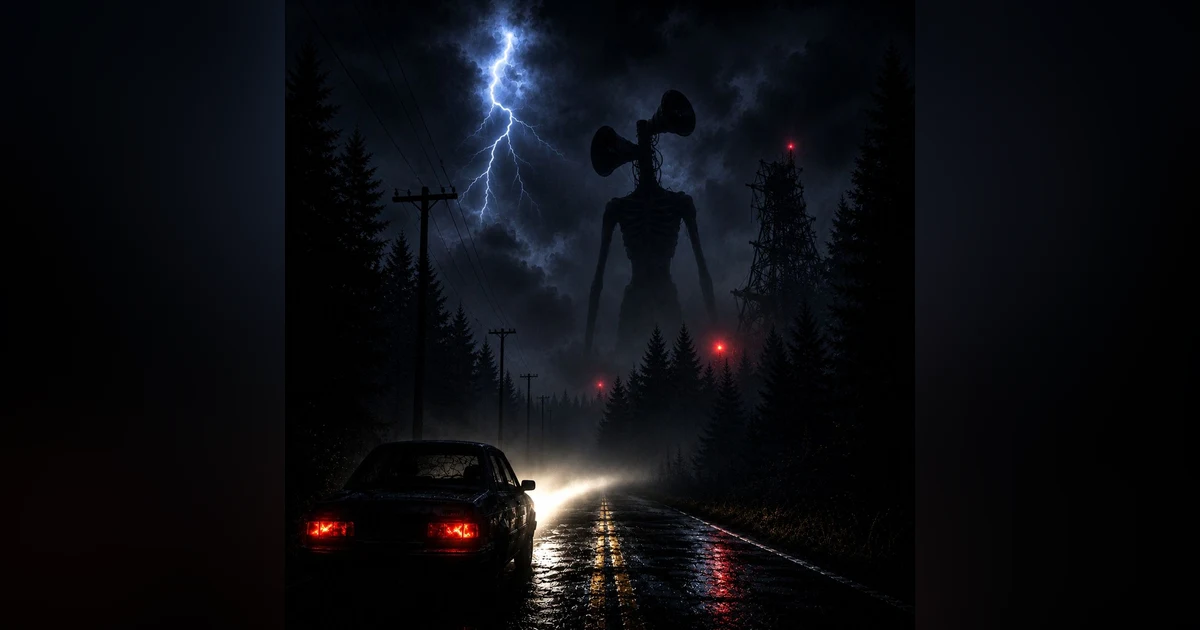
Now, Sirenhead is a little different from some of the older legends we talk about on here. With Bloody Mary, you can argue about where she came from. With the hook Man, everybody's uncle swears it happened just one county over. With Bigfoot, people will pull out maps, footprints, casts, audio clips, newspaper clippings, and trail cam blobs until the sun comes up. Siren Head has a birth certificate. We know the creature was created by horror artist Travis Henderson in twenty eighteen. We know it started as a piece of Internet horror art, a tall, skeletal figure standing in the distance with two old emergency siren speakers where a head should be.
We know it's fictional, but that's almost what makes it more interesting, because folklore doesn't always need to be ancient. Sometimes it's not carved into a cave wall or passed down by somebody's great grandmother. Sometimes folklore starts as a picture online, and then the Internet does what the Internet does best. It looks at the thing, gets scared by the thing, laugh set the thing, remixes the thing tells a story about the thing, and then tells that story so many times that the monster starts to feel like it was always there. That is the fun of siren Head.
It's not pretending to be an undiscovered animal. It's not asking you to believe there is literally a forty foot siren monster hiding behind every cell tower. It's asking a much creepier question, What if the warning sound is the trap? Think about how strange sirens already are. We grow up understanding them before we understand much. Else Where I live, they play a tornado siren every Monday at the start of the month. Ambulance sirens mean move over, fire siren means something is burning, and of course the aforementioned tornado siren means get inside. Air raid siren means history has gone very, very wrong.
Emergency alert tone means stop what you're doing and listen. A siren is not just a noise, it's an authority, its instruction. It's the voice of the world saying pay attention. Danger is here. So when you put that sound on top of a monster, you're not just making something loud. You're making a creature that steals our survival instincts. And that is why the stories work and fast. The classic siren Head set up usually doesn't need a big, haunted house explanation. It's almost always somewhere open and lonely. A rural road, a dead field, a forest edge, an abandoned town, a power line cut through the woods, a storm warning tower no one has serviced in years, A place where a tall thing could stand perfectly still and your brain would file it away as infrastructure, a pole, a dead tree, a radio mast, a piece of equipment, until, of course, it moves.
That is the little nasty magic trick in the legend. Siren Head is too big to hide like a normal monster, so it hides as part of the land. You do not miss it because it's invisible. You miss it because your brain is lazy. Your brain sees a long vertical shape and says telephone poll. Your brain sees a pair of speakers and says warning system. Your brain sees something impossible, and for one second it explains it away, and that one second is all the monster needs. The Internet is full of little siren Head story shapes. Some are short films, some are creepy pasta style posts, some are game descriptions, some are fake sightings, and some are kids telling each other no, seriously, I heard this happen near an old campground by here.
One version goes like this. Someone is out late near a stretch of woods when an emergency siren begins playing from deep inside the trees. They know there's no town close enough for that, they know there's no storm, but the siren it just keeps on going, and then it changes. It becomes a weather alert, then a numbers station, then a voice saying, in a flat, dead tone, please remain where you are, and that is where the trees start parting. Another version has a group of friends wandering near an abandoned school or old industrial lot. They music first, not scary music, and that's the problem.
They hear an old song, or an ice cream truck tune, or a little warped melody that sounds like it's coming through a speaker with water inside it. One of them jokes about it, the other records it, and yet another says, hey, look at that pole, and then the pole turns. These are versions where siren head mimics people. A parent's voice, a missing friend's voice, a child crying from the woods, a police officer telling you to come closer, a voice calling for help from somewhere just beyond the flashlight beam. In that part is what makes it so spooky and fun.
It makes siren Head more than a big monster. A big monster can chase you, it can stomp around, it can kick down trees. But a voice can make you choose wrong. It can make you leave the porch, make you step off the path. A voice can make you say, wait, did you hear that? Somebody is out there? And in the spooky logic of the legend, that is how it gets you. Not because you were stupid, because you were kind, because you were trained to listen, because somebody needed help. That is the campfire core of siren Head.
It's the old story of the thing in the woods that imitates something human. Only instead of a witch or a ghost or a monster wearing your friend's face, it's a public warning system with long arms and no eyes. There is something beautifully modern about that. Siren Head belongs to the world of fake emergency alerts, bad cell service, glitchy videos, distorted audio, and clips that are only ten seconds long but somehow ruin your whole evening. You see it for half a second between two buildings, you hear it before you see it. You pause the video and zoom in.
You wish you hadn't. That is why siren had exploded so well in short form video. The creature is basically designed for the phone screen. You don't need a whole movie to understand the scare. You just need a normal skyline, a normal street, a normal field, and then that impossible silhouette in the background. The fun thing is that Sirenhead also feels like it should be an ancient legend, even though it's definitely not. It has the shape of something people could have whispered about during the Cold War. It has numbers, station energy, emergency broadcast energy, abandoned, civil defense tower energy.
It feels like a monster that should come with a grainy government training film about it. And if you've ever been outside when a tornado siren test starts right about noon, you know the sound is already a little uncanny. Everyone in town knows it's just a test. The sun is shining, people are mowing lawns, someone is carrying in groceries. But the second that siren starts, the air changes. You look up, you check the sky. Some ancient little animal part of your brain whispers what if this time it's real and siren Head lives in that whisper. If you're enjoying this ride through modern folklore, spooky Internet legends, and the monster's hiding just beyond the headlights, make sure you're subscribed to Weekly Spooky so you never miss a Thursday Thrills as well as all the other programs proliferating you're week.
We have plenty more creepy places, strange obsessions, haunted stories, and late night rabbit holes coming your way. Now, let's put our eyes back on the road, as dark as it may be the other thing that keeps siren Head alive is that the rules are simple, but not too simple. You can explain it in one sentence. It's a giant creature with sirens for a head. That is the thumbnail, it's the hook. It's why a kid can draw it in a notebook and another kid immediately knows what it is. But then you can keep adding little scary possibilities.
Does it use the sirens to hunt? Broadcast old radio clips, repeat emergency warnings from disasters that already happened. Does it mimic the last words of its victim, or only appear near lonely places where sound is known to carry. Does it stand still for hours, days, years, waiting for someone to get curious. None of those questions need a final answer. In fact, it's better if they don't get one, And that is something that modern internet horror sometimes forgets. The fastest way to make a monster less scared is to explain every organ, every rule, every timeline, every map, every power level, and every family tree.
A little lore is delicious. Too much lore turns the monster into homework, and no one wants something that scary. Sirenhead works best when it stays half glimpsed. The best version is not an encyclopedia entry. It's a friend's video. It's a blurry shape behind a field. It's someone saying, I know this is fake, but why does it make my stomach drop? Because it does, And part of that stomach drop comes from the way siren Head sits right next to the real world fears we all have, without needing to become one of them. We already live in a world where alarms go off and nobody knows if they're tests, mistakes, emergencies, pranks, hacks, glitches, or the beginning of something terrible.
We already live in a world where every strange sound gets recorded, uploaded, argued over, debunked, reposted, and turned into a meme before anyone has even figured out what happened. So a monster that sounds like an emergency doesn't feel random. It feels like the nightmare version of the notification age, only instead of your phone lighting up, it's the forest that does. And that's where the first hand style stories get especially creepy, not because we should treat them as evidence, but because they understand the emotional truth of the legend. There's the hiker story. Someone alone on a trail hears a warning siren from somewhere deeper in the woods.
They laugh at first because it's absurd. Then the siren plays a voice telling them to evacuate the area. The voice is old, official and badly warped. They turn around, but every time they stop walking, the sound gets closer. There's the highway story. A driver sees what looks like a utility pole standing in a field where no utility pole should be. As the car passes, the radio cuts to static for a second. Through the speakers, the driver hears the same siren that's coming from the field. Then both sounds stop at once. There's the small town story.
Kids dare each other to go out near the old warning tower after dark. The tower hasn't worked in years. Everyone knows that. They get close enough to touch the fence, and a voice from the speakers says one of their names. That's all you need, name called footsteps. Running story over and you can almost see why people keep telling these sharing these. Siren Head is flexible. Put it in the woods and it becomes a cryptid. Put it in an abandoned mall and it becomes analog horror. Put it at the edge of town and it becomes local legends.
Put it in a video game and it becomes a boss you hear before you fight. Put it on TikTok and it becomes ten seconds of fake footage that a million people send to their friends with the message simply saying, Nope, that is folklore in a nutshell, Not ancient folklore. No, no, not Grandma on the porch folklore, but definitely campfire behavior. The campfire just has a comment section now, and in some ways that makes Sirenhead a perfect monster for Thursday thrills. It's spooky without being complicated, it's fun without being silly. It's new, but it feels old.
It's fake, but it tells the truth about what scares us deep down. We're scared of big things in the dark, lonely places, hearing a voice where there shouldn't be one at all, and we're scared that the systems built to protect us might one day speak with someone or something else's mouth. That might be why Hollywood is circling Sirenhead. Now, like Hungry Sharks, internet horror has moved from niche message boards and fan videos into the mainstream. The back rooms showed how powerful an online legend could become when you treat it seriously. And now Sirenhead is right there, waiting in the tree line, already built for sound design scale and that perfect theatrical moment when the entire room goes quiet, except, of course, for one broke in siren.
But honestly, siren Head doesn't need a movie to work. It already works when you're driving at night and you pass a dark field with one weird shape standing in it. It works when the town's siren goes off and you simply don't know why. It works when your phone speaker crackles for no reason, when you hear music outside and can't find the source, because it turns one of the safest sounds in the world into a question, are you being warned or are you being called? So? Tonight, when this episode ends and the house gets quiet, here's your little campfire take home assignment.
Think about the nearest siren to where you live, the one on top of the firehouse or near the school, or the one by the old factory. Maybe the one you never really notice until it goes off. Picture it standing there in the daytime, harmless and bolted into place. Now picture it at two seventeen in the morning, no storm, no test, no flashing lights, just that sound rolling over the roofs then a click, then static, then a voice that should not know your name. And if you look out the window and the siren is not where it always was before, don't follow the sound.
Come back to morrow for more fear. Until then, lock your doors as if that will help you.
