


 Apple Podcasts

 Spotify

 Spreaker

 Audible

 Castro

 RSS Feed

 iHeartRadio
Terrifying & True | Deer Woman Legend Explained: Indigenous Folklore and the Dark Warning Behind the Myth
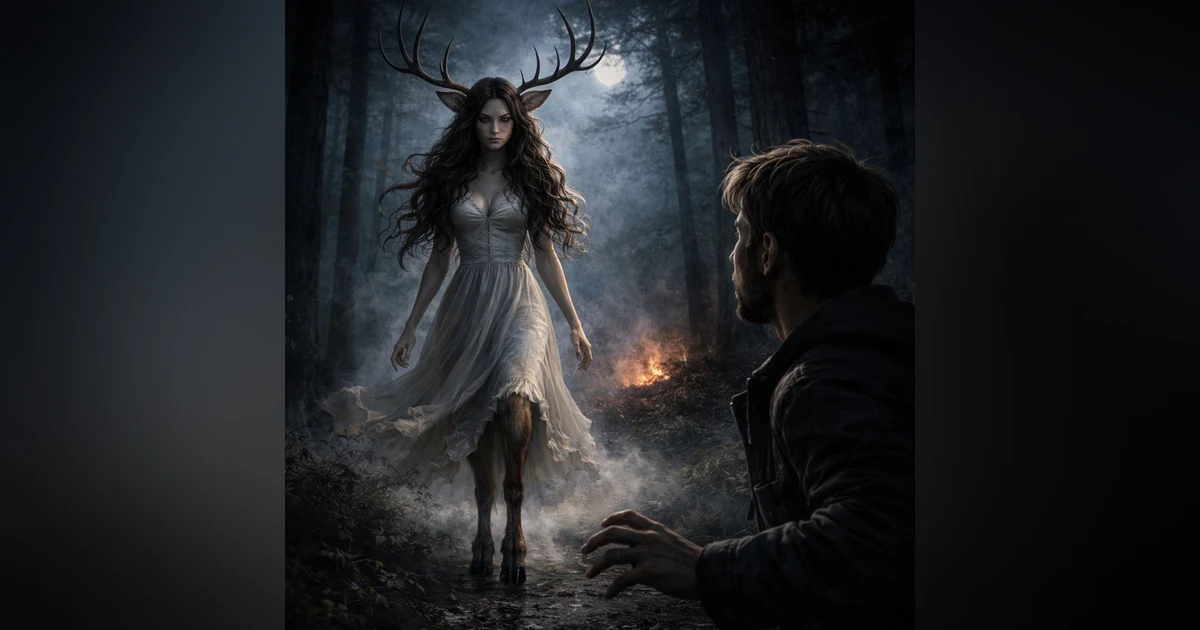

The Deer Woman is one of the most haunting figures in Indigenous folklore and modern paranormal legend—a beautiful woman with deer hooves who appears at the edge of the woods, the roadside, the party, or the dark place where safety ends. In this episode of Terrifying & True, we explore the chilling shape of the Deer Woman story, the many ways it appears across traditions and retellings, and the reason this legend still hits so hard today: because in many versions, she is not random evil. She is warning, justice, and consequence.
We follow the core pattern of the legend—the alluring woman, the reveal of the hooves, the predator becoming the prey—and examine how Deer Woman stories survive in modern encounter lore, including roadside sightings, party retellings, and the Haskell-associated versions that spread as powerful warnings inside communities. This episode also takes the careful route, separating traditional story, modern folklore, and pop-culture adaptation, while asking why so many Deer Woman stories cluster around themes of stalking, harassment, predation, and violence against women.
Inside this episode:
- What the Deer Woman is across folklore and modern retellings
- Why there is no one single “official” version
- The hooves reveal and why it makes this legend unforgettable
- Roadside, party, and encounter-story variants
- The Haskell folklore cluster and why Deer Woman persists as a warning
- The connection between the legend and predatory male behavior
- Why Deer Woman still resonates now as both horror figure and moral consequence
🎧 LISTEN NOW and subscribe for spine-tingling horror stories every week!
🎉 Unlock exclusive bonus episodes and support the show on Patreon!
👉 WeeklySpooky.com/Join
📬 Contact Us / Submit Your Horror Story!
- Twitter: @WeeklySpooky
- Facebook: facebook.com/WeeklySpooky
- Email: WeeklySpooky@gmail.com
🎵 Music by Ray Mattis 👉 Check out Ray’s incredible work here !
👨💼 Executive Producers: Rob Fields, Bobbletopia.com
🎥 Produced by: Daniel Wilder
🌐 Explore more terrifying tales at: WeeklySpooky.com
0:00 She waits where the light runs out at the tree line by the roadside, just beyond the safety of the campfire, beautiful, still almost inviting. Then you look down and see the hoofs, and in one sickening instant, you understand this isn't temptation stepping out of the dark. Its consequence. What you are about to tet is believed to be. Based on witness accounts, testimonies, and public record. This is.
0:48 Terrifying. And imagine this lonely road, A party breaking up a path through the woods after dark. A man notices a woman standing just beyond the light. She's calm, beautiful, unafraid. Maybe she smiles, maybe she says nothing at all. And then, just before he gets too close, he sees the detail that changes everything. She has hoofs. Across multiple traditions and later retellings, the figure, now widely known as the deer Woman, has endured as one of the most haunting and complicated beings in American folklore. She's not merely a monster in the woods. In many versions, she is a warning. She is judgment. She is the terrible moment when someone who thought he was the danger realizes something even worse is waiting for him in the dark. Tonight we explore the
2:21 Dear Woman legend, the folklore, the encounter stories, the modern adaptations, and the deeper reason this story refuses to die because some legends survive not simply because they frighten us, but because they speak to something communities know too well. And sometimes the tracks left behind are not just signs of something supernatural, sometimes their proof that a warning was there all along. So make sure you're subscribed as we tell that story tonight. You're in a quiet forest at dusk.
3:28 The air is thick with pine and damp earth, and somewhere behind you there's a pulse of drums, distant, steady, like a heartbeat under the ground. A young man slips away from the firelight after catching movement between the trees. He tells himself it's nothing, just a deer, just wind, the woods making shapes out of the dark. Then he sees her. A woman stands where the tree line goes black, still enough to seem planted there, waiting. Her hair catches the last strip of sunset like copper wire. When she speaks, her voice is soft enough to make him lean in.
4:30 He steps closer. She smiles, and for one terrible second, he thinks something looks wrong below the hem of her dress. He blinks, looks again, and the night begins to tilt. Because where he expected shoes, or bare feet or anything human, there are hoofs, split, dark, clean edged, pressed into the soil like a signature. He stumbles back, The air goes cold.
5:10 The drums seem louder, now closer, as if the ground itself is warning him. If he's lucky, that is where the story ends, a scare, a chill, a laugh the next morning over coffee. If he's not lucky, if he keeps walking toward the voice, toward the darkness, toward the thing that wants him to follow, the deer Woman does not vanish. She takes him, and what gets left behind is rarely a neat answer, just tracks, just silence, just the feeling that whatever happened out there was not random.
6:02 Because in these stories, the terrifying part is not only that she exists, it's that she might be the consequence of your actions. The dear Woman is a figure that appears across multiple indigenous traditions and later in modern retellings, urban legends, and pop culture adaptations. Right away, we need to draw a bright line. These are not dead stories from some sealed off past. There are living cultures behind them, communities with their own languages, histories, rules and meanings around what is told, how it's told, and who gets to tell it. So we are not flattening all of that into one neat little monster legend. We're going to do this the terrifying and true way. First will look at the shape of the story as people tell it. Then we will look at what we can responsibly say about where that story lives, what seems traditional, what looks like later folklore, and what is clearly modern adaptation. And finally we'll ask why this figure still matters now, Because by the end, the real question is not simply is the dear woman real? The deeper question is why does this warning,
7:34 this very specific one, keep surviving. Because sometimes the scariest thing is not a monster. Sometimes it's a line that people keep crossing. Strip away the century, the location and the storyteller's style, and Deer Woman's stories often follow a familiar pattern. Encounters a beautiful woman, usually at night, often near some kind of boundary, the edge of the woods, the edge of a road, the edge of camp, the edge of a party, the edge of where safety ends.
8:18 She's alluring, calm, confident, sometimes playful. Then comes the reveal hoofs, animal legs, feet turned wrong, some unmistakable sign that what looked human is not fully so. In some tellings she's openly dangerous. In others she's a test. But yet in others, even still, she is punishment. One detail keeps surfacing, however, especially in modern retellings, her target is rarely random, not the innocent wanderer, not the unlucky passerby. The target is often the kind of man everyone already knows how to describe, the man who pushes stalks, coerces corners, follows, pressures, harms, the man who thinks he can take what he wants and walk away untouched. This is what makes the deer Woman so unsettling in a way standard ghost stories do not.
9:34 She's not just danger, she's consequence. She is what appears when ordinary protections fail. For one listener, that makes her terrifying. For another, it makes her strangely reassuring, Because in many versions, the deer Woman does not function like a random predator in the dark. She functions like justice, in a form the world cannot ignore. This is where we slow down, because the Internet loves to talk about the deer Woman legend as if there's one clean, canonical version, one tribe, one origin, one agreed upon meaning. That is not how living story traditions work across indigenous communities. There are multiple stories, overlapping themes, regional differences, retellings over decades, if not centuries, and outsider distortions layered on top of one another. There are stories of women connected to deer, women who transform, women who punish, women who protect, and beings whose role is warning, seduction, danger, or justice. The Internet prefers tidy folklore, but real folklore is almost never tidy. So the honest thing to say is not here is the one true dear Woman legend. The honest thing is to say that
11:07 this is a recurring figure, appearing across multiple traditions and later retellings, carrying themes of power, danger, morality, and consequence. That matters, because once you pretend there is only one version, you stop listening to the people the story belongs to. When folklorists look at a legend, one blunt question matters, what job does the story accomplish? The Dear Woman does several at once. She warns men that predatory behavior has consequences.
11:48 She warns women and young people that danger can wear a charming face. She warns communities that ignoring harm does not make it disappear. She offers symbolic justice where real justice may be absent, delayed, or denied. Even the deer imagery matters. Deer are familiar, quiet and beautiful. They appear at the edge of headlights and vanish into brush. They're often treated as prey, So a figure that merges woman and deer creates a powerful reversal. What is usually hunted becomes the hunter. That inversion is part of the moral force of the story. The deer woman is not frightening only because she is supernatural. She's frightening because she reverses the expected order of things. She is the hunted thing that stops running, the watched thing that watches back. The more closely you look, the less dear deer woman feels like one creature in one tale. She feels like a pattern, a shape that returns whenever people need a warning. With teeth or hoofs now. We move from mythic pattern into
13:27 encounter story. This is where the deer woman becomes the kind of tale somebody tells, low and serious after dark. No listen, this really happened. Modern versions tend to be set in places that feel immediate. Roads through the woods, reservations, small towns, college campuses, bars, parties, parking lots, and they often end in one of a few ways. A man disappears, a man is found dead. A man survives but will not explain what happened. Someone notices tracks that shouldn't be there, hoof prints or footprints turned the wrong way, or marks in the mud, snow or tile that seem to say the same thing, something inhuman was here before we chase any one case, it helps to understand how encounter stories travel.
14:40 They move the way rumors do. They mutate, they attach themselves to real places. They absorb local fear. They become more believable because the setting is familiar, and because the storyteller swears it happened to a cousin, a roommate, a friend of a friend. And deer woman is built from that kind of spread because the image at the center is unforgettable. You look down, you see hoofs, and the whole story changes. One modern cluster often tied to dear woman retellings is Haskell Indian Nations University in Kansas. In those stories, a man follows a woman, ignores warnings, and by mourning he's dead, missing, or ruined. Whether any specific version is verifiable is not the only point. The legend functions there like a warning system, it spreads where people want language for danger and where a community wants to give shape to predatory behavior without pretending that harm is abstract or rare. Here's the hard truth. Encounter stories are notoriously difficult to verify. They travel by word of mouth,
16:13 They shift details, they absorb local anxieties. They attach themselves to real locations because real locations make them feel truer. Sometimes there's a real tragedy underneath a disappearance, an assault, a death, and the story grows around it. Sometimes there isn't. That does not make the legend meaningless. If anything, it may make the legend more revealing, because what Dear Woman's stories often encode is the community's sense of threat, predatory behavior, secrecy, silence, people being warned and not listened to harm being minimized until it's too late. In other words, even if you cannot confirm the deer hoofs you can often confirm the reason people keep telling the story, and that is a principle worth hanging on to. A legend can be unproven and still be true in what it reveals about the world that produced it. One common modern version happens on the road. A man is driving late at night. He sees a woman standing alone at the shoulder. She's calm, beautiful, strange, only in the way lonely things on empty roads always
17:44 feel strange. He offers her a ride. She gets in. At first, everything is normal. Then the conversation shifts. Sometimes she asks him where he's going. Sometimes she asks him what he's done. Sometimes she asks him if he's ever hurt a woman who told him no. He laughs, or lies or flirts. Then he glances down at a stoplight, maybe, or when she shifts in the seat and he sees the hoofs split black solid. He looks up and she's smiling, like she's been waiting for him to notice. In some tellings, he swerves and crashes. In others, he disappears. In darker versions, he's found the next day near the road, dead or wrecked, with prints around him that no one can explain. Again, this is not proof but it is a pattern. It's a story about boundaries. Do not pick up strangers. Do not assume vulnerability means weakness. Do not move through the night thinking it all belongs to you, because it doesn't.
19:16 Another common retelling is the party version. A man meets a woman at a gathering. She's magnetic, laughing at his jokes, touching his arm like it's nothing. He takes that as permission, so they slip outside or toward a hallway or toward a car. Then someone, a friend, a witness, somebody sober enough to notice details, sees her feet, no shoes, no socks, just hoofs. When the witness looks again, she's gone. This version usually ends with the man missing the next day, dead or very much alive, but refusing to say what happened, and it's always summed up with the same grim line, he got what he deserved. That line tells you exactly what job the story is doing. This is not only watch out for the weird woman in the dark, It's more watch out for the being the kind of man the dark is waiting for. Some versions move the reveal into a mirror. A man heads toward a bar, restroom, or some semi private place with a woman he just met, grinning to his friends on the way. Minutes later, the
20:48 screaming starts when people rush in. He's alone, collapsed, shaking, wide eyed, and he keeps repeating the same line, I saw her feet in the mirror. In some tellings, the mirror shows hoofs where human legs should be. In others, it shows something even worse, that she was never reflecting right at all. Other stories are told less as a revenge tale and more as community warnings. Watch who you follow, watch who you trust, Do not wander off with someone you don't know, do not bring harm into the circle, and expect the circle not to answer back. In those versions, dear Woman is not only punishment, she's boundary enforcement. She's the edge of the safe place. Different towns, different decades, different storytellers, same reveal, same track, same silence. At the center of the Deer Woman is a tension that gives the legend its power. She's frightening because she harms, takes, punishes, kills,
22:22 but she's also comforting because her target is often the kind of man women are forced to navigate every day, the kind of man whose danger is known but never officially confirmed. In spaces like that, a legend like this becomes a protective shadow, not because it's literally true in a courtroom sense, but because it shapes behavior. It warns. It says, if you do this, something will come for you. That something may be supernatural in the telling, it may also stand in for the community itself, finally deciding not to look away. Most horror monsters are random. They kill because that is what they do. The Dear Woman is different because she rarely shows up without moral framing. In many stories, she's selective, purposeful in a grim way, almost ethical.
23:33 That complicates the fear. It asks the listener to make a choice. Do you fear her because she's dangerous or because she exposes what you've done. That is why people often tell Deer Woman stories with two emotions at once. There's dread, but there's also satisfaction. She got him. That satisfaction is a clue. It tells you the world where the story lives is a world where him is a familiar problem. It tells you people are not merely afraid of monsters. They are relieved by the fantasy. Sometimes the hope that predation does not go unanswered. It's worth stating plainly, many Dear Woman retellings are tied to violence against women, coercion, harassment, stalking, and predation. This is not accidental or a coincidence. That is the story doing its job. Legends often become stronger where institutions fail, where people feel unheard, unprotected, or ignored.
24:57 A story like this offers a kind of moral order. If the law does not punish you, the woods just might. If the community cannot stop you, she will. This is one reason the Deer Woman survives so easily in modern settings. She provides language for a fear that has not gone away. She gives shape to the sense that danger is real, recurring, and often socially tolerated long before it's formally acknowledged, and the hoof prints are a perfect symbol for that. They are evidence that feels undeniable, even when the rest of the story is slippery. Another reason the Deer Woman has resurfaced so strongly is that people are naming predatory behavior more clearly than they used to. The story keeps up.
25:59 It shifts from do not wander into the woods to do not ignore red flags, and in that shift, the deer Woman becomes less like a fairy tale witch and more like a living warning that updates itself every generation. A random monster is just bad luck. A consequence with a pattern is something else entirely. In recent years, deer Woman has shown up more and more in popular culture. That is always a complicated moment for a figure rooted in living traditions. On one hand, modern media can introduce audiences to stories and themes they might never encounter otherwise.
26:49 On the other, media can flatten and remix a tradition until it becomes unrecognizable. A show or film might use Dearer Deer Woman as a horror figure, a social commentary figure, and a symbol of consequences all at once. When that happens, the core often survives beauty, lure, reveal punishment, but the meaning shifts depending on who is telling the story and why. So here is the careful approach we prefer to take.
27:29 Treat modern portrayals as what they are adaptations. They can be powerful, they can be respectful, they can even be brilliant, but they are not proof of an origin. They're simply part of the legends afterlife. A skeptic can reduce the dear Woman to familiar parts a cautionary tale, an urban legend pattern, a protective figure that grows stronger where communities need her. That explains a lot, But if you leave room for the part that refuses to be explained away, she remains striking because she is not merely a creature that eats. She's a judge. She appears at the boundary between what someone did and what they think they can hide.
28:28 A skeptic could argue that this is an archetype built for survival. It has a perfect visual reveal, a simple moral frame, a clear target, and endings that are hard to disprove because they thrive on disappearance, silence, and rumor. That is all fair, But even then, the deer woman can still feel haunted because she shows up where people have real reasons to be afraid. She shows up in places where walking alone at night is a calculation, where warnings circulate quietly, where danger is often recognized socially before it's recognized officially. So the legend feels ghostly because the problem it points to is still alive. The supernatural element may be debated. The social reality underneath, however, usually isn't.
29:42 Here's a modern twist that changes everything for the first time in history, a legend doesn't stay local. A story, once told within specific communities, places, seasons, and meanings can now be ripped doubt of that context and uploaded as content. The moment that happens, it starts behaving differently. It gets simplified into bullet points, It gets optimized, it gets collapsed into a checklist. Beautiful woman lures men Hoof's dead body. Lesson learned that is great for clicks and rough on truth.
30:28 Because dear Woman now sits at the intersection of three categories, people constantly confuse traditional story told within a community, contemporary folklore that shifts from place to place, and popular culture adaptation built for entertainment online. Those categories get stacked together until they look like the same thing. Then someone asks the obvious question, Okay, but did it happen? And in most cases, the honest answer is the story happened as in people told it, people believed it, people used it as a warning. It shaped their behavior around it. Did a literal woman with deer legs physically appear and drag a predator into the woods? That is the part we cannot prove from retellings alone. We have to live in that tension without cheating. When most people say evidence, they mean a police report, a news story, a photograph, a name, and a date. Folklore does not always leave that kind of receipt. Instead, folklore leaves patterns, repeated images, shared behaviors, repeated warnings, rules that communities pass along because those rules
31:59 are doing work. So if you are investigating the Dear Woman, the questions change. Where is the story told most intensely and why there? What behavior does it punish, What anxieties does it encode? What kind of danger makes people feel the need to tell it again? That is not courtroom evidence. It's cultural evidence. But cultural evidence can still be real, especially when it reflects a real world problem people are trying to survive. When it comes to the hoofs, they're not merely a cool twist. They're a nearly perfect storytelling tool.
32:47 A hoof print is simple, immediate visual. It's the kind of detail that lets the listener see the scene in one flash. More importantly, it reverses the expected power dynamic. In most stories, hoof prints mean deer prey game something you track. In Deer Woman stories, the hoof prince mean the hunter has arrived, The prey leaves proof that it was never prey at all. That reversal is what gives the legend so much emotional punch. These stories often end with a disappearance, a missing man, a body in a place that makes no sense, or a survivor who refuses to talk. That structure keeps the legend alive in the maybe space. It doesn't prove the story false. It means the story is built to live in ambiguity, and good legends know how to survive there. If we're being fair, the Dear Woman is not only a scare tactic. She's a story that offers control in a world where violence against women can be hidden, minimized, denied, or laughed off.
34:06 She refuses denial. She makes the threat visible. She makes consequences feel possible. Whether you believe she exists as a literal spirit or a symbolic force, the emotional effect is often the same. The predator is not the apex. He is not untouchable. That is why, even outside the communities most closely tied to the figure, Dear Woman still resonates. The need she answers is tragically familiar. But that also means storytellers should handle her with care. Do not collapse all versions into one official myth. Do not sensationalize the underlying violence. Keep attribution language honest, separate tradition material from campus legend from modern adaptation. Keep the moral center visible.
35:08 In most retellings, the deer Woman punishes predation, coercion, and harm, not innocent curiosity. Even if you don't buy the supernatural reading, there is something real to take from the legend. Believe people when they warn you about someone, watch your friends at parties, Take I feel unsafe seriously, pay attention to the patterns of behavior before they become headlines. And if you're the kind of guy who hears all this and thinks that would never be me, then good. The deer Woman is not hunting your innocence. She's watching those who think they can get away with it. That is the twist.
36:00 Even if she's only a story, she still changes the way people walk through the dark. So where does that leave us? If you're looking for a single, definitive answer, one tribe, one origin, one case file stamped deer Woman confirmed, You're not going to get it. You should not even expect it. The deer Woman lives in a place where fact and meaning overlap in stories told to protect people, to warn them, to explain consequence, and give shape to dangers that are very real, even when the supernatural framing is debated. And maybe that's the point. Maybe the deer Woman does not need to be proven the way a photograph needs to be proven. Maybe she survives because she's true in a different way, true as warning, True is consequence, true as the shadow that follows men who think they're untouchable.
37:06 And if you want the final question of the show, it's this, what does it say about the world If the Deer Woman is only a story and people still need her. Maybe that is why the last image in so many versions is the same. Not a scream, not a monster's face, not even a body, just tracks in the dirt or stamped into the snow, leading away from the light, proof that something was there, proof that it left with purpose. So if you ever find yourself walking away from the firelight and you hear hoofs where hooves should not be, don't chase the voice, don't follow the smile.
38:03 And if you see tracks in the dirt that look like a signature, turn around, because the woods might not be hunting you. The woods might be collecting what You Owe. Terrifying and True is narrated by Enrique Kuto. It's executive produced by Rob Fields and bobble Toopia dot com and produced by Dan Wilder, with original theme music by Ray Mattis. If you have a story you think we should cover on Terrifying and True, send us an email at Weekly Spooky at gmail dot com, and if you want to support us for as little as one dollar a month, go to Weeklyspooky dot com slash join. Your support for as little as one dollar a month keeps the show going.
38:47 And speaking of I want to say an extra special thank you to our Patreon podcast boosters, folks who pay a little bit more to hear their name at the end of the show. And they are Johnny Nicks, Kate and Lulu, Jessica Fuller, Mike Escuey, Jenny Green, Amber Hansford, Karen We met, Jack Ker and Craig Cohen. Thank you all so much and thank you for listening. We'll see you all right here next time on Terrifying and True.
