


 Apple Podcasts

 Spotify

 Spreaker

 Audible

 Castro

 RSS Feed

 iHeartRadio
Terrifying & True | Setagaya Murders: Japan's Most Chilling Unsolved Case
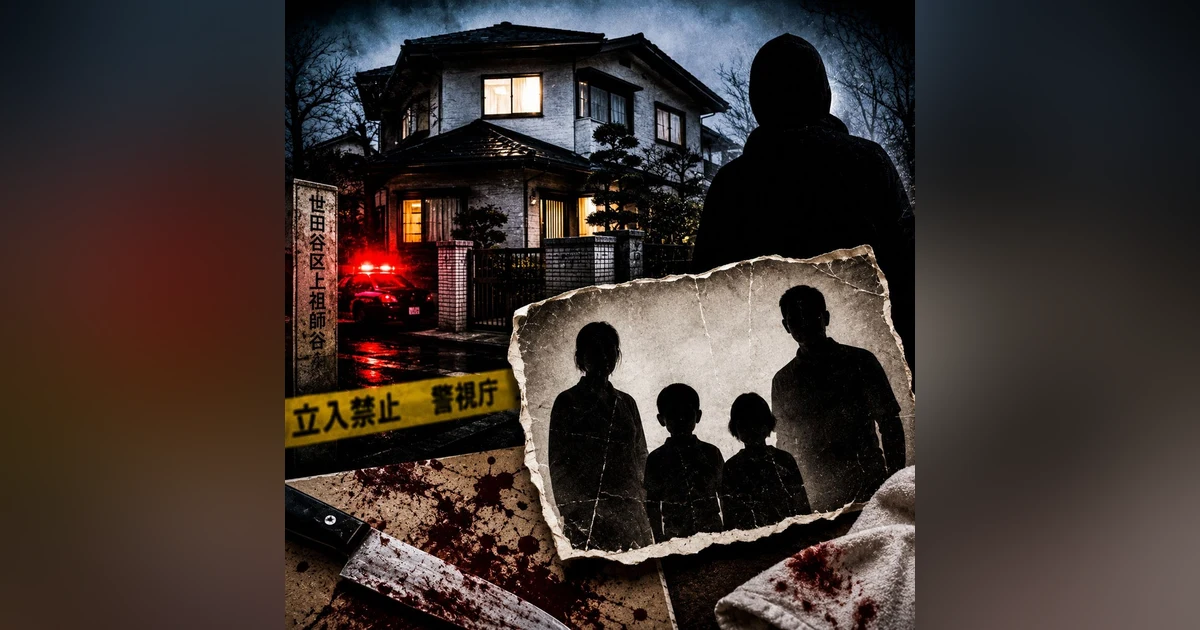

The Setagaya Family Murders remain one of Japan's most horrifying unsolved cases—a brutal true crime mystery wrapped in eerie forensics and supernatural dread. On December 30, 2000, investigators discovered the Miyazawa family in the aftermath of a nightmare that would baffle authorities for decades. With overwhelming evidence yet no killer ever caught, Henrique uncovers the haunting details, chilling theories, and the darkness that still surrounds this case.
The killer did not immediately flee. He stayed inside the Miyazawa home for hours. He ate from the kitchen. He drank barley tea. He used the bathroom. He tended to his own injuries. He touched the family computer. Then he left behind an astonishing trail of evidence: blood, fingerprints, palm prints, clothing, shoes, a hip bag, gloves, a scarf, handkerchiefs, and even DNA.
And still, more than twenty years later, police do not know his name. Inside this episode:
- The Night of the Murders: How a quiet family home in Setagaya became the scene of one of Japan’s most infamous unsolved crimes.
- The Miyazawa Family: The ordinary lives behind the case — a father, mother, daughter, and son killed inside the place they should have been safest.
- The Killer Who Stayed: Why the murderer’s hours-long behavior inside the home makes this case so uniquely disturbing.
- A Mountain of Evidence: Blood type, DNA, fingerprints, palm prints, clothing, shoes, and personal items left behind.
- Theories and Dead Ends: Robbery, personal motive, random violence, foreign suspect theories, park-side tensions, and why none have solved the case.
- The Unanswered Question: How can a killer leave so many traces and still disappear?
This is not a case defined by a lack of evidence. It is defined by the terrifying failure of evidence to become identity. The Setagaya Family Murders are a story about a home violated, a family destroyed, and a killer who left behind almost everything except the one thing investigators needed most: his name. In Setagaya, the most frightening part is not that the killer vanished without a trace. It is that he left so many traces and vanished anyway.
We’re telling that story tonight.
🎧 LISTEN NOW and subscribe for spine-tingling horror stories every week!
🎉 Unlock exclusive bonus episodes and support the show on Patreon!
👉 WeeklySpooky.com/Join
📬 Contact Us / Submit Your Horror Story!
- Twitter: @WeeklySpooky
- Facebook: facebook.com/WeeklySpooky
- Email: WeeklySpooky@gmail.com
🎵 Music by Ray Mattis 👉 Check out Ray’s incredible work here !
👨💼 Executive Producers: Rob Fields, Bobbletopia.com
🎥 Produced by: Daniel Wilder
🌐 Explore more terrifying tales at: WeeklySpooky.com
0:01 A family is murdered in their own home. The killer leaves blood, fingerprints, clothes, shoes, DNA, and even uses their computer. He eats from their kitchen, drinks their tea, tends his wounds, then he walks out of the house and disappears. More than twenty years later, Japan is still asking the same question, who was inside the house? What you were about to beat? Is believed to be based on witness accounts, testimonies, and public record. This is terrifying and on the night of December thirty, two thousand, in a quiet neighborhood in Setagaya, Tokyo, the Miyazawa family was preparing for the new year. By morning, all four were dead. The killer had entered their home from the park side. He murdered Mikio, Yasuko, Nina, and Ray in a violent attack that stunned Japan. But what happened afterward made the case even more disturbing. The intruder stayed,
1:37 He ate food from the family's kitchen, he drank their tea, he used their bathroom, he treated his own injuries, he used their computer, and when he finally left, he abandoned an extraordinary amount of evidence. Blood fingerprints, all prints, clothing, shoes, and DNA. Police could describe him in fragments, but they couldn't name him. More than two decades later, the Setagaya family murders remain unsolved, a mountain of evidence, a devastated family, and somewhere perhaps still alive, a killer who should have been caught. So get comfortable, my spookies, for a very terrifying and true episode, because we're telling that story here. Tonight, December thirtieth, two thousand, Setagaya, Tokyo, Japan. A winter night settles over Kamiso, Shigaya with the flat, dry cold of late December. The neighborhood around the Miyazawa home is quiet
3:12 in that peculiar way places become quiet when they are already half on their way to disappearing. Only a few houses still remain on that little strip of land. The park behind the property is dark, the river is close by. The paths beyond the yard feel empty more than they should, even before anything happens. The place has a faint abandoned quality to it, as though the edge of the neighborhood has already started pulling away from the rest of the city.
3:55 Inside the house, though it's just a family night before new Mikio Miyazawa forty four, Yasuko forty one, their daughter Nina eight, their son Ray six. They shop, They eat, Nina spends some time next door with her grandmother watching television, then comes home. It's an ordinary domestic evening, the kind that leaves no sign. It's about to become a border between two lives, the life before and everything. After some time between about eleven that night and dawn the next morning, someone enters the house from the park side and murders all four of them. Ray is strangled, Mikio is attacked near the stairs, Yasuko and Nina are killed upstairs. The violence is intimate, frantic, and close. A sashimi knife is used until the blade breaks. Another knife from inside the house is taken up. Blood is everywhere. The killer is injured too, and then the story takes its sickening turn.
5:29 The killer doesn't run, instead remaining inside the house for hours, eating from the family's kitchen, drinking barley tea, using the toilet and not flushing, rummaging, tending to their wounds, leaving behind blood fingerprints, a hip bag, gloves, a scarf, handkerchiefs, and one of the richest crime scenes modern investigators could ask for. Police will know an astonishing amount about the man who did this, But what they won't know is the one thing that should have been unavoidable, his name.
6:19 That's what makes the Sedagaya family murders so truly cold. This isn't a case where the killer slipped in and out like smoke, leaving almost nothing behind but carnage. It's a case where he practically remained in the house long enough to become a presence in it. He moved through a family's rooms after destroying them, shedding clues as casually as if being identified were somebody else's problem, a mountain of evidence, a faceless intruder, and some more than two decades later, no answer. The Sedegaya family murders struck Japan with particular force because the victims seemed heartbreakingly, almost painfully ordinary.
7:18 Mikiyah worked in branding and corporate identity. Yasuko had been a teacher. Nina was a lively little girl. Ray was a little boy with special needs who was deeply cared for by his family. The Miyazawas did not present like a household standing at the edge of some dramatic criminal feud. They lived next door to Yasuko's mother in a quiet residential area, and from the outside they look exactly like the sort of family most people instinctively place in the category of safe. That is part of the wound this case leaves behind. It violates not just four people, but a whole idea of domestic safety. Investigators have long focused on the rear second floor bathroom window as the likely point of entry. The screen had been removed, footprints were found in the mud outside. Some reconstructions described the killer climbing up from the park side, possibly using the tree, then slipping through that bathroom window and entering near Ray's bedroom.
8:44 The precise movement cannot be witnessed now, but the broad shape matters because it tells you how close the house sat to vulnerability, the dark park, the exposed rear side, the family asleep. The route was not mystical, It was ordinary, which somehow makes it so much worse. What seems most likely is that Ray was the first to die, strangled in his bed. He was not stabbed like the others, and investigators have long treated that difference as meaningful. Then Mikio apparently heard something or saw something and moved toward the disturbance. He was attacked near the stairs with the aforementioned sashimi knife. The assault was so violent that the blade tip had broken off in his skull. After that, Yasuko and Nina were attacked upstairs. When the first knife failed, the killer armed himself with a kitchen knife from inside the home and kept going. Even when you strip the case down to its most cautious outline, the sequence is appalling.
10:14 A child is killed in his room, A father rushes toward danger and is cut down near the stairs. A mother and daughter are driven or cornered upstairs. And this is not a distant, impersonal killing. The blood evidence, the broken blade, the injuries to the killer's own hands, all of it points to close contact, frantic movement, and a level of violence that feels almost physical to read about. But the detail that truly freezes the case in place is what comes next. He stays not for a minute, not just long enough to wipe something down or grab a few valuables, and flea for hours. Investigators believe he remains in the house while the family lies dead all around him. He consumes ice cream, he drinks barley tea, uses the bathroom, leaving his feces behind, tending to his injured hands with first aid supplies and sanitary products from the house, using the family computer in the early hours of the morning. That post crime behavior changes the emotional temperature of the case completely. This is no longer just murder.
11:49 It becomes occupation, desecration, a second trespass layered on top of the first. The killer is not merely escaping the aftermath of what he has done. He's moving inside it, settling into it, behaving with a grotesque sort of temporary comfort in the middle of someone else's annihilated home, and the house is left almost theatrically full of him. As we mentioned, clothing, shoes, a scarf, gloves, handkerchiefs, a hip bag, a sweatshirt police later emphasized was sold in extremely limited numbers.
12:36 Slazenger shoes made in South Korea, size twenty seven point five centimeters. Blood type A, the fingerprints, palm prints, handkerchiefs that may have helped him grip the knife or conceal part of his face, even traces suggesting drachar nore on the cloth that had wrapped the such knife. This is not a crime scene with one vague silhouette running off into darkness. It's a crime spree, with the killer's body, habits, injuries, wardrobe, and carelessness still hanging in the air. And then the morning comes. Yasuko's mother living next door, goes over to the house and discovers what's left at around ten forty am.
13:38 That human detail is important. For hours, unimaginable violence sat only a few steps away from a grandmother on the other side of the property line. The family was not lost in some distant wilderness or sealed away in an anonymous apartment tower. They were right there, close enough that the ordinary routines of the next morning still carried someone to the door. That's one of the reasons the case still remains so difficult to shake. It's not remote, it's adjacent, domestic, reachable.
14:24 The horror is not just that a killer got in. It's that he moved through the intimate geography of family life, the child's room, the stairs, the kitchen, the bathroom, the computer desk, and then left the survivors and investigators to walk that same geography afterward and reconstruct what happened from the things he touched. The broad factual structure of the crime is unusually strong. The victims, the rough time window, the like parkside entry, Ray's strangulation, the stabbing deaths of the other three, the killer's injuries, and his strange lingering behavior are all well established in police summaries and later reporting.
15:15 The exact minute by minute movement through the house remains reconstructed rather than witnessed, but the evidentiary base here is far richer than in most unsolved family murder cases. He did not just leave bodies behind. He left a version of himself in the house, and somehow that still wasn't enough to tell police who had been there. By ordinary true crime logic, the Sedagaya case should have been solvable. That is what gives it an almost modern myth quality.
15:55 In the age of forensic certainty, we're trained to believe that a killer who bleeds at the scene, leaves fingerprints, abandons clothing, uses the toilet, eats food, and interacts with a family computer is a killer who is eventually going to acquire a name. The Sedegaya murderer left not a trace, but an accumulation, and somehow the accumulation never closed in to an identity. One of the most talked about threads in the case is the DNA. Over the years, reporting has described analysis indicating the killer was male and that his paternal line likely pointed broadly to East Asia, while mitochondrial analysis suggested maternal ancestry connected somewhere to southern Europe, often described in press accounts as Mediterranean or Adriatic. Those findings added a strange global content to the case because they hinted the suspect might not fit the first assumptions people made. But they're not a name tag. They are probability but not biography. They narrow the field without delivering the man. The same is true of the clothing trail.
17:22 Tokyo police have repeatedly highlighted the garments left behind because they are so specific and so ordinary at the same time. A black Uniqlo Air Tech jacket, a green checked scarf, a knit cap, gloves, a distinctive sweatshirt sold in strikingly limited numbers South Korean made Slazenger shoes. There's something eerie about a police investigation spending years not only asking who did this, but also asking where a the sweatshirt was sold. Who might recognize a scarf, might remember a certain pair of shoes, it's a kind of forensic archaeology of everyday life, trying to build a human being from the retail debris he abandoned in a murdered family's home, and yet motive remains slippery. Was it robbery? Some money was taken, but not enough, and too much was left behind from the scene to feel like money was the clean factor in the crime. Was it personal? The brutality and the lingering suggest intimacy or rage, but the public record has never produced a simple, obvious enemy who snaps perfectly into place.
18:54 Could it be random? The attack feels too close, too prolonged, to committed for that explanation to rest comfortably. Was it connected somehow to the skate park behind the house, to youthful resentment, noise, territorial friction That theory has lingered because the geography invites it. The house backed onto the park, there had reportedly been local tensions. The clothing profile could be read in that direction, But a plausible atmosphere is not the same thing as a solved motive. This is one of the trap doors cases like these open beneath people.
19:42 The more clues there are, the more stories rush in to explain them. A skater, a foreigner who slipped out of Japan quickly, a military connection, a professional hit that somehow behaved nothing like a professional hit, A person grudge no one ever fully saw. Every strange object becomes a hook, Every behavioral oddity becomes the center of somebody's grand theory. The danger is that the richness of the evidence can create the illusion that speculation is the same as understanding. Meanwhile, the official investigation never really became cold in the ordinary sense.
20:30 The Tokyo Metropolitan Police kept the case alive, continued public appeals, publicized object details, and preserved the home itself as part of the investigation. Rewards remained high. This was not a file forgotten in a cabinet. It was an institutional wound. Year after year, officers inherited a case that happened before some of them had even enjoin the force, and still the same faceless figure remained at the center of it all. That may be the most chilling fact in here. This is not unsolved because no one cared. It's unsolved because people cared deeply and looked and analyzed and preserved and returned to the evidence over and over, and still the man in the house would not turn into a person on paper. Police can sketch a body, a blood type, a likely age range, a shoe size, a waste measurement, a cluster of ancestry signals, a wardrobe, a meal, a wound pattern, a behavioral profile. They can describe him in fragments so intimate they almost feel like they should easily add up to recognition, But somehow the fragments never become
22:04 a face anyone can confirm. The safest way to discuss the evidence is to separate hard trace from theory. The blood, DNA, footwear, clothing, hand injury, and extensive scene contamination are hard evidence. Theories about skaters, foreign military ties, a contract motive, or a specific grudge remain theories. Even the ancestry analysis is best treated as an investigative lead rather than a solved identity. He left enough behind for police to describe the outline of a life, just not the life itself. When people remember these murders, they all often remember the leftovers first, the ice cream, the barley t the computer, the discarded clothes, The sense that the killer did not merely survive the crime scene, but lingered inside it as if ordinary rules no longer applied. To him. Those details are important because well they're unforgettable. They can also distract from the deepest horror in the case, which is much simpler. This was
23:35 a family home, not a criminal underworld meeting, not a roadside encounter, not a place already coded in the public imagination as dangerous. A home, a father, a mother, a daughter, and a son on one of the most family centered nights of the Japanese year, inside the place where they should have been safest. That is why the case lodged itself so deeply in public memory. It violated something foundational. It made the ordinary feel porous. There's also something peculiar about the modern dread it leaves behind. Older unsolved murders often stay alive because the era failed them. There was too little evidence, too little technology, too little preservation. This case remains alive because there was almost too much evidence.
24:41 In a world shaped by forensic television and database thinking, the case feels like a rebuttal to the promise that modern systems always close the distance between clue and culprit. Sometimes a person can leave half his life at the sea and still remained nameless, and the house itself became part of the horror for years. It remained there, fenced off and preserved, a suburban home beside a park, slowly hardening into a kind of shrine to death. That image is very important. A quiet house, winter branches, the dark park at the rear, the grandmother next door, Everything ordinary except for what happened there. Not a castle in ruins, not a mythic wasteland, just a residential structure made permanently uncanny because one unknown man moved through it for a few hours, in a way no one has ever been able to fully answer for. So what is the most most grounded reading of the killer? Probably not a supernatural mastermind, Probably not the flawlessly disciplined professional. Some theories imagine the
26:14 evidence suggests somebody reckless, violent, physically capable, perhaps young. Somebody who may have counted on being difficult to identify within Japan's systems, or who believed he could disappear quickly afterward. He may have known the terrain, He may have selected the house because the parkside exposure made it more vulnerable. But once you move beyond cautious inferences, certainty falls away and fast. That is where the story lands its final sting.
26:57 The real chill is not only in the violence, it's in the comfort afterward. The killer did not just end lives. He behaved as though the house had become temporarily his, drinking their tea, eating their food, using their bathroom, all in the middle of their Ruin that post crime behavior feels like a second crime layered over the first. Not legally, but from a human standpoint, it turns murder into occupation, and occupation into desecration. That may be why the case still feels so eerie and cold, not simply because it happened in winter, and not simply because it remains unsolved, but because it presents a human being so detached that the signals which should have driven panic, flight or collapse seem not to have functioned at all. He acted less like a fleeing murderer and more like someone passing through a private interval in which everyone else has stopped existing.
28:20 So the final image is not just crime scene tape or a family portrait. It's the bathroom window at the rear of the house, the dark park behind it, Ray asleep in his room, Mikyo moving toward a sound on the stairs, Yasuko and Nina upstairs, the grandmother next door, waking in to an ordinary morning, and somewhere in those silent hours before she crosses over, one unknown man walking through the rooms, as if time has stall for everyone but him. That is the Setagaya family murders in their rawest form, a mountain of evidence, a mountain of grief, and a man who should have become identifiable, but somehow never did. The question has not changed in all these years.
29:23 Who was in that house, in this sleepy little burg in Japan. The most terrifying thing is not that the killer vanished without a trace. It's that he left so many traces and managed to vanish anyway. Terrifying and True is narrated by Enrique Kuto. It's executive produced by Rob Fields and bobble Topia dot com and produced by Dan Wilder, with original theme music by Ray Mattis. If you have a story you think we should cover on Terrifying and True, send us an email at Weekly Spooky at gmail dot com, and if you want to support us for as little as one dollar a month, go to Weeklyspooky dot com slash join. Your support for as little as one dollar a month keeps the show going. And speaking of I want to say an extra special thank you to our Patreon podcast boosters, folks who pay a little bit more to hear their name at the end of the show.
30:20 And they are Johnny Nix, Kate and Lulu, Jessica Fuller, Mike Escuey, Jenny Green, Amber Hansford, Karen Wee, met Jack Ker and Craig Cohen. Thank you all so much, and thank you for listening. We'll see you all right here next time on Terrifying and True
