


 Apple Podcasts
 Spotify
 Spreaker
 Audible
 Castro
 RSS Feed
 Terrifying & True | Black Shuck: The Hell Hound Behind a 1577 Storm
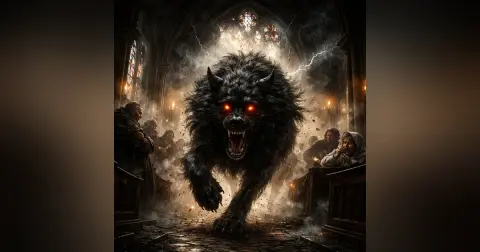
When a black hell hound with burning eyes supposedly crashed through two churches during a violent 1577 storm in Suffolk and Norfolk, was it folklore or fact? In this episode of Terrifying & True, we investigate Black Shuck—the most fearsome cryptid in English folklore—and uncover the real storm disaster that may have birth one of the world's most enduring eerie legends. From eyewitness accounts to historical records, we separate the supernatural from the historical truth.
From the shattered calm of church services in Bungay and Blythburgh, to stories of death omens, devil dogs, scorched church doors, and a beast said to move with the storm itself, this is a tale where English folklore, paranormal legend, and real historical fear collide. We explore the terrifying reports tied to the August 4, 1577 thunderstorm, the long tradition of phantom black dogs in Britain, and the grounded explanations behind one of the most enduring supernatural legends in the British Isles.
We’re telling that story tonight.
Rather than relying on the headline alone, this Terrifying & True account traces Black Shuck through the people affected, the known record, and the questions the evidence still cannot settle.
🎧 LISTEN NOW and subscribe for spine-tingling horror stories every week!
🎉 Unlock exclusive bonus episodes and support the show on Patreon!
👉 WeeklySpooky.com/Join
📬 Contact Us / Submit Your Horror Story!
- Twitter: @WeeklySpooky
- Facebook: facebook.com/WeeklySpooky
- Email: WeeklySpooky@gmail.com
🎵 Music by Ray Mattis 👉 Check out Ray’s incredible work here !
👨💼 Executive Producers: Rob Fields, Bobbletopia.com
🎥 Produced by: Daniel Wilder
🌐 Explore more terrifying tales at: WeeklySpooky.com
0:05 A storm tears across Anglia in fifteen seventy seven, inside two churches miles apart, Terrified worshipers claim the same thing came in with the lightning, a huge black dog with burning eyes, and for centuries after they gave that fear a name, black Shuck. What you were. About to bet is burnt to be Based on witness accounts, testimonies and puplic record, this is terrifying And.
0:57 On August fourth, fifteen, teen seventy seven, a violent storm descended on East Anglia, rattling church windows, splitting the sky with lightning, and leaving devastation in its wake. But according to legend, the storm did not arrive alone. In the towns of Bungay and Blitheberg, witnesses claimed a monstrous black dog with blazing eyes burst into sacred space itself, bringing panic, destruction and death. Was black Shuck a supernatural warning, a devilish omen or the fearful shape? A real disaster took in the minds of those who survived it. Tonight we step into one of England's darkest legends and follow the sound of thunder back to the night terror came in out of the storm, So make sure you're subscribed on your favorite podcast app, because we bring you something terrifying and true every Monday here at Weekly Spooky, and while you're at it, leave us a five star rating. It really does help other spookies discover the program. But now we're heading to East Anglia and the weather seems to
2:31 be turning August fourth, fifteen seventy seven, Suffolk, England. The sky is already turning dark before the service is even over. At Bungay. The light outside the church windows goes a sickly color. Then comes the thunder, not a distant rumble, but a rolling concussion that seems to drag across the heavens, like something heavy being hauled from room to room above the town. Rain lashes the glass, wind rattles the leaded panes.
3:30 People in the pews pull cloaks tighter around their shoulders and try to hold their attention on prayer, But the storm is getting inside them now. Every crack of thunder lands in the ribs. Then something worse is said to come in with the weather, a huge black dog, shaggy, fast, out of place, eyes burning like coals in a dark grate. In later tellings, it tears through the church with impossible speed.
4:11 One second, there's only thunder, smoke, and panic. Next there's this thing rushing the aisle while the congregation recoils into itself, grown men stumbling backward, women screaming, children clinging to whatever hands they can find. Some stories say two worshipers died there. Some say the beast vanished as suddenly as it appeared, leaving only terror, storm damage, and a story nobody could tell without making it sound larger than life. And if that were all, it would already be enough for a legend.
4:56 But the story says it did not stop in Bung. Roughly a dozen miles away, at Holy Trinity Church in Blitheburg, another congregation is trapped in that same storm. Lightning tears across the sky. The church itself is said to be struck. Fire flashes, smoke rolls. Men and women crouch or run, or simply freeze where they stand because there's nowhere else to go. In the confusion, thunder, falling, debrieze, scorched air, prayers half shouted and half swallowed. In that moment, the black dog appears again, or so the legend says, rushing up the aisle like judgment given shape and then it's gone back into the storm, back into the black weather that delivered it. On the church door, darth marks are still shown to visitors as the creature's calling card, the devil's fingerprints. That beast has a name now, Black Shuck old Chuck, the hellhound of East Anglia. Sometimes it's described as the size of a large dog, sometimes as big as a calf, a pony, even a horse. Sometimes it
6:29 has two blazing eyes, sometimes only one, fixed in the center of its skull, like something ancient and malformed. Sometimes it means death. Sometimes it escorts the lonely safely home. But in its darkest form, black Shuck is what awaits on a road when the mist gets too thick, when the churchyard empties, when the lane goes quiet and you realize the footsteps behind you don't sound human at all. And that is why this story has stood the test of time, because black Shuck is not just a monster.
7:17 It's the weather, darkness, bad luck, old roads, death, and the animal part of the mind that still believes something large is breathing just beyond the reach of the lantern. Because once a storm has a face, people do not forget it. Before we get to what might be true, we have to stay for a while where black Shuck lives best. In the story, black Shuck belongs to East Anglia, especially Norfolk and Suffolk, but also nearby parts of Essex and Cambridgeshire, and he is one of the most famous examples of the British isle's wider black dog tradition. Britain is crowded with phantom hounds, churchyard dogs, death portending dogs, lane haunting dogs, guardian dogs, demon dogs. Black Shuck is east Anglia as version, but calling him merely local under sells him. He's one of the great old monsters of English folklore, and like most folklore that survives for centuries, he is inconsistent in exactly the right way. A modern monster tends to come with a fixed design, black Shuck
8:51 does not. He shifts depending on who saw him, where they were standing, what the weather was doing, and what they already feared. In one telling, he is enormous, black, shaggy, silent footed, with blazing red eyes. In another, as we mentioned, he has only one eye, but in another he is less a dog than a pressure in canine form, something seen at cross roads in churchyards on marsh roads beside hedges, or moving just past the edge of vision, where moonlight and mist distort everything. Some stories treat him as a straight omen See him and someone will die. Others make him eerie but not wholly malicious, a strange escort for women traveling alone, or a presence that appears near danger without directly causing it. That slipperiness is part of what keeps him alive. He can absorb whatever a place most fears.
10:05 Even the name does half the work. Schuck is generally linked to the Old English scuka, meaning demon, fiend, or something frightening. This is not just a black dog, It's the fear dog, the devil dog, the thing older relatives warn you about when the marsh fog creeps in and you are foolish enough to take the long road home after dark. And East Anglia gives that warning a perfect stage. Flat country, huge sky, marshes, reed beds whispering in the wind, sudden banks of mist, coastal roads, isolated lanes, church towers rising from the landscape like fixed points in a place that can otherwise feel all weather and distance. Black Shuck does not belong to a crowded city. He belongs to country where a traveler can feel watched simply because there's so much open space and so little human noise to push back the dark. He's the kind of legend that only needs one flash of movement, one barking dog in the wrong place, one lonely walk gone strange, and half the work is already done. Then comes the most famous
11:39 tale of all, the Storm of fifteen seventy seven. On August fourth of fifteen seventy seven, a violent thunderstorm hit the region. The best known early written account is associated with Abraham Fleming's pamphlet A Strange and Terrible Wonder, which describes the Bungay event in dramatic, moralizing terms. Later, folklore binds Bungay and Blitheberg together into one unforgettable night. The black dog comes into one church, leaves death and terror behind, then seems to race through the same storm and appear at the other. That image is almost unfairly powerful. Not a peasant rumor about a ghost near a hedgerow, not a vague fireside tale about hearing something at a crossroads.
12:45 A black dog invading sacred space during a storm while people are already on their knees. That is the kind of image that survives because it feels like more than a haunting. It feels like a warning, a punishment, a sermon with teeth. And that mattered in sixteenth century England, where whether death and divine judgment were not cleanly separated in the imagination, a bolt of lightning was not just meteorology. A disaster in church was not just bad luck. The world felt morally charged, So if terror entered with the storm, people were primed to ask not only what happened, but what it meant. That is where the human part starts to become apparent. Imagine the congregation not as names on a page, but as bodies in a room, wet wool, mud on boots, children trying not to cry, Someone already frightened of storms before this one began. Someone glancing toward the windows every few seconds, Someone muttering prayers faster as the thunder gets closer. Someone deciding later, maybe honestly, maybe helplessly,
14:16 maybe because the memory itself has already started changing that in the flash and smoke and confusion, they saw not merely lightning damage, but a beast. That is how folklore takes shape, not because everybody calmly agrees on a fact, but because a terrifying event gives frightened people an image sturdy enough to carry afterward, and once black Shuck was loose in the local imagination, he stayed that way. Later centuries placed him on coast paths, in churchyards, along village roads, in the broads, beside Marshland tracks near Reedham, Coltishawl, potterheiem Berg Castle, Blythberg, Marshes, and plenty of other places already have to go story country. Exact sightings vary wildly in detail and credibility, but that is almost beside the point.
15:22 The pattern is the thing. Black Shuck became not one incident but an ongoing possibility. He's not one story, He's a whole category of dread wearing the same black cloak. The folklore around black Shuck is unquestionably real and honest folklore. East Anglia has a long established black dog tradition, and the Bungay and Bleithberg storm of August fourth, fifteen seventy seven is the event most strongly tied to black Shuck in the surviving written tradition. The specific details exact size, i count, behavior, and whether the same creature appeared in both churches belonged to legend rather than anything that can be historically verified. Once people decided the storm had come with teeth and eyes, East Anglia did not just remember a disaster. It remembered a creature. Now it's time to ask the less romantic question, what probably happened? The short answer is that something dramatic, almost certainly did occur. On August fourth, fifteen seventy seven. There really was a severe storm.
16:53 Bungay's church was struck by lightning, and later sources connect that event to real damage and deaths. Blitheberg also preserves a deep tradition linking the same storm to lightning, destruction and panic inside the church, So the historical seed is not invented out of nothing. There was weather, there was fear, and there was damage. There may well have been fatalities, and lightning is already theatrical enough to create monsters. Imagine being trapped in a sixteenth century church during a violent thunderstorm.
17:42 There's no modern forecast, no electric light, no easy separation between natural catastrophe and divine meaning. The room brightens white with a strike, then black again. The smell changes smoke, scorched wood, hot stone, wet clothing, people scream, because that's what human beings do when the world suddenly becomes noise and fire. Someone falls, someone is burned, someone thinks they see movement in the nave or the doorway at the exact instant lightning strobes the interior. In that moment, a black dog does not have to physically be there for the story to begin. It only has to feel as though terror has entered the room. That is especially important because Abraham Fleming's pamphlet is not modern journalism. It is a sixteenth century religious broadside, and thus those were built to moralize. Disaster was not just described, it was interpreted.
19:07 A terrible event became a wonder, a warning, and a sign. So even one of the oldest written versions we have is already filtering panic through theology and rhetoric. The black dog in that context is not merely evidence its meaning. Then there are the famous marks at Blitheberg. They are real in the sense that visitors can be shown dark marks on the church door and told they are black shucks, claw prints or the devil's fingerprints. But that is very different from those marks being good evidence for a supernatural beast.
20:05 More grounded explanations include lightning damage, ordinary wear over time, or deliberately made protective burn marks. The marks matter because they make the story tangible. They do not matter because they prove a hell hound. And then there is the animal question. Was Black Shuck based on a real dog or wolf like creature, Maybe, but only loosely. There were certainly large dogs in Britain, mastiff type animals, hunting dogs, farm dogs, strays in bad weather, poor light, or the chaos of a storm. An ordinary large black dog can become something much larger in memory. But the strong explanation is probably not one flesh and blood animal. It is collision, real dogs, dangerous roads, local grief, older mythic motifs, Christian fear, weather violent enough to demand a villain. That is usually how durable folklore works. It's almost never just one thing.
21:26 Take one real storm, add lightning damage, deaths or injuries, witnesses trying to explain something they barely understood while it occurred. Add a preacher or pamphleteer eager to frame that event as a spiritual warning. Add an older regional tradition of ghost dogs and death omens on lonely roads. Give the story a few generations to settle, sharpen, and retell itself health. By then nobody can neatly peel the weather back out of the demonology. There is another wrinkle too, and it's one of my favorite parts of the whole legend. Black Shuck is not always evil. That inconsistency makes him feel older, stranger, and more folkloric. In some tellings, he is a death omen.
22:29 In others he escorts or protects vulnerable travelers. That suggests something important. The church invading demon and the eerie roadside guardian may be different masks worn by the same older local spirit, a pre Christian or folk supernatural presence can be morally slippery in a way later religious retellings often aren't. Once you pass the story through churches, sermons, and pamphlets, the shape hardens, the old road spirit becomes the devil's dog, which brings us to the real historical question. Underneath of all of this is black Shuck based on true history, yes, but not in the tidy way people often mean. The fifteen seventy seven storm appears to be the historical trigger event most responsible for fixing the legend. In writing, the broader black Dog tradition predates and exceeds that one Sunday.
23:47 So black Shuck was not created from nothing in a single thunderclap. But Bungay and Blitheberg seem to be the moment when older regional fears, a genuine weather disaster and moral interpretation fused into the version that lasted centuries. That is the core truth here. Not a demon dog proved real, a catastrophe vivid enough to give an old fear a permanent name and a face. The strongest grounded explanation is not that black Shuck was neatly debunked, but that a real storm disaster in fifteen seventy seven merged with an already existing black dog tradition. By the time the weather was done, East Anglia did not just have damage to explain, it had a devil shaped answer. There is one final reason black Shuck works so well as folklore. Even after after you strip away the literal monster, the story does not get any less eerie. It gets more human, because what black Shuck really preserves is the feeling of terror when people do not understand what is happening around them.
25:20 A church struck in a storm, a crowd trapped in noise and fire, smoke, darkness, splintering wood, collapsing masonry, screaming parishioners, someone falling, someone praying harder because prayer is all they have left, Someone staring into the black doorway, certain, absolutely certain that something living came in with the lightning. That is frightening enough without a hell hound. The supernatural layer is almost a coping mechanism. It gives chaos a face.
26:03 It makes disaster feel less random by making it intentional, and once a place has that kind of story attached to it, the land starts doing some of the work all by itself. Blitheberg is still tied to Black Shuck to this day, Bungay still wears the legend. The tale feeds tourism, local pride, local weirdness, local art, local memory. This is important because it shows how folklore survives, not by being proven in a courtroom or in a laboratory, but by being useful, useful for identity, for atmosphere, for the delightful pleasure of living somewhere that feels and stranger than the modern world usually allows. There was even a modern flap over supposed black Shuck bones in twenty thirteen.
27:13 Archaeologists at least an Abbey uncovered the remains of a large dog, and some early coverage quickly inflated that into talk of proof that black Shuck had existed. Later analysis made the find much less supernatural and much more ordinary, likely the remains of a large dog from a later period, perhaps even a valued farm or working animal, which is in its own way the perfect ending. The legend is still so alive that people are eager to turn any giant dog shaped thing the earth can give back into every evidence, and that feels right because black Shuck has never depended on proof. He survives because he belongs to a family of fears that never go out of date.
28:15 Fear of darkness, fear of the road, fear of storms, fear of death, fear that some places are thin and some nights are wrong. The black dog with burning eyes is simply the costume those fears were in East Anglia. Strip away the fur and glowing gaze, and what remains is much older than church pamphlets. It's the sense that landscape can hold memory, that weather can feel personal, that a traveler can still meet something out there that does not belong to the ordinary world, even if that something is only terror given shape by the human mind. So is black Shuck real, not in the sense of a wildlife survey or a police report, but as folklore, as atmosphere, as flavor, as a record of how communities process danger, death, weather, and isolation. Yes, absolutely, black Shuck is real in the way all great monsters are real. He leaves marks on places, He shapes memory, He gets handed from mouth to mouth until people start glancing over their shoulder on certain roads
29:45 without even knowing exactly why. And that is the image worth ending on a church after the storm, wet stone, splintered wood, the air still smelling of lightning, a congregation trying to explain what happened. Maybe it was only thunder, it was only fire, It was only grief and fear that gave the dark a shape it did not deserve. Or maybe just maybe something old and black and shaggy came in with the weather and left before the prayers were done. Either way, if you find yourself walking a lonely East Anglian road after sunset and you hear padded footfalls behind you that somehow also make no sound at all, you may not care which explanation is right. You'll only care that you do not turn around too slowly because weather black shuck was ever Flesh and blood matters less than this. For centuries now, East Anglia has known exactly what shape fear takes when it comes out of the storm.
31:14 Terrifying and True is narrated by Enrique Kuto. It's executive produced by Rob Fieldsman bobble Toopia dot com and produced by Dan Wilder, with original theme music by Ray Mattis. If you have a story you think we should cover on Terrifying and True, send us an email at Weekly Spooky at gmail dot com, and if you want to support us for as little as one dollar a month, go to Weeklyspooky dot com slash Join. Your support for as little as one dollar a month keeps the show going. And speaking of I want to say an extra special thank you to our Patreon podcast boosters, folks who pay a little bit more to hear their name at the end of the show, and they are Johnny Nix, Kate and Lulu, Jessica Fuller, Mike Escuey, Jenny Green, Amber Hansburg, Karenwemet, Jack Kert, and Craig Cohen. Thank you all so much and thank you for listening. We'll see you all right here next time on terrifying and true
