


 Apple Podcasts

 Spotify

 Spreaker

 Audible

 Castro

 RSS Feed

 iHeartRadio
Terrifying & True | The Fox Sisters: When Spiritualism's Greatest Hoax Fooled a Nation
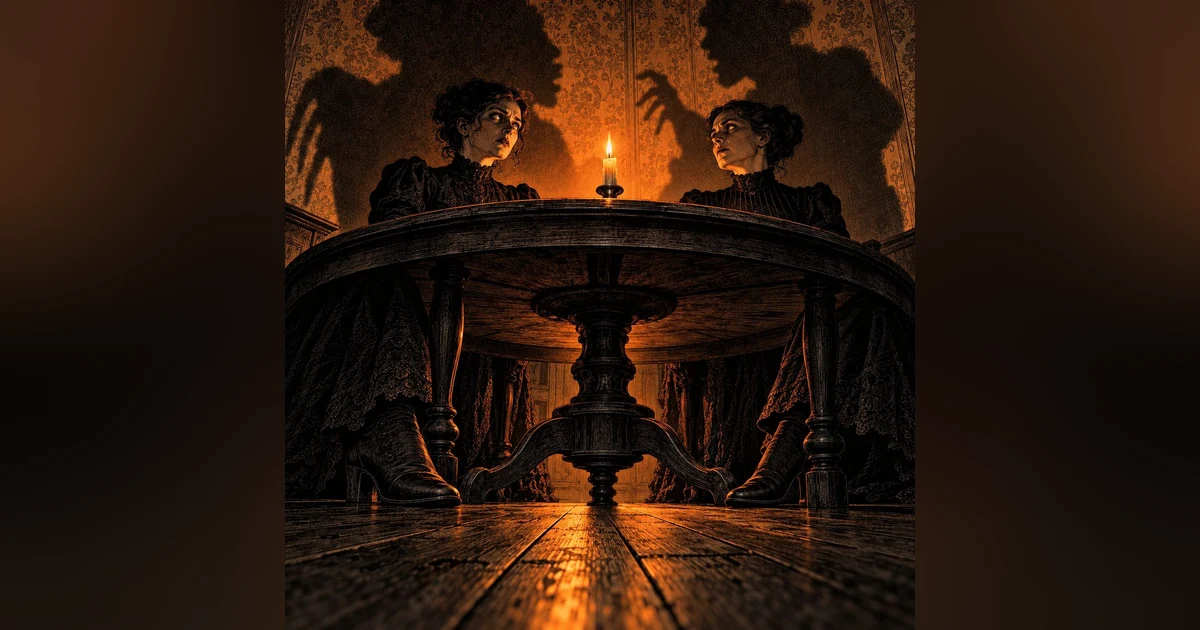
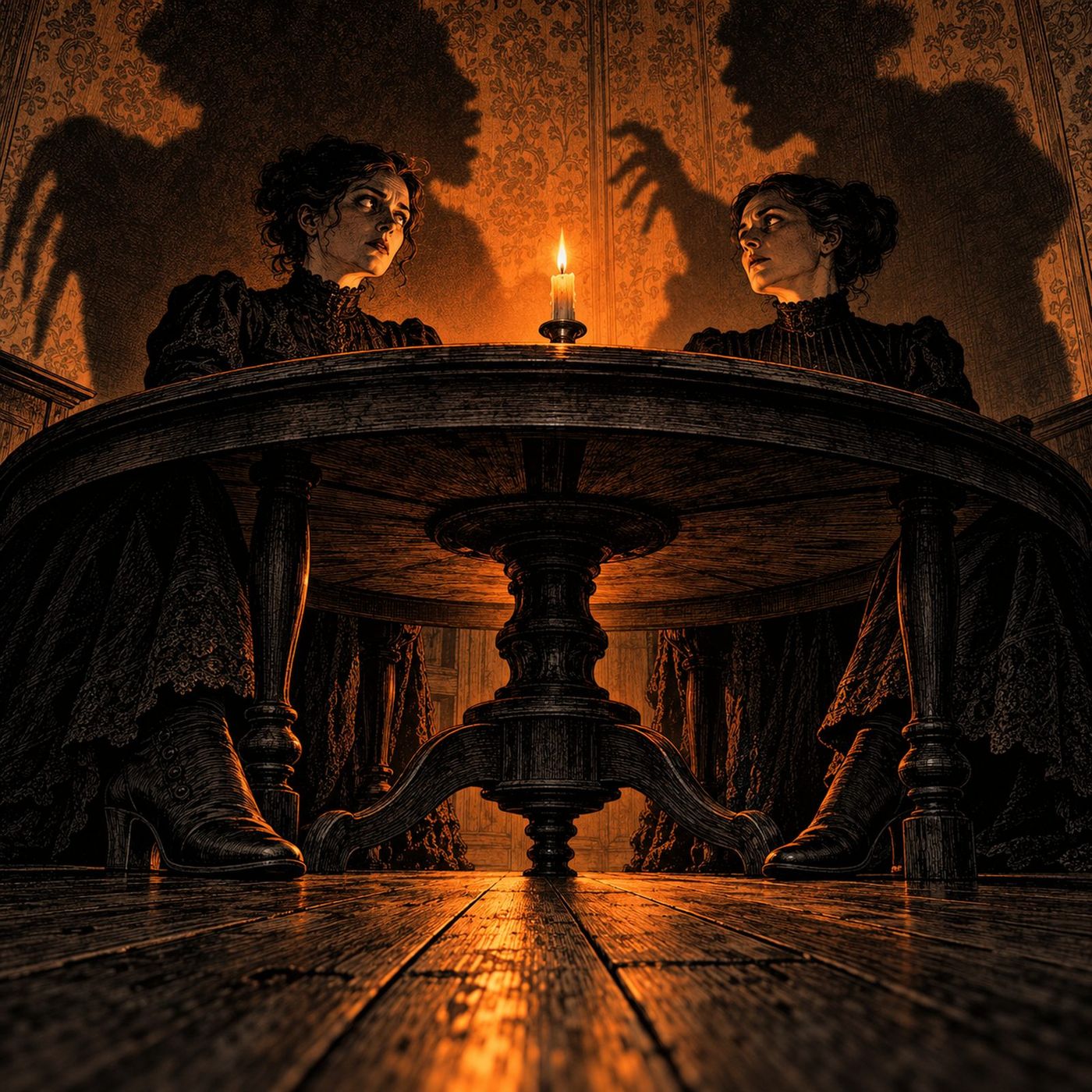
The Fox Sisters sparked spiritualism's biggest hoax in 1848 Hydesville, New York. Maggie and Kate claimed they could communicate with spirits through mysterious knockings—a deception that captivated millions, spawned folklore legends, and shaped paranormal belief for generations. Explore how two sisters' ghost story became history.
But was it a true haunting… or one of the most consequential paranormal hoaxes ever performed?
Inside this episode:
- The Hydesville Rappings: How strange knocks in a farmhouse became a chilling code from “the dead.”
- Maggie and Kate Fox: Two young girls caught between childhood mischief, family pressure, celebrity, and exploitation.
- Leah Fox and the Spiritualist Machine: How the sisters’ older sibling helped transform a local haunting into a public spectacle.
- Seances, Grief, and Belief: Why 19th-century America was so ready to believe the dead could answer.
- The 1888 Confession: Maggie Fox’s shocking public admission that the spirit rappings were produced by physical tricks.
- The Bones in the Wall: The strange 1904 discovery that seemed to vindicate the legend… until the certainty began to fall apart.
This is not just a ghost story. It is a story about grief, faith, fraud, family, and the terrible human hunger to hear one more message from someone we have lost. Whether the Fox Sisters were frauds, victims, performers, believers, or all of those things at once, their story changed the way America imagined the dead.
From a cold farmhouse in Hydesville, New York, to packed lecture halls and séance parlors, the Fox Sisters helped build a movement on one promise: ask the dead a question, and they might answer.
We’re telling that story tonight.
🎧 LISTEN NOW and subscribe for spine-tingling horror stories every week!
🎉 Unlock exclusive bonus episodes and support the show on Patreon!
👉 WeeklySpooky.com/Join
📬 Contact Us / Submit Your Horror Story!
- Twitter: @WeeklySpooky
- Facebook: facebook.com/WeeklySpooky
- Email: WeeklySpooky@gmail.com
🎵 Music by Ray Mattis 👉 Check out Ray’s incredible work here !
👨💼 Executive Producers: Rob Fields, Bobbletopia.com
🎥 Produced by: Daniel Wilder
🌐 Explore more terrifying tales at: WeeklySpooky.com
0:01 A farmhouse goes quiet, a little girl snaps her fingers, something in the dark snaps back. Soon the knocks become answers, the answers become a dead man, and the dead man becomes a movement that convinces millions. The grave has a voice. But when the truth finally comes out, the haunting doesn't end. It only gets uglier. What you are about to pet you is belived to be based on witness accounts, testimonies, and pupply record. This is terrifying and truth. In the spring of eighteen forty eight, in the small community of Hydesville, New York, a family began hearing sounds they couldn't explain.
1:09 Knocks in the walls, raps from the floor, answers from the darkness. At the center of it all were two young sisters, Maggie and Kate Fox. To some, they were gifted mediums who opened a doorway between the living and the dead. To others, they were frightened children trapped inside a lie that grew too large to escape. Their story would help launch modern spiritualism, fill seance rooms across America, and offer comfort to thousands of grieving believers, But decades later, one of the sisters stepped onto a stage and claimed the miracle had been a trick all along. Was Hydesville truly haunted? Were the Fox sisters frauds? Or were they victims of a world that wanted the dead to speak so badly it refused to let two girls fall silent, get comfortable. As we tell that story here tonight, March
2:39 eighteen forty eight, Hydesville, New York. Winter is losing its grip, but it hasn't let go yet. The roads are half mud, half frozen ruts. The fields outside the Fox farmhouse look dead under the moonlight, and the last of the cold clinging to everything. Wind slips through the cracks in the boards. Somewhere in the dark. The house gives the ordinary complaints of an old place settling for the night. Then something answers back. A knock, not loud, not dramatic, just wrong.
3:30 Another from somewhere else, Then another sharp, this time deliberate. Inside, the Fox family lies awake, listening, a mother trying to calm herself, a father trying to sound practical, children staring into the dark. Every small noise suddenly charged with meaning. Was that the wall, the floor, under the bed, in the frame of the house itself. It's impossible to say what makes it worse. The sounds do not come from one place. They seem to move, to wait to respond.
4:22 Night after night, the noises return. At first, maybe you tell yourself it's the wind mice in the walls, timber shrinking pipes, anything. But old houses make random sounds, and these do not feel random. These seem to listen a wrap after a question, a pause as if thinking, then a reply. The youngest girls in the house, Kate and Maggie Fox, are frightened, then fascinated, then playful, in the way children sometimes become. When fear starts turning into a sort of game, Kate snaps her fingers and dares the unseen presence to do the same. A knock answers the room changes. What had been a household nuisance becomes a conversation.
5:31 Soon they have a code one rap fre yes two for now. Questions bring answers. Answers become identity, and before long the thing in the room is no longer just a sound in the walls. It is, as they say, a murdered peddler, buried somewhere on the property. Now the dead have a voice, and the living cannot stop listening. Neighbors hear the story, then they come to hear the knocks for themselves. In a little place like Hydesville, that kind of news spreads in dry timber, fast, hot, and hard to put out. People crowd into the farmhouse wanting the same thing every ghost story promises and almost never delivers proof, and the story just keeps growing. What begins in one drafty room in upstate New York doesn't stay there.
6:44 It spills outward into parlors, lecture halls, newspaper columns, seance circles, and crowded theaters. It crosses cities, then countries. It helps ignite an entire movement built on one intoxicating promise that death is not the end and the dead can still answer when called. But if those voices from beyond were not voices at all, if the foundation of the movement was built on cracking joints in the dark, suggestible adults, frightened children, and people hearing exactly what they needed to hear, then the Fox Sisters are not just a ghost story.
7:37 They are something even more unsettling. They are a story about grief made vulnerable, about performance mistaken for revelation, about what happens when a child's eerie little trick meets an audience desperate for eternity is once people believe the dead are speaking, they do not simply want the truth, They want one more knock. To fully understand why the Fox sisters are relevant, you have to picture the country they emerged into. Mid nineteenth century America was loud with conviction, revival meetings, reform movements, utopian communities, prophecy mesmerism, mystical experiment, spiritual hunger. The culture was already vibrating with the sense that hidden truths might be waiting just beyond the visible world.
8:45 To modern years, the claim that the dead could communicate with the living sounds outrageous to many people. Then it sounded thrilling, consoling, and very possible. Margaret Fox called Maggie, and her younger sister Catherine or Kate, moved in with their family to a farmhouse near Hydesville in eighteen forty seven. The next year, famous disturbances began. Rappings, knockings, night noises. Not a single grand apparition, not some flaming ghost spectacle, but a series of sounds ordinary enough to explain away and unnerving enough not to That is how stories like this gain their traction. They start with ambiguity. As we previously mentioned, Kate's challenged to imitate the snapping of her fingers led to questions. Could it count yes? Could it identify ages? Yes? Was it the spirit of a murdered man? Yes?
10:04 Once their family and their visitors settled on a code, the house became something new, not a haunted home, but a machine for producing answers. And once a mystery starts answering questions, people stop treating it like a mystery. A noise becomes a sign, a sign becomes a message, a message becomes a revelation. Neighbors came to witness it. Some were frightened, some were skeptical, Some almost certainly arrived already hoping to be convinced. The story passed beyond the farmhouse walls, and with that it slipped out of the family's control, or maybe more accurately, into the hands of the person most capable of exploiting it. Leah Fox the Older, her sister, is one of the messiest and most interesting parts of this story, because she appears not as some passive relatives standing off to the side, but more as a force.
11:14 She saw immediately that Hydesville was no longer just a family embarrassment or a local panic. It was an opportunity. She brought the younger girls to Rochester, where the Rochester rappings became a sensation, and she helped transform two frightened children into public instruments of wonder. That transformation should be ugly, because the moment you stop picturing Maggie and Kate as famous mediums and start remembering them as girls, the whole situation changes. You see children being watched by rooms full of adults, strangers leaning in for signs of eternity, their gestures interpreted, their silences filled in, their fear turned into theater, and whether the girls began it, embellished it, believed it, or got swallowed up by it, they were still very young when the world decided they had access to the grave.
12:24 In November of eighteen forty nine, Maggie and Kate reportedly demonstrated their powers before a paying crowd at Rochester's Corinthian Hall. Hundreds came. Imagine the sound in that room before the show begins. Coats, rustling chairs, squeaking and groaning, people, whispering, skeptics, smirking, believers, braced for the promised revelation. Then imagine the pressure on the two young girls. They're no longer in a bedroom with frightened parents. They're in public, now on display. Their value tied directly to whether the dead keep performing. By eighteen fifty, the sisters and Leah Or in New York City holding regular seances. Important people came, curious, people came, mourning, people came. Horace Greeley, the powerful editor of the New York Tribune, was among those impressed enough to show them support.
13:37 That was a big deal, because celebrity does not just create fame. Once influential people treat something as plausible, the public gets more comfortable with surrendering to it. And the thing about celebrity is that it doesn't require truth, only appetite. Soon, the Fox sisters were no longer the center of a curiosity. They were the center of an expanding market. Other mediums emerged, imitators appeared, seances spread, spirit communication moved from scandal to fashion to belief system. Modern spiritualism traces its rise directly to Hydesville in eighteen forty eight, which is an astonishing legacy for one farmhouse, one family, and one series of noises in the dark. But the story gets more disturbing when you look at what successes did to the sisters themselves.
14:47 They grew up inside apart they could not easily leave. Maybe at first there was mischief in it, or maybe fear, maybe a kind of improvisation, maybe a child realizing adults were reacting in ways she could control. But once the money came in, once crowds gathered, once newspapers printed their names and strangers stared at them like vessels of the beyond, the performance solidified all around them. The sisters were no longer free to simply be children who had gotten carried away.
15:27 Too many people now needed the thing to be real. Leah needed it to be real, Believers needed it to be real, and the paying public needed it to be real too, and perhaps, after a while, Maggie and Kate needed it most of all. That's where the human messiness really starts to creep in, because neat fraud narratives are emotionally satisfying, but real lives almost never stay neat. Maggie later attached herself to Alicia Kent. Kane pulled away from active mediumship for a time and converted to Catholicism, Kate moved deeper into public spectacle. Both sisters struggled under the strain, both learned to drink heavily. Both seem, in different ways, to have buckled under the burden of becoming symbols before they were equipped to understand what that even meant. And that may be the bleakest reading of the whole story, not that they fooled the world, but that once the world decided it needed them, it would not let them stop.
16:52 Imagine being a child doing something eerie in the dark, maybe as a prank or a game, or as a response to a house filled with tension, and then watching adults build an empire out of it, watching them hand you a roll, a script, a destiny, watching every doubt become betrayal, every hesitation become danger, every attempt to escape met with the same demand, do it again, make the dead speak again, give us one more sign. And if that is what happened, then the first true haunting in the Fox Sister's story was not in the walls of the farmhouse. It was in the room full of adults who would not let the children fall silent. The basic historical framework here is solid. The Fox family moved near Hydesville in eighteen forty seven. The famous rappings began in eighteen forty eight. Leah did help manage and promote the younger sisters, and by eighteen fifty they were conducting seances in New York City. Major historical reference works do indeed place the rise of modern spiritualism right there in Hydesville.
18:17 What remains much harder to pin down is the sister's interior reality at different stages, whether they always understood the events as fraud, whether belief and performance blurred together, and how much family pressure, fame, and money shaped what followed. What began as a noise in the night was now a profession, a spectacle, and a promise to the grieving. And promises like that do not fade quietly. They demand to be fed. If our show so far has been about the birth of a legend, now we're going to talk about the machine that turned that legend into a movement.
19:04 The Fox Sisters did not simply become famous. They became a template. Once the Hydeville story escaped into public life, spirit communication spread with extraordinary speed. Seances became social rituals. Parlors were now little theaters for longing mediums became interpreters between the living and the dead. A table, a darkened room, and a set of coded responses. That was all it took to create the sense that another world was pressing close against this one, waiting, almost begging to be heard.
19:50 And in Victorian culture, where death was common, mourning was public, and grief was often prolonged and ritualized, that promise was almost impossible to resist. Imagine a mother who has buried a child, a widow with no final goodbye, a father still replaying the last look on a son's face. Now imagine someone telling them that the silence of death might not be silence at all, That with the right medium, the right room, the right conditions, the dead might answer back.
20:33 That is not just entertainment, that is the ultimate human temptation. By the eighteen eighties, estimates placed the number of spiritualists in the millions across the United States and Europe, and the movement gained still more force during and after the Civil War, when the scale of death shattered families expand to unprecedented amounts. In that context, the Fox Sisters were not merely selling weird thrills to curious audiences. They were standing at the headwaters of a culture wide answer to mass grief, which is what makes the moral center of their story so uncomfortable. If the phenomenon was fraudulent, then what exactly were they doing? A lie or a performance, a coping mechanism in costume, or a con that sometimes soothed the people it deceived while making sure they were freed of their hard earned money. Because even if you strip down every supernatural claim from the story, the emotional transaction remains. People in pain wanted signs. They wanted continuity.
21:59 They wanted not philosophy or doctrine. They wanted proof, a knock, a name, a coded answer from the dark. The Fox Sisters stepped into that hunger and turned it into a livelihood and eventually a cottage industry. And almost from the beginning, some people suspected exactly that skeptics followed them. Early observers proposed natural explanations, some suggested correctly or merely so that the wrappings might be produced by the body itself. But skepticism could not kill the phenomenon. If anything, it sharpened its edges. Believers reinterpreted criticism as persecution. Doubt became evidence of closed mindedness. Exposure became part of the drama, and that pattern should feel familiar. Movements built on wonder often survived contradiction because they turned the contradiction into fuel. Maybe a medium faked some manifestations, believers might say, but that does not mean all of them were fake. Maybe a performance was embellished, but the underlying gift was still real.
23:26 Once people have tied their grief, hope, and identity to a system of belief, embarrassment alone rarely tears it down. Then came eighteen eighty eight, forty years after the Hydesville rappings, Maggie Fox turned on the story that had made her. On October twenty first, eighteen eighty eight, The New York World published in interview ahead of her appearance at the New York Academy of Music. She was reportedly paid one thousand, five hundred dollars for the exclusive, which is over fifty two thousand dollars when adjusted for inflation. Kate was there too, supporting her. Maggie declared that she and Kate had begun the phenomenon as children, and that the mysterious sounds could be produced by simple physical means. An apple on a string in one telling, and more famously, the manipulation of joints in the toes, feet, and other parts of the body.
24:42 Then she demonstrated it. That scene is one of the great ugly reversals in American occult history. Imagine that room, the academy packed spiritualists, outraged or anxious, skeptics delighted the a woman at the center of one of the century's great supernatural movements, standing before them, not as a medium anymore, but as a witness against herself, and in a way, a whistleblower against the entire movement. She removes her shoe, places her foot on a wooden stool, and instead of waiting for messages from the dead, the audience listens for clicks from flesh and bone, all at once. It is humiliating, theatrical, and devastating. The miracle collapses into anatomy, The veil between worlds shrinks into a woman flexing her foot before a crowd.
25:48 And still, even then, the story refused to die cleanly because Maggie later recanted. That detail is what keeps The Fox Sisters from being a simple morality tale. If she had confessed and never looked back, the story would feel tidier, but people are rarely tidy at the moment of collapse. Maggie later said she had been pressured or misled, or driven by desperate circumstances. Some accounts framed the confession as motivated by money, others by resentment toward Leah, others by Kate's troubles by alcohol, family fractures, and emotional breakdown. Believers dismissed it as a drunken betrayal, Skeptics treated it as final proof, and Maggie herself drifted back into ambiguity, leaving historians to sort through a wreckage of motives that is the human messiness the clean versions of the story try to scrub away. By this point, nobody in the Fox family seems whole. Lea, the organizer impresario, appears again and again as both architect and exploiter. Maggie seems torn between roles performer, penitent, accuser, recanter. Kate's life darkens into public
27:23 decline and alcoholism. These are not glamorous occult celebrities. In the end, they are damaged people bound together by a phenomenon that made them famous, fed them, divided them, and watched them deteriorate. Leah died in eighteen ninety Kate died in eighteen ninety two, Maggie died in eighteen ninety three. All three gone within a few years of each other. No triumph, no vindication, no peaceful final unveiling of truth.
28:04 Just poverty, bitterness, collapse, and the unpleasant knowledge that even Maggie's confession had not really freed anyone, not the believers, not the skeptics, not the sisters themselves. Whatever started in Hydesville, they never escaped it. And perhaps that's what makes the eighteen eighty eight confession so haunting, not that it exposed a trick, but that even exposure was just another performance in a life where the audience never went away. Maggie's eighteen eighty eight confession is well documented, as is her public demonstration of how the rappings could be produced. It is also well established that she later recanted what remains unresolved motive. Money, resentment, family conflict, support for Kate, alcohol, remorse, renewed belief, or some unstable combination of all of them may have been involved. The confession is one of the strongest anti spiritualist pieces of evidence in the entire story but it does not supply the meat ending people often want.
29:27 She took off her shoe, showed them how the dead had spoken, and still the dead would not stay buried. There is one more reason the Fox Sisters continue to endure. They're not just a ghost story. They're a story about appetite, the appetite for meaning, for spectacle, for certainty, for a system that takes the worst silence in human life, death and fills it with answers. That is why this story still feels modern. Change the dresses to studio lights, the seance parlor to a live stream, the coded raps to some other viral manifestation, and the machinery beneath barely changes.
30:21 People still want marvels, They still reward confidence, They still confuse emotional force with evidence, and the Fox Sisters sit at the root of that pattern. But they also linger because the ending keeps refusing to settle. And then something strange happened that poetically raised more questions from the grave. In nineteen o four, long after Leah, Maggie and Kate were dead, school children playing in the old Hydesville house reportedly found a partial human skeleton between the earth and a crumbling wall. For believers. It looked like vindication, the murdered peddler, at last, proof that the girls had spoken to something real all along. It's the exact kind of PostScript.
31:20 A ghost story longs for bones in the walls, the dead resurfacing after decades, the impossible made flesh, but almost immediately the certainty began to rot. Later reporting and historians treated the discovery skeptically. The remains were described as inconsistent, possibly a mixed collection, reportedly including animal bones chicken bones.
32:01 In other words, the final great proof attached to the Fox mystery may itself have been contaminated by folklore, bad reporting, misidentification, or plain old wishful thinking, which feels almost too perfect. A story that begins with uncertain sounds and ends with uncertain bones, a movement born from ambiguity, remains wrapped in it. And maybe that is the real haunting here. Not whether spirits ever spoke in Hydesville, but whether Maggie's confession was total truth, partial truth, or another desperate performance in a life already built on one. Not even whether the sisters were frauds, victims, opportunists, believers, or some unstable codation of all four. The haunting is how badly human beings need death to be negotiable, how quickly grief will lean toward pattern, how readily pain will treat an answer as proof. There's also a darker social undercurrent in the Fox Sisters story that makes it harder to dismiss as mere hocum. These were women and girls in a culture that often denied them plain authority, yet rewarded them extravagantly when they seemed
33:36 to serve as channels for unseen power. A medium could command a room in ways an ordinary woman often could not. She could become oracle comforter spectacle threat that power was real, even if the spirits were not, and like a lot of power granted on fragile terms, it could curdle fast. The girls were valuable when they produced wonder, Valuable when they soothed grief, Valuable when they filled halls, Valuable when they kept the story alive. But the moment they faltered contradicted themselves, drank too much, aged out of innocence, or exposed the trick, the same culture that had fed on them could turn and call them degraded, pathetic, corrupt, and unstable.
34:40 That does not excuse fraud, but it does make the fraud feel less like a single bad act and more like a whole ecosystem of hunger, reward pressure, and exploitation. If they lied, who taught them how profitable the lie could be? If they kept performing, who kept buying tickets? If they wanted out, who let them. By the end of their lives, the glamour was gone. The movement they helped ignite lived on, but they did not prosper within it. Their final years were marked by poverty, alcoholism, family fracture, and public disgrace. The women who helped launch one of the most influential supernatural movements in modern Western history did not get to stand outside it and explain themselves. Clearly, they were crushed inside it. So what do we do with them now? You can call them frauds, There is strong evidence for that. You can call them tragic figures trapped in a deception that outgrew them. Their strong evidence for that too. You can even argue that the original disturbances may have involved some strange mixture of prank, panic, suggestibility,
36:10 family tension, and later showmanship rather than one clean answer. The record leaves room for debate, But there is one thing the record does not really allow. You can't call them unimportant. The Fox Sisters changed history. Their story helped ignite modern spiritualism and helped reshape the Western imagination around contact with the dead. Whether the knocking came from beyond the grave, from the joints of a frightened child, or from that murky place where performance, belief, grief, and suggestion all begin talking at once, the effect was enormous, and maybe that is the image worth leaving. In the dark.
37:05 Not a triumphant medium, not a debunker on a stage, just a farmhouse at night, cold boards, breath held in the dark, a mother listening to girls in bed. Fear, mischief, pressure, hunger, and possibility, all packed in to one small room. A clap, a pause, then the answering knock, and in that tiny interval between sound and meaning, between grief and proof, between what happened and what people needed to believe had happened, an entire movement is born. The Fox Sisters may never tell us exactly what happened in Hydesville, but they tell us something almost as unsettling. Once the dead seem to answer, the living will do almost anything to keep listening. Terrifying and true is narrated by Enrique Kuto. It's executive produced by Rob Fields and bobble Topia dot com and produced by Dan Wilder, with original theme music by Ray Mattis.
38:28 If you have a story you think we should cover on Terrifying and True, send us an email at Weekly Spooky at gmail dot com, and if you want to support us for as little as one dollar a month, go to Weeklyspooky dot com slash join. Your support for as little as one dollar a month keeps the show going. And speaking of I want to say an extra special thank you to our Patreon podcast boosters, folks who pay a little bit more to hear their name at the end of the show, and they are Johnny Nix, Kate and Lulu, Jessica Fuller, Mike Escuwey, Jenny Green, Amber Hansford, karenwe Met, Jack and Craig Cohen. Thank you all so much and thank you for listening. We'll see you all right here next time on Terrifying and True.
