


 Apple Podcasts
 Spotify
 Spreaker
 Audible
 Castro
 RSS Feed
 Terrifying & True | Elisa Lam at the Cecil Hotel: The Truth Behind the Elevator Video
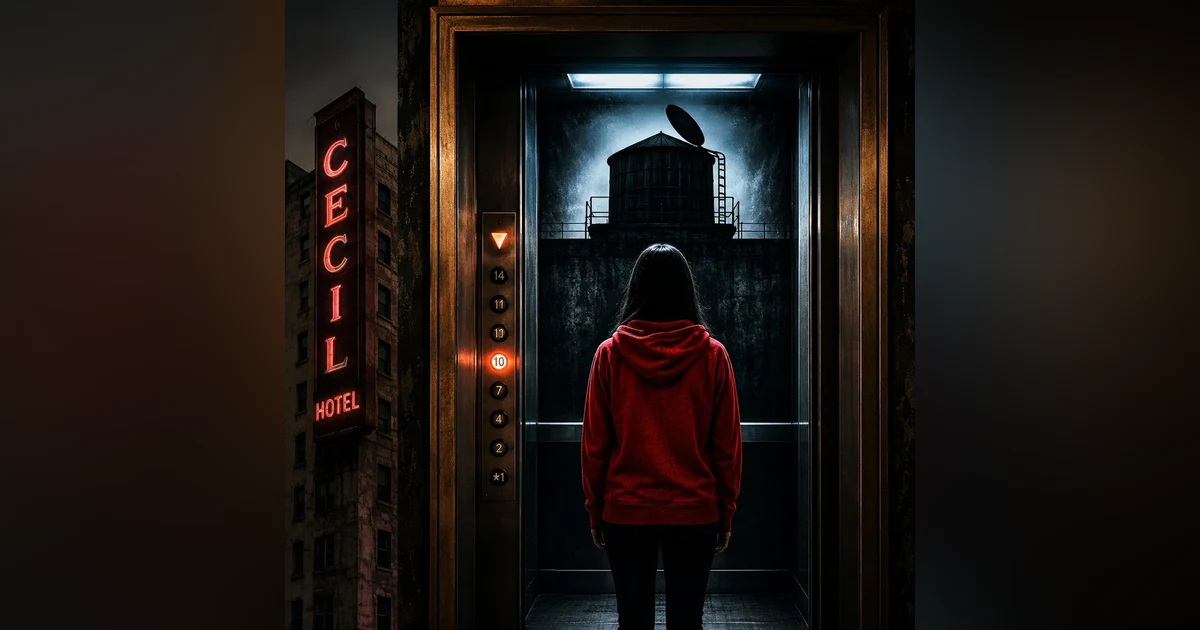
Key Takeaways
- Elisa Lam's tragic disappearance from the Cecil Hotel in January 2013 remains one of the internet age's most haunting true crime mysteries.
- The viral elevator video of Elisa Lam shows her acting erratically and pressing buttons, but it features no other visible individuals or supernatural entities.
- Los Angeles County medical examiners officially ruled Elisa Lam's death an accidental drowning, with bipolar disorder listed as a significant contributing condition.
- Public speculation and web sleuths transformed the ambiguous facts of the case into modern folklore, fueling countless supernatural theories and paranormal urban legends.
- Court documents and maintenance records disproved early rumors that the rooftop water tank hatch was sealed shut over Elisa's body, confirming it was found open.
Elisa Lam's Cecil Hotel elevator video became an internet mystery, but her 2013 death was officially ruled an accidental drowning. Terrifying & True follows the Canadian traveler's final days in Los Angeles and examines how a rooftop water tank became the focus of ghost stories and murder theories. Court records, the elevator's controls, and a maintenance worker's account challenge claims about impossible access and a sealed hatch. Follow the documented evidence behind the viral footage, with Elisa's life kept in view, and see how a tragedy became a story the internet kept rewriting.
Bonus episodes & support: https://weeklyspooky.com/join
More scary stories: https://weeklyspooky.com/
Story submissions: WeeklySpooky@gmail.com
Frequently Asked Questions
What happened to Elisa Lam at the Cecil Hotel?
Elisa Lam was a 21-year-old Canadian traveler who disappeared in January 2013 and was found dead inside a rooftop water tank nearly three weeks later. The Los Angeles County coroner ruled her death an accidental drowning with bipolar disorder as a contributing factor.
What does the Elisa Lam elevator video show?
The silent surveillance footage shows Elisa Lam stepping in and out of a hotel elevator, pressing buttons, gesturing into the hallway, and appearing distressed or disoriented. No other person is visible in the footage with her.
Was the Cecil Hotel water tank hatch closed when Elisa Lam was found?
No. According to the maintenance worker's sworn account and court filings, the metal hatch to the rooftop water tank was open when her body was discovered.
Why did the Elisa Lam case attract so many conspiracy theories?
The combination of the eerie elevator video, the Cecil Hotel's dark history of true crime and tragedies, and incomplete early media reports fueled internet sleuths to build supernatural and paranormal folklore around the investigation.
A young woman vanishes inside one of America's most infamous hotels. The last footage shows her stepping in and out of an elevator, reacting to something beyond the camera. Weeks later, she's found in a rooftop water tank. The hatch is open. So why then, did the Internet lead an obsession over the idea something impossible had happened? What you were about to do is burt Based on witness accounts, testimonies, and public record, this is terrifying and February nineteen, two thy thirteen, a maintenance worker named Santiago Lopez rides an elevator to the fifteenth floor of a downtown Los Angeles hotel.
From there, he takes the stairs to the roof, shuts off an alarm, and walks into the hard California daylight. Guests have complained about the water. The pressure is weak, some say it tastes wrong. Four large tanks rise above the roofline, surrounded by pipes, platforms, and the machinery of an old building. Lopez climbs first a utility platform, then the ladder fixed to the side of one tank, and at the top he finds the metal hatch already open. He looks inside, a young woman is floating near the surface. For nearly three weeks, police and family members have been searching for twenty one year old Canadian traveler Elisa Lamb.
Officers have walked the hotel, dogs have searched the roof. The public has watched the last known footage of Elisa inside an elevator, stepping in and out pressing buttons, peering into an empty hallway, moving her hands as if trying to explain something to someone the camera can't see. Now the search is over, and the mystery is about to become much larger than the evidence. Soon, millions of strangers will insist the roof was impossible to reach. They'll say the tank hatch had been closed over Elisa's body. They'll search the elevator footage for a killer, a ghost, a hidden edit, or a doorway into another world, but the hatch was open.
That single fact does not make Elisa's death simple. It does change the story because this is not merely the tale of a frightening hotel and a strange video. It's the story of a young woman in distress, an investigation with gaps, and an Internet audience that turned uncertainty into modern folklore. What happened to Alisa Lamb at the Cecil Hotel and what happened to her story after she was gone. We're telling that story tonight, so make sure you're subscribed on your favorite podcast to never miss a terrifying in truth every Monday. The Cecil Hotel opened at six point forty South Main Street in December of nineteen twenty four.
It was fourteen stories tall, with roughly seven hundred rooms, an ornate lobby, and the confident vertical lines of a city still inventing its future. The Cecil was not built as a palace for movie stars. It was meant to be modern, respectable, and affordable, a place for business, travelers, salesmen, tourists, and people passing through downtown Los Angeles. That distinction is important. The building's later legend often begins with a fall from impossible luxury into absolute depravity. The real history is less theatrical and more revealing. The Cecil was ambitious, but it was also practical. Many rooms shared bathrooms, The grandeur was concentrated where guests would see it first.
The lobby, the polished surfaces, the promise that a room in Los Angeles could place you near the center of everything. Its public spaces promised permanence, while many of its rooms were designed for brief stays in a restless city. Then the city changed around it. The Great Depression arrived only a few years after the hotel opened. Downtown businesses struggled, residents moved out. The streets around Maine became home to cheap lodging missions, bars, labor agencies, and an increasingly visible population of people living in poverty. The area that became known as skid Row was not a supernatural wasteland.
It was and remains a neighborhood shaped by policy, housing shortages, addiction, disability, mental illness, and generations of public neglect. The Cecil became part hotel, part long term residence, and part refuge of last resort. That made it vulnerable to tragedy, but it did not make the people inside it scenery for a ghost story. Even so, the tragedies accumulated. Newspapers documented deaths by suicide at the hotel beginning in its early decades. In nineteen sixty two, a woman named Pauline Auten jumped from a ninth floor window and struck a pedestrian below, killing them both. In nineteen sixty four, a long term resident known as Pigeon Goldie Osgoode was found murdered in her room.
Her killing was never solved. Later came the associations that permanently attached the Cecil to true crime mythology. Richard Ramirez, the Nightstalker was widely reported to have rented a room there during part of his nineteen eighty five murder Spray. Austrian killer Jack Hunterweeker stayed at the hotel in nineteen ninety one while in Los Angeles, where he murdered three women. Some of the wilder stories came later, Ramirez returning in blood covered clothes, staff casually ignoring obvious evidence, the building acting almost like an accomplice. Those details are repeated often, but many survive as lore rather than firmly documented history.
The same caution applies to the Black Dahlia Countless Cecil Hotel. Histories claim Elizabeth Short drank at the hotel or stayed there shortly before her nineteen forty seven murder. The story fits the building so neatly that it is repeated as fact, but no reliable record places her there. It's a perfect example of the Cecil's legend working backward, pulling an unrelated Los Angeles mystery through its doors because the association just feels right. The documented record was grim enough, the legend didn't need help, but it still received plenty. By the early two thousands, every new account of the Cecil seemed to absorb every old one.
A death in one decade became proof of a curse in another, A killer's reported stay became evidence that the building attracted evil. The hotel stopped being treated as an address where terrible events had occurred and became a character hungry, watchful, and waiting for another victim. In twenty eleven, part of the building was rebranded as Stay Maine. The new name, bright website, and inexpensive rooms were intended to attract backpackers and budget travelers who might never book a room at a place already burdened by the Cecil name. The branding changed, the elevators, hallways, roof, and water system did not.
On January twenty sixth, two thy thirteen, Elisa Lamb checked in. She was twenty one years old and from Vancouver, British Columbia. Her family had emigrated from Hong Kong and operated a restaurant in the Vancouver area. She studied at the University of British Columbia, loved clothes and books, and maintained an online life through blogs, where she collected fashion images, observations, jokes, fragments of loneliness, and candid references to depression and bipolar disorder. Those posts are often mined as clues now, but they were not a coded confession or prophecy. They were the writing of a young person trying to make sense of herself in public and private.
At the same time, Elisa had set out alone on a West Coast trip, traveling by train and bus. She called it a journey, a chance to see places beyond home and move through the world on her own terms. She stayed in San Diego before arriving in Los Angeles, and planned to continue north to Santa Cruz. Her parents worried about her traveling alone, so Elisa checked in with them every day. At first, her stay at the hotel appeared ordinary. Management later said she had begun in a shared room and was moved to a private one after roommates complained about unusual behavior.
That account came from hotel staff after the fact. It may indicate that Elisa was already becoming unwell, but it does not establish what she was thinking, what she feared, or what would happen next. On January thirty, first, the days she was supposed to check out, Elisa visited the last bookstore a few blocks away. Manager Katie Orphan later remembered her as quote very outgoing, very lively, very friendly. Elisa bought books, records, and gifts for her family. She wondered aloud whether the thing she had chosen would make her luggage too heavy as she continued traveling. It's one of the last human recollections of her that does not begin with the elevator.
She was not a spectral figure in a red hoodie. She was a traveler considering the weight of presence she hoped to bring home that evening, Elisa did not call her parents. She did not check out of the hotel. She did not board the next bus north. Her belongings remained behind. Her family contacted authorities and came to Los Angeles to help search. Police issued a missing person alert and began working through the most immediate possibilities. Had she become lost, had she left with someone, Had she been injured, robbed, or taken the cecil officers searched her room and common areas.
They brought in dogs, They went to the roof. Nothing led them to Alisa. The hotel already contained decades of stories about people who entered and never truly escaped its reputation. Now a young woman had disappeared inside it, and the ordinary facts of a missing person case began to bend toward the building's legend. Alisa's family needed a phone call, a witness, a location, anything that might bring their daughter home. What the world received instead was a silent video, and once that video escaped the hotel, Alisa Lamb would never again belong only to the people who loved her.
On February thirteen, the Los Angeles Police Department released surveillance footage from one of the hotel's elevators. The purpose was practical. Detectives hoped someone would recognize Elisa, remember seeing her, or identify a detail that placed her after she left the camera's view. Her parents had already appeared before reporters asking for help for them. The clip was not a horror artifact. It was the last available trace of their daughter and a tool that might still bring her back alive. The video lasts a little more than two minutes. There's no sound. The camera looks down from a high corner, flattening the small metal box beneath it.
The timestamp in the public copy is difficult to read. The hallway outside is visible only in pieces. The clip begins after Elisa has reached the elevator and ends without showing where she goes next. It's a fragment, not a timeline. Elisa enters wearing a red hooded sweatshirt, dark shorts, and sandals. She moves to the control panel and presses several buttons, then she steps back. The doors do not close. She leans toward the hallway and looks to her left, then to her right. She retreats into the elevator, pressing herself near the wall beside the buttons. After a moment, she steps out again.
She moves in and out of frame. At one point her arms rise and her hands make a loose, complicated series of motions. Then she returns to the elevator, presses more controls, and leaves. Only after she's gone do the doors begin opening and closing. Normally, that is what the camera records. Everything else is interpretation. Some viewers see terror. Elisa appears to hide, so there must be someone pursuing her. Some see playfulness, as though she's teasing a friend just beyond the camera. Others see confusion, agitation, or an attempt to make an uncooperative elevator move. Once the Cecil's reputation is added, still more viewers see a presence in the corridor, a ghost holding the doors, or an invisible force drawing her out.
The footage is almost perfectly constructed to invite projection. It's silent, incomplete, and detached from whatever happened before or after. We cannot hear the elevator chime, Alisa's breathing, a voice in the hallway, or the absence of one we cannot see around the corner. Every viewer supplies the missing sound and chooses what kind of story is happening just outside the frame. The doors become one of the video's greatest mysteries. Why would they remain open for so long? A close look at the control panel offers an ordinary possibility. Among the buttons Alisa appears to press is the door hold control designed to keep the elevator open for an extended period.
That does not explain her behavior, but it means the doors need no ghost, hacker, or unseen hand to remain apart. The public video also fueled claims that police or hotel staff had altered it. Viewers noticed the obscured timestamp, changes in playback speed, and moments they believed looked cut or repeated. The clip released to the public was an exported surveillance file, not pristine cinematic footage. Its presentation was strange enough to encourage suspicion, but no reliable evidence has ever shown that a person was digitally removed, or that investigators edited the recording in order to hide a crime.
The official death in investigation noted something simpler. No other person is visible in the elevator video. That isn't proof Elisa was alone elsewhere in the hotel. It's proof only that the most replayed piece of evidence does not show a pursuer. The footage can establish Elisa's clothing, movements, location, and the fact that she appears distressed or disoriented. It cannot diagnose her. It can't tell us what she believed she was seeing, and it can't prove the presence of someone outside the camera's view, merely because a viewer can imagine one. By the time the video was released, police knew Elisa had been diagnosed with bipolar disorder and depression.
Her family told the coroner's investigator that she had been prescribed for or medications effects or lamictal, zyroquell and wellbutrin. They also reported no known history of suicide attempts or suicidal statements. That last point is very important. Elisa's death should not be casually rewritten as suicide simply because she lived with mental illness. The coroner did not classify it that way. Her family did not discover her as suicidal. The available evidence supports an accident during a period of serious impairment, not a deliberate plan to die. Bipolar disorder can, in some episodes, involve paranoia, hallucinations, racing thoughts, disrupted judgment, and behavior that makes sense only within the person's altered experience, but a diagnosis this is not a screenplay.
We can't look at a silent recording and confidently narrate Elisa's thoughts. Saying she may have been experiencing a psychiatric crisis is a medically plausible interpretation, supported by the later investigation Claiming exactly what she saw in the hallway is invention online restraint disappeared. Quickly, the video spread through YouTube, message boards, social media, and true crime forums. People slowed it down, sped it up, mirrored it, sharpened the shadows, and traced Elisa's fingers as if they formed a secret code. They mapped the order of the buttons. They compared the movement of her feet to dance, panic, intoxication, possession, and ritual.
For some participants, the ch was sincere. A young woman was missing. Police had asked for public help. Watching closely felt like participation in a rescue, but the footage also offered the pleasures of a puzzle. It had a haunted hotel, an apparently malfunctioning elevator, and a figure who seemed to react to something the audience couldn't see. The distinction between helping and consuming began to vanish. The Cecil's history supplied possible villains. Maybe another guest had followed her, Maybe a staff member had access to areas tourists did not. Maybe a predator had recognized that Elisa was vulnerable. Those were not irrational questions in the early days of an open missing person investigation.
The problem came when possibilities hardened into certainty without evidence, People began describing the video as though it clearly showed Elisa hiding from a killer, but it doesn't. Others claimed the elevator had been controlled from another floor, but there's no proof of that. Still, others decided the building itself was responsible, as if decades of unrelated deaths had created a force capable of choosing its next victim. Meanwhile, Elisa's parents were in Los Angeles doing something far less abstract. They were waiting police searched with limited information. Hotel staff continued their routines. Guests slept only a few walls away from rooms.
Investigators had already searched the rooftop tanks sat above the building unexamined. Days passed. The public knew Elisa through two minutes of silent video. Her family knew the silence after a daily phone call had failed to arrive, and while strangers searched every pixel for a figure in the hallway, the most important question remained unanswered. Where did Alisa go after she left that elevator. On the morning of February nineteenth, hotel maintenance employee Santiago Lopez received a complaint about the water system. Accounts from guests varied. Some described weak pressure. Others later told reports the water had appeared dark or tasted unusual.
The exact length of time Alisa had been in the tank was never established, so the frequently repeated claim that guests used water containing her body for a full nineteen days goes beyond what the evidence can prove. What is documented is the route Lopez took. He rowed to the fifteenth floor, climbed a stairway to the roof, and deactivated the door alarm. He walked to the four large tanks above the hotel. To inspect them. He had to climb onto a platform, move among pipes and equipment, and to send a ladder attached to the side of a tank at the top.
The hatch was open. Lopez looked inside and saw Elisa floating near the surface. Her clothing and sandals were in the water with her, along with her hotel key card and wristwatch. The discovery transformed a missing person case into a death investigation. It also created the central image that would drive years of conspiracy, a body inside a rooftop water tank above an allegedly locked and alarmed hotel. Early news coverage made the roof sound nearly inaccessible. Police described a locked door connected to an alarm. Some reports stated or implied that the tank lid had been closed if Elisa had climbed inside alone.
Audiences asked how could she have replaced a heavy metal cover over her own head. She couldn't have, but she didn't have to. The maintenance worker's sworn account, later filed in the Lamb family's civil lawsuit, states that the hatch was open when he found her. The roof was restricted, but court documents identified four possible access routes, one interior stairway, and three exterior fire escapes. Reaching the tank required effort, It was dangerous, it was not physically impossible. This does not tell us which route Alisa used. The interior door was alarmed, though an alarm can warn staff without becoming an impenetrable lock, a fire escape could bypass that door.
The investigation never established a definitive path. What the documents do establish is that the famous closed lid puzzle was built on an inaccurate premise. There was another painful fact. Police had searched the roof earlier with dogs, but they had not inspected the interior of the tanks from ground level. The tanks rose above the roof, a scent trail could be disrupted by water, height, wind, machinery, and the maze of surfaces around them. The search had reached the correct general place, yet still missed Elisa. That failure feels impossible only because we now know where she was. Investigations are full of places that appear obvious after discovery.
Before though their one more locked room, maintenance space, roof, edge, or container among hundreds. The error was consequential, but it doesn't require a conspiracy. The Los Angeles County Medical Examiner performed an autopsy on February twenty first. The final report listed the cause of death as drowning and the manner as accident, with bipolar disorder identified as a significant contributing condition. The report documented moderate decomposition but no external or internal traumatic injuries. It did not identify physical evidence establishing an assault or homicide. Testing did not show common recreational drugs or meaningful alcohol intoxication. Toxicology did find some of Elisa's prescribed medications or their metabolites, others were not detected.
Those results are often summarized as proof that she had quote stopped taking her medication, but the reality is more limited. Decomposition, sample quality, drug metabolism, and the time between a final dose and death all effect what can be found. Toxicology cannot reconstruct every pill she took. It can support the possibility of inconsistent medication use, especially when considered with her diagnosis and behavior. It cannot tell us the exact beginning or content of a psychiatric episode. Her clothing being in the tank also inspired some suspicion. Why was Elisa unclothed? There are several non criminal possibilities. What clothing becomes heavy and can restrict movement.
A person trying to stay afloat or climb a smooth interior wall may remove it deliberately. Disorientation could also lead to actions that appear inexplicable in hindsight. The clothing was not found hidden elsewhere, It was in the tank beside her. The strongest evidence based reconstruction is therefore bleak but physically possible. Elisa, likely experiencing a serious episode connected to bipolar disorder and perhaps irregular medication use, reached the roof by an unknown route. She climbed the tank ladder. She entered through the open hatch, possibly seeking concealment, safety relief, or something understood only within her altered state. Once inside, she could not get back out from the roof.
The opening may have looked broad enough to enter from the water, it became a rectangle high overhead. There was no practical way to climb back to the opening. Once a person dropped below the rim. The same tank that was reachable from outside could become a sealed vertical chamber. From within, the tank's interior offered no ordinary exit. The opening was above her, The walls were smooth, water levels changed as the hotel's system drew from the tank. Even a capable swimmer could become exhausted while trying to remain afloat beneath a hatch that was increasingly difficult to reach.
That is a reconstruction, not a witnessed event. We don't know whether she entered quickly or hesitated. We don't know whether the water seemed like a hiding place, an escape, or something else. We don't know how long she survived. Those unknowns are important to consider because responsible storytelling stops where the evidence does. Could another person have been involved in the abstract? Almost any unwitnessed death permits alternate scenarios, but a theory of homicide needs more than the atmosphere of the cecil. Investigators found no injuries indicating a struggle, no identified suspects, no second person in the elevator footage, and no evidence that someone closed the hatch or attempted to conceal the body.
The Lamb family later sued the hotel's owners and operator, arguing that dangerous conditions and failures of care contributed to Elisa's death. The case was dismissed. The court concluded in essence that the hotel could not reasonably have foreseen a guest climbing into a rooftop water tank. That civil ruling did not explain Elisa's state of mind, it did confirm that the physical route was not the locked room impossibility popular culture had made it out to be. By the time the autopsy findings became public, the official case had a conclusion accidental drowning with bipolar disorder contributing. For many people online, that answer felt emotionally insufficient.
There was no villain to expose, no final confrontation hidden between the frames, and no clean explanation for why a young woman would climb toward danger while believing, perhaps that she was escaping it. The open hatch solved the internet's favorite mechanical puzzle, It did not give anyone access to Elisa's final thoughts, and in the space between what could be reconstructed and what could never be known, the legend took over. A mystery does not need to be officially unsolved to remain unresolved in public imagination. Alisa Lamb's death had a cause, a manner, and a plausible physical sequence and an official finding.
What it lacked was a witness who could describe the final transition elevator to hallway, hallway to roof, roof to ladder, ladder to water. That missing passage became an invitation. The Cecil already carried the architecture of a haunted story. Its red sign towered over downtown, Its corridors appeared worn and anonymous. Its history could be arranged into a procession of suicide, sides, murders, and killers. When Alisa's silent elevator footage arrived, the building seemed to provide its own explanation. The hotel had claimed her. That is folklore, not evidence. The parallels to the horror film Dark Water made the case feel even more uncanny.
In the two thousand and two Japanese film and its two thousand and five American remake. An apartment building suffers discolored water and elevator problems before a child's body is discovered in a rooftop water tank. The resemblance is eerie. It's also a coincidence. There's no evidence Alisa was reenacting the movie or that the film predicts anything beyond the fact that water tanks and elevators are effect sources of urban dread. Another theory attached Elisa to the so called Elevator game, an online ritual in which a person presses a sequence of floor buttons to enter another dimension. Viewers compared the ritual's instructions with the buttons she touched.
No evidence has ever shown that Alisa knew of the game or attempted it. The theory was fitted to the footage after the fact. Then came ghosts, possession, government experiments, tuberculosis conspiracies, and claims that the elevator video contained a hidden accomplice. Each explanation offered what the official finding could not. Intention A ghost wanted her, a killer chose her, a conspiracy needed her silenced. An accident during a psychiatric crisis is harder to shape into a satisfying plot because it may have no conscious design at all. The Internet was doing more than inventing stories. It searched for suspects.
Users discovered videos posted by a musician and filmmaker named Pablo Vigara. He performed under the name Morbid. He had stayed at the Cecil and made horror themed art filled with violent imagery. Two amateur investigators already convinced Elisa had been murdered. This persona looked like a confession waiting to be decoded. There was just one overwhelming problem. Virgara had stayed at the hotel in twenty twelve, nearly a year before Alisa arrived, and he was in Mexico when she died. That didn't stop the accusation. Strangers labeled him a killer, sent threats, reported his accounts, and circulated his image through forums and news coverage.
Bergara later said the harassment drove him to a suicide attempt and damaged his ability to make music. He had no connection to Elisa, but the demand for a villain created another person in crisis. This is the point where the phrase websleuth can become dangerously flattering. Curiosity is not investigation. Pattern recognition is not evidence. A crowd can collect useful information, sure, but it can also amplify the same error until repetition feels like proof. Elisa's family endured a different kind of harm. Their daughter became a public object. Her medical history, clothing, blog posts, and final moments were analyzed by strangers who could pause and replay her distress.
The family largely avoided the media and did not participate in the later Netflix series. Their silence left more room for others to speak on Elisa's behalf. In twenty twenty one crime scene, The Vanishing at the Cecil Hotel introduced the case to another enormous audience. The series corrected important myths, including the open tank hatch, and examined the false accusations against Viagara. It also demonstrated the central tension of telling this story at all. To criticize sensationalism, it had to replay the footage, rebuild the suspense, and sell the mystery one more time. The Cecil continued to appear in television podcasts, tours, videos, and fictional horror.
American Horror Story Hotel drew openly from the building's reputation and from the unsettling idea of a person behaving strangely in an elevator before vanishing. With each retelling, fact and fiction became harder for casual audiences to separate, So here is a final reality check. What is documented. Alisa Lamb was last publicly seen in the hotel elevator footage recorded around the time she disappeared. Her body was found on February nineteenth inside an open rooftop water tank. The autopsy documented drowning, no traumatic injuries, establishing homicide, and no recreational drug intoxication. The coroner ruled her death accidental and listed bipolar disorder as a significant contributing condition.
What is strongly supported but not witnessed well. Alisa was likely experiencing a severe psychiatric episode. She probably reached the roof and entered the tank herself, then became unable to escape in consistent. Use of prescribed medication may have contributed, but toxicology cannot tell the entire story. What remains unknown her precise route to the roof, why the alarm did not lead someone to her, if she had indeed used the interior door, what she believed was happening the hallway, why she chose the tank, how long she remained alive inside it? What belongs to legend? Well, that's where you put a closed hatch, a person erased from the video, the elevator game, a cecil hotel curse, a supernatural force holding the doors, a metal musician stalking her.
None is supported by the evidence. Elisa's story survives because the documented answer and the emotional answer don't feel the same. The documented answer is that a vulnerable young woman entered a dangerous place during a period of impaired judgment and drowned. The emotional answer people want is a reason large enough to match the image the old hotel, the open elevator, the empty hallway, the high above the city. But a death does not become less tragic because the cause is ordinary enough to happen without involving a monster. Mental illness is not supernatural, It is not a moral failure, and it is not shorthand for unknowable madness.
People with bipolar disorder live full lives, travel, study, create, love, their families, take medication, mismedication, recover from episodes, and continue on. Elisa's diagnosis was one part of her life in her final days. It may also have placed her in danger. Remember the bookstore. Hours before the image that would define her, Elisa was choosing gifts and wondering how much her suitcase could carry. She had plans beyond Los Angeles. She expected a next stop. Her parents expected another call. The elevator camera captured only a narrow slice of a human being, a moment when she may have been frightened, confused, or trying to solve a problem no one else could see.
It did not capture the reader, the traveler, the daughter, or the young woman laughing with a bookstore manager. It captured ambiguity, and the Internet treated ambiguity as an empty room it had permission to decorate. There may never be a sentence that explains every movement Alisa made that night. There doesn't need to be a ghost in that gap, or a killer hidden behind the frame. Sometimes the final unknowable part of a death is not evidence of conspiracy. It's the boundary between another person's mind and our own. The most frightening thing in the elevator was not what the camera failed to see.
It was how quickly the rest of us could fill that empty space with horrors. Terrifying and true is narrated by Henrique Couto. It's executive produced by Rob Fields and bobble Topia dot com and produced by Dan Wilder, with original theme music by Ray Mattis. If you have a story you think we should cover on Terrifying and True, send us an email at Weekly Spooky at gmail dot com, and if you want to support us for as little as one dollar a month, go to Weeklyspooky dot com slash join. Your support for as little as one dollar a month keeps the show going.
And speaking of I want to say an extra special thank you to our Patreon podcast boosters, folks who pay a little bit more to hear their name at the end of the show, and they are Johnny Nix, Kate and Lulu, Jessica Fuller, Mike Escuey, Jenny Green, Amber Hansford, Karen Wee, Met Jack Ker, and Craig Cohen. Thank you all so much, and thank you for listening. We'll see you all right here next time on Terrifying and True.
