
 Apple Podcasts

 Spotify

 Spreaker

 Audible

 Castro

 RSS Feed

 iHeartRadio
Terrifying & True | Dangers of a Victorian Christmas: Fires, Poisons, and Deadly Traditions
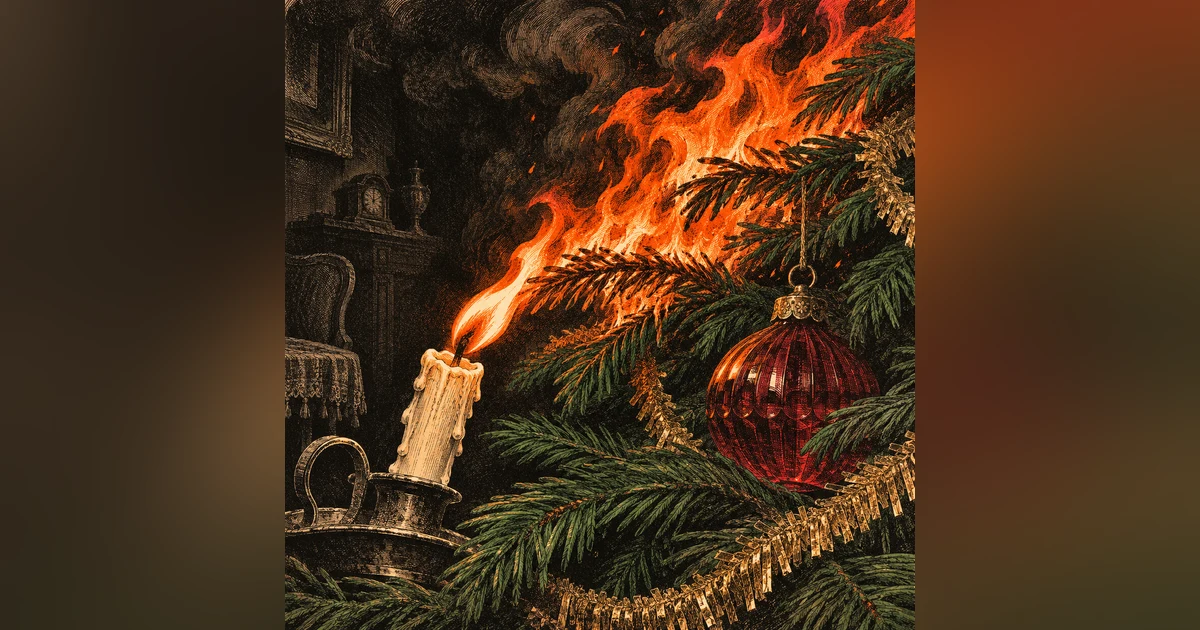
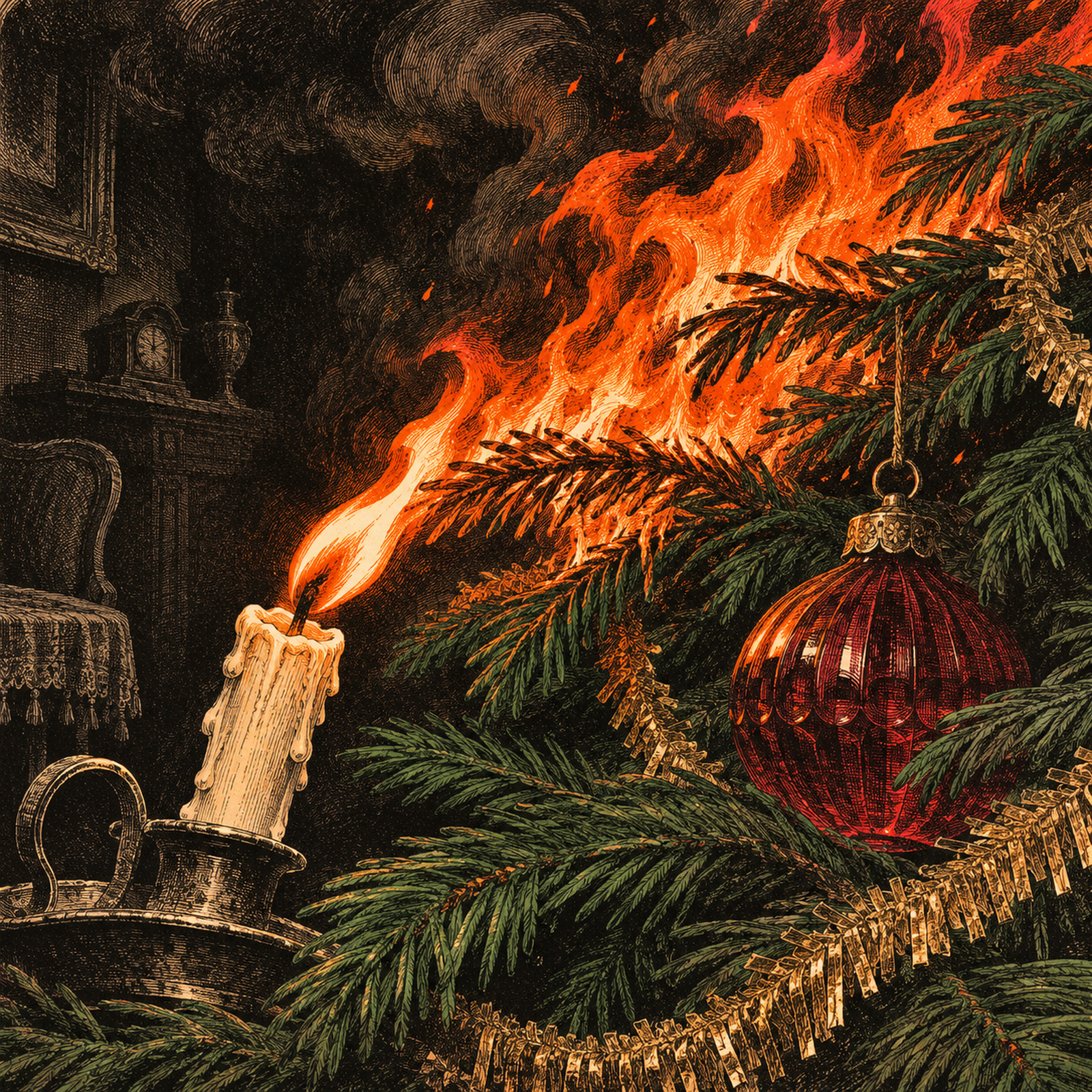
A Victorian Christmas looks cozy on greeting cards—glowing candle-lit trees, shimmering tinsel, children gathered around the fire. But behind the snow-globe charm was a season of deadly house fires, toxic decorations, poisoned sweets, and experimental electric lights that turned “old-fashioned Christmas” into a very real nightmare. In this episode of Terrifying & True, we dig into the true history of how festive traditions nearly burned homes to the ground, poisoned entire families, and forced the world to rethink what “safe” even meant.
Inside this episode:
- Candle-lit Christmas trees as ticking time bombs: How dry fir branches, open flames, and flammable Victorian fashion created instant infernos in parlors across Britain and beyond.
- Toxic snow, tinsel, and ornaments: From cotton “snow” that flashed into flame to lead-based tinsel and arsenic-dyed decorations that slowly poisoned anyone who touched or tasted them.
- Deadly toys and poisoned treats: The rise of arsenic greens, adulterated candies, and tainted puddings, and the chilling real-life stories of children who paid the price for “holiday cheer.”
- Early electric lights and new kinds of danger: How the “safe” alternative to candles—experimental electric light strings and overloaded wiring—brought shocks, sparks, and fresh fears to the Christmas season.
- From horror to reform: The fires, poisonings, and public scandals that pushed governments, scientists, and ordinary families toward modern safety standards, consumer protections, and fire codes that still save lives today.
This Christmas, as you plug in your UL-listed lights and hang shatterproof ornaments, remember the people who learned these lessons the hardest way possible—and the ghostly echoes of Victorian Christmases that still haunt our holidays. We’re telling that story tonight.
🎧 LISTEN NOW and subscribe for spine-tingling horror stories every week!
🎉 Unlock exclusive bonus episodes and support the show on Patreon!
👉 WeeklySpooky.com/Join
📬 Contact Us / Submit Your Horror Story!
- Twitter: @WeeklySpooky
- Facebook: facebook.com/WeeklySpooky
- Email: WeeklySpooky@gmail.com
🎵 Music by Ray Mattis 👉 Check out Ray’s incredible work here !
👨💼 Executive Producers: Rob Fields, Bobbletopia.com
🎥 Produced by: Daniel Wilder
🌐 Explore more terrifying tales at: WeeklySpooky.com
0:03 A Victorian mother reaches to steady the Christmas tree and in a heartbeat, her silk dress is on fire. Candles topple, dry needles flash like gunpowder, and the parlor becomes an inferno. Tonight, we're not talking about ghost stories. We're talking about real Christmas traditions that killed. What you were about to teat is believed to be based on witness accounts, testimonies, and public record.
0:46 This is. Terrifying and treat. Hello, my spooky. This episode of Terrifying and True is sponsored by save Arista Coffee. They provide half calf and decalf blends that still taste premium, so you can stay up late enjoying scary content with a rich cup of coffee, knowing that when your heart races, it's not from caffeine. And right now, if you go to savorista dot com and use promo code spooky at checkout, you get twenty five percent off your first order and it supports the podcast directly. So head to Saveorista dot com, get yourself a light, medium or dark roast, use promo code spooky and save twenty five percent off your order. Thank you, spookies for giving save Arista a little love and thank you to save Arista for supporting the show. Oh Christmas in Victorian England is often remembered as a season of carols, crackling hearths, and snowy streets straight out of a Dickens novel.
2:15 But behind the warm glow of candle lit trees and glittering ornaments lurked a far more unsettling truth in parlors from London to small country towns. Holiday gatherings ended in sudden fires, mysterious illnesses, and toxic decorations that slowly poisoned the people who trusted them. Tonight will step inside those richly furnished homes and watch as a single spark turned celebration into catastrophe, as arsenic green ribbons and leaden tinsel brings sickness instead of joy, and as the first strands of electric lights introduce a new, unexpected danger to the Christmas season. What hidden hazards were wrapped up in the Victorian idea of a perfect Christmas? How did these festive horrors help shape the safety laws, fire codes and consumer protections we rely on today? And could echoes of those very risks still be hanging on your own tree? Join us as we uncover the hidden dangers of a Victorian Christmas,
3:48 and make sure to subscribe every Monday. This month, we'll be uncovering new horrors of the Christmas season right here. Imagine this a cozy Victorian parlor on Christmas Eve. The tree in the corner glistens with ornaments and real wax candles, each tiny flame flickering warmly. Children's faces glow with excitement as they each inch closer to the German tree, an imported wonder decked in ribbon, candies and small gifts. A young lady in a gauzy silk gown leans in to pluck a bonbond off the tree. When disaster strikes in an instant, her delicate dress brushes a candle and ignites flames, racing up the fabric. She screams as fire envelops her, turning holiday joy into terror. This is no fictional ghost story.
5:17 It really happened. In eighteen forty nine. Miss Gordon was nearly engulfed by flames when her dress caught fire from a candle lit Christmas tree at an English party. Quick thinking guests saved her by smothering the fire with a rug, but not before her arms were severely scorched. She was fortunate to survive. Many others did not. The Victorian Christmas, for all its nostalgic charm, hid lethal dangers lurking in plain sight. The flammable decorations, toxic treats, deadly toys, and electrifying mishaps that turned celebrations into tragedies. Through real historical accounts and spine chilling anecdotes, we'll unwrap how Christmas in the nineteenth and early twentieth centuries was as hazardous as it was heartwarming. So dim the lights, but maybe not too low. If you've got a tree nearby, stoke the fire, careful with those stockings on the mantle, and get ready for a journey into the dark side of Christmas past.
6:49 This is a tale of festive joy mingled with danger, a reminder that some of the holly jolly traditions of yester year came at a truly frightening cost. Nothing evoked Christmas spirit in Victorian times quite like a candle lit Christmas tree. Long before safe electrical lights, families illuminated their trees with real candles clipped on to the branches. The site was admittedly magical, tiny flames dancing among evergreen boughs, and it became a beloved tradition from its origins in Germany to homes across Britain and America. President Franklin Pierce even brought the first candlelit tree into the White House in eighteen fifty six. But those delicate flames could turn homes into infernos. Victorian era news newspapers and medical journals are filled with accounts of Christmas trees exploding into flame, often with ghastly consequences. As one modern historian dryly noted, quote, we may take as read the thousands, if not hundreds
8:19 of thousands of deaths from fire caused by candle lit trees a bit sensational, but you get the idea. Consider the grim statistics. By nineteen oh eight, house fires from Christmas trees had become so routine that many insurance companies flat out refused to pay for any blaze started by the festive decoration, and for good reason. In eighteen eighty five, a Chicago hospital burned down after Christmas tree's candles ignited it. On Christmas Eve of nineteen oh nine, in Pennsylvania, five children sneaked out of bed to light the family Christmas tree themselves, the results of which killed all five children, their parents, and two boarders sleeping in the house. Even public celebrations were not safe. In Oklahoma, in nineteen twenty five, a Christmas tree fire at a community gathering killed thirty six people. These are horrifying numbers. Entire families and communities wiped out in minutes, all because of a tradition meant to symbolize light and joy. Why were these fires so common and so deadly well, Dry trees and open flames
9:55 are a lethal mix. Early Victorian trees were often small, tabletop affairs, kept fresh for a day or two. Families typically decorated the tree on Christmas Eve, lit the candles for a short, supervised spell on Christmas Day, and promptly took the tree down the following day. As long as the tree was green and moist and candles were never left unattended, the risk could be managed. But as Christmas trees became more central to holiday festivities, people began using bigger trees and keeping them up longer a week or more into the season. Inevitably, the needles dried out. A tinder dry six foot fir tree can flash into an all consuming blaze in mere seconds, burning so hot that nearby furniture and curtains across cross the room will burst into flames just from the radiant heat. Victorians didn't know the exact science, but they learned this through cruel experience.
11:14 Newspapers at the time carried annual warnings. One nineteen eleven safety notice pleaded with parents quote, do not permit children to light or relight the candles while parents are not present. They frequently set fire to their clothing. Instead. The tree itself will burn when the needles have become dry. That warning proved all too true. Children excited to see the pretty lights or frequent fire victims. In one nineteen oh five incident, a man in Kansas City dressed up as Santa Claus had his costumes set ablaze by the trees candles, along with the sack of toys on his back in a minor Christmas miracle. However, he actually survived, albeit singed.
12:13 And of course, in the opening story, we saw how easily a swish of a dress could ignite. Victorian women's fashion favored voluminous crinolines and lightweight, gauzy fabrics that could flare up in a most alarming manner from a single candle spark. Once a dress or a dried branch caught fire, panic often ensued, and burns were severe or fatal Before help arrived. Efforts were made to reduce the danger. Inventors devised special Christmas tree candle holders. In eighteen sixty seven, a weighted pendulum holder was patented to keep the candles upright, and by eighteen seventy eight, clip on candle holders appeared to better secure the candles to swaying boughs. These gadgets helped a bit. At least, candles were less likely to tip into the tree or onto the carpet. Wealthy households might station servants nearby with buckets of water or blankets, ready to extinguish any rogue flame. Some families placed their tree in a bucket of sand or used metal stands.
13:47 The water filled stands that most of us are used to used to keep trees moist were not common until much later, and typically candles were only lit for a short ceremonial period, say during the gift exchange, and then promptly blown out. But human error and curiosity foiled many precautions. An excited child might sneak into the parlor at dawn to light the tree on their own, with tragic outcomes, as in that Pennsylvania case. A candle clipped on a flimsy branch might still topple onto a paper decoration, or a sudden draft could blow lace curtains or ribbons into the flames. Victorian fire departments certainly earned their keep during the holidays. The phrase holiday conflagration became a familiar headline.
14:51 Imagine the horror of fire fighters arriving to a scene where a festive gathering had turned into a charred ruin, the smell of pine and wax replaced by smoke and ash. This dark side of Christmas left an impression on society. By the early twentieth century, public pressure to find a safer alternative was growing. The obvious solution to candle fires was to eliminate the open flame, a topic will explore when we get to the advent of electric Christmas lights.
15:34 But fire wasn't the only hazard hanging on Victorian Christmas trees. The very decorations meant to beautify a home could be ticking time bombs of another kind to modern eyes. A Victorian Christmas tree might look oddly sparse and home made with paper cones of candy, strings of popcorn, and small gifts. But as the years went on, the decorations became more elaborate and more dangerous. Starting with the Victorian love of a white Christmas snow effect. Lacking spray on snow in a can, nineteenth century families simulated snow by strewing fluffy cotton batting over tree branches and wreaths. It looked charming until a candle's flame touched it. Dry cotton ignites as fiercely as dry pine needles. Fire safety advocates eventually realized cotton, candles, children and matches make a very dangerous Christmas combination that casts a gloom over many households every year. After countless fires, authorities began actively discouraging cotton snow by World War I.
17:09 In nineteen seventeen, one American newspaper admonished readers to skip the cotton and use less harmful substitutes. Quote let us use metallic tinsel, asbestos fiber, and powdered mica for decorations and imitation snow instead of highly combustible cotton. The article urged yeah, you heard that right. They suggested asbestos and led tinsel as safer alternatives to cotton. I guess in a way it was less brutal than burning alive. The road to a safer Christmas was paved with many ironic twists. Tinsel, those shimmering icicles we drape on trees, has its own toxic history. Tinsel originated in seventeenth century Germany, where real silver shredded into strips created a dazzling sparkle next to the candles. By the late Victorian era, few could afford silver, so manufacturers tried cheaper metals. In the early nineteen hundreds, tinsel was made from aluminum or tinfoil. It gave a nice shine for a fraction of the price, but there
18:42 was a catch. The aluminum based tinsel was often backed with paper or lacquer that turned it into a fire accelerant. It was very flammable. Hanging strands of this early tinsel on a candlelit tree was like adding strips of kindling. After some scary incidents and material shortages in World War One, which made metals scarce, tinsel temporarily fell out of fashion. Then came the era of a supposedly safer material to make the decorative icicles, a material that would bring death in a very different method. We now enter the era of leaded tinsel. Around the nineteen twenties, manufacturers discovered that lead foil made perfect tinsel. It was cheap, heavy, so it draped elegantly on branches, and importantly, it was flammable at last, a safe solution to the flying spark problem.
20:06 By the mid twentieth century, lead tinsel, often called icicles, was everywhere countless. Baby boomers grew up tossing shiny lead strands on the family tree. Early on, even experts believed it was mostly harmless. A nineteen fifty nine safety article cheerfully noted that quote tinsel is fairly safe because even if kitties decide to swallow it, it will not cause poisoning. In hindsight, that statement is chilling. Lad tinsel was absolutely poisonous if ingested or handled frequently. Lead accumulates in the body, damaging the brain, kidneys, and other organs. It just doesn't cause immediate dramatic symptoms unless a child were to eat a lot of it at once, So the danger went overlooked for decades by the nineteen sixties, scientists and pediatricians finally began sounding the alarm on chronic lead poisoning from household items. The United States FDA and manufacturers reached an agreement in nineteen seventy two to halt all production of lead tinsel. In fact, this ban was initially kept hush
21:41 hush for fear people would hoard the old tinsel. Today tinsel is made from PVC plastic or milar, non toxic to the touch, though not exactly eco friendly, and I don't recommend eating it. It's a dark irony that Victorian reformers touted lead tinsel and even asbestos snow as safety measures. Asbestos is flameproof, so cotton snow was swapped for fluffy asbestos fibers that could be sprinkled on trees or holiday scenes.
22:26 Victorians unwittingly traded a fire hazard for a cancer hazard. Asbestos we now know can cause deadly lung disease if inhaled. For decades, though, boxes of artificial snow made of asbestos were sold as fireproof Christmas decoration. If you shudder at that thought, you're not alone. One author remarked that just looking at old packages of asbestos snow quote makes me itch. It wasn't until the latter twentieth century that asbestos was removed from holiday products. And let's not forget the ornaments and toys themselves. Many were essentially time bombs. The late eighteen hundreds brought a flood of cheap, mass produced decorations and children's toys, thanks in part to industrialization. These new products boasted vibrant colors and novel materials, many of which turned out to be deadly. Brightly painted Victorian ornaments often got their hues from toxic metals, lead and arsenic, chief among them. A child might unwrap a beautiful new toy soldier set on Christmas morning, not knowing the shiny paint
23:59 was lead based and highly poisonous if they put that toy in their mouth, as children inevitably do. In fact, entire legions of Victorian boys were given lead toy soldiers to play with. Some even melted them down to recast their own figures, unknowingly breathing in lead fumes. It's no surprise that Victorian children sometimes fell mysteriously ill from lead poisoning, and it was only years later that doctors connected some of those cases to toys and nursery decorations. One historian quipped that quote those shiny new Christmas toys turned out to be killers, and it's true. Many a victori Orian playroom was a toxic minefield. Perhaps the most notorious offender in the Victorian toy box and on the Christmas tree was shields green, an arsenic based pigment. This intense emerald green was the fashionable color of the nineteenth century, used in everything from wallpapers and fake flowers to candies and toys.
25:32 Arsenic is, of course, a potent poison, and Victorians gradually learned that the arsenic that beautified their homes could also destroy their health. Arsenic green pigments, Shields Green and its even deadlier cousin Paris Green, laced countless Christmas items, Green dyed ribbons on wreaths, artificial missiletoe leaves, which in its natural state is already poisonous, so in a way it was a very accurate replica wrapping papers, and even the wax candles on the tree. One eighteen seventy six public health report found arsenic in green Christmas tapers or candles.
26:26 When burned, the candles released arsenic fumes into the parlor air. The author of the report scolded this practice as highly reprehensible, noting that even a small amount of arsenous oxide in a candle could cause toxic symptoms in sensitive individuals who inhaled it. Think about it, a Christmas tree brilliantly illuminated with arsenic candles. It sounds like a more bid joke, but it was a real hazard. In fact, there were documented cases of people, especially children, getting sick with strange symptoms during the holidays, which doctors later traced to colored Christmas candles. A nineteen twelve medical review noted that quote many children have been victims from colored Christmas candles. Yes, adults were seized with curious and inexplicable symptoms. Attention was then drawn to the candles on the Christmas tree, many of which were green. Analysis proved they contained shields green.
27:47 The red candles, moreover, were colored with vermilion, a mercury compound. So if the arsenic in the green candles didn't get you, the mur in the red ones just might. Victorians loved a festive glow, but little did they know they were poisoning the very air of their homes with each lit candle. One particularly eerie story from eighteen sixty nine claims that Princess Frederica of Hanover was arranging a Christmas tree for poor children in Vienna when a burning green wax candle fell on her arm. According to newspapers, the arsenic die in the candle poisoned her through the wound, causing a painful death months later. This story was circulated as a cautionary tale, though in reality the princess survived and the account was likely exaggerated or confused with another incident. Still, the fact that it was believed shows how aware people were becoming of those deadly green dyes. Even the greenery
29:24 itself could harbor peril. Homes were often decorated with holly, mistletoe and other winter plants. Children attracted by bright red holly berries sometimes snacked on them, with dire results. Holly berries are poisonous if eaten in quantity. In one eighteen fifty eight case, an eleven year old boy nearly died after gobbling a large number of holly berries on a dare. He suffered violent vomiting and seizures so extreme his family thought he had died on Christmas Day. Only a last ditch effort of pouring wine down his throat revived him, though not a recommended cure. That boy was lucky. Others were not so fortunate. When sampling toxic mistletoe berries or ewe sprigs used in decor, the Victorians slowly learned to keep natural decor out of reach of curious tots, a lesson still relevant to day, as any veterinarian will warn regarding pets and poinsettas. For example, we've hung our Christmas
30:55 tree with fire and poison. Now let's turn to the holiday feast. Food and drink are central to Christmas merriment, but in the nineteenth century, they too could be fatal in surprising ways. One obvious risk was food spoilage. The concept of refrigeration was rudimentary, germ theory was still new, and food poisoning often meant actual poison to Victorian doctors. A tragic example occurred in eighteen seventy one. The Harrison family of London enjoyed a Christmas turkey dinner, only to fall violently ill with vomiting afterward. Mister Harrison died a few days later. An inquest was held to find if someone had deliberately poisoned the food. The analysis found no arsenic or other mineral poisons in the turkey or condiments.
32:05 This baffled the medical examiner. He noted a similarly perplexing case of a fatal illness after a Christmas goose, where no toxin was identified. In the end, the coroner concluded that quote the turkey was poisonous in its nature, and declared the death natural causes. In hindsight, the poor man almost certainly died of bacterial food poisoning. Perhaps the turkey had spoiled, but Victorian science hadn't quite caught up to microbes.
32:45 To them, a turkey could just spontaneously be toxic. It's a small comfort that out of such cases grew a better understanding of food safety, even if mister Harrison doctor basically threw up his hands and blamed the bird. More insidious, though, was the threat of food adulteration. In Victorian times, ingredient labels and purity standards were practically non existent. Dishonest suppliers would stretch expensive ingredients with cheap fillers, and sometimes those fillers were dangerous. Sugar was costly, so candy makers often mixed in chalk or clay as daft filler, not tasty, but not deadly either. However, in one infamous incident in eighteen fifty eight, this practice turned lethal. In what became known as the Bradford Sweets poisoning, a confectioner's assistant accidentally used arsenic trioxide instead of the usual harmless filler when making peppermint Humbug candies. The mistake was tragically caught only after the candies were sold. Over two hundred people were sickened,
34:21 and twenty, mostly children, died from eating just a couple of the arsenic laced sweets. Each candy contained enough arsenic to kill two adults, as it was later discovered. While this particular poisoning wasn't tied directly to Christmas, it serves to illustrate the ever present risk of Victorian treats. One shutters to imagine a child finding a treat in their Christmas stocking. Public outrage over the Bradford death did spur new laws, Britain's eighteen sixty Food Adulteration Act and the Pharmacy Act of eighteen sixty eight in an attempt to prevent such horrors. By late century, at least blatant poisonings by candy were rarer, but lesser adulterants like led chromate to color candies or copper sulfate to make pickles look green, still posed chronic health risks. Even beloved Christmas desserts could harbor danger. Let's take a look at plum pudding, traditionally
35:52 doused in brandy and set a light in a blue flame before serving. It is a spectacular sight and generally the alcohol burns off quickly, but now and then a putting explosion or mismanaged flame caused burns and fires. Victorians also had a charming custom of hiding small trinkets or coins inside the Christmas pudding for guests to find, which led to the occasional choking hazard or cracked tooth at the dinner table. Minor dangers, perhaps compared to arsenic candies, but still enough to send someone to the infirmary on Boxing Day. By the nineteenth century, technology began to offer hope for a safer Christmas. Electricity was emerging from the laboratories of Edison and Tesla, promising light without flame. In December eighteen eighty two, just two years after Edison patented the first practical light bulb. An inventor named Edward H.
37:12 Johnson had a brilliant idea, why not string those new electric lights around a Christmas tree. Johnson, who was a colleague of Edison, hand wired eighty red, white, and blue miniature bulbs and wrapped them around a rotating evergreen tree in his New York parlor. The effect was stunning. One reporter described a large Christmas tree presenting a most picturesque and uncanny aspect, brilliantly lighted with many colored globes about as large as an English walnut, continuously twinkling. Onlookers were amazed not only by the beauty but by the apparent safety.
38:02 Quote electric trees will prove to be far less dangerous than wax candle parlor trees. Johnson noted confidently he was right eventually, but at first electric lights were rare and came with their own hazards. In eighteen eighty four, the New York Times called the idea of electric Christmas lights extravagant because at the time less than ten percent of American homes had electricity at all. Early electric light strings were battery powered or wired to primitive generators. They were expensive and finicky. An electrically lit tree in nineteen o three could cost ten dollars or more to illuminate hundreds of dollars in today's money. Often people would rent electric light sets for a party rather than buy them. Those who did wire up lights faced new risks electrical shock and fire from faulty wiring. Early wiring insulation was cloth or rubber that could degrade or overheat. Many homes had old style fuse boxes, or even just one outlet per room, leading to dangerous daisy chains of extension cords around the holidays.
39:38 Overloaded circuits could spark fires behind walls. Bulbs themselves ran hot. Those early carbon filament bulbs got so warm that if one nestled against a dry pine needle, it could ignite it, just as a candle would. Newspapers of the nineteen hundredsccasionally reported electrical mishaps, a child shocked by grasping a defective bulb, or a tree fire blamed on crossed wires. Still, compared to open flames, the scale of disaster was usually smaller, and improvements came about rapidly. By nineteen fourteen, competition had driven the cost of a string of lights down to one dollar in seventy five cents, or about fifty dollars in today's money. More households were getting wired for electricity each year. An oft repeated legend tells of Albert Steca, a fifteen year old boy in New York whose family owned a lighting business. In December of nineteen seventeen, a tragic tenement fire caused by Christmas candles killed several people in the city. Saddened by the news, young Satica suggested his family start making affordable electric Christmas light strings to
41:11 prevent such fires. Within a few years, the Satica family helped form Noma Electric Company, which became one of the biggest makers of Christmas lights. Mid century, the push for safety and mass adoption of electric lights got a boost from such entrepreneurs and from groups like Underwriters Laboratories, which began testing and certifying holiday light strings by nineteen oh five to ensure they met basic safety standards. By nineteen twenty one, UL had published its first safety requirements specifically for Christmas lighting, establishing guidelines that significantly reduced the risk of electrical fires. As the technology improved, the nature of the risk shifted. Instead of a whole tree going up in flames, you might get a localized problem, a short circuit charring a cord, or a single bulb popping. One famous incident shows that even by the nineteen forties caution was still needed. Being Crosby the singer who crooned White Christmas lost his own home to a Christmas tree fire in nineteen forty three, caused not by candles but by
42:46 faulty electric light wiring. Clearly, one couldn't be complacent even with the new lights, but overall, as decades passed, the number of house fires during the holidays dropped dramatically. By the mid twentieth century, most families in America and Europe had traded in candles for strings of electric fairy lights, and in recent times the shift to cool burning LEDs has further reduced the fire hazard to near zero. You can actually wrap an LED light in tissue paper and it won't ignite, though please do not test this theory.
43:36 The Victorian fear of candle flames gradually faded into an almost quaint memory. Yet, if you've ever seen those dramatic fire safety PSAs showing how fast a dry Christmas tree can engulf a room in flames, you'll realize the caution remains relevant. Fire departments still urge watering your tree and unplugging lights when you're away, And indeed, nobody wants to be the family that makes the news as yet another holiday statistic. As one writer Riley put it, in a way, the ghosts of Christmas past have taught us well as spine tingling. As these true stories are, they come with a silver or perhaps lead tinsel lining. Each disaster pushed society to make Christmas safer. The hidden dangers of Victorian Christmas traditions spurred changes in laws, technology, and public awareness that benefit us to this day. It's remarks to think that our modern holiday safety net was woven from the threads of past tragedies. The innumerable candle related fires led
45:11 directly to the adoption of electric lights. Insurers and fire brigades essentially forced the issue. By the early nineteen hundreds, if you insisted on candles, your home insurance might not cover you. Companies like Edisons and SODCAS seized the opportunity to market safer electric alternatives, and organizations like the National Fire Protection Association, formed in eighteen ninety six, started holiday fire safety campaigns over a century ago. The tradition of community fire safety announcements around Christmas, like not leaving lights on unattended or keeping your trees watered, dates back to those early warnings. Today, thanks to these lessons, Christmas tree fires have become far less common, and many families opt for fire resistant artificial trees or at least flame retardant decorations.
46:18 As a result of standards that were developed over time, The Victorian arsenic mania in wallpaper, toys, and clothing eventually subsided due to public outcry and scientific revelations. By the eighteen seventies and eighteen eighties, articles like Pretty Poison Wreaths and expose as on arsenic dyed dresses caused a scandal. The death of workers like Matilda Shorer, a nineteen year old who died from making arsenic green artificial flowers, became a rallying point for reform. Manufacturers like William Morris, famous for wallpapers, were pressured to remove arsenic from their products.
47:09 Laws lagged behind somewhat. Britain didn't outright ban arsenic in non food products even into the twentieth century, but consumer preference shifted by the eighteen nineties. Shiel's green had largely fallen out of use due to its reputation. In nineteen oh three, Britain passed a law limiting arsenic in foods and drinks. Over the following decades, many countries gradually eliminated lead and mercury from consumer goods, though astonishingly lead foyle tinsel hung around until nineteen seventy two. In the United States, as we noted, today, we have strict toy safety regulations, no lead paint, no toxic dyes, precisely because we learn from an era when children suffered from such poisons. If you by your child a painted toy now you can thank Victorian era scandals for the fact that it won't be covered in arsenic or lead. In many ways, more important than laws is the cultural knowledge passed down. Victorians learned the hard way about holly berries, so later generations taught their kids don't eat those. They'll make you sick.
48:40 We now know not to use open flames on a dried out tree, unless you're really chasing that Victorian esthetic, in which case be extremely careful. We no longer put real lit candles on Christmas trees, except in controlled brief situations. Some European households still do it for tradition's sake, but always cautiously, often keeping a bucket of water nearby. We also have inherited a healthy skepticism about too good to be true food and drink. Those nineteenth century food poisonings led to modern food safety laws and the basic habit of checking expiration dates and sources. Even the concept of holiday safety campaigns from fire departments distributing Christmas tree safety tips to consumer groups testing the latest high tech toys for hazards can trace a lineage back to the late Victorian push for safer holidays. The Victorians loved Christmas, but they also began the conversation about keeping Christmas safe. As we can cl lute our journey through the ghostly dangers of Christmas past, it's worth reflecting on how far we've come.
50:08 In a modern living room, a family gathers around an artificial tree bedecked with cool to touch led lights, UL certified cords, shatterproof ornaments, and flame retardant tinsel. Children tear open their gifts toys made of tested plastics with non toxic paints regulated by strict standards. The holiday treats are store bought from inspected facilities or baked at home with known ingredients. It's a scene that would seem almost science fiction to a time traveling Victorian. Sure there are still risks, don't let that tree get too thirsty, keep those glass ornaments away from toddlers, and perhaps go easy on the egg nog, But nothing like the hidden minefield of the nineteenth century home. Yet we owe those Victorian families a debt.
51:11 Their suffering and loss illuminated, often literally by the light of a blazing Christmas tree. The path to safer celebrations, as one commentator from nineteen seventeen optimistically wrote, thanks to new precautions, quote, the vast majority of families have gone for generations without a single mishap related to Christmas decorations. That might have been a bit premature in nineteen seventeen, but by and large it came true in the years after. Each generation learned and improved. We learned to respect the power of fire, to treat mysterious chemicals with caution, and to prioritize safety in the very ways we mark the season.
52:03 So this Christmas, as you enjoy the twinkling lights and the cozy glow of your safely wired decorations, Spare a thought for the eerie stories of yesteryear. The next time you hang an ornament, remember it might once have been made of lead or arsenic laced glass, and be glad that it's not. When you flip on the tree lights, consider how not so long ago that would have meant striking a match to dozens of open flames. The past was a different, often scarier place. Now, my spookies, as you get ready to move on with your holiday and the ghosts of Victorian Christmas have spoken, heed their warning, and hear their messay, it's ultimately one of gratitude. We enjoy a merrier Christmas present because of those very warnings from Christmas past. Stay safe, keep the fire in the hearth and off the tree, and have a happy holiday one hopefully free of any unintended frights. And I'll be back next week with another terrifying story of the darker, deadlier side of Christmas. Terrifying and True is narrated by
53:39 Enrique Kuto. It's executive produced by Robfields and bobble Toopia dot Com and produced by Dan Wilder, with original theme music by Ray Mattis. If you have a story you think we should cover on Terrifying and True. Send us an email at Weekly Spooky at gmail dot com, and if you want to support us for as little as one dollar a month, go to Weekly Spooky Slash join. Your support for as little as one dollar a month keeps the show going. And speaking of I want to say an extra special thank you to our Patreon podcast boosters, folks who pay a little bit more to hear their name at the end of the show, and they are Johnny Nicks, Kate and Lulu, Jessica Fuller, Mike Escuey, Jenny Green, Amber Hansburg, Karen we Met, Jack Ker and Craig Cohen.
54:22 Thank you all so much and thank you for listening. We'll see you all right here next time on Terrifying and True.
