


 Apple Podcasts

 Spotify

 Spreaker

 Audible

 Castro

 RSS Feed
Terrifying & True | Brian Barrett: The TalHotBlond Internet Love Triangle Murder

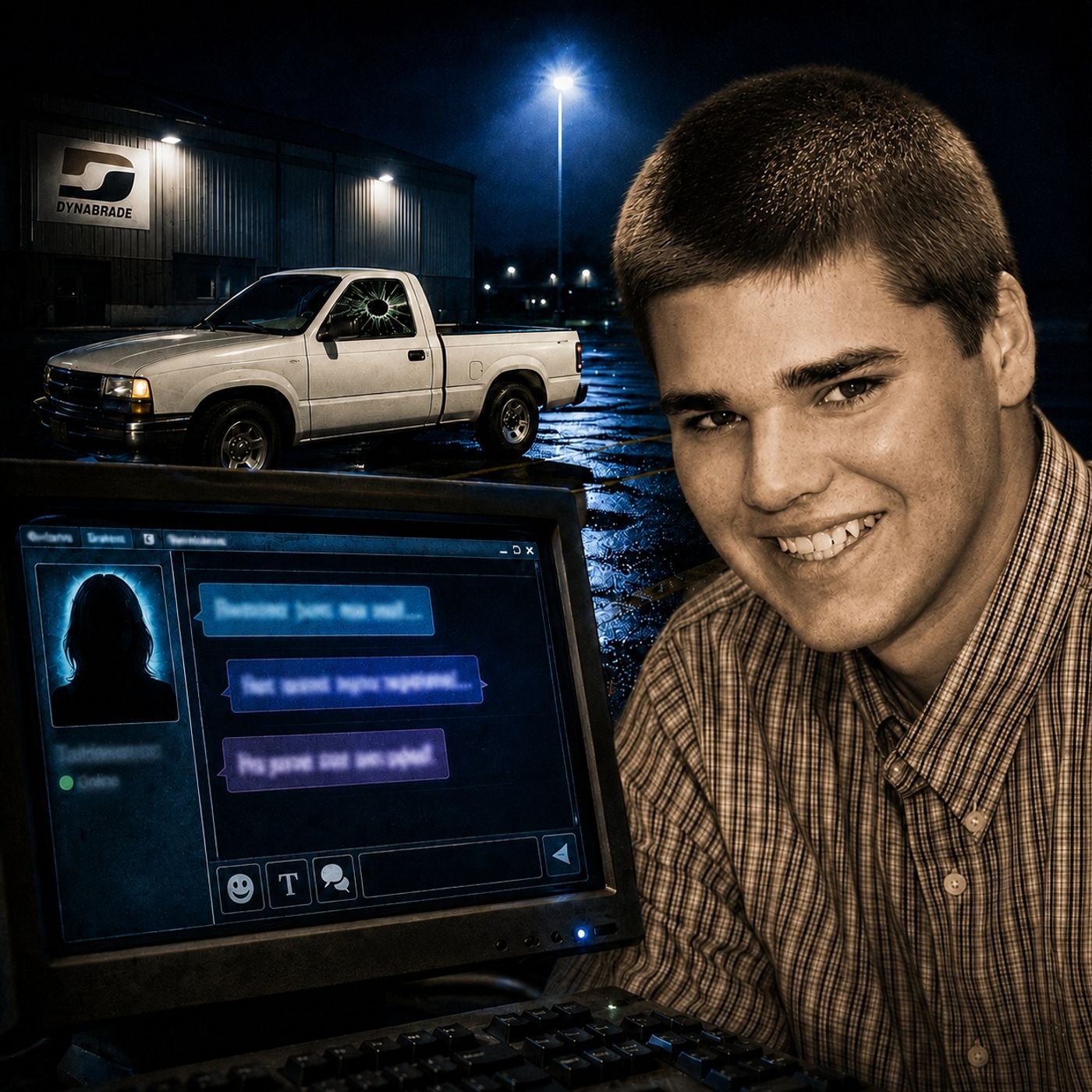
Key Takeaways
- The TalHotBlond murder case serves as a chilling reminder of the dangers inherent in early internet chatrooms where anonymity allowed predators to construct elaborate, fake identities.
- Brian Barrett, a promising college student and athlete, was tragically killed due to the obsessive, jealous, and delusional reactions of a coworker, Thomas Montgomery.
- The case involved two adults—Thomas Montgomery and Mary Shieler—who both created fake online personas to escape their real lives, with devastating real-world consequences.
- This investigation highlights how quickly digital deception and online rivalry can escalate into physical violence when boundaries between fantasy and reality become blurred.
- The murder of Brian Barrett demonstrates that the most dangerous lies are not just those typed on a screen, but the ones that individuals decide to defend with lethal force.
Brian Barrett was himself online; the adults in the TalHotBlond romance were hiding behind invented identities. In 2006, the 22-year-old student and coach was murdered outside his workplace near Buffalo. Terrifying & True traces Thomas Montgomery's teenage Marine persona, Mary Shieler's use of her daughter's identity, and the jealousy that crossed from chatrooms into real violence. Messages, physical evidence, and the investigation reveal how the deception unraveled. Follow the case beyond its screen name to remember the young man whose future was taken by someone else's fantasy.
Bonus episodes & support: https://weeklyspooky.com/join
More scary stories: https://weeklyspooky.com/
Story submissions: WeeklySpooky@gmail.com
Frequently Asked Questions
What is the TalHotBlond murder case?
The TalHotBlond murder refers to the 2006 killing of 22-year-old Brian Barrett, who was ambushed and shot by his coworker, Thomas Montgomery, following an online love triangle involving false identities.
Who was behind the TalHotBlond screen name?
The screen name TalHotBlond was used by Mary Shieler, a 45-year-old mother in West Virginia who was posing as her own teenage daughter to maintain an online fantasy.
Why did Thomas Montgomery kill Brian Barrett?
Montgomery, who was posing online as a young Marine, grew consumed by jealousy and humiliation after Brian, who also chatted with 'TalHotBlond,' exposed his true identity and mocked him.
How did investigators solve the murder of Brian Barrett?
Detectives uncovered a massive digital trail of chat logs, instant messages, and fake accounts that connected the workplace rivalry between Brian and Montgomery to the online deception.
In two thousand and six, Brian Barrett was shot outside his workplace in Clarence, New York. The motive wasn't robbery, revenge, or a random attack. It was an online fantasy involving fake identities, catfishing, jealousy, and two adults pretending to be teenagers. Tonight, we explore the love triangle that led to murder. What you were about to be is burd to be based on witness accounts, testimonies, and public record. This is terrifying. And a young man clocks out after a long shift. He's twenty two years old, a college student, a coach, a future teacher. He walks into the dark parking lot, opens the door of his pickup truck, and sits down behind the wheel.
Then three shots tear through the driver's side window. At first, the murder of Brian Barrett seems almost impossible to explain. There's no robbery, no obvious enemy, no ordinary motive waiting in his past. But investigators begin reading the messages, Hogo chat rooms, Yahoo instant messages, fake names, stolen photos, a supposed teenage girl who went by the handle, tall, hot blonde, a middle aged man pretending to be a young marine, a middle aged woman pretending to be her own daughter, and Brian Barrett, the only one in the triangle who was largely who he said he was. Tonight, we dive deep into the murder of Brian Barrett, the tall, hot blonde case, and the deadly online deception that turned a jealousy into an ambush.
Because sometimes the most dangerous lie is not the one typed on a screen, It's the one someone decides to kill. Four But before we begin, make sure you subscribe on your favorite podcast app for a brand new, terrifying and true every Monday. Here at weekly Spooky Friday, September fifteenth, two thousand and six, the second shift is ending at Dina Braid Corporation in Clarence, New York, east of Buffalo. At ten sixteen pm, twenty two year old Brian Barrett punches out. He's spent most of the day moving between college classes and the factory job that helps him pay for them.
Now, he walks into an isolated section of the employee parking lot, opens the door of his white pickup truck, and gets behind the wheel. Three shots tear through the driver's side window. Investigators will later identify the likely weapon as a thirty caliber carbine. The gunfire strikes Brian in the neck, jaw, and arm. He has no meaningful chance to escape. The attack suggests the shoe knew where his truck was parked, knew when his shift ended, and came close enough to make certain the ambush would be fatal. Then the shooter leaves Brian in the cab and disappears.
Just before midnight, an instant message appears on the computer of a young woman in West Virginia. It comes from one of Brian's coworkers, a much older man named Thomas Montgomery. Quote you waiting for your BF. The boyfriend is Brian. By the time that message is sent, Brian can't answer any more. His body will remain in that truck until Sunday, when a coworker notices the vehicle still sitting in the lot. Detectives will find no robbery, no random quarrel, and no mystery enemy from Brian's past. Instead, they'll find online conversations, invented identities, a missing rifle, a peach pit carrying DNA, and a jealousy that had been typed out almost line by line before it became murder.
The woman at the center of those conversations called herself Jesse. Brian believed she was an eighteen year old high school student. Thomas believed the same thing, but the girl in the photographs had never spoken to either man. Of the three people trapped in the online rivalry, Brian was the only one who hadn't concealed his face, age, or real life from the person he dated before his name became attached to Fray Like Internet love triangle and chat room murder. Brian Barrett was a son, a brother, a student, a friend, and a coach. He grew up in western New York, attended Star Point High School and stood out in baseball and soccer.
The adults who coached and taught him remembered more than just athletic ability. They remembered his character. Tom Sarkovic's, Brian's former baseball coach and Star Points athletic director, described him in the simplest terms possible quote he was just a nice kid, a gentleman. That's important because the sensational version of this case often rushes past Brian to get to the twist. He was twenty two years old, studying at Buffalo State College to become an industrial arts teacher. The kind of teacher who could show students how to build, repair, solve problems, and take pride in work done with their own hands.
Paying for that future required a punishing routine. Bryan's father later described weekdays that began around six thirty in the morning, ran through college classes until about three, then continued at Diner Brade until ten o'clock at night. The factory job was not his destination, it was how he was trying to reach one outside school and work. His life was ordinary in the best sense. He met friends for wings, beer and pool on Sundays. He volunteered as a little league coach, and also helped his father coach soccer. There is a temptation in true crime to polish every victim into perfection, as though a person must be flawless before their death can be treated as an outrage.
Brian didn't need that. He joked, he flirted online, made immature choices, and sometimes underestimated danger. None of that diminishes what was stolen from him. If anything, it makes him recognizable a young man still learning, while already giving his time to children and working toward a life in the classroom. At Dina Braide, Brian was one of the younger employees. Thomas Montgomery had worked there for approximately twelve years. He was old enough to be Brian's father, but the two men were friendly enough to play poker together and cross paths in online games. In the factory. There was nothing remarkable about that connection.
Online, Brian used the screen name Beefcake fifteen seventy two. It was playful, but the person behind it was largely who he said he was, a twenty two year old college student in western New York. He wasn't inventing a military career, borrowing another person's face, or pretending to be a teenager. Thomas Montgomery, on the other hand, was doing all three. By spring of two thousand and five, Thomas had created the screen name Marine Sniper. Behind it, he began erasing nearly three decades from his life and building an imaginary young man named Tommy, someone stronger, braver, more exciting, and more desirable than Thomas believed himself to be.
Thomas was forty five years old, a former marine, a machinist, a husband of sixteen years, and the father of two daughters. He took his children to swim, practice, played cards with coworkers, walked the family dog, and went to the same factory he had worked at for more than a decade. Nothing about that life was imaginary, but Thomas appeared to experience it as confinement. On the gaming site Pogo, Marine Sniper could be someone else, Thomas used a photograph from marine boot camp taken roughly thirty years earlier, and presented it as current. He told other users he was an eighteen year old marine named Tommy, bound for a rack and trained as a sniper.
Military records later obtained by ABC News showed that Thomas had served for six years and qualified as a sharpshooter, but had not tr raigned as a sniper and had not seen combat. The lie did not remain a false age attached to an old picture. Thomas built Tommy a history, a personality, a body, emotional wounds, military adventures, and a future. When maintaining the role became difficult, he invented another character, Tommy's father, Tom Senior. Thomas could then write as both the young marine and the older man, supposedly passing messages and packages to him. In May of two thousand five, Marine Sniper began corresponding with a user called Tall Hot Blonde.
She presented herself as Jesse, a West Virginia high school student who was seventeen and approaching eighteen. Her photographs showed a smiling, athletic blonde. Her messages described softball, school, family frustrations, and the emotional turbulence of being a teenager. Thomas later said he initially justified the deception by telling himself they would never meet, but distance made the lie safe, and that safety allowed it to grow. Tommy and Jesse exchanged instant messages, telephone calls, gifts, letters, videos, and intimate photographs. Packages arrived at Thomas's real home carrying symbols meant for the imaginary marine. Each object moved the fantasy farther into the physical world, and each new piece of the relationship required Thomas to protect the identity he had made.
In a recorded interview years later, he described the result with unusual clarity, quote, it became more real to me than real life. Thomas also compared the daily contact to a drug. That language didn't excuse him, but it revealed how completely he had surrendered responsibility for his choices. He repeatedly chose the fantasy, reinforced it, and punished anyone who threatened it by late two thousand and five, he was talking at work about leaving his family for Jesse. At home, he spent long hours at the computer and pushed away the people who actually knew him. On a pad at work, he wrote that on January second, two thousand and six, forty six year old Thomas Montgomery would cease to exist and be replaced by an eighteen year old battle scarred marine moving to West Virginia.
The date came, nothing changed, his body, marriage, job, and obligations remained. The contradiction did not end the fantasy. It made him more desperate to defend it. His wife, Cindy, eventually found the gifts and messages being sent to the supposed young marine. She confronted Thomas, then made a decision that placed the truth directly in front of Jesse. Cindy wrote to her, enclosed a current family photograph and explained that Tommy did not exist. Tom Senior and Tommy were the same forty six year old married father. The bootcase MP photo was Thomas decades earlier. Then, Cindy offered seven words that should have stopped everything quote do not trust words on a computer.
The person writing as Jesse claimed not to know whether to believer Thomas had layered the deception so deeply that even a photograph of his real family could be interpreted as another trick. To find out, she looked for someone Thomas had mentioned from work, a younger coworker who also played on Pogo. The username was Beefcake fifteen seventy two. The person behind it was Brian. When Jesse contacted Brian, she was looking for confirmation. Was Thomas Montgomery truly a middle aged married man? Was Tommy entirely invented? Brian knew the answer. He confirmed that Cindy's photograph was real and that Thomas was the man behind both entities.
For Jesse, at least as she presented herself, it was devastating. Brian became the person who could verify reality, explain Thomas's life at the factory, and listen while she reacted to the betrayal. They began playing lotso together in a Pogo room called Princess Priceless. They moved to Yahoo instant messages. The conversations became friendly, then flirtatious, then openly romantic and sexual. Brian believed he was speaking to an eighteen year old. He talked about meeting her, She delayed or discouraged an actual visit while continuing to send messages and photos that made the relationship feel immediate. For Thomas, Brian's involvement was not merely romantic competition.
Brian knew who he really was. Worse, Brian was physically present in the part of Thomas's life the fantasy had been designed to escape. The conflict spilled into public game rooms and the factory. Brian and Jesse mocked Thomas online and called him a predator for posing as a teenager while pursuing someone he believed was a high school student. Jesse shared passwords with Brian, and he sometimes entered her accounts and spoke to Thomas while pretending to be her. At work, Brian boasted about the relationship, according to a recovered exchange. He also left printed copies of conversations on Thomas's toolbox.
Those actions were humiliating and reckless. They were also the actions of a twenty two year old confronting a forty six year old coworker who had constructed a fake teenager to pursue a supposed high school student. Brian may have believed he was exposing a liar who deserved ridicule. He couldn't have known that Thomas was converting embarrassment into homicidal grievance. The distinction must remain clear. Mockery can be cruel, but it is not consent to be stalked, ambushed, or killed. Brian did not cause Thomas to choose a rifle. That decision was Thomas's alone. The messages show Thomas experiencing the exposure as the destruction of both identities he had been living.
He complained that coworkers saw him as a loser and a predator. He threatened to make himself and Tommy disappear. He blamed Jesse for replacing the fictional young marine with the real young man who worked beside him quote half the company knows now, but the person writing as Jesse did not make a clean break. She told Thomas she still ached for Tommy. She promised to stop speaking to Brian, then continued. At other moments, she told Thomas the relationship with Brian had begun as revenge. She alternated reassurance, rejection, affection, and silence while hiding the most fundamental fact of all.
She was not the teenage in the photographs. By the summer of two thousand and six, Thomas was sleeping little and exercising intensely. He told Jesse he was training for war at Dinah Braid. His vague threats made at least one coworker feel uneasy enough to wear a bulletproof vest as a grim joke. In one message, he warned that if he discovered more lies, she would lose something close to her. The target didn't need to be named. Brian was the person Thomas saw at work. Brian was the person whose messages could be placed on his toolbox. Brian was the person who had replaced Tommy without having to invent youth, strength or a future, and Brian's work schedule was predictables.
Before the killing, a coworker would later tell detectives, Thomas stood near the time clock and asked exactly when Brian finished his shift. The same coworker recalled Thomas making a chilling comment if he ever killed someone, he would not be stupid enough to leave shell casings behind. At the time, the remarks passed without intervention. After September fifteen, they would sound like a rehearsal. The final escalation unfolded in messages investigators would later read in sequence in the early hours of September thirteen, two thousand and six, Thomas sent Jesse an abusive message and received almost no response. He continued trying throughout the day.
On September fourteen, he sent another crude message that named Brian. On the morning of Friday, September fifteenth, Thomas telephoned Jesse. According to the woman on the other end, he was screaming and deranged. She hung up. Thomas knew Brian would be at Dinah Braid later that day. Brian completed his second shift routine with no known reason to think the argument had crossed from online threats into physical planning. There's no indication that he expected an armed man in the parking lot he punched out at ten sixteen pm. The attack was not a spontaneous fight. Brian was seated in his truck when three rounds came through the driver's side window at close range.
Investigators identified the ammunition as consistent with a thirty caliber carbine and believed the killer approached in camouflage and a ski mask. No property was taken. The location and timing indicated that Brian had been selected and waited for. Thomas returned to his computer that night Just before midnight, he asked Jesse whether she was around waiting for her boyfriend. Around two fifteen in the morning, he sent another message suggesting that Brian would not mind her talking to him. The cruelty of those messages is in their ordinary tone. There's no confession or dramatic announcement. Thomas simply writes as though Brian is unavailable, while knowing he will never log in again.
Saturday passed, Brian didn't come home. His parents, Dan and Deborah, had gone camping with their youngest son and another family. When they returned Sunday morning, they noticed Brian had not fed the cats. It was a small disruption, but it told them something was wrong. Brian was responsible. He didn't vanish without explanation. At Dinah Brade, a co worker saw Brian's white pickup still parked in the isolated lot. Inside was the young man who had worked late to pay for college. His body had been there for nearly two days. About an hour after the Barrett family returned home, police and sheriff's deputies arrived at their door.
Daniel Barrett later remembered opening it and understanding before anyone explained that the news was bad. The first public descriptions emphasized the apparent absence of motive. Brian had no known criminal ties and had not been robbed. But inside the factory rumors formed quickly. Co workers knew about Thomas Jesse and the public arguments and the humiliating printouts. They remembered Thomas asking about Brian's schedule and talking about killing without leaving shell casings. Detectives also recovered Brian's mobile phone in it was a number for Jesse in West Virginia. Lieutenant Ron Kenyon called to warn the young woman that Brian had been murdered and that she might also be in danger.
A female voice answered to Kenyan she sounded exactly like the teenager Brian believed he knew. The next morning, a police officer knocked on the door connected to that number. The blonde girl in the photographs was not the woman who answered. The house was in Oak Hill, West Virginia. The officer, J. L. Kirk, asked for Jesse. The woman at the door identified herself as the girl's mother, Mary Sheeler, and said her daughter was away. She claimed there was no way to reach her. That explanation created an immediate contradiction. Kenyan had spoken to Jesse only hours earlier.
At that number, Kirk continued asking questions, Mary became nervous, and eventually the second major deception collapsed. Mary Sheeler was indeed tall, hot blonde. She was a forty five year old married mother who had been writing as her teenage daughter and using the daughter's photographs without her knowledge or consent. The real young woman whose face had been sent to Thomas and Brian had not conducted the romances, had not written the messages, and did not know her identity was being used in this way. Kenyan later described how persuasive the voice had been, quote, she sounded like an eighteen year old girl to me.
Mary portrayed the early messages as harmless play. She said she regarded Brian as a sweetheart and had not known how to reject him without exc disposing herself. She also claimed she stayed in contact with Thomas because she feared what he might do. Whatever the original impulse, the surviving record showed sustained choices. Mary used her daughter's photographs, spoke by telephone in a younger voice, discussed school and prom accepted romantic attention, and shifted affection between Thomas and Brian. Even after Thomas was exposed, Mary did not expose herself. She wasn't charged in Brian's death. There was no evidence that she ordered the shooting or helped planet, or even knew Thomas was going to attack Brian that night.
Her deception caused profound harm, especially to her daughter and to the people who believed the persona. But Thomas alone made the decision to bring a firearm to Brian's workplace and pull the trigger. For detectives, the discovery in West Virginia clarified the emotional landscape. Proof of the shooter began accumulating much closer to Brian's truck. Near the vehicle, investigators recovered, of all things, a peach pit. DNA testing linked it to Thomas Montgomery. They also found a leather ammunition case bearing dog hares that investigators believed could have come from Thomas's family dog shadow. The shell casings were absent, but other pieces of preparation remained.
When detectives questioned Thomas, he mentioned peaches in his car and asked to retrieve his lunch before they spoiled. That detail sharpened their interests in the pit found beside Brian's truck. A search of Thomas's home produced a photograph of his gun cabinet. In that picture was a thirty caliber rifle. By the time police search, that rifle was missing. The suspected murder weapon was never recovered. Thomas claimed he had gone to a restaurant and returned home between ten and ten ten pm before the shooting. Cindy placed his arrival as later cell phone records located him in the vicinity of Dinah Braid around the relevant time.
On November twenty seventh, two thousand and six, Thomas Montgomery was arrested and charged with second degree murder. He denied killing Brian. After the arrest, investigators monitored a jail call in which Thomas appeared to acknowledge why doghare might be found on the leather ammunition case. Then there was the archive Thomas had kept himself, hundreds of pages of messages, photographs, notes and exchanges documenting the invention of Tommy, the exposure, the jealousy, the threats, and the fixation on Brian. The computer did not contain a single tidy confession. It contained something more extensive, a record of motive developing over months.
By then, investigators knew the woman he had killed over was not the woman in the photographs. At the time of his early questioning, Thomas reportedly didn't know yet that Mary had deceived him as well. The revelation changed nothing essential about the crime. Brian had been real, the rifle had been real, the shots had been real. Only the romance Thomas claimed to be defending had existed entirely on a screen. Thomas initially pleaded not guilty. In August of two thousand and seven, he accepted a plea agreement, pleaded guilty to first degree manslaughter and admitted to shooting Brian.
The plea avoided a murder trial and reduced his exposure. It did not, though, leave the central questions unresolved. Thomas Montgomery killed Brian Barrett. Before sentencing, Thomas tried to withdraw the plea, claiming coercion and confusion about his possible sentence. Judge Penny Wolfgang rejected the request, and the later appellate record found that his own plea statements contradicted the claim. At the November twenty seven, two thousand seven sentencing hearing, prosecutor Frank Sadida asked for the maximum term of twenty five years. He described the messages as evidence of an obsessive desire to make Brian suffer. After Mary's attention shifted away from Thomas.
The defense argued that fantasy and reality had blurred and that Thomas was suffering from diminished capacity. That description may help explain how he rationalized his behavior, it doesn't erase the planning reflected in the work schedule question, the missing rifle, the close range ambush, or the messages sent after Brian was dead. Thomas chose not to address the court. Daniel Barrett, however, did quote to gun down a boy over simple jealousy does not make sense to us. Judge Wolfgang sentenced Thomas to twenty years in prison. A New York Cappellate court upheld the judgment in two thousand and nine.
Recent reporting based on New York Corrections records lists Thomas as released to parole supervision as of January eleventh, twenty twenty four, after roughly seventeen years. A prison term can end the sentence imposed on Brian's family, doesn't. Mary Schieler was never prosecuted in connection with Brian's murder. Public anger toward her remains intense, and understandably so her impersonation kept the conflict alive, but responsibility must be accurately depicted. Mary created and manipulated the persona Thomas created. Tommy became violently obsessed, selected Brian, armed himself, waited for him, and killed him. The case is often called the tall Hot Blonde murder or the Internet love triangle murder.
Those labels are catchy, but they pull attention toward the twist and away from the person who died. There was no ordinary triangle. There was a middle aged man pretending to be a teenage marine, a middle aged woman pretending to be her own teenage daughter, an uninvolved young woman who whose face was taken, and Brian, a real twenty two year old who did not conceal his age, face or life. Brian made mistakes within the conflict, no doubt. He mocked Thomas and treated a volatile older coworker like an opponent in a game. Those details belong in an honest retelling, but they do not make the killing in any way mutual, inevitable, or understandable.
Humiliation does not explain stalking a coworker's schedule, carrying a rifle into a parking lot, and firing through a truck window. Brian's father did not remember him as a username or a point in a sensational triangle. He remembered a big, strong, happy young man who went from school to work, met his friends for wings and pool, and gave his Sundays to Little League. A teacher remembered a helpful student. A coach remembered a gentleman. His obituary named the network of real people left to absorb a death caused by invented lives. Had Brian lived, he would now be in his early forties, perhaps nearly two decades into teaching students how to repair what was broken and turn raw material into something solid.
That future cannot be measured in the prison years that Thomas served. The warning is not simply that people lie online. The deeper warning is that fantasy becomes dangerous when a person treats other human beings as supporting characters, people to possess, punish, or erase whenever they threaten the preferred narrative. Thomas Montgomery tried to make his real self cease to exist and replace it with Tommy. When Brian embodied the distance between the fantasy and the man, Thomas did not abandon the lie he chose to kill the real young man who made that distance impossible to ignore. But Brian Barrett was never merely a witness to someone else's deception.
He was a son, a brother, a friend, a coach, a future educator, and he is the person that must be remembered from this story. Terrifying and True as narrated by Henrique Couto, its executive produced by Rob Fields and bobble Topia dot com and produced by Dan Wilder, with original theme music by Ray Mattison. If you have a story you think we should cover on Terrifying and True, send us an email at Weekly Spooky at gmail dot com, and if you want to support us for as little as one dollar a month, go to Weeklyspooky dot com slash Join.
Your support for as little as one dollar a month keeps the show going. And speaking of I want to say an extra special thank you to our Patreon podcast boosters, folks who pay a little bit more to hear their name at the end of the show. And they are Johnny Nix, Kate and Lulu, Jessica Fuller, Mike Escuey. Jenny Green, Amber Hansburg, Karen Wee, Met Jack Ker, and Craig Cohen, Thank you all so much, and thank you for listening. We'll see you all right here next time. On Terrifying and True
