


 Apple Podcasts

 Spotify

 Spreaker

 Audible

 Castro

 RSS Feed

 iHeartRadio
Hungry Ghost Month: Supernatural Folklore from Asia | Thursday Thrills

Key Takeaways
- Hungry Ghost Month represents a rich living season of remembrance, community entertainment, and Chinese ghost folklore rather than a simple internet list of horror rules.
- Traditions during this seventh lunar month blend Chinese folk practices, the Daoist Zhongyuan Festival, and the Buddhist Yulanpen or Ullambana observances.
- Well-known Getai and Wayang performances in Singapore and Malaysia intentionally leave the front row completely vacant to seat unseen supernatural guests.
- Documented cultural taboos during the season include avoiding roadside offerings, not taking reserved front-row seats, refraining from nighttime swimming, and postponing major life events like weddings.
- The true core of Hungry Ghost Month focuses on hospitality, ancestral memory, and caring for wandering or forgotten spirits rather than merely depicting evil monsters.
Why is the best seat at a Hungry Ghost Festival performance left empty? Thursday Thrills explores Chinese ghost folklore and unseen guests honored in the seventh lunar month. Henrique Couto follows Singaporean getai, Taiwan's water lanterns, and Hong Kong's Yu Lan traditions, distinguishing Daoist Zhongyuan observances from Buddhist Yulanpen and ancestor remembrance. Food, incense, joss paper, and regional taboos reveal practices that reach beyond a scary story. Discover who the offerings are for, why some front rows stay vacant, and how communities make room for spirits in daily life.
Bonus episodes & support: https://weeklyspooky.com/join
More scary stories: https://weeklyspooky.com/
Story submissions: WeeklySpooky@gmail.com
Frequently Asked Questions
When does Hungry Ghost Month take place?
Hungry Ghost Month corresponds to the seventh month of the lunar calendar, running from August 13 through September 10 in 2026, with the Hungry Ghost Festival falling on August 27.
Why is the front row left empty at Getai and Wayang performances?
Performers and communities in places like Singapore and Malaysia deliberately leave the front row vacant as a sign of hospitality to reserve the best seats for wandering spirits and unseen guests.
What is the difference between an ancestor and a hungry ghost?
An ancestor has a personal relationship, family, and a preserved place in memory, whereas a wandering spirit or hungry ghost may be someone who died without descendants, whose identity is lost, or who suffers from relentless craving.
What are some common taboos observed during Hungry Ghost Month?
Common regional customs advise against disturbing or stepping on roadside offerings, taking reserved front-row seats at shows, swimming alone at night, peering under offering tables, and scheduling major life events like weddings.
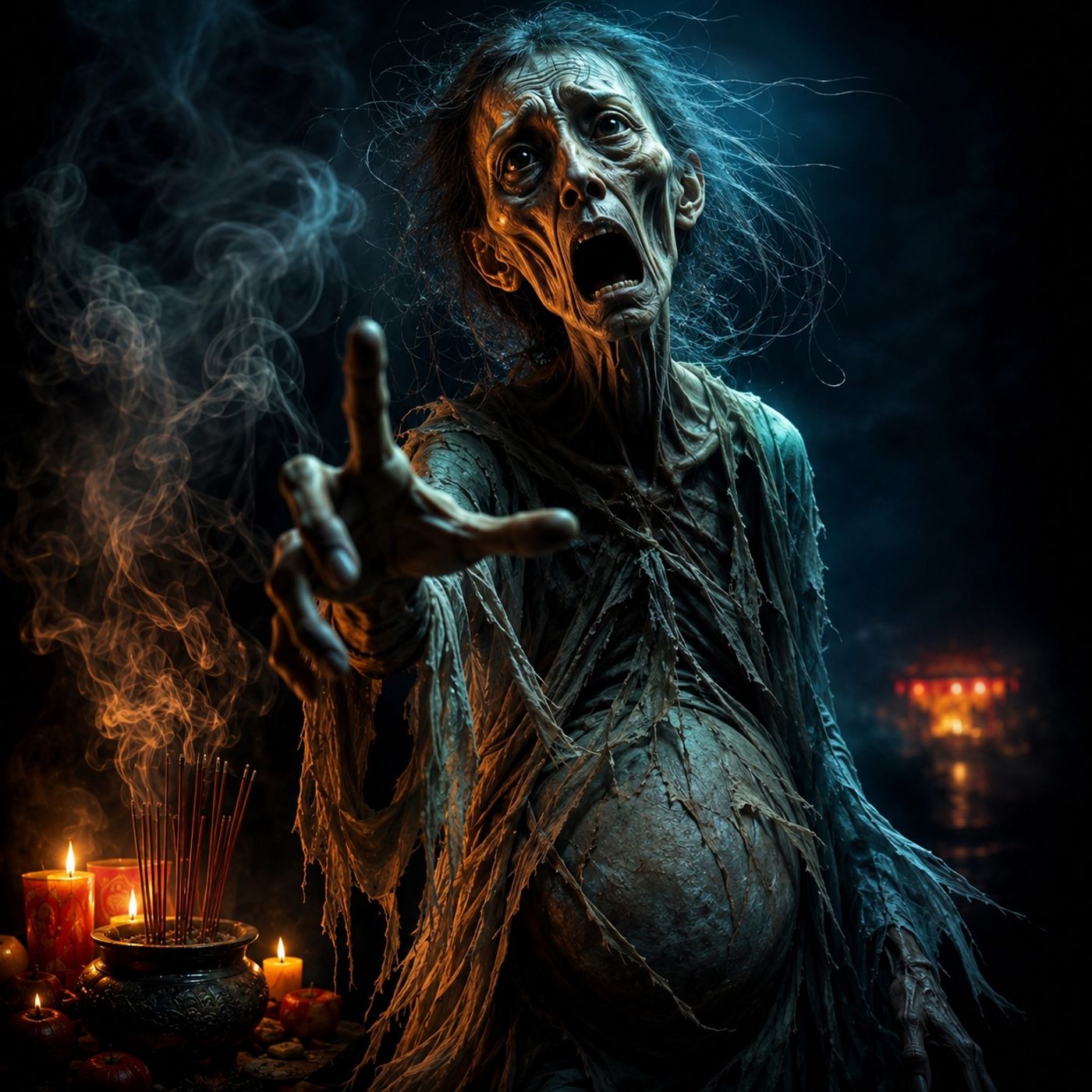
After dark, music drifts from around the corner, too cheerful for a street this empty. Then the stage appears, glowing red between the apartment blocks. Incense smolders along the curb, paper curls into flame, and just beyond the lights stands something impossibly thin, its belly swollen, its throat narrow as a wire, staring at the offerings with a mouth that can never be filled. Thurstay Thrills. This is Thursday Thrills, a quick weekly ride into the creepy stories, haunted places, weird obsessions, and eerie little corners of the world worth talking about. I'm Henrique Couto, and tonight we're following one wonderfully spooky image an empty front row at a nighttime performance, into Hungry Ghost Month, a living season of remembrance, offerings, neighborhood entertainment, and Chinese ghost folklore.
Ghost Month twenty twenty six begins August thirteenth and runs through September tenth. That's my birthday. I hope that's just a coincidence. The fifteenth day falls on August twenty seventh. Cemeteries and performances may land on different days because traditions vary by place, but those are the verified dates for the seventh lunar month. Don't worry, I'm not about to lock the car doors and turn this into a comparative religion lecture. We just need a roadmap. Because the Internet loves throwing several traditions into one haunted blender or a vitam X more vitam X and calling the result ten rules you must never break, or some click baity crap.
The real story is stranger, warmer, and honestly far more interesting. Here's the cleanest way to think about it. Hungry Ghost Month is the whole stretch of road. The Hungry Ghost Festival is the big landmark near the middle. The month is the seventh month of the lunar calendar. The festival name in English usually points to the fifteenth day, although in Singapore and some other community people may use it more broadly because prayers, offerings, dinners, and performances continue throughout the season Under that big umbrella, several traditions meet. Chinese folk religious practices may include honoring ancestors, making offerings to deities, and providing for wandering spirits who have no family tending to them.
In Daoist tradition, the fifteenth day is associated with the xiong Win festival. It can include rights and offerings intended to bring pardon, peace, or relief to suffering souls. The Buddhist yulan Pun or Ulambana tradition carries the story of the monk known in Chinese as Muleenne. He discovers that his mother is suffering after death and learns that rescuing her requires generosity beyond one private act, offerings to the monastic community, and merit dedicated on her behalf. So one temple may emphasize chanting and compassion. One family may prepare food for ancestors. One neighborhood may build a stage, hang lights, and turn the night into a show.
Those all overlap, but they're not identical. There's no single official ghost month checklist hiding in a secret drawer somewhere. This is what happens when traditions stay alive long enough to travel. They meet new languages, new neighborhoods, and generations, while keeping some old shapes and taking on new ones. Now, let's get to the part with the unbeatable horror movie name the Hungry Ghosts. First. A beloved ancestor is not automatically a hungry ghost just because that person has died. That's one of the biggest things spooky Internet summaries they get wrong. An ancestor has a relationship to the living a name, a family, a place in memory.
Depending on the household, that relationship may be maintained through tablets, incense, food, graveside visits, prayers, or simply the act of remembering. A wandering spirit is different. In some traditions. This may be someone who died without descendants, whose identity has been lost, or who has no one performing rites for them, and a hungry ghost can mean something even more specific. In Buddhist cosmology, a praeta is a being trapped in relentless craving, unable to satisfy its hunger. In everyday folk usage, the phrase can be broader, describing restless or neglected spirits believed to need food, attention, or ritual care.
That is what makes the offerings so important. Food can be hospitality, Incense can express reverence or carry prayer. Joss paper made to represent money or useful objects may be burned as symbolic provision for the spirit world. Not everybody does all of these things. Some Buddhist communities emphasize chanting, merit, and charity rather than paper offerings, and there is the little chill hiding under all of it. The truly frightening idea is not that the dead are hungry. It's that someone could be forgotten so completely that hunger becomes another word for having no place at anyone's table. We have food for the spirits, paper money for the other side, and an entire front row nobody living wants.
That feels like the perfect place for a very living break. Well, you made it, back, gues. Those ghosts weren't as hungry as we worry. But it's still early, so let's head back to that stage. In Singapore and Malaysia, Seventh Month celebrations may include Guttai meaning song stage, and Guttai is not a hushed seance with one candle and a table that may or may not wobble from spirits. It can be loud, bright, and joyfully over the top singers, hosts, comedians. They all dance, flashing costumes and a sound system fully committed to making sure the next neighborhood hears the chorus as well.
Traditional Chinese opera may also be performed in Singapore and Malaysia, the word wayang is often used for stage performances. These shows are entertainment for the living, community, events, and in in some places, offerings to unseen guests all at once. That's where the empty front row comes in. At some get ti and wayang performances in Singapore and Malaysia, the first row is deliberately left vacant for spirits. Sometimes the seats are marked. Sometimes regular attendees simply know not to sit there. Reports from Penang even describe places identified with large jawsticks. This is a regional custom, not necessarily a rule for every performance, because even performers differ in which precaution they follow.
But where the custom is practiced, it creates one of the best spooky images that I'm aware of. The show is lively. The host is joking, the singer is working the crow out. Nobody is screaming or pointing at the reserved chairs. That normality is what kind of gets to you. The spirits aren't treated only as monsters that must be driven away. They're offered food, they're given entertainment. They are acknowledged as members of the audience. The living sit behind them. The performers face a row of absence and behave as if it's watching. So the question is no longer why is that seat empty, but more what would it mean if it wasn't.
Of course, once a season has wandering spirits, burning offerings and reserved seating for the dead, it's going to collect a few rules. But these are family customs and regional beliefs, but a universal instruction manual. Someone from Singapore may know a warning that means nothing to a family in Taiwan. Still a few beliefs are well documented. First, do not step on, kick, or casually move roadside offerings. In Singapore and Malaysia, you may see food, incense, or paper placed near a curb, tree or a temporary altar in some communities disturbing. It is believed to disrespect the spirits who are waiting to receive it supernatural consequences aside, somebody carefully arranged a religious offering, so it's not litter, just walk around it.
Second, do not take a reserved seat if the first row has been intentionally left open. At Gettai or way Yang performances, upgrading yourself to the best view in the house means intruding on space prepared for extra special unseen guests. It's one of those warnings that becomes creepier when you consider that nobody has to explain it twice. And Third, some communities worn against swimming at night during the seventh month. Singapore accounts connect that caution with stories of water ghosts believe to seek company among the living. Taiwan's Ghost Month traditions also include lanterns guiding souls lost in water toward offerings.
The customs are not identical, but both treat water as a place where the boundary can feel feel a bit thin. Also, not swimming alone at night is in general excellent advice, even when the supernatural is not really on the table. Fourth, in some Singapore traditions, people are warned not to crawl beneath or peer under offering tables. The space around the altar is understood to belong to the spirits receiving the offerings. It's not a haunted blanket for it, so leave it alone. Fifth, some families postpone weddings, moving into a new home, or making a major purchase during that month.
This one is less cinematic and more pragmatic, I suppose, but it shows how folklore can shape everyday ordinary life. If the season is considered spiritually unsettled, it may not feel like the right time to begin something meant to carry luck or stability. The Internet sees a living observance like this and immediately tries to turn it into a haunted escape room. Don't touch the offering, don't take the seat, don't swim after dark. Break one rule, and a ghost follows you home before the next ad. That makes a tidy scary list, but it does flatten the country's religions and families into one rule book, albeit cursed.
It also turns every dead ancestor into a ravenous monster, which is simply not what these traditions are all about. You'll often hear Ghost Month reduced to the gates of Hell open and everything evil gets loose. That image exists in popular folklore, but it cannot carry the whole story. It can't explain a Buddhist temple emphasizing compassion and merit. It can't explain a family preparing a favorite dish for someone that they miss. It can't explain Hong Kong Yulan rights for ancestors and wandering souls, Taiwanese water lanterns, or a Singapore neighborhood who's built a stage and given unseen guests the best seats.
Modern horror loves the season for obvious reasons. Movies such as Singapore's The Maid have used the seventh month as a setting for dread and ghost stories. They borrow the offerings, temporary stages, ritual boundaries, and warnings against disrespect. It's almost a perfect horror movie mechanism, a limited season, familiar streets, rules, and outsider may misunderstand an invisible population moving through the same spaces as everyone else. But the strongest fear is still very human, a living human. Neglect, obligation, memory. Maybe the dead don't become frightening because somebody remembers them. Maybe they become frightening because nobody does. Now imagine that street one last time.
The final song ends, the host says good night. Plastic chairs scrape across pavement as families head home and workers begin coiling cables beneath the makeshift stage. The offerings have burned low. One by one, every occupied row empties, but the front row looks exactly as it did when the night began. Maybe nobody invisible ever sat there. Maybe the chair creak was the plastic cooling or shifting pavement, or a little breeze that knew exactly when was the right time to scare you hungry. Ghost Month is eerie because it opens doors between things we prefer to keep separate, family and stranger, religion and entertainment, public street and sacred space, the remembered dead and the dead with no one left to remember them.
And the empty front row holds all of that in one simple image. Its hospitality offered to absence. It's a warning not to mistake invisibility for non existence, and it is a reminder that even an unnamed guest can still be given a place. The first row isn't empty, It's what remembrance looks like when absence is given a seat, and one day you'll PLoP your happy butt right down with them. Come back tomorrow for more fear. Until then, lock your doors, as if that will help you
