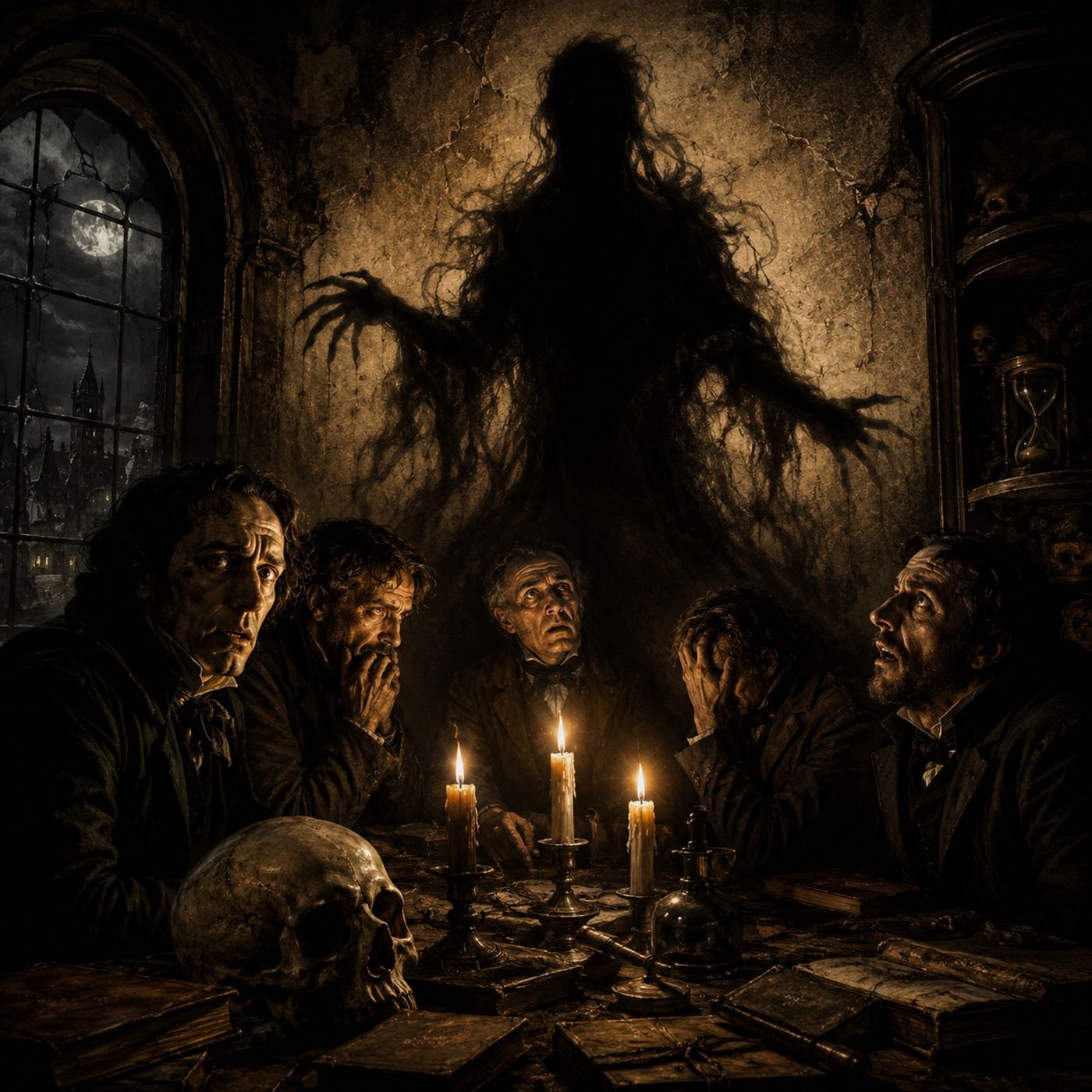
The Whispering Dead: Understanding the Chorus of Grief in Poe's 'Shadow, a Fable'
Poe's 'Shadow, a Fable' plunges us into a chilling abyss where the very air is thick with dread. Beyond the creeping plague and the oppressive darkness, a more insidious terror emerges: a voice woven from countless lost souls. This blog post explores that spectral chorus, delving into how Poe uses it to personify our deepest fears of mortality and inescapable sorrow.
Key Takeaways
- The Shadow's chilling voice in Poe's tale is not a single entity, but a multitude of departed souls.
- This chorus represents the inescapable weight of collective grief and unresolved sorrow from the past.
- Poe uses this auditory manifestation of death to heighten the psychological terror, making the abstract palpable.
- The 'Year of Terror' and the plague create an environment where the whispers of the dead become more believable and terrifying.
- This symbolic chorus underscores the gothic theme of the past's persistent influence on the present.
- The lack of individual identity within the chorus emphasizes the overwhelming and impersonal nature of death and loss.
The Chorus of Sorrow: A Symphony of the Damned
In the heart of Edgar Allan Poe's 'Shadow, a Fable,' amidst the suffocating atmosphere of plague and pervasive dread, lies a particularly unsettling element: the voice of the Shadow itself. This is no mere guttural growl or spectral sigh. Instead, Poe describes it as a sound composed of "thousands upon thousands of voices, each, as the one before, of the most mournful and stifled character, - all shouting in one intense, prolonged, and despairing cry." This auditory hallucination, or perhaps supernatural manifestation, is not the cry of a single tormented soul, but a vast, unified lamentation. It is a chorus of the departed, a chilling echo of countless lives extinguished, all converging into a single, overwhelming sound that perfectly encapsulates the story's themes of death, grief, and inescapable dread.
The 'Year of Terror' that sets the stage for the fable is not just a temporal marker; it is a state of being, a societal descent into nameless anxieties and supernatural unease. The subsequent plague only intensifies this pre-existing terror, making the physical reality of death an inescapable presence. It is within this fertile ground of fear and dying that the Shadow, and its haunting chorus, emerges. Poe masterfully uses this cacophony of voices to personify the abstract concept of death and the collective weight of human sorrow. The thousands of voices are not random; they are explicitly identified as "departed friends" and "lost companions," suggesting a profound and personal connection to the living characters, even if that connection is now one of shared despair.
Origins and the Underworld Connection
The Shadow's spectral origins, when it chooses to reveal them, further solidify its connection to the realm of the dead. It speaks of its dwelling places as being near the "catacombs of Telomes" and bordering the "Charonian Canal." These are not random locations but are steeped in mythological and symbolic significance. The catacombs are universally recognized as resting places for the dead, often associated with ancient burial rites and the preservation of mortal remains. The Charonian Canal, a direct reference to the river Styx navigated by Charon, the ferryman of the dead in Greek mythology, unequivocally links the Shadow to the underworld and the passage of souls from the land of the living to the afterlife.
This proximity to the ultimate threshold of death imbues the Shadow's chorus with a chilling authority. The voices are not merely echoes of the past but are sounds that have crossed the veil, sounds that belong to the realm that the living characters are so desperately trying to avoid confronting. The fact that the Shadow's voice is a multitude, a collective groan of the damned or the departed, emphasizes that death is not an isolated event but a universal end that connects all souls. For the characters trapped within the story, this chorus serves as a constant, auditory reminder of their own mortality, a sound that can never be truly silenced or escaped, mirroring the inescapable nature of the plague itself.
The Shadow's Voice as a Metaphor for Grief
Beyond its literal spectral origins, the Shadow's voice functions as a powerful metaphor for the enduring and overwhelming nature of grief. The "thousands upon thousands of voices" can be interpreted as the accumulated sorrows of a lifetime, both personal and collective, that continue to haunt the living. When we experience loss, especially profound or repeated loss, the grief can feel like a chorus of despair, a multitude of voices whispering doubts, regrets, and sorrows in our minds. Poe taps into this universal human experience, externalizing it into a terrifying entity that speaks directly to the characters' deepest emotional wounds.
The lamenting quality of the voices, described as "most mournful and stifled," suggests a suppressed or unresolved sadness. It’s the sound of grief that has not found peace, of losses that continue to echo. The characters in the story are already surrounded by death due to the plague, making them acutely sensitive to these echoes. The Shadow's chorus becomes a tangible manifestation of their own internal suffering, a terrifying confirmation that they are not alone in their despair, but are instead part of a vast, mournful continuum. This shared suffering, amplified by the Shadow, presses in on them, much like the plague that decimates their numbers, blurring the lines between external threat and internal anguish.
Psychological Terror and the Unknown
Poe's genius in 'Shadow, a Fable' lies in his ability to craft horror that preys on the mind rather than just the senses. The chorus of the Shadow is a prime example of this psychological torment. It is not a visible monster to be fought, nor a tangible threat to be evaded. Instead, it is an insidious auditory assault that infiltrates the characters' consciousness. The terror comes from the unknown nature of these voices and the sheer overwhelming quantity of them. Who are they? Why are they lamenting? What do they want? The lack of specific answers fuels the dread.
The gothic genre often thrives on the dread of the unseen and the unexplained, and Poe uses the Shadow's voice to its full effect. The voices are described as "shouting in one intense, prolonged, and despairing cry," a sound so potent it likely paralyzes the characters with fear. It’s the sound of collective despair, a sound that offers no comfort, no resolution, only an endless, unified expression of misery. This is far more terrifying than a singular scream or a monstrous roar because it suggests a pervasive, inescapable, and shared doom. The characters are not just facing death; they are being enveloped by the collective suffering of all who have died, a truly horrifying prospect that speaks to the deepest existential anxieties.
Conclusion: The Lasting Echo of Loss
Edgar Allan Poe's 'Shadow, a Fable' offers a profound exploration of death and dread, and at its core is the haunting chorus of the Shadow. This multitude of lamenting voices, emanating from the very threshold of the underworld, serves as a powerful metaphor for the inescapable weight of collective grief and the terrifying anonymity of death. Poe masterfully transforms the abstract concept of mortality into a palpable, auditory horror that preys on the psychological vulnerabilities of his characters and, by extension, his readers. The chilling symphony of the departed reminds us that loss reverberates, and in the deepest shadows of our fears, the echoes of sorrow may never truly fade.
For a deeper dive into this chilling tale and others like it, be sure to check out the 'Weekly Spooky' episode on 'Shadow, a Fable' by Edgar Allan Poe. Listen Now!
Frequently Asked Questions
What is the primary symbolic meaning of the Shadow's voice?
The primary symbolic meaning of the Shadow's voice is the collective weight of grief, sorrow, and unresolved loss experienced by humanity, personified as a multitude of departed souls.
How does the plague in the story relate to the Shadow's chorus?
The plague intensifies the characters' awareness of death and mortality, making them more susceptible to the terrifying presence and auditory manifestation of the Shadow's chorus, thus blurring the line between physical and existential threats.
What does the reference to the Charonian Canal suggest about the Shadow?
The reference to the Charonian Canal directly links the Shadow to the underworld and the journey of souls after death, signifying its origin from or close proximity to the realm of the dead.
Is the Shadow's voice meant to be frightening due to its content or its quantity?
It is frightening due to both its content (a mournful, despairing cry) and its quantity (thousands upon thousands of voices), creating an overwhelming and inescapable sense of collective doom and sorrow.
How does Poe use the Shadow's voice to create psychological horror?
Poe uses the Shadow's voice to create psychological horror by making the threat auditory and pervasive, preying on the fear of the unknown and the overwhelming nature of grief and death, rather than presenting a visible antagonist.