


 Apple Podcasts

 Spotify

 Spreaker

 Audible

 Castro

 RSS Feed

 iHeartRadio
Was Walt Disney Cryogenically Frozen? The Disneyland Urban Legend | Thursday Thrills
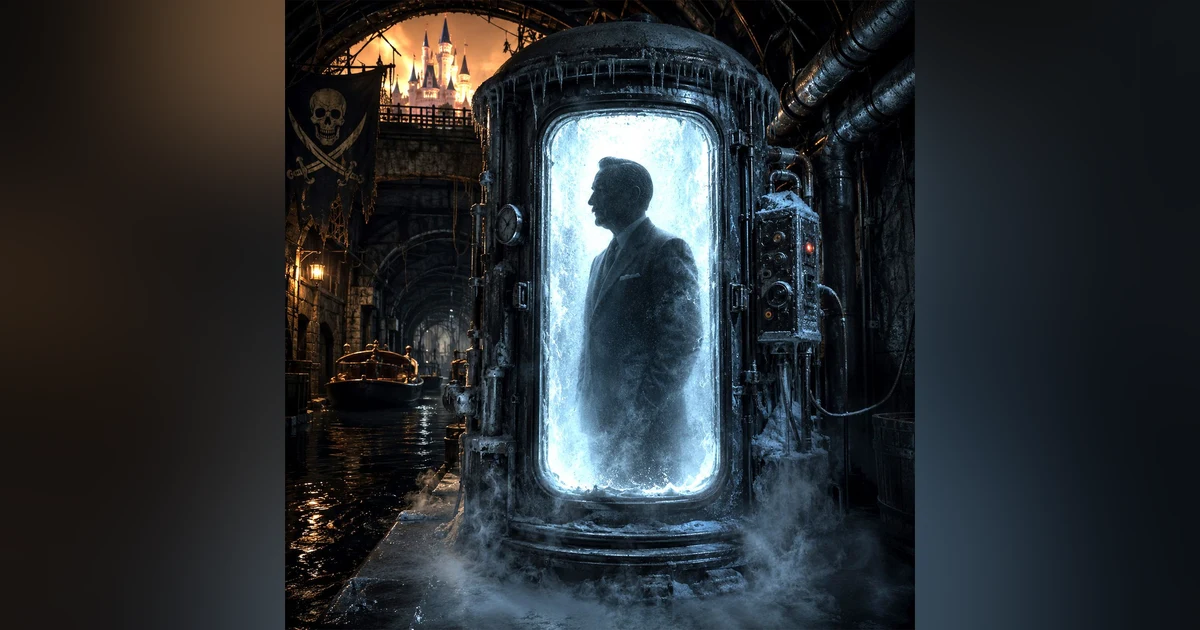
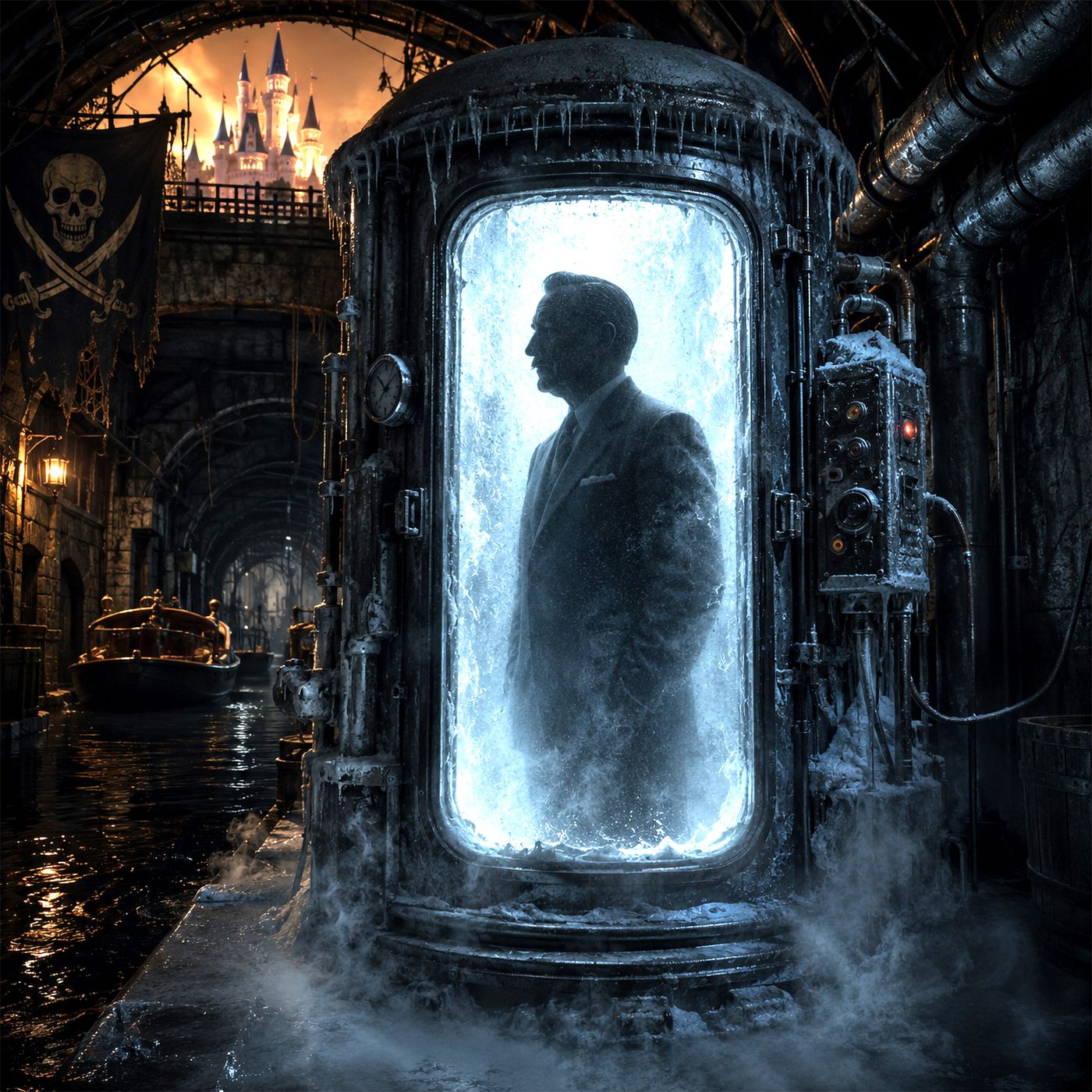
Walt Disney was cremated, yet a legend still places him in a frozen chamber beneath Disneyland. Henrique Couto traces the cryonics rumor on Thursday Thrills, from Disney's futuristic public image to theme-park tunnels, tabloid repetition, and early preservation experiments. The documented record leads to Forest Lawn in Glendale; the story keeps returning to Pirates of the Caribbean. Audio-Animatronics add another way a creator can seem present after death. Explore why this disproven claim survived, and how technology and storytelling gave a famous life an imaginary unfinished ending.
Bonus episodes & support: https://weeklyspooky.com/join
More scary stories: https://weeklyspooky.com/
Story submissions: WeeklySpooky@gmail.com
Thus Thrills Tonight, I want you to imagine Disneyland after midnight. The main street is still glowing, but the music has stopped. The crowds are gone. The boats inside Pirates of the Caribbean are sitting motionless in black water. Somewhere beneath the attraction, behind a steel door that ordinary guests will never see, an industrial machine gives off a low, steady hum, and inside a frost covered chamber is Walt Disney himself, not buried, not exactly dead, just waiting waiting for medicine to catch up for the right year, for somebody to open the tank and tell him that the future he spent his life imagining has finally arrived.
That is the legend, and it's also completely fake. But don't get comfortable just yet, because the truth leaves us with something almost better, a rumor born at the exact moment human cryonic preservation became real. A secret chamber supposedly hidden beneath one of the world's most famous attractions, and a theme park that now invites visitors into a dark theater to watch Walt Disney move and speak again. This is Thursday Thrills. A quick weekly ride into the creepy stories, haunted places, weird obsessions, and eerie little corners of the world worth talking about. I'm your host, Enriquecuto, and tonight we're taking the coldest possible trip to Disneyland.
You've probably heard some version of the story. I know I heard a bunch of them growing up. Walt Disney knew he was dying, but he believed technology would eventually conquer death, so instead of being buried or cremated, he arranged to have his body frozen. Some versions say his entire body was preserved, but when I was growing up, I always heard it was only his head, which is usually the point where the story stops sounding like a corporate secret and starts sounding more like a rejected Futurama episode. The hiding place also changes quite a bit. Sometimes it's a private laboratory, other times it's a vault somewhere on Disney property.
But the best known version puts him right underneath Pirates of the Caribbean at Disneyland in California, sealed in liquid nitrogen, while boats full of tourists float above him, singing Yoho. And I understand why that version won the Urban Legend Olympics If you're going to hide the frozen body of America's most famous dreamer, you don't put him in a warehouse beside some boxes of old parade decorations. You put him beneath a dark ride filled with skeletons, secret tunnels, underground water, and extremely convincing mechanical corpses. The ride practically writes the rumor for you. But here's what actually happened.
Walt Disney died at Saint Joseph's Hospital in Burbank on December fifteenth, nineteen sixty six. He was sixty five years old and had been battling lung cancer. Two days later, his remains were cremated and his ashes were placed at Forest Lawn Memorial Park in Glendale, California. His daughter Diane later wrote that there was no truth to the claim that her father wanted to be frozen. In fact, she doubted that he had even heard of cryonics. If I buy that one, because he was a futurist after all, but I digress. That should end the story. There is a death certificate, there was a cremation, There is a real memorial site.
The family denied it, so case closed. Everybody go home, except urban legends don't need an open case. All they need is an open feeling, and Walt Disney left behind exactly the right feeling. He was associated with Tomorrow, Tomorrow Land, experimental cities, robots, monorails, new forms of animation, new ways of building worlds. He appeared on television explaining technologies that most families had never seen, and he sold the future as a place that would be cleaner, brighter, more exciting, and somehow just around the corner. Even his original idea for Epcot was not simply another theme park. It was supposed to be an experimental prototype community of tomorrow eh Epcot see a living city where new technology and urban planning would constantly reshape daily life.
So when a man like that dies, people don't imagine him choosing an ordinary ending. They imagine one more invention, and the timing could not have been more perfect. Cryonics was becoming a real public obsession in the nineteen sixties. The basic idea was that after a person was legally dead, the body could be cooled and presume deserved at extremely low temperatures. Supporters hoped that future medicine might one day repair the disease that killed them, fix the damage caused by preservation and somehow restore the person to life. Nobody preserved through cryonics has ever been revived at this time.
Today it remains an enormous scientific gamble. But in the nineteen sixties it sounded like tomorrow had arrived a little ahead of schedule. Robert Ettinger's book The Prospect of Immortality helped popularize the idea in nineteen sixty four. Then on January twelfth, nineteen sixty seven, less than one month after Walt Disney had died, doctor James Bedford became the first person pryonically preserved with the intention that he might someday be revived. Think about how neatly those headlines would collide in people's minds. Walt Disney, the famous futurist, dies in December. A man is frozen for the future in January.
The public doesn't need proof, It only needs to connect two dots that were never actually connected. Then the tabloids supplied the spooky details. One early version of the legend told of a reporter who disguised himself as a hospital orderly slipped into a forbidden storage room and saw Walt Disney's body suspended inside a metal cylinder. Now, is that a trustworthy eye witness account? Absolutely not. Is it a nearly perfect urban legend scene? Hell? Yes, You have the unnamed insider, the disguise, the locked room, the shocking glimpse of something powerful people do not want you to see.
Then the witness escapes and tells the world, but somehow never produces a photograph, a document, or anything else that might ruin a perfectly good story. From there, the rumor needed a permanent home. Pirates of the Caribbean was still under construction when Walt died. It opened at Disneyland on March eighteenth, nineteen sixty seven, just a few months later, and it was one of the final attractions whose development he personally oversaw that made it irresistible. People already knew that theme parks had backstage corridors, control rooms, maintenance areas, and entire pieces of architecture hidden from the guests. Disneyland was designed to make you wonder what existed beyond the painted wall, behind the false storefront, or underneath the track.
So why not a cryogenic chamber, Why not a secret room beneath the Pirates? Why not one final hidden attraction with an audience of exactly one. The Frozen Waltz story might have faded into old playground gossip, but the Internet, of course, gave it fresh layers. One of my favorites is the conspiracy theory about Disney's twenty thirteen film Frozen. Yeah, you get where this is going. According to that theory, the company did not choose the title simply because the movie involves a woman who can control ice. No, the title was supposedly selected so that anyone searching Disney Frozen online would get pages of Elsa Oloff songs, toys, and movie clips instead of stories about Walt Disney's frozen body or severed head.
There is no credible evidence that this was the plan, but it is a beautiful example of how urban legends protect themselves. Search for Disney Frozen, and you see Frozen. A believer can point at the search results and say, see it worked. The absence of evidence becomes evidence of how powerful the cover up must be. That is conspiracy theory, judo. And then Disneyland did something that feels as if it was designed by a folklore professor with a dark sense of humor. On July seventeen, twenty twenty five, Disneyland opened Walt Disney a Magical Life inside the Main Street Opera House.
The attraction begins with a film about Walt's life, Then the experience culminates in a recreation of his office featuring the first audio animatronics figure of the man himself, Walt Disney, ever to be created. The figure moves, it speaks, using Walt's words assembled from recordings made across decades. It gestures in the office while visitors sit in the dark and listen to the founder of Disneyland address them once more. To be clear, this is a tribute, right, it's not sinister. Disney imagineers spent years trying to create something respectful, inspirational and recognizably human, but place it beside the old legend and it becomes brilliantly uncanny.
For nearly sixty years, people claimed Walt Disney had used futuristic technology to preserve himself until he could return. Disneyland's response, intentionally or not, was essentially, we didn't freeze him, but we did build him again. No secret laboratory was required, no miracle cure, no thawing process, just archival recordings, painstaking design, advanced robotics, and the storytelling technology. Walt himself helped pioneer the legend, promised that Walt would come back when the future was right for him. Now, a mechanical Walt stands inside the only Disney park he ever personally walked through, telling new generations about his life and his ideas.
While that may not be a resurrection from the back row of a dark theater, it gets close enough to make the hair on your arms stand up. And maybe that's why the Frozen Walt rumor has lasted so long. It was never really about whether someone could produce a cremation record. It was about the strange way Walt Disney became inseparable from the company he created. Most famous people die and leave behind their work. Walt left behind a world that kept expanding in his name. His voice remained on film, His signature stayed over the castle. His face appeared in documentaries, exhibits, statues, TV specials, and corporate history.
The parks kept presenting themselves as extensions of his imagination. Every new attraction could be described as something Walt would have loved, wanted, approved of, or dreamed about. The company didn't need to preserve his body. It preserved the idea of him. In a way, Disneyland itself became the cryogenic chamber, a sealed, carefully maintained environment where the past is repaired, repainted, updated, and sent around the track one more time. The attractions grow older, but they're not allowed to die normally. They close, reopen, receive new faces, new voices, new machinery, and another chance to perform. And I don't mean that to be criticism, honestly.
In a way, it's part of the magic. But it's also a little spooky when you really sit down and think about it. So, no, Walt Disney is not frozen beneath Pirates of the Caribbean. There is no hidden tank humming under the boats, no emergency thaw date circled on a calendar in some underground control room. The truth is much simpler. Walt Disney died in nineteen sixty six. He was cremated, his ashes were interred in Glendale. But the story people wanted from the legend has finally happened. In its own peculiar way. Technology advanced, Disneyland opened the curtain, and Walt began speaking again.
So the frozen Walt Disney myth, in many ways, came from a company an entertainment powerhouse that simply would never let him die. That's actually a lot creepier than the idea of a human popsicle under the pirates of the Caribbean, if you ask me. In a way, maybe they're simply prodding the idea of his corpse every day to get a little more cash and a little more excitement for the audiences. Until next time, drive safe, keep your headlights on, and be very suspicious of any cold air coming from behind a door marked Cast members only come back tomorrow for more fear.
Until then, lock your doors as if that will help.

