


 Apple Podcasts
 Spotify
 Spreaker
 Audible
 Castro
 RSS Feed
 Terrifying & True | The Greenbrier Ghost: A Haunted Murder Mystery
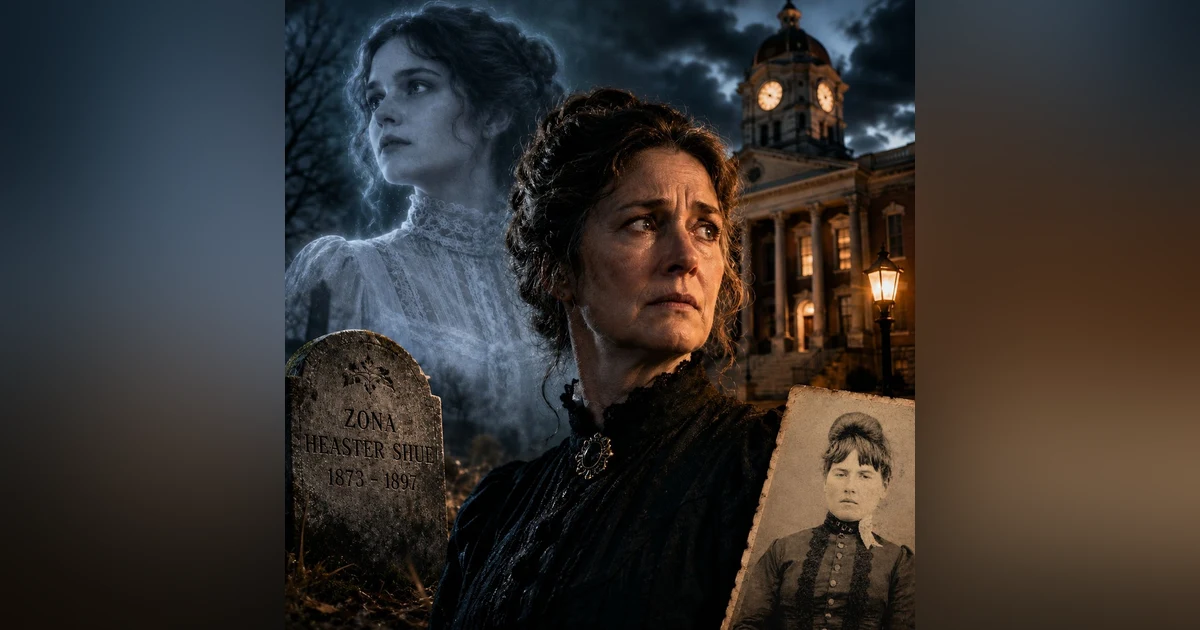
Zona Heaster Shue's mother said a ghost revealed her daughter's murder; an exhumation supplied physical evidence. Terrifying & True revisits the 1897 Greenbrier Ghost case in West Virginia, where Mary Jane Heaster challenged a natural-death ruling and accused Zona's husband, Trout Shue. Follow the broken-neck findings, the trial, and the defense questioning that brought the apparition story before jurors. A murder conviction followed, but the ghost claim remains a claim. Examine how a mother's insistence forced a second look, and why the legend should never eclipse the woman who died.
Bonus episodes & support: https://weeklyspooky.com/join
More scary stories: https://weeklyspooky.com/
Story submissions: WeeklySpooky@gmail.com
In eighteen ninety seven, a young West Virginia woman named Zona Heaster Shoe was buried after what looked like a natural death. Then her mother claimed Zona returned from the grave and revealed the truth her husband had broken her neck. Tonight we investigate the Greenbrier Ghost, the murder trial where ghost testimony exposed a killer. What you were about to be is burd to be based on witness accounts, testimony, pies, and public record. This is terrifying and true truth. In a quiet West Virginia courtroom, a defense attorney asked aaving mother to admit the impossible. Had she dreamed it?
Had sorrow confused her? Had the ghost of her murdered daughter truly come back from the grave. Mary Jane Heaster would not retreat her daughter, Zona Heaster Shoe, was dead, Her husband, E. S. Trout Shoe, was on trial for murder, and Mary insisted Zona had appeared to her in the night and revealed exactly how she died. At first, Zona's death had been treated as natural causes. Her body was dressed quickly, her neck covered. The examination was stopped before the truth could be found. Then the grave was opened, doctors discovered a broken neck, a crushed windpipe, and evidence that someone had hidden a murder beneath a collar.
Tonight, we dive deep into the Greenbriar Ghost, the strange story of a West Virginia murder case where folklore, grief, medical evidence, and courtroom testimony collided. A dead woman could not take the stand, but her mother could speak for her buckle. In June eighteen ninety seven, inside the Greenbrier County Courthouse in Louisbourg, West Virginia, a defense attorney is trying to make a ghost disappear. The witness before him is Mary Jane Heaster, mother of a young woman named Elva Zona Heaster Shoe. Zona has been dead for five months. Her husband aramis stribbling trout. Shoe sits accused of breaking her neck, hiding the injury, and allowing her death to pass as something natural.
No one claims to have watched him kill her. The medical evidence proves Zona died violently, but it cannot place another living person in the room. The state's case is circumstantial. That makes Mary dangerous to the defense, not because she saw the murder, but because she insists the victim told her how it happened afterward. The prosecution has avoided making a ghost the center of its case. Now the defense brings the apparition into the courtroom, hoping to make Mary sound irrational. The attorney asks whether grief produced four dreams. Mary refuses the word quote I was as wide awake as I ever was.
He presses again, would she admit the visits were dreams rather than appearances of her daughter. Mary does not retreat, quote, I am not going to say that, for I am not going to lie. The answer leaves the courtroom with an impossible problem. A dead woman cannot take an oath, face cross examination, or point to the man who killed her, but a living mother can repeat what she says the dead told her, and the injuries discovered after the body was exhumed match the strangest part of her account. History will remember this as the trial where testimony from a ghost helped send a man to prison.
But the real story is not about a spirit taking the stand. It's about a young woman's death being accepted too quickly, a husband who believed there was no witness against him, and a mother who refused to let the grave close over the questions before she became the Greenbriar ghost she was simply Zona. The surviving record preserves only fragments of Elva Zona Heaster's life. She grew up in Greenbriar care in the Southeastern Mountains of West Virginia, and was still a young woman when a newcomer arrived in eighteen ninety six. Even her birth year is uncertain, with later sources commonly giving either eighteen seventy three or eighteen seventy six.
That small disagreement says something larger about the record. Zona becomes sharply visible only when she marries and dies. The years in which she was simply living were preserved far less carefully. His full name appeared in different forms, Aramis Edward or E. S. Shu, but people commonly referred to him as Trout. He was a blacksmith, physically strong, and new enough to the community that much of his history remained elsewhere. Zona and Trout married on October twentieth, eighteen ninety six, after a brief courtship. Her mother disliked the match. How much Mary Jane Heaster knew at that time is unclear, but Trout had served time for horse theft and had been married twice before.
One marriage ended in divorce. Another wife had died later. Retellings attach darker suspicions to those facts, but they were never proven in court. What can be said safely is that Zona married a man with a troubled past, and the marriage lasted only three months. The silence around that marriage is one of the case's most frustrating features. There's no diary telling us how Trout behaved when doors were closed, no letter records whether Zona feared him, regretted the marriage, hoped it would improve, or plan to leave. The honest record gives us an abrupt sequence, a wedding in autumn, a funeral in winter, and a mother who immediately suspected the man her daughter had chosen.
On the morning of January twenty third, eighteen ninety seven, Trout went to his blacksmith shop. At some point, he stopped at a nearby home and asked a boy to go to the shoe house, gather eggs, and see whether Zona needed anything from the store. It was an ordinary errand the kind of favor that passed easily between neighbors in a rural community. The boy knocked, no one answered. He went inside. Zona lay on the floor. Contemporary trial reporting described her body as stretched perfectly straight, feet together, one hand by her side and the other across her body.
Her head rested at a slight angle. There was no staircase in the contemporary account, no melodramatic tableau from later legend, only a child confronted with a dead young woman in a quiet house. He ran to tell his mother, then hurried to the blacksmith shop. By the time doctor George W. Knapp arrived, Zona was no longer where the boy had found her. Her husband had moved her and laid her out. That decision changed the scene before a physician could study it. It also placed control of Zona's body in the hands of the person who would later be accused of killing her.
Doctor Napp attempted to revive her, even though the body had already grown cold. He noticed slight discoloration on the right side of her neck and cheek, and began examining the throat. When he tried to continue, Trout caused him to stop. She then helped dress Zona for burial, placing her in clothing with a high stiff collar, winding a folded veil around her neck before tying it underneath her chin. The precise exchange is damaged in the surviving newspaper transcription, but the outcome is clear the doctor did not complete the examination. Accounts differ over the first cause assigned to Zona's death, using phrases such as an everlasting faint, heart trouble, or childbirth.
The contradictions are fascinating, but they matter less than the shared failure beneath them. None came from a complete examination of the body. At the funeral, Trout's behavior drew attention. Witnesses later testified that Zona's head seemed unnaturally loose and would fall from side to side unless supported. The collar and layers of cloth remained in place. The grieving husband stayed close, controlling access and explaining the supports around her head and neck. Grief can look strange without proving guilt, but taken together the body being moved before the doctor arrived, the neck being strangely covered, the examination being stopped, and the unstable head, the details formed a pattern that became impossible to ignore once someone, anyone, began asking the right questions.
Mary Jane Heaster was already asking them. Zona was buried. In legal terms, there was no murder case. In medical terms, there had been no complete examine nation in the ground lay, the only witness whose body could contradict the story everyone had been asked to accept. Then, according to Mary Heaster, Zona came home. Mary later testified that she prayed for her daughter to return and tell her what had happened. She did not describe one uncertain dream glimpsed through sleep. She described four visits on four nights, each one adding detail to the accusation forming in her mind.
In Mary's account, Zona appeared as she had been in life. There was light in the room, but not from a lamp. Mary said she raised herself on an elbow, reached toward the figure, and found no coffin surrounding her. She believed she was awake, believed she could touch her daughter, and believed the visitor had come because Mary was the one person Zona trusted to act. The apparition spoke first about the household. Trout had become angry over supper, Zona allegedly said, because he believed there was no meat prepared. She insisted there had been plenty of food and named what was stored in the house butter, apple, butter fruit, and several kinds of preserves.
To a modern listener, the inventory can sound almost absurdly domestic. Aside an accusation of murder. That's also what makes it unsettling. The story didn't begin with thunder or a grave opening up. It began with a quarrel over a meal. Mary said, Zona described the house and sellar even though Mary had never visited the couple's home while her daughter was alive. She claimed that after seeing the property later, she found its layout as Zona had described it. The spirit also directed her toward places to search, though one lead near a rocky fence produced nothing. The account contained apparent correspondences, unverifiable statements, and a clue that went nowhere exactly, the mixture that makes an extraordinary claim difficult to classify.
The central allegation did not change. On the second visit, Mary said Zona told her that Trout had squeezed or broken her neck at the first joint. To demonstrate the injury, the figure turned her head completely around before leaving. Mary told neighbors about the experiences before the inquest and that timing is important. Her courtroom account was not invented for the first time under oath after everyone knew the autopsy findings. She had been speaking publicly while Zona was still buried, and while the official explanation remained a natural death, what the record cannot establish is why Mary chose the language that she did, whether she believed she had encountered Zona's spirit, experienced a waking vision created by grief, transformed intuition into a story others would take seriously, or something else entirely.
She carried the story to Greenbrier County Prosecutor John Alfred Preston, who did not need to decide whether the dead could speak. His responsibility was to determine whether the living had overlooked a crime. That distinction kept the inquiry from becoming a seance, and turned it back toward the body. Preston revisited the circumstances of the death. Doctor Knapp acknowledged that his first examination had been incomplete. Witnesses could describe Trout's conduct, the high collar, the folded veil, and the strange movement of Zona's head. Questions that had seemed intrusive at the bedside now became urgent. If the doctor had been stopped from examining the neck, what had he failed to see?
Authorities ordered Zona's body to be exhumed on February twenty second, nearly a month after burial, doctor Knapp joined doctor Rupert and doctor McClung for a post mortem examination. Whatever anyone believed about Mary's visitor, the doctors now had physical evidence in front of them. The findings were unequivocal. Zona's neck was broken, her windpipe had been crushed. More specifically, the neck was dislocated between the first and second cervical vertebrae, and the ligaments were torn and ruptured. Later summaries also described marks on the throat as signs of fingers. The rest of her organs appeared healthy. The earlier assumption of natural death could no longer survive scrutiny.
A break high in the neck might have raised questions about a fall, but the crushed airway and throat marks pointed toward direct violence. The location also matched the detail Mary said she had announced before the grave was opened. That match did not identify the attacker by itself. It did, however, establish that the mother's supposedly impossible accusation had led investigators to a real, concealed injury. The body didn't prove who had caused the injuries, but it proved that a homicide had been hidden beneath the collar. Trout was required to attend the proceedings surrounding the exhamation and inquest.
Witnesses later recalled statements that sounded less like shock and more like calculation. He said he expected to return under arrest. He also repeatedly expressed confidence that no one could prove he had done the killing. Suspicion was one thing, proof was another. He appeared to believe the absence of an eye witness would protect him for several weeks it had. No one had seen Zona die. The original examination had ended before the fatal injury was found, the body had been buried. Had Mary accepted the doctor's conclusion, the evidence might have remained underground until it could no longer clearly speak at all.
Instead, Trout Schu was arrested and charged with murdering his wife. The legend says a ghost named the killer. The investigation shows something more precise. Mary's claim forced authorities to look again, and the second examination found what the first had missed. From that moment forward, the prosecution did not need to prove the existence of an apparition. It needed to prove that the living man who controlled Zona's body after her death was the same man who had broken her neck before it. The trial of the State of West Virginia versus E. Shu began in Greenbrier Circuit Court on June twenty second, eighteen ninety seven.
Twelve jurors faced a case with a dead wife, a suspicious husband, a broken neck, and no eye witness to the act itself. Contemporary coverage was blunt about both the weakness and the strength of the prosecution. The evidence was entirely circumstantial. The doctors could identify lethal violence, but they could not reconstruct the exact movement that had caused it. The state had to build its case from opportunity, conduct, statements, and concealment. The timeline placed Trout at the house that morning, before anyone else was known to have been there. He sent the boy to find Zona. Once the body was discovered, he moved it before the doctor arrived.
He helped dress it, covered the neck, stopped the physician from continuing the examination, stayed close to the coffin, and offered explanations for why Zona's head needed support. Later, he predicted arrest, while insisting the authorities could never prove the killing. None of those facts alone required a guilty verdict. However, they described a man behaving as if he knew exactly which part of the body must not be examined. Trout took the stand in his own defense and remained therein afternoon. A newspaper reporter described him as extremely detailed about minor events, while denying nearly everything damaging said by other witnesses.
He called the prosecution spite work, protested his innocence, invoked God, and declared that he had loved his wife. At one point, he asked the jurors to look into his face and decide whether it was the face of a guilty man. It was an emotional appeal against a physical case. The same reporter wrote that Trout's testimony and manner made an unfavorable impression on spectators. That observation was not evidence, but it captured the risk of his strategy. The longer he talked, the more the jury could compare where his explanations with the sequence established by other witnesses. Mary Jane Heaster also took the stand on direct examination.
The prosecution concentrated on the earthly facts. It did not ask the jury to believe that a spirit had solved the murder. The defense made the different choice. Hoping to damage Mary's credibility, Trout's counsel questioned her at length about the four appearances. From the defense perspective, ignoring the ghost story carried its own risk. Greenbrier County was a small community, the exhumation had attracted attention, and Mary's account was already circulating. Council tried to confront the story and strip it of authority by presenting it as grief. The strategy was understandable. It also gave Mary the opportunity to repeat every supernatural detail in open court.
Under pressure, the attorney suggested that relentless mourning had produced dreams. Mary agreed that her daughter's death had never left her mind. She rejected the conclusion that followed. She said she had prayed for Zona to return and believed the Lord had sent her. She described the visits, the food argument, the unfamiliar house, the strange light, and the revelation about the neck. Questioning repeatedly offered her an escape. Call them dreams and the impossible part of the story becomes ordinary. Mary would not do it. When asked whether she was superstitious, she said she was not. When counsel tested her religious beliefs, she turned the question back on him.
When asked to withdraw the claim, she said she would not lie. This is where the simplified version of the Greenbrier ghost becomes misleading. Zona did not appear in court. No judge swore in a spectral witness. The prosecutor did not build the charge on a message from beyond the grave. A living woman testified about experiences she believed were real, and the defense chose to place those experiences before the jury in an effort to discredit her. Legally, that distinction is crucial. Emotionally, it may have mattered very little. The jury had now heard a mother described the injury before doctors found it in the grave.
Mary did not crumble, become confused, or contradict the central claim. Jurors did not have to decide whether the figure in her bedroom was truly Zona. They had to decide whether Mary's persistence had led investigators to real evidence, and whether that evidence, combined with Trout's behavior, proved murder beyond a reasonable doubt. The arguments ended with no comfortable compromise available. The newspaper covering the trial observed that the logical choices were first degree murder or acquittal if Trout had not caused the fatal injury. The state had failed to identify who did. If he had caused it, the concealment and manipulation after death made an accident difficult to believe.
The jury deliberated for one hour and ten minutes. It returned a verdict of murder in the first degree and recommended mercy, replacing a possible death sentence with imprisonment for the remainder of Troutshu's natural life. The verdict did not announce that ghosts exist. It announced that the jurors believed the husband had murdered his wife. For Zona's family, it could not restore what had been lost. It did something more limited but still important. It corrected the official story Zona had not collapsed from an unnamed natural cause. Someone had violently ended her life, concealed the injury, and nearly succeeded because the first examination stopped where the collar began.
The man who believed there was no witness against him had been convinced by the people who saw what he did afterward, and by the body he failed to keep hidden. Trout Chu was sentenced to life in the West Virginia State Penitentiary at Moundsville community anger remained intense, and contemporary and later accounts describe an attempted mob action after the verdict, but authorities prevented a lynching. The legal judgment, rather than vigilante violence, remained the final public answer to Zona's murder. Chu lived only a few more years. He died in prison in March of nineteen hundred during an illness outbreak, and was buried without the lasting memorial that would eventually mark Zona's resting place.
Mary Jane Heaster survived him, her testimony outlived them both. Today, a West Virginia historical marker near sam Black Church calls this the only known case in which testimony from a ghost helped convict a murderer. That statement alone is irresistible. It turns a complicated prosecution into a perfect piece of folklore. A murdered woman returns, names her killer, and speaks through her mother until justice is served. The records tell a story that is less tidy and in some ways even more remarkable. There is no serious question that Zona was real, that her death was initially treated as natural, that the first examination was incomplete, that her mother pressed authorities to reopen the matter, that an exhemation revealed a broken neck and crushed windpipe, and that Trout was convicted of murder.
There's also no question that Mary testified under oath about four appearances and remained firm when challenged. The conviction does not make every rumor surrounding Trout true. No court determined that he killed an earlier wife. The state never proved a precise motive for Zona's murder. He left no confession that completed the Storyareness requires keeping those gaps visible, even while recognizing the force of the evidence that persuaded the jury. In this case. What the record cannot answer is what happened in Mary's bedroom. One possibility is exactly what she said Zona returned. Another is that Mary experienced vivid, waking visions shaped by grief, prayer, and suspicion.
She may have inferred the neck injury from the collar, the way the head was supported, comments around the funeral, or information that never entered the surviving newspaper account. It's also possible she deliberately gave supernatural form to an accusation she believed but couldn't prove otherwise. That final possibility as an intriguing piece of context on January twenty eighth, eighteen ninety seven, the Greenbrier Independent printed an Australian story known as Fisher's Ghost, in which a supposed apparition revealed a murder victim's location. Zona's death notice appeared elsewhere in that same issue. Historian Katie Letcher Lyle later argued that the published story may have suggested a method to Mary.
If ordinary suspicion would not move authorities, perhaps a message from the dead would. It is a compelling theory, not a demonstrated fact. However, there is no surviving proof that Mary read the article, copied it, or fabricated anything. The coincidence deserves attention because it offers a plausible earthly pathway by which one ghost story could influence another. It does not erase the possibility that Mary sincerely believed every word she said. Later Retellings added more atmosphere, a sheet from the coffin staining washwater red, a colder room, more dramatic clothing, a more violent turn of the head. Some elements come directly from Mary's recorded testimony.
Others appear more clearly in later folklore. Like every enduring legend, the Greenbrier Ghost accumulated details because the story answered an emotional need as well as a historical one. The need is easy to understand. Zona's life life survives only in fragments, while the manner of her death is preserved in gruesome detail. Her husband was allowed to move and dress her body, interrupt the examination, and send her to burial under a natural explanation. The first official response gave more weight to the appearance of ordinary death than to clues hidden beneath the collar. Mary reversed that process, whether guided by a spirit, intuition, grief, or strategy.
She made people uncomfortable enough to look again. The prosecutor asked questions, the doctor admitted the limits of his first examination. The grave was reopened, medical evidence replaced assumption that distinction protects the truth at the center of the legend. The Greenbrier Ghost is not a case in which superstition replaced evidence. It's a case in which an extraordinary claim created the pressure necessary for evidence to be found. The ghost itself did not perform the autopsy, or weigh witness statements, or return the verdict. Living people did those things. After a mother refused to accept a convenient ending, It's also worth resisting the temptation to turn Trout into a supernatural villain.
He was frightening enough as a human being, a husband convicted of killing his wife, hiding the injury, and trusting that privacy custom and the absence of an eye witness would shield him. The horror does not require an ancient curse. It lives in how close he came to being right. And Zona should not disappear behind the title history gave her. She was not born a ghost. She was a daughter, a young wife, and a member of a community that nearly buried her under the wrong explanation. We cannot reconstruct every hope she had or every fear she carried inside that brief marriage.
We can say her death mattered enough for her mother to challenge a doctor, a prosecutor, a courtroom, and anyone willing to call her foolish. Whatever crossed Mary Heaster's bedroom, spirit, waking vision, grief, or deliberate story. The body answered, Zona's neck had been broken, her husband was convicted. The false account of a natural death did not survive. Before she became the Greenbriar Ghost. She was simply Zona because her mother would not let the story end at the grave. The record still speaks her name. Terrifying and True is narrated by Henrique Couto, its executive produced by Rob Fields and bobble Topia dot com, and produced by Dan Wilder, with original theme music by Ray Mattis.
If you have a story you think we should cover on Terrifying and True, send us an email at Weekly Spooky at gmail dot com, and if you want to support us for as little as one dollar a month, go to Weeklyspooky dot com slash join. Your support for as little as one dollar a month keeps the show going. And speaking of I want to say an extra special thank you to our Patreon podcast boosters, folks who pay a little bit more to hear their name at the end of the show. And they are Johnny Nicks, Kate and Lulu, Jessica Fuller, Mike Escuey, Jenny Green, Amber Hansford, Karen We met, Jack Ker and Craig Cohen.
Thank you all so much, and thank you for listening. We'll see you all right here next time on Terrifying and True.
