


 Apple Podcasts
 Spotify
 Spreaker
 Audible
 Castro
 RSS Feed
 Terrifying & True | The Caretos de Entrudo – Portugal’s Carnival Demons

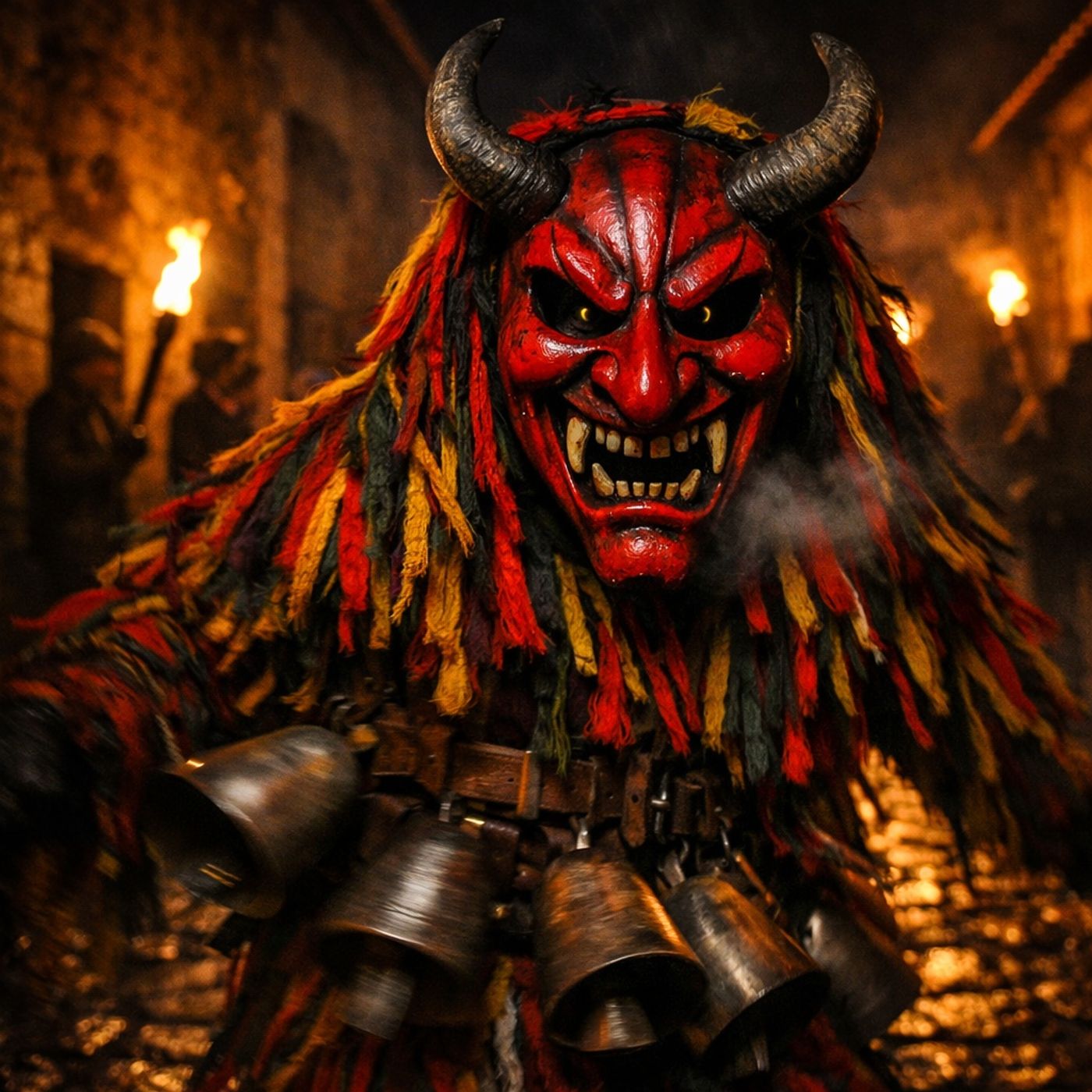
Portugal folklore turns feral in the mountain village of Podence, where the only warning is the clatter of cowbellsricocheting off stone walls. Then the Caretos burst from the dark—men (and now women and kids, too) swallowed in ragged ribbons of red, yellow, and green, faces erased behind blood-red demon masks, hips loaded with heavy bell harnesses that turn every lunge into a metallic scream. It’s Carnival… but it moves like a hunt.
This is Entrudo—a tradition believed to reach back to pre-Roman Celtic seasonal rites, an “entry” into the warm season after winter’s darkness. Long before Lent ever claimed the calendar, this was a community ritual of mischief, rule-breaking, and purification: scare off the bad spirits, shake loose the old year, and drag spring and fertility into the streets by force of noise.
Inside this episode:
- The first warning: cowbells in a stone alley, laughter turning predatory
- Ancient roots: the pagan “entry” of Entrudo and the Celtic ties that won’t die
- The disguise: fringed wool suits, horned masks, and the deafening bell harness
- Ritual permission: three days where chaos is allowed—then paid for
- Fire and farewell: the burning of effigies, bonfires, and Carnival’s final cleansing
- Near-extinction and comeback: depopulation, revival, facanitos, and a tradition reborn
- UNESCO recognition: how Podence’s “carnival demons” became world-famous without going tame
- Cousins of the Caretos: Peliqueiros, Joaldunak, and Iberia’s other bell-bearing “devils”
If you ever find yourself in Podence after dark—listening to cowbells get closer—remember: the masks don’t perform. They pounce.
We’re telling that story tonight.
🎧 LISTEN NOW and subscribe for spine-tingling horror stories every week!
🎉 Unlock exclusive bonus episodes and support the show on Patreon!
👉 WeeklySpooky.com/Join
📬 Contact Us / Submit Your Horror Story!
- Twitter: @WeeklySpooky
- Facebook: facebook.com/WeeklySpooky
- Email: WeeklySpooky@gmail.com
🎵 Music by Ray Mattis 👉 Check out Ray’s incredible work here !
👨💼 Executive Producers: Rob Fields, Bobbletopia.com
🎥 Produced by: Daniel Wilder
🌐 Explore more terrifying tales at: WeeklySpooky.com
0:03 Cow bells. That's the first sign, metallic, frantic bouncing off stone, like footsteps of a stranger. Then the laughter hits. A horned red face snaps into the torchlight, ribbons, flaring bells, screaming at its hips, and the corrito lunges grabbing you in a mischievous embrace. What you were about to beat is buried to be based on witness accounts, testimonies, and public record, this is terrifying, And.
0:58 Tonight we travel to northern Portugal, the land of many of my ancestors, into a village of stone lanes and cold night air, where an ancient festival still unleashes something that looks, sounds and moves like a demon. They call them the Krritos, masked figures in shredded color, armed with cow bells, anonymity and a tradition that appears older than the country itself. Some say it's pagan theater and echo of pre Roman rites. Others insist it's simply the community granting chaos, a brief sanctioned rain before the solemnity of lent.
1:53 But if those bells are closing in you hear them all around, you may not have time to decide what exactly you believe, so make sure you're subscribed on your favorite podcasting app. As we head to Iberia, we have a date with a dark destiny. As we discover these fascinating and terrifying traditions, night falls on the remote village of Podense in northern Portugal. The only warning is the clatter of cowbells echoing off stone walls. A young woman presses herself into a doorway, heart pounding and laughter and wild shrieks grow nearer. Suddenly, a figure bursts from the shadows, a man shaped thing draped in ragged ribbons of red, yellow, and green. A demonic face glares from behind a horned mask with a whoop. The creature lunges, cow bells jangle
3:25 furiously at his waist as he throws a wooly arm around the girl in what would be called a mischievous embrace. He bats playfully at her hair with the tasseled tip of his long hood and bumps his bell studded hips against hers in a manic dance. She squeals in mock horror while her family roars with laughter. In a flash, the masked demon releases her and away down the alley. Bells clanging, and cape flying off to startle his next victim.
4:11 This is not a nightmare, but a celebration. Welcome to Intrudeau, where the Carretos, the wild carnival demons of Trasos Montes run riot. The cartos tradition is among the oldest in Portugal, believed to date back centuries, perhaps even millennia. Many historians trace these masked revelers to pre Roman Celtic rituals that survived in the remote hills of the Iberian Peninsula. The very word in Trudeau, today synonymous with carnival, originally meant an entry in pagan times, referring to the entry into the warm season after winter's darkness, long before it became tied to lent, and Trudeau marked the end of winter and the arrival of spring, a time to drive away evil spirits and invite fertility and renewal. In these ancient festivals, young men would dawn fearsome disguises, wild costumes, and frightful masks to represent other worldly beings. By becoming these devils, they could scare off the literal and figurative gloom of winter.
5:39 Some anthropologists believed that karritos began as a rite of passage away for adolescent boys to prove themselves through boisterous rule breaking behavior. Scholars also link the kartos to agrarian cults of fertility and ancestor worship, where the masked youths as proxies for ancient gods or spirits, insured bountiful crops, healthy livestock, and the continuity of the community. By downing the mask, an ordinary villager could bridge the worlds of the living and the dead, channeling primal chaos for the good of the tribe. The Catholic Church later folded this unruly celebration into the pre lent carnival season, but beneath the veneer of Christianity, the pagan DNA of Intrudeau remains unmistakable.
6:46 The hallmark of Acquareto is his vividly colorful costume and devilish mask, a look at once comical and frightening. Traditionally, the costume handmade from old quilts or thick woolen blankets cut into fringed strips of red, green, yellow, black, and other bright hues. These long fringes cover the Carreto from head to toe, giving him a ragged shaggy silhouette that flutters as he moves over this, he straps on leather harnesses hung with clanging cowbells and rattles, often weighing many pounds.
7:34 Every step or hip thrust produces a wild jangle, the unmistakable soundtrack of Intrudeau. In fact, the Carreto carnival is often nicknamed Intrudeau cocarero, literally Carnival of the rattles and bells, for the deafening noise of those bells. And then there is the mask, usually made of sheet metal, leather, or wood. Each mask is painted in lurid colors, blood red being the favorite, with exaggerated features like a long hooked nose, bulging lips or teeth, and occasionally horns. The effect is a caricature of a devil or mischievous spirit. In the village of Podense, Carreto masks are often bright red with a menacing grin In Lazarim. By contrast, the masks are hand carved from alderwood and topped with horns for an even more demonic look. Whatever the material, the mask conceals the reveler's identity completely, two eye holes and perhaps a mouth slit. Are the only human feels features in an otherwise monstrous visage. In the flickering torchlight of a Podensa alley,
9:08 such a horned apparition truly looks like a nightmare come to life. Disguised in this way, the correto is effectively no one and everyone free to unleash mischief without personal consequence. The anonymity of the mask is the key to the tradition. It grants a license to transgress. As one cultural historian put it, when the creto masks up quote, the world of gods and the dead is temporarily established among men, and normal rules no longer apply. The young men and nowadays women as well, behind the masks adopt high pitched voices, beastly grunts, or other distorted sounds, never speaking in their normal tones. Further shrouding themselves in mystery, they transform fully into koreatos, carnival demons. For the few days of intrudeu night in Podensee brings an uneasy thrill. Somewhere out in the darkness, the karatos are on the move, their cowbells faintly jangling in the distance. When the festivities begin, the
10:42 quiet villages of trasos montesch erupt into chaos and laughter. Traditionally, the revelry kicks off in the days leading up to Lent, from Fat Sunday through Shrove Tuesday, with karetos pouring in from the surrounding countryside. They come from every part of the village to join in groups. One account describes running and shouting excitedly, scaring the people and assaulting all the wine cellars. Indeed, a time honored Crito pastime is to barge in to local taverns and sellers, rob them of wine or food, and gulp down hardy quantities of the region's wine. It's all done in good humor. Villagers often play along by offering the masked mob alcohol and watching the fun. One local tale recounts how a mob of karetos once invaded a tavern, seized a full wine cask and passed it around like a giant cup, gulping the contents amid gales of laughter. The Koreatos' main targets, however, are not the wine jugs, but the villagers themselves, especially
12:12 young women. An old carnival courting play that modern eyes might find a bit unsettling during Intrudeau, gangs of Koreatos charged through the streets on a mission of semi serious mischief, frightening bystanders, chasing women, and generally causing mayhem. They leap out from unexpected corners, let out ear piercing whoops, and rattle their belts ferociously at anyone in their path. If you're caught, prepared to be playfully harassed. A favorite trick is to rattle or shake the girls, essentially to jingle the belt of cowbells against a woman's hips in a a symbolic, if not suggestive dance. In the past, karetos carried dried pig bladders or inflated cow bladders as weapons, whacking onlookers with these smelly balloons for a laugh. Others swung whips made of animal hide or sticks, striking the ground or the legs of laggards to herd people along.
13:30 It's said that no one is supposed to walk the streets uncostumed during Intrudeau, and the Karetos enforced that rule by terrorizing anyone not in a disguise until they join the fun or seek refuge indoors. For the young women of the village, carnival mischief traditionally had a rough edge. Older generations still recall how decades ago quote the village girls used to hide inside their homes to avoid the unruly karretos attention and little wonder. In those days, the masked youths took pride in truly outrageous pranks. They would whip people with the mentioned bladders, shower crowds with ashes and even animal manure, and if a girl was too slow to flee, she might get grabbed and unceremoniously smeared with soot. Karetos thought nothing of bursting into houses, bashing down doors to overturn dinner pots, blow out lamps, or drag people outside into the cold of night. In one notorious stunt, particularly bold karreatos reportedly dumped unsuspecting victims into a bath of ants, upending an ant infested log or
15:03 antill onto a person. Such antics made the kaatos genuinely feared by children and respected, if begrudgingly, by adults. These were nights when the devils ran free, and all decent folk could do was either join in the madness or stay behind locked doors until the storm passed. In modern times, the kritos have toned down the brutality, but only a little. Today's pranks are described as relatively mild and playful compared to the past. The wild chases continue, but the weapons of choice are now more symbolic, the bells and hoods of the costume itself. Kretos will bash people with their long hoods, rock parked cars back and forth, pilfer hats, and of course still grab and bump into attractive young women amid fits of giggles. Antics carried on with a wink, even if they might raise a few eyebrows. Today it is not uncommon for a kreto to clamber up a balcony or scale a low roof if a group of girls has wisely sought higher ground. The sight of a
16:33 dozen fringe suited devils swarming up a wall as there would be victims shriek with laughter is the essence of intrudeau mischief. No one is truly safe from their shenanigans. Aside from the quick and the cleverly costumed about the only people that karretos leave alone are the matrophonas men dressed in drag, as gaudy old women who are considered off limits in the spirit of carnival parody. These Matrophonos, with their garish dresses and head scarves, will later enact mock weddings with the Carretos as part of the festivities, further blurring gender and social norms. Despite all of the mayhem, the atmosphere is overwhelmingly festive and good humored. All over town, bells clang and people howl with laughter, as everyone young and old is either part of a prank or the target of one. The entire community understands that this temporary chaos is the point of Intrudeau, a cathartic release of societal pressure. For a few days, the usual hierarchies vanish, the youth have the run of the village. Authority is mocked, and even the shy can become flamboyant tricksters behind a mask.
18:04 As one participant Riley noted after being jostled by some Carretos. Today, the pranks may leave you quote a little bruised, but they're all in good fun. Come ash Wednesday, the costumes will be hung up, the soot washed off, and the normalcy will return. But until then, through the long winter nights of Intrudeau, the carnival demons reign supreme. The Crrito celebrations typically build to a raucous climax on Shrove Tuesday, also known as Mardi Gras. By that point, the masked revelers have been causing havoc since the preceding Sunday, and the entire village is swept up in the carnival spirit.
18:56 In Podunse and many other towns, Carnival is actually the wildest day of all, so packed with events that locals simply call it the fun second Fiatra. Medieval style marching bands roam the streets, Drummers and bagpipers add to the din of bells, and satirical skits or plays are performed in the village square. One long standing tradition on Carnival Monday night in Podense is for a group of men to publicly read a list of fictitious engagements, pairing off local boys and girls in joky betrothals to illicit groans and laughter from the crowd. It's a night of relentless mockery and mirth. As darkness falls on Shrove Tuesday, Intrudeau often ends in literal flames. In keeping with Carnival customs worldwid wide, tras os. Motese villages will torch a figure called the Intrudeo, a Shrovetide carnival effigy that represents the excesses of the season. Sometimes the effigy is a straw stuffed dummy, symbolizing the sins of the past year. Other times there are two figures, a male and female carnival
20:27 that are set ablaze as a purification rite. In Podense, an impressive torchlit procession winds through the darkened streets, with karetos leading townsfolk by flaming torches to the site of the bonfire. There to triumphant shouts, the giant effigy is ignited. Sparks fly up into the cold sky as the demon masked karatos dance around the flames, ringing their bells in frenzied fair well to Intrudeau. By the time the last Ember dies, the rain of the Crretos is over, at least until next winter. For all of its chaos, Intrudeau has always been about driving away winter's darkness and ushering in the spring. Even the corretos playful harassment of young women echoed ancient fertility rites, a covert courtship ritual promising new unions and future births. Beneath the guise of mischief, underneath the revelry lies an age old hope scare off the evil spirits and cold of winter, ensure that warmth and fertility return, and the sight of life can begin anew.
22:05 By the mid twentieth century, the Carretos of trosso Montes had terrified and delighted countless generations, but the pressures of the modern world nearly snuffed them out. The nineteen sixties and seventies were hard times in rural Portugal. Economic hardship and the authoritarian Salazar regime drove many young people to emigrate, leaving villages depopulated. Winters in Podense grew eerily quiet. The clamor of bells and whoops vanished, as in Trudeau all but faded away. With so few youths left to don the costumes, and a dictatorship that frowned on unruly festivals, the annual masquerades waned. Some villages simply stopped holding in Trudeau altogether during those dark and cold years. Yet, like spring itself, in Trudeau refused to vanish forever. With the return of democracy and a renewed pride in folk culture.
23:20 The nineteen eighties saw a determined revival of the koretos in Podenze. Locals formed a Koreatos association to ensure the tradition did not disappear. They also started the next generation. Early children, affectionately nicknamed Fakanitusch or little knife Blades, began dressing up as miniature karritos and learning the tricks of the trade. It's not unusual now to see toddlers trotting along in tiny fringed suits, complete with pint sized cowbells, eagerly mimicking their older brothers. This passing of the torch guarantees that each new generation grows up with Intrudeau in their blood. Each year, the sight of little krtos trotting alongside their elders in the Intrudeau parade is a joyful reminder that the tradition's future is in good hands. Another major change in recent decades is that women have joined the ranks of the carretos. What began as an all male right of passage has evolved with the times. Today, girls and women are welcome to down the fringed suit and mask alongside the boys. This not only doubles the
24:55 number of potential revelers, but adds a new dynamic, perhaps even more incentive for the men to bring their a game when they know some of the devils chasing them might actually be the young women they wish to pursue. Efforts to preserve this unique heritage got a major boost in twenty nineteen when the United Nations Scientific and Cultural Organization or UNESCO, inscribed Podenses Winter Festival in Trudeau Cocquerero on its representative list of Intangible Cultural Heritage of Humanity.
25:40 The UNESCO citation praised the practice as a living link to ancient seasonal rights and a pillar of community identity. Today, far from fading, the Cretos are thriving. The tiny village of Podensee has become world famous each carnival season, drawing thousands of visitors eager to witness and perhaps survive, the corrito onslaught. What was once an insider's festivity is now a major tourist attraction, though still very much run by locals for locals, with outsiders as welcome spectators and of course sometimes pray. Podense even opened a dedicated Casa do Correto museum in twenty seventeen to showcase costumes and educate visitors on Intrudeau's history. In Lasarim, for example, carnival revelers still carve demon faced wooden masks and read satirical wills before burning a gigantic effigy of Carnival at the festival's close.
26:59 And in the villages of Vignai's, the local corritos have been revived to showcase community pride and attract new generations of merrymakers. If you attend, expect a raucous, immersive affair rather than a sanitized parade. As travel writer Julie Dawn Fox observed about Podenze, there are no carnival floats or samba squads here, just forty men dressed in stripes of red, yellow and green wool, sporting leather belts with cowbells. The crritos spend three days before Lent running wild in the streets, playing tricks on the unsuspecting. Make no mistake, this is Carnival at its most raw and authentic, worlds away from the glitzy parade floats of Lisbon or Rio. In other words, prepare to be grabbed, rattled, and perhaps splashed with wine.
28:09 But you'll come away with unforgettable memories of a tradition that is equal parts spooky and spectacular. While the corretos of Podensee are legendary, they are not alone. Just across the border, in nearby Spain and in other corners of Iberia, similar masked trouble makers come out each year during carnival. In Galicia, for example, the pelliceros of Lasa raced through the streets, cracking whips and clanging cowbells. Nearby towns boast their own horned mischief makers with names like Cigarones and pantaias, demanding wine tolls or startling anyone not in a costume.
29:03 Even elsewhere in Portugal, villages such as Lazarim keep alive kindred traditions, carving diabolic masks and ending the festivities with bonfires. Different names, different costumes, but the same wild spirit of Intrudeau thrives beyond Pudense. Nor is the mayhem limited to Carnival itself. In some places, the masquerades emerge around Christmas time and New Year's a throwback to even older Solstice rights. On New Year's Day in Spain, Zamora Province, soot smeared devils called Los Corochos rampage through the streets accompanied by characters staging a comic battle between good and evil. Meanwhile, in the the Basque Highlands, fur clad bell bearers known as jol Dunach march from village to village, swinging enormous cowbells in solemn procession to drive off evil spirits. And one of the most striking offshoots is Portugal's cho Ca la rue da Bemposhta, a horned bell ringer who begs meekly on December twenty six, then turns ferocious on January first, chasing everyone in sight. According to local lore, this devil
30:38 was punished by God for trying to tempt the Virgin Mary, condemned to alternate one day of peace with one day of fury. It's a vivid mix of Christian legend and pagan revelry, and further proof that Intrudeau's anarchic spirit extends far beyond beyond one village or season. In the end, the creatos of Intrudeo embody the double edged nature of Carnival itself. Terrifying because in the flicker of torchlight, these masked horned figures really do look like something out of your oldest nightmares, faeral demons springing from the dark to grab us, and yet true because they represent real traditions and real human needs, the need to laugh at fear, to rebel playfully against the rules, and to bind a community together by facing the monsters as one. The karatos may have the faces of devils, but their antics carry the promise of spring and renewal under all the bluster.
32:02 Once a year, in tras Os Montesh, an ordinary young man becomes a prowling fiend for a night, and a quiet farming village becomes a cauldron of sacred mischief. The fact that this still happens today in our age of technology and tame entertainment is a testament to the power of tradition. Clearly, there is something in us that still thrills to the clamor of cowbells in the dark, to the wild promise that chaos can cleanse and renew the world. Imagine standing in Pudense on a chilly carnival evening, the smell of wood smoke and fried dough in the air, when from somewhere down a dark lane you hear the first jingle of a cowbell, a surge of a excitement, and a jolt of primordial fear ripples through the crowd.
33:07 They're coming. Moments later, a chorus of whoops and cackles irrupt, and the Katos are upon you, leaping, ringing red tassels, flying, demon masks, gleaming in the lamplight. You yelp and jump aside as a grinning devil barrels past, and find yourself laughing, filled with exhilaration. You have been part of Intrudeau's magic, chased by a devil, and lived to tell the tale. And, as the villagers of Podensi and countless communities before them would assure you, there's no better way to welcome the spring.
33:59 Terrifying in That's True is narrated by Enrique Kuto. It's executive produced by Rob Fieldsman Bobbletopia dot com and produced by Dan Wilder, with original theme music by Ray Mattis. If you have a story you think we should cover on Terrifying and True, send us an email at Weekly Spooky at gmail dot com, and if you want to support us for as little as one dollar a month, go to Weeklyspooky dot com slash Join Your support for as little as one dollar a month keeps the show going. And speaking of I want to say an extra special thank you to our Patreon podcast boosters, folks who pay a little bit more to hear their name at the end of the show. And they are Johnny Nix, Kate and Lulu, Jessica Fuller, Mike Escuey, Jenny Green, Amber Hansburg, Karenwemet, Jack Ker, and Craig Cohen. Thank you all so much and thank you for listening. We'll see you all right here next time on Terrifying and True m
