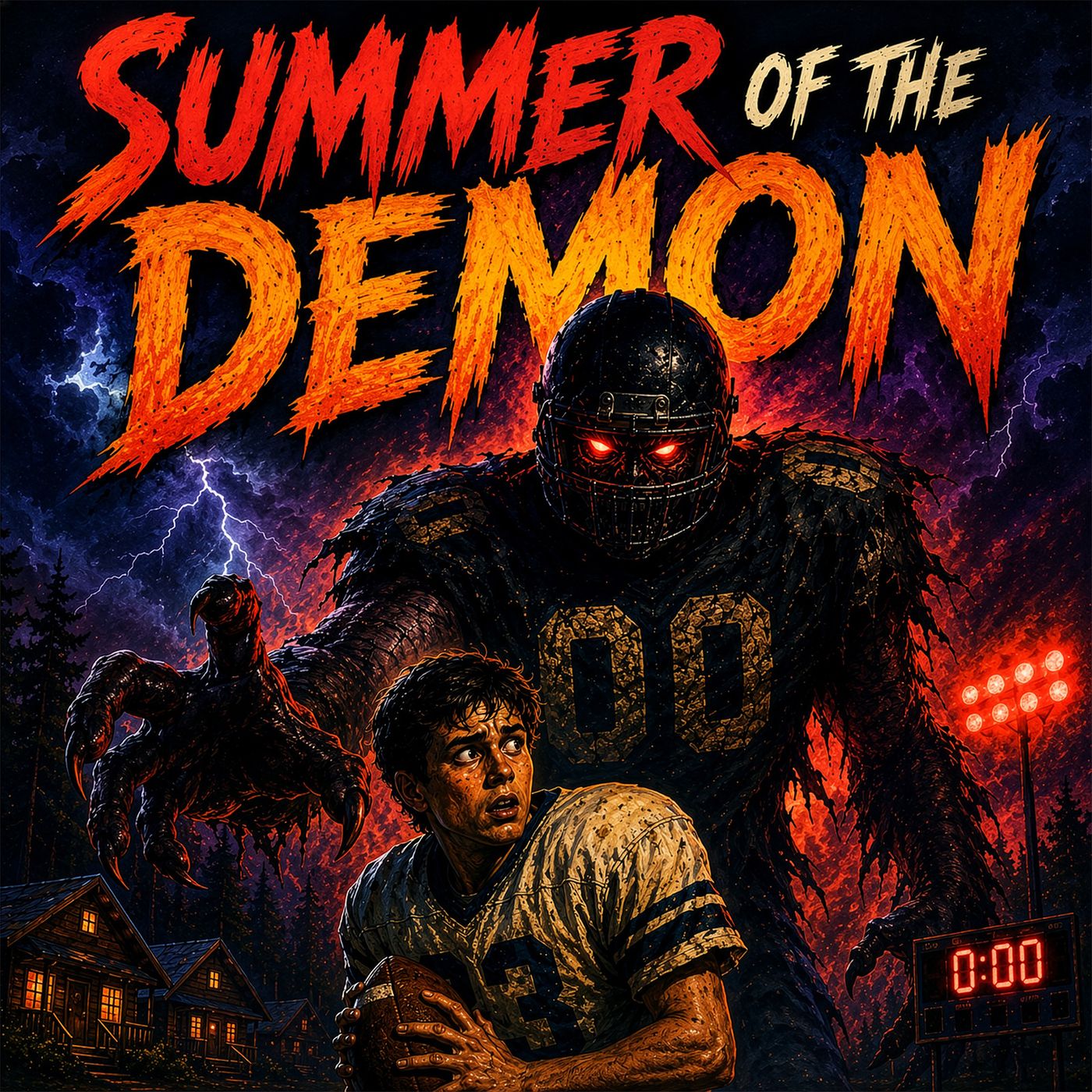
The Demon's True Nature: Beyond Possession at Camp Redfeather
Was the entity at Camp Redfeather simply a possessed Greg Branlake, or is there a more ancient, cunning force at play? 'Summer of the Demon pt 3' hints at a terrifying truth: the 'demon' might be a distinct entity, manipulating events for its own sinister purposes, independent of Greg's fate.
Key Takeaways
- The evidence in 'Summer of the Demon pt 3' suggests the entity is not simply the spirit of Greg Branlake.
- The demon's actions, particularly its selective targeting, indicate motivations beyond Greg's personal vengeance.
- Katie's confession and Greg's journal present conflicting accounts, casting doubt on the possession theory.
- The cursed football jersey appears to be a conduit or amplifier, not the ultimate source of the demonic power.
- The entity's strategic manipulation of characters points to an intelligence far exceeding that of a typical vengeful spirit.
- Distinguishing the demon's true identity from Greg's ghost is crucial to understanding the overarching threat.
Is It Truly Greg, or Something Else Entirely?
The chilling third installment of 'Summer of the Demon' at Camp Redfeather, titled 'Cursed Objects & Camp Horror Nightmare,' initially paints a grim picture: Greg Branlake, consumed by a cursed football jersey, has returned as a vengeful demon. However, as Eddie Richter, Jessica, and Chase delve deeper, a more complex and unsettling narrative emerges. The evidence increasingly suggests that this monstrous entity might not be Greg Branlake at all, but a separate, ancient evil that has latched onto the camp's despair and the legend of Greg's demise. This distinction is critical; it shifts the horror from a tragic haunting to a calculated malevolent presence.
Greg's journal entries are the bedrock of the possession theory. His descriptions of being 'consumed' by the jersey seem to confirm that the entity is, in fact, Greg himself, transformed by dark forces. Yet, the context provided by Katie, who claims she killed Greg to prevent him from being 'consumed,' introduces a profound contradiction. If Greg was killed *before* full consumption, how could he then manifest as the consuming demon? This discrepancy suggests Greg's journal might be a distorted account, perhaps written under duress, or even a deliberate fabrication designed to mislead. It’s possible Greg was struggling against an external force, a demon that was *trying* to consume him, and his journal reflects this internal battle rather than a complete transformation into the entity.
Unmasking the Manipulator: The Demon's Calculated Actions
The entity's behavior throughout the episode offers compelling evidence against a simple possession narrative. A vengeful spirit, particularly one tied to a specific tragic event, might be expected to act erratically, driven by raw emotion and a singular focus on retribution. This demon, however, exhibits a chilling level of strategic cunning. Its actions appear calculated, designed not just to inflict terror, but to manipulate the characters and obscure the truth. The way it selectively targets individuals, and at times seems to disregard others (like Jessica for extended periods), suggests a purpose beyond merely avenging Greg's death. If it were solely Greg's spirit, why would it spare someone like Jessica, who was directly involved in his death, or focus its energy on terrifying campers who likely had no direct role in his fate? This selective aggression points towards an intelligence with its own agenda, using Greg’s story as a convenient cover.
Consider the demon’s interactions with Eddie. While the entity clearly wants to stop Eddie from uncovering the truth, its methods are not purely destructive. It creates obstacles, manipulates events to sow discord among the campers, and uses fear as a tool to silence those who might know too much. This is the behavior of a predator that understands its prey and seeks to control the narrative. A simple ghost, bound by its own earthly trauma, might lash out indiscriminately. This demon, however, seems to be actively managing information and the perception of reality within Camp Redfeather. The cursed football jersey, while undeniably a focal point for the horror, seems more like a powerful amplifier or an anchor for this entity, rather than its origin point. The true source is something far older and more insidious, using the legend of Greg Branlake as a smokescreen.
The Role of Cursed Objects in the Demon's Rise
The episode title itself, 'Cursed Objects & Camp Horror Nightmare,' highlights the significance of these items. The cursed football jersey is the most prominent, acting as the catalyst for the legend of the demon. However, the narrative implies that this jersey isn't the *source* of the evil, but rather a potent conduit through which a pre-existing malevolent force can manifest. This entity likely feeds on negative energy – fear, despair, anger – and the jersey, imbued with the trauma of Greg's presumed final moments and potentially other negative energies from the camp's history, becomes its perfect vessel. The demon's ability to influence and empower other cursed objects, as hinted at in the episode, further supports this theory. It’s not just one item; it’s an ancient evil that knows how to leverage the camp's history and its objects of misfortune to extend its reach and power.
The distinction between the object and the entity is crucial for understanding the horror. If the demon *is* the jersey, its power is limited. If the demon *uses* the jersey, its power is potentially limitless, able to jump between objects, influence minds, and weave a tapestry of terror that extends far beyond a single ghost's revenge. This interpretation aligns with the idea of an ancient entity rather than a recently deceased spirit. Such an entity would be adept at manipulating the physical world through cursed artifacts, exploiting the fears and superstitions of those who inhabit haunted places. The narrative actively steers us away from seeing the jersey as the cause and more towards it being a tool in a much larger, darker game being played by an unseen force.
Separating Fact from Fear: The Ghost vs. The Demon
To truly appreciate the terror presented in 'Summer of the Demon pt 3,' we must be able to differentiate between the potential ghost of Greg Branlake and the active demonic entity. A ghost, typically, is a residual imprint of a person, bound to a place or event, often driven by unfinished business or trauma. While terrifying, its actions are usually rooted in its past life and death. A demon, particularly an ancient one, is a more independent entity with its own consciousness, motivations, and agenda. It can possess, manipulate, and exert influence far beyond the scope of a spectral echo.
The key lies in the demon's intent and its apparent understanding of the camp's secrets. If the entity were merely Greg's ghost, its focus would likely be on revenge against those responsible for his death or perhaps reliving his final moments. The demon, however, seems to possess a broader awareness. It actively works to keep secrets buried, to turn people against each other, and to foster an atmosphere of pervasive fear that seems to strengthen it. This suggests an intelligence that is not bound by Greg's personal tragedy but is actively exploiting it. The selective nature of its attacks, its apparent ability to anticipate the campers' actions, and the strategic way it uses the cursed objects all point towards a conscious, manipulative entity rather than a tormented spirit. By focusing on these behavioral differences, we can move beyond the initial assumption of possession and confront the far more terrifying possibility of an ancient evil actively orchestrating the horror at Camp Redfeather.
Conclusion: A More Sinister Truth
The 'Summer of the Demon' arc at Camp Redfeather is building towards a revelation that transcends a simple ghost story. The evidence meticulously presented in 'Cursed Objects & Camp Horror Nightmare' strongly suggests that the entity terrorizing the camp is not the vengeful spirit of Greg Branlake, but a more ancient and cunning demon using Greg’s tragic legend as a convenient facade. Its strategic manipulations, selective targeting, and the way it leverages cursed objects point to a singular, malevolent intelligence with its own dark agenda. Understanding this distinction is key to grasping the true depth of the horror unfolding, transforming a tale of tragic haunting into a chilling narrative of calculated demonic oppression. For more terrifying tales, be sure to listen to the full episode: Summer of the Demon pt 3: Cursed Objects & Camp Horror Nightmare.
Frequently Asked Questions
Is the demon in the episode definitely not Greg Branlake?
While the episode initially presents Greg Branlake's spirit as the cause, evidence suggests the entity is a separate, more ancient demon that is using Greg's story as a cover.
What is the significance of the cursed football jersey?
The cursed football jersey appears to be a powerful conduit or amplifier for the demonic entity, rather than the source of its power itself.
How does the demon's behavior differ from a typical ghost?
The demon exhibits strategic cunning, selective targeting, and a clear agenda to manipulate events and people, which is more indicative of a conscious malevolent entity than a residual spirit.
Why would an ancient demon use Greg's story?
Using Greg's tragic legend provides a convenient and believable explanation for the terror, diverting attention from the demon's true, more ancient and sinister origins and motives.