


 Apple Podcasts
 Spotify
 Spreaker
 Audible
 Castro
 RSS Feed
 Cartoon Cat Internet Horror: Why Creepypasta Monsters Feel Sinister | Thursday Thrills
Key Takeaways
- Cartoon Cat is a viral internet horror creature created by artist Trevor Henderson, designed to exploit the uncanny valley of 1930s rubber-hose animation.
- The character's horror lies in the subversion of childhood nostalgia, transforming harmless, fluid cartoon aesthetics into something sinister and physically impossible.
- Unlike traditional monsters, Cartoon Cat is defined by inconsistency; it has no fixed anatomy and can stretch or shift its form, making it a shapeless, adaptive nightmare.
- The effectiveness of Cartoon Cat as a horror icon stems from the audience's role in its creation, as fans collaboratively built the character's lore through internet discussions and media.
- Sony’s Tristar Pictures has acquired the film rights for Cartoon Cat, marking a significant transition for this internet-born legend from niche creepypasta to mainstream cinema.
Trevor Henderson's Cartoon Cat turns the look of an animated friend into an internet horror nightmare. Thursday Thrills explores the fictional monster's rubber-hose style, distorted nostalgia, and creepypasta appeal, asking why a familiar cartoon grin can feel wrong when it appears outside the screen. The episode follows its imagery and folklore before an original story enters an abandoned mall after dark. Explore how playful shapes become threats when their rules stop making sense. Listen for the moment something that belongs in a drawing starts moving through a place you recognize.
Bonus episodes & support: https://weeklyspooky.com/join
More scary stories: https://weeklyspooky.com/
Story submissions: WeeklySpooky@gmail.com
Listen Next
Keep listening with these related Weekly Spooky episodes.
The Backrooms
Explore the internet horror legend that turned empty rooms into a seemingly endless nightmare.
Jeff the Killer
Trace a fictional creepypasta character and the online storytelling that made him an urban legend.
The Pale Crawler & The Rake
Follow how an invented creepypasta creature crossed into reported cryptid lore.
Frequently Asked Questions
What is Cartoon Cat horror?
Cartoon Cat is an internet horror phenomenon created by artist Trevor Henderson that uses the visual style of vintage 1930s rubber-hose cartoons to create an unsettling, modern monster.
Who created Cartoon Cat?
Cartoon Cat was created by Canadian artist and writer Trevor Henderson, who is also known for other internet horror icons like Siren Head and Long Horse.
Why is Cartoon Cat considered scary?
Cartoon Cat is considered scary because it twists familiar, nostalgic cartoon imagery into something predatory, suggesting that the 'costume' is merely a mask for an ancient, hungry entity.
Will there be a Cartoon Cat movie?
Yes, Sony's Tristar Pictures acquired the feature film rights to Cartoon Cat in July 2026, and the project is currently in the early stages of development.
At three oh seven in the morning, every television in the abandoned mall turns on at once. The same black and white cartoon plays on every screen, a smiling cat dancing in a perfect loop. Then the music stops, the cat stops, and one by one, across fifty flickering screens, it turns its head toward you. The cartoon isn't playing anymore. It's watching Thursty thrills. This is Thursday Thrills, a quick weekly ride into the creepy stories, haunted places, weird obsessions, and eerie little corners of the world worth talking about. I'm Henrique Couto, and tonight we're heading back into the strange wilderness of Internet horror.
Only this time there are no foggy forests, no distant warning sirens, and no giant shape standing between the trees. This monster prefers somewhere with a roof, an empty theater, a forgotten warehouse, a dead shopping mall where the lights still hum even though the last store closed ten years ago. Somewhere an old screen can flicker to life, a tune from another century can begin playing to an audience of one. Because tonight we're talking about cartoon cat and cartoon Cat is not really a cat. That may be the first thing worth noting. Cartoon Cat is a fictional internet horror creature created by Canadian artist and writer Trevor Henderson.
The same imagination behind siren Head, long Horse, and an entire gallery of things you would never want to see standing at the edge of a flash photo. Henderson's monsters often appear in ordinary looking images a roadside, a parking lot, an apartment building, a field behind somebody's house. The setting feels real enough that your brain accepts it before noticing the impossible thing inside it. Then comes a short cat, not a completed story, just a fragment, and suddenly the image feels less like artwork and more like evidence somebody was never supposed to upload. Cartoon Cat began appearing in Henderson's work in twoenty eighteen.
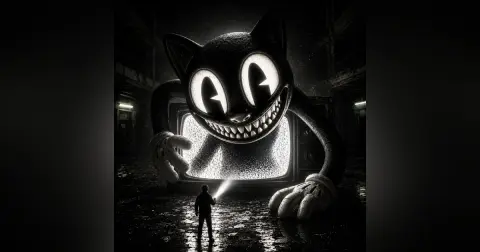
The creature's design borrows the visual language of early black and white animation, a pitch dark body, enormous eyes, white gloves, long boneless limbs, and a smile broad enough to suggest that the face may split open if it gets any happier. But there is no single, perfectly consistent model sheet for cartoon Cat. Sometimes it's almost playful. Looking. Some times it's towering. Sometimes the body stretches thin or folds into shapes that shouldn't fit inside of a building. That inconsistency isn't a mistake. It's part of the nightmare. Cartoon cat does not have anatomy. He has a costume. Henderson has described the thing behind that costume as something ancient and empty, a hungry rot hiding behind an outdated, smiling face.
The cartoon shape is not necessarily its original body. It may simply be the form it's using for now, filtered through the old images people already carry in their minds. And that is there's a lot scarier than an evil cartoon that comes to life. I mean, if you want to see that, just watch fred ol and Ray's evil tunes. You're welcome. It suggests the cat is only a mask and the real creature is standing somewhere behind it. Now, to understand why that mask works so well, we need to have a little talk about rubber hose animation.
The style became one of the defining looks of American cartoons in the nineteen twenties and early nineteen thirties. Characters were built from simple black shapes, pie cut eyes, oversized shoes, bright white gloves, and arms and legs without any visible joints. Their limbs simply bent like hoses. Their bodies stretched, flattened, detached, inflated, and snapped back into place whenever a gag demanded it. Even the gloves had a practical purpose. White hands were easier to see moving in front of a black body. These cartoons were energetic, musical, and often delightfully weird. Buildings bounced, furniture danced. The moon could lean down from the sky and join in on the chorus.
A character could turn its own tail into a tool, remove its head, or squeeze through a keyhole without anybody asking how their bones functioned. Because there were no bones, there were barely any rules, and early cartoons could be surprise macabre. Skeletons danced, shadows, developed personalities, smiling, objects came alive. Whole scenes moved according to a dream logic, where one image melted into the next, and the story could end without explaining a single strange thing you had just witnessed. That playful unreality is charming. When the character on screen is trying to steal a pie cooling on a window, sell it becomes something else when the character notices you.
Cartoon Cat takes the freedom of old animation and removes the joke. A body that can stretch for a punchline can also stretch down a hallway. A mouth that can swallow a piano hole in a cartoon can swallow something else in the dark. A character that cannot be crushed, cut, flattened, or blown apart because it always pops back into shape is suddenly less funny when you're the one trying to escape it. And then there's the smile. Cartoon smiles are supposed to reassure us. They tell us which character is friendly, harmless, and ready to entertain. Cartoon Cat's grin does the opposite because it never changes.
It's not a reaction, it's not happiness. It's part of the disguise, held in place while everything around it becomes worse. That's also what makes the creature perfect for the Internet. Henderson did not introduce cartoon Cat through a novel explaining its history, powers and weaknesses. It arrived as imagery, captions, fragments, and suggestions. Fans filled in the empty spaces with videos, games, theories, drawings, animations, and arguments over what exactly the creature could do. In other words, cartoon Cat spread like modern folklore, not the kind passed around a fire, but the kind passed from screen to screen. The audience didn't merely receive the monster, they helped it grow and inside the fiction that may be exactly what it want.
The most unsettling version of the idea is that human awareness gives cartoon Cat a passage into our world. Every remembered image of a smiling black and white mascot becomes part of the doorway. Every new drawing video and late night podcast gives the shape a little more definition. You look at the cat, you remember the cat, and now the cat has somewhere to stand. This week, that old smile has a brand new reason to circulate. In July of twenty twenty six, Sony's Trystar Pictures acquired the feature film rights to Cartoon Cat. The project is still in the beginning of development.
There's no announced director, cast, or release date yet, but the studio is reportedly moving quickly to find a filmmaker. That means cartoon Cat is making the leap that Internet monsters have nightmares about, from eerie images shared online to a possible full length theatrical film. And after our recent encounter with siren Head, it feels like Trevor Henderson's creatures are no longer standing quietly at the edge of the Internet. They've been noticed by the real monsters in our world, Hollywood. Before we go any deeper into the dead, mall, take a second to follow Weekly Spooky where wherever you're listening, so you never miss a new Thursday Thrills, but also so you don't miss all the other great spooky content we have.
It's always Halloween at Weekly Spooky. And if you know somebody who loves Internet cryptids, haunted media, weird animation, or monsters with smiles that are way too wide, send them this episode. It's the best way to keep these strange little nighttime rides rolling along. Now, Cartoon Cat is not a creature with verified sightings or old newspaper reports. It's a work of fiction that has become an Internet legend. So let's treat it the way we would treat any good campfire monster. Imagine what happens when somebody sees it anyway. Imagine a shopping mall that's been closed for years, not completely abandoned, at least not yet.
A property company still pays for electricity. In a few less dark corridors, security cameras still blink above the entrances. Once a week, a maintenance worker walks the building to check for leaks, broken windows, and copper thieves. His name doesn't matter. What matters is that on a wet Thursday night, he hears music coming from the old movie theater. It's faint at first, a bright little piano dancing through a melody too cheerful for the empty mall follows it past the dry fountain, past a food court full of stacked chairs, and into a lobby where sun bleached posters still advertise films.
No one remembers seeing the music is coming from Auditorium six. Inside, the projector is running. That should be impossible. The digital equipment was removed years ago and sold. But a beam of pale light cuts through the dust, and on the screen is an old black and white cartoon. The film projectors had went the way of the Dodo even fifteen years earlier. A cat in white gloves dances around a kitchen while a wind up bird steals sausages from a pan. The cat slips, the bird laughs, The cat stretches one arm across the room misses the bird and gets tangled into a knot.
The film jumps back to the beginning. The cat dances, the bird steals the sausage, The cat slips, the bird laughs again. The maintenance worker climbs to the projection booth. There's no film in the machine, no computer, no cable connected to anything, just a projector that seems missing, out of time, throwing light through an empty room. Then the cartoon changes. The cat misses its cue, The bird steals the sausage and waits three full seconds. The cat stands motionless in the kitchen. Then it turned away from the bird and looks directly out from the screen at the projection booth.
The worker steps back on screen. The cat raises one white gloved hand and waves. The projector bulb bursts. The theater goes black, and somewhere below in the front row, a seat folds down. The worker does what any sensible person would do. He runs. He bursts into the lobby, but the piano music is already playing through the speakers all over them. All the notes are slower now, each one drags, as though the music itself is becoming exhausted. Across the food court, an old menu screen flashes on. The cat is standing inside it, not dancing or waving, just smiling.
The worker turns toward the nearest exit. Another screen flickers on ahead of him. The cat appears there too, one arm stretching just beyond the edge of the picture. It's not moving from screen to screen, it's getting closer through them. He passes a photo booth, and the machine suddenly spits out four photographs. In the first, the booth is empty. In the second, two white gloved hands grip the curtain. In the third, a black face leans into view. The fourth photograph is still developing when something inside the booth giggles. The worker reaches the glass doors and shoves the crash bar locked locked locked behind him.
The mall music stops for one second. The building is perfectly silent. Then comes a soft, rubbery squeak, like a balloon twisting. He looks down the corridor. Cartoon cat is standing beneath the dead sign of a children's clothing store. Its head nearly touches the ceiling. Now, its arms hang all the way to the floor. The gloves are clean white. The body is black enough to look like a hole cut into the building. Itself, and that smile is waiting exactly where a smile should be. The cat takes one step, its leg stretches the entire length of the corridor.
No running, no chase, It simply edits the distance between them. The worker slams his shoulder into the door again. The lock finally gives rain and cold air rush inside. He stumbles into the parking lot, reaches his truck and doesn't look back until the engine is running. The mall behind him is dark, no cat, no screens, no music. He laughs once, because people sometimes laugh when terror has nowhere to go. Then the truck radio clicks on. That bright little piano tune begins again. In the rear view mirror, a white gloved hand slowly rises from behind the driver's seat.
That story is fiction. Cartoon Cat is fiction, but the reason the creature sticks in your mind is very real. It turns nostalgia into a mouse trap. See what I did there. Most monsters enter through the wilderness, the basement, the graveyard, or the dark road home. Cartoon Cat enters through something familiar, a style of movement, a tune, a smile you've seen a thousand times without ever being afraid of it. It asks a nasty little question, what if the things we invented to make us feel safe, if we're only teaching something else how to imitate us. And maybe that's why cartoon Cat feels so perfectly built for this moment.
We live inside our screens. We resurrect old characters, remix old images, and feed forgotten styles back into circulation every day. Nothing stays buried, nothing stays canceled, nothing stays off the air, not forever. All the classics come back eventually, sometimes as nostalgia, sometimes as merchandise, and sometimes if the lights are low and the signal is weak, as a tall black shape with white gloves waiting just beyond the edge of the picture. As my aunt Betty used to always say, everything old is new again, so tonight. If an old cartoon begins playing by itself, keep an eye on the background.
If the music starts skipping, turn it off. If the smiling cat stops dancing, just leave the room, hell, leave the state. And if it looks directly at you, it was nice knowing you come back tomorrow for more fear. Until then, lock your doors, as if that will help you
